Tomatoes in Turkey: Where They Grow, Kinds and Prices
Where tomatoes grow in Türkiye, greenhouse or field, what the market names mean, and how a hal price reaches the stall.
Table of Contents
Türkiye grew 13.3 million tonnes of tomatoes in 2023, and Antalya province alone grew 19.6 % of them. Table tomatoes (sofralık) were 58.3 % of the crop and paste tomatoes (salçalık) 41.7 %. At the wholesale market (hal), an average kilo cost 5.23 to 96.24 Turkish lira (TL) on 25.10.2026, by kind.
In short · checked 26.10.2026
Türkiye grew 13.3 million tonnes, and Antalya grew the most.
- 13.3 million tonnes in 2023. TÜİK (Türkiye İstatistik Kurumu, the Turkish Statistical Institute) counted 13,300 thousand tonnes on 166 thousand hectares, 80.1 tonnes from each hectare.
- Antalya, Bursa and Manisa grow the most: 19.6 %, 11.5 % and 8.2 % of the 2023 crop.
- Two crops: sofralık (for eating fresh) 7,750 thousand tonnes, 58.3 %; salçalık (for paste) 5,550 thousand tonnes, 41.7 %. Paste tomatoes rose 10 % on 2022 and table tomatoes fell 2.6 %.
- A hal price is a wholesale price, what traders pay in bulk, not the price at a stall. The bulletin of 26.10.2026 lists an average kilo from 5.23 TL (salçalık) to 96.24 TL (cherry).
- Ask for the künye. The künye is the origin tag that the Hal Kayıt Sistemi (the Ministry of Trade’s hal record system) creates; it shows the production place, kind and quantity and must be on the goods, on the packaging or at a visible place in the sales area.
Tool · hal bulletin of 26.10.2026 (data of 25.10.2026)
The kinds on a hal price list, drawn
The Ministry of Trade’s hal bulletin prices tomatoes by kind. Tap a drawn tomato for its Turkish name, how to say it, what the word means, its average price per kilo that day and a question to ask at a stall.
Ayaşah-yahshDrawing
Ayaş is a district of Ankara province. The bulletin prints it as a kind name.
5.37 TL a kilo · average, hal bulletin of 26.10.2026
Ayaş domates var mı? Kilosu kaç lira?
ah-yahsh doh-mah-tes vahr muh? kee-loh-soo kahch lee-rah
Do you have Ayaş tomatoes? How many lira is a kilo?
BeefbeefDrawing
Beef is the English word; a beef tomato is a large one.
30.57 TL a kilo · average, hal bulletin of 26.10.2026
Beef domates var mı? Kilosu kaç lira?
beef doh-mah-tes vahr muh? kee-loh-soo kahch lee-rah
Do you have beef tomatoes? How many lira is a kilo?
Cherrycheh-reeDrawing
Cherry is the English word; a cherry tomato is a small, round one.
96.24 TL a kilo · average, hal bulletin of 26.10.2026
Cherry domates var mı? Kilosu kaç lira?
cheh-ree doh-mah-tes vahr muh? kee-loh-soo kahch lee-rah
Do you have cherry tomatoes? How many lira is a kilo?
Pembepehm-behDrawing
Pembe means pink.
48.40 TL a kilo · average, hal bulletin of 26.10.2026
Pembe domates var mı? Kilosu kaç lira?
pehm-beh doh-mah-tes vahr muh? kee-loh-soo kahch lee-rah
Do you have pink tomatoes? How many lira is a kilo?
Petemek (erik)peh-teh-mek (eh-reek)Drawing
Erik means plum, so the drawing is plum-shaped. Petemek is the kind name the bulletin prints.
14.84 TL a kilo · average, hal bulletin of 26.10.2026
Petemek domates var mı? Kilosu kaç lira?
peh-teh-mek doh-mah-tes vahr muh? kee-loh-soo kahch lee-rah
Do you have petemek tomatoes? How many lira is a kilo?
Salkımsahl-kuhmDrawing
Salkım means a hanging cluster, so the drawing shows tomatoes on one stem.
51.54 TL a kilo · average, hal bulletin of 26.10.2026
Salkım domates var mı? Kilosu kaç lira?
sahl-kuhm doh-mah-tes vahr muh? kee-loh-soo kahch lee-rah
Do you have cluster (salkım) tomatoes? How many lira is a kilo?
Yeşil (turşu)yeh-sheel (toor-shoo)Drawing
Yeşil means green; turşu means pickles. The bulletin prints it as green, for pickling.
12.71 TL a kilo · average, hal bulletin of 26.10.2026
Yeşil domates var mı? Kilosu kaç lira?
yeh-sheel doh-mah-tes vahr muh? kee-loh-soo kahch lee-rah
Do you have green tomatoes? How many lira is a kilo?
Salçalıksahl-chah-luhkDrawing
Salçalık means for paste (salça is tomato paste): a tomato grown to be made into paste.
5.23 TL a kilo · average, hal bulletin of 26.10.2026
Salçalık domates var mı? Kilosu kaç lira?
sahl-chah-luhk doh-mah-tes vahr muh? kee-loh-soo kahch lee-rah
Do you have paste tomatoes? How many lira is a kilo?
Drawings, not photos. Cherry is drawn small, beef large, salkım as a cluster, pembe pink, yeşil green and petemek (erik) plum-shaped; salçalık is drawn oblong. Prices are the hal bulletin’s averages per kilo for 25.10.2026, checked 26.10.2026.
How much grows, and where
TÜİK counts the crop. A tonne (t) is 1,000 kilograms and a hectare (ha) is 10,000 square metres, so 80.1 tonnes per hectare is 8 kilograms from each square metre.
Tomatoes, 2023 · TÜİK figures
13.3 million t on 166 thousand ha.
That is 80.1 tonnes from each hectare. The area was 173 thousand hectares in 2019 and 166 thousand in 2023. In FAO’s table for 2022 (FAO is the United Nations Food and Agriculture Organization) the world grew 186.1 million tonnes: China 68.2, India 20.7, Türkiye 13.0, the USA 10.2 and Egypt 6.3.
| Year | Area (thousand ha) | Output (thousand t) | Yield (t per ha) |
|---|---|---|---|
| 2019 | 173 | 12,842 | 74.2 |
| 2020 | 174 | 13,204 | 75.9 |
| 2021 | 165 | 13,095 | 79.4 |
| 2022 | 159 | 13,000 | 81.8 |
| 2023 | 166 | 13,300 | 80.1 |
TÜİK figures as printed in TEPGE report no. 396 «Domates Ürün Raporu 2024» (TEPGE: the Ministry of Agriculture and Forestry’s agricultural economics and policy institute), September 2024 · checked 26.10.2026 · report.
Ten provinces grew 9,851 of the 13,300 thousand tonnes in 2023. Antalya grew 19.6 %, Bursa 11.5 % and Manisa 8.2 %.
| Province | Output 2023 (thousand t) | Against Antalya |
|---|---|---|
| Antalya | 2,601 | |
| Bursa | 1,528 | |
| Manisa | 1,096 | |
| Konya | 963 | |
| İzmir | 891 | |
| Mersin | 759 | |
| Çanakkale | 577 | |
| Balıkesir | 535 | |
| Muğla | 470 | |
| Niğde | 431 |
TÜİK figures as printed in TEPGE report no. 396 · all other provinces together grew 3,448 thousand t · checked 26.10.2026 · report.
- Akdeniz (Mediterranean region)
- 25.2 % of the 2023 output
- Marmara
- 20.8 %
- Ege (Aegean region)
- 18.2 %
- İç Anadolu (Central Anatolia)
- 10.4 %
- Land, a different order
- Bursa 19,054 ha, Antalya 16,923, Konya 14,093, Manisa 12,962 and İzmir 11,508 in 2023 TEPGE report no. 396, checked 26.10.2026
Under cover or in the open: sera and tarla
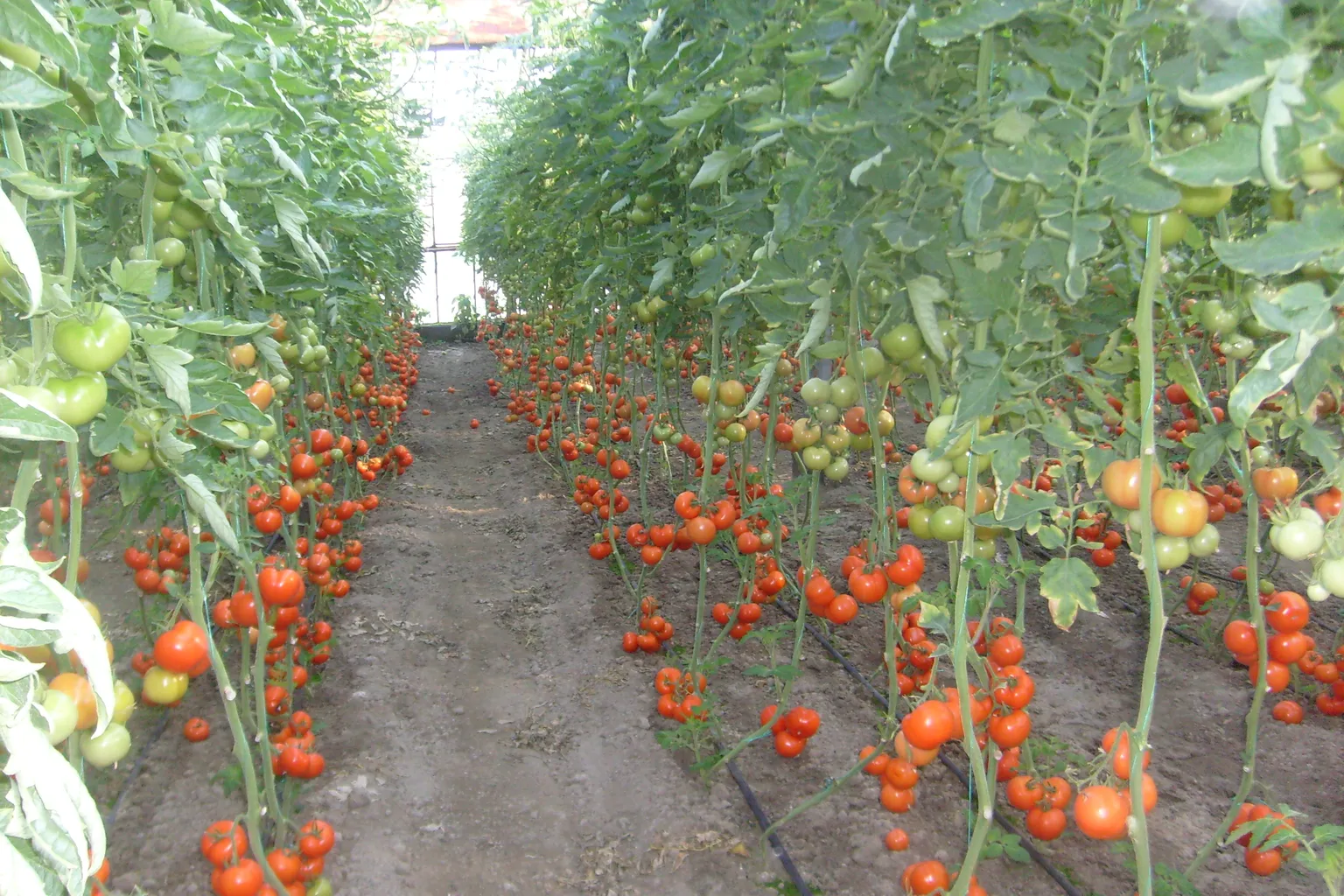
A greenhouse is a sera; the Ministry’s brochures call greenhouse growing örtüaltı (örtü is cover, altı is under). Growing in the open is tarla (field). Tomatoes are grown in the open in every farming area of Türkiye, and greenhouse growing is mostly in the Ege, Akdeniz and Marmara regions. A greenhouse is planted with seedlings; direct sowing is mostly done in the open field.
A greenhouse crop is picked in one of three windows. Picking starts about 4.5 to 5 months after the seed is sown.
| Greenhouse crop | Picking months |
|---|---|
| Single crop (tek ürün) | February to July |
| Autumn crop (sonbahar) | Mid-November to mid-February |
| Spring crop (ilkbahar) | April to July |
Gaziantep Provincial Directorate of Agriculture and Forestry, brochure «Örtü Altı Domates Yetiştiriciliği» (greenhouse tomato growing), undated · checked 26.10.2026 · brochure.
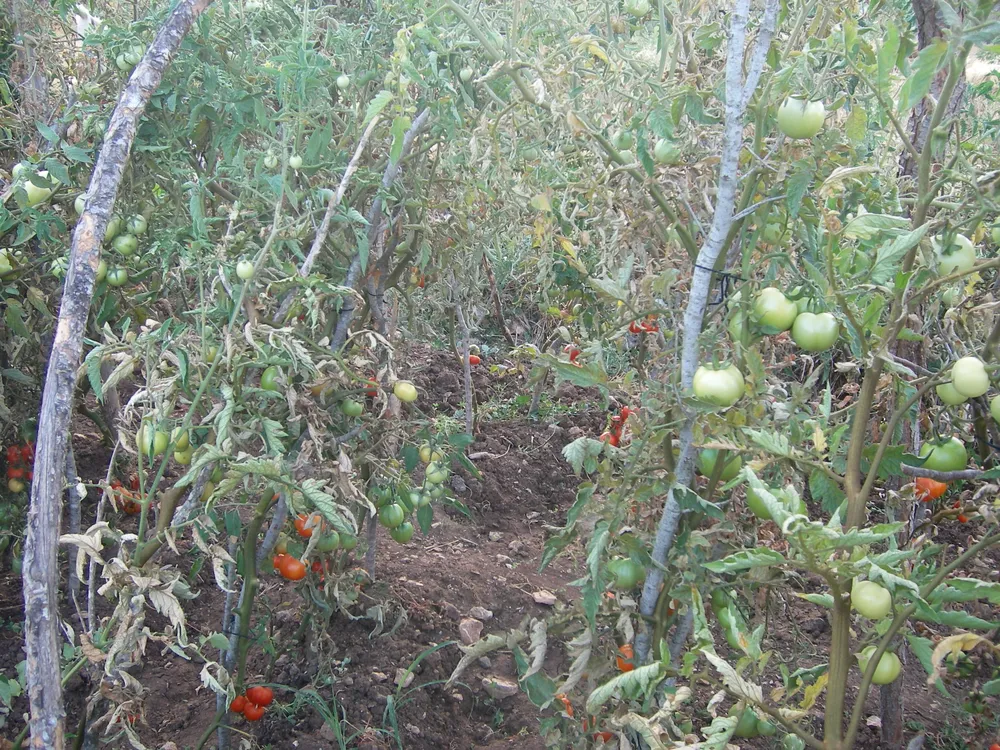
In the open field
- Seed or seedling. Direct sowing needs soil of at least 14 °C. Seedlings are usually raised in warm beds (sıcak yastık) and are ready about 6 weeks after sowing, at 15 to 20 cm.
- A stake. A staked variety (sırık domates) gets a stake (herek) about 10 cm from a seedling that has reached 30 to 35 cm. Side shoots (koltuk) are removed about every 15 days.
- How ripe. Fruit for a near market is picked fully ripe; for a far market it is picked pink or green-pink.
Yalova Atatürk Horticultural Research Institute, farmer brochure «Domates Yetiştiriciliği», undated · checked 26.10.2026 · brochure
- Warmth
- The temperature for plant growth is 22 to 26 °C, and a greenhouse is aired once the heat passes 24 °C. Gaziantep brochure, checked 26.10.2026 · brochure
- Strings
- In a greenhouse most plants are staked varieties. Each plant gets its own string, tied below the point where the third or fourth leaf joins the stem. Gaziantep brochure, checked 26.10.2026
- Who grows what
- In the Marmara and Ege regions tomatoes are grown for industry (sanayi); greenhouse tomatoes in the Akdeniz region are grown to be eaten fresh. Alata Horticultural Research Institute, Mersin, brochure by Mine Bulut, 2022 · checked 26.10.2026 · brochure
Two crops: sofralık and salçalık
TÜİK counts tomatoes in two groups. Sofralık tomatoes (sofra is the table) are grown to be eaten fresh. Salçalık tomatoes (salça is tomato paste) are grown for paste. Processed tomato goes into salça, ketchup, canned tomato and frozen tomato.
| Year | Table, sofralık (thousand t) | Paste, salçalık (thousand t) |
|---|---|---|
| 2019 | 8,836 | 4,006 |
| 2020 | 8,656 | 4,548 |
| 2021 | 8,581 | 4,515 |
| 2022 | 7,955 | 5,045 |
| 2023 | 7,750 | 5,550 |
TÜİK figures as printed in TEPGE report no. 396 · checked 26.10.2026 · report. The processed uses: Yalova Atatürk Horticultural Research Institute, brochure.
Which crop?
- 2023
- 7,750 thousand t, 58.3 % of the crop; 2.6 % less than in 2022.
- Provinces, 2023
- Antalya 2,595 thousand t, Mersin 759, Muğla 470, Çanakkale 356, Burdur 258, Bitlis 227.
- 2023
- 5,550 thousand t, 41.7 % of the crop; 10 % more than in 2022.
- Provinces, 2023
- Bursa 1,359 thousand t, Manisa 958, Konya 787, İzmir 770, Balıkesir 464, Niğde 406, Çanakkale 221, Şanlıurfa 113.
TÜİK figures as printed in TEPGE report no. 396 · checked 26.10.2026 · report.
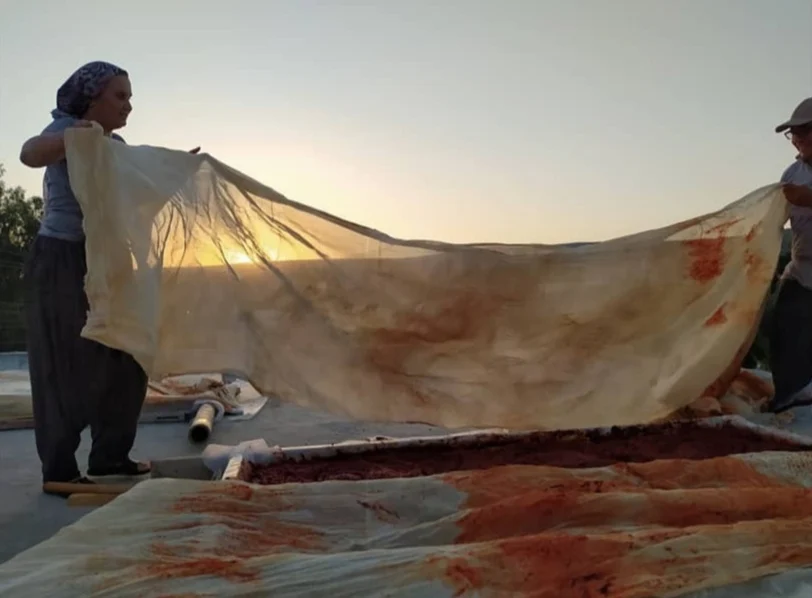
Salça
- Salça is tomato paste.
- Salçalık means for paste: the tomato is grown to be made into it.
- Ev salçası means home-made salça (ev is home).
Names on the market sign
A pazar (weekly open-air market) stall writes the tomato’s name on a hand-written card.
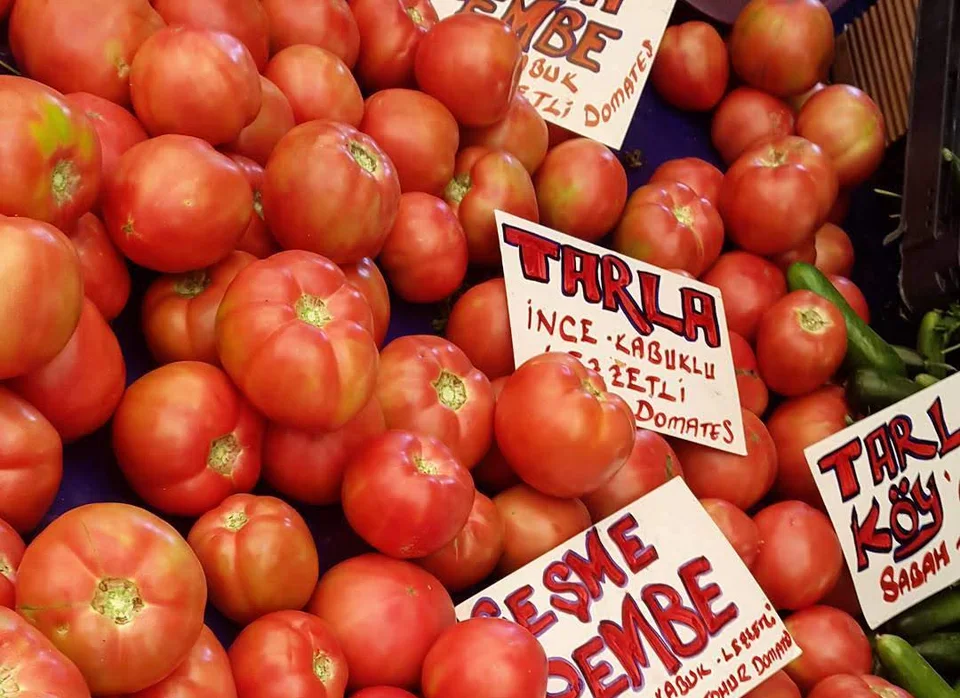
Words on the cards
- Tarla is field. A card with tarla names the tomato as a field tomato.
- Pembe is pink.
- İnce kabuklu is thin-skinned (ince is thin, kabuk is skin).
- Köy is village.
Protected name · Ayaş Domatesi
Ayaş is a district of Ankara province. Ayaş Domatesi (Ayaş tomato) is registered in the European Union as a coğrafi işaret (geographical indication: a protected place name). TÜRKPATENT, the Turkish Patent and Trademark Office, announced it on 30.11.2023 as the first of 12 applications it made directly to the EU in January 2023, and as Türkiye’s 15th EU-registered one.
Checked 26.10.2026 · TÜRKPATENT news
The hal and the price
A hal is a wholesale market for fruit and vegetables. Prices there are what traders pay in bulk; a stall or shop has its own price. The Ministry of Trade runs the Hal Kayıt Sistemi (HKS, the hal record system).
The HKS works under Law no. 5957, the law on the trade in vegetables, fruit and other goods with enough supply and demand. It has been in use since 15.02.2012 and records the kind, quantity, price, buyer and seller of each sale.
- Notification (bildirim)Before the goods leave the production place or the customs gate, the sender notifies the system. Senders include industrialists, exporters, importers, producer organisations, commission agents, traders, retailers (markets, manavs, the greengrocers, and pazarcıs, the market-stall sellers), restaurants and hotels.
- The künyeAfter the notification the system creates a künye, the origin tag. It shows the production place, kind, quantity, the producer or business and any certificate.
- On the goodsThe künye must be on the goods, on the container or packaging, or at a visible place in the sales area.
- The hal fee (hal rüsumu)The buyer pays it on the wholesale price to the municipality or the hal operator: 1 % if the goods are sold in the hal and 2 % if sold outside it, for goods bought from producers with an invoice or a müstahsil makbuzu (the receipt for a farmer’s sale), and for imports. It is not charged on goods for industry or export, on organic or good-agricultural-practice-certified goods, on producers’ own retail sales or on producer organisations’ sales.
Ministry of Trade, hal.gov.tr, frequently asked questions of the wholesale halls · checked 26.10.2026 · page.
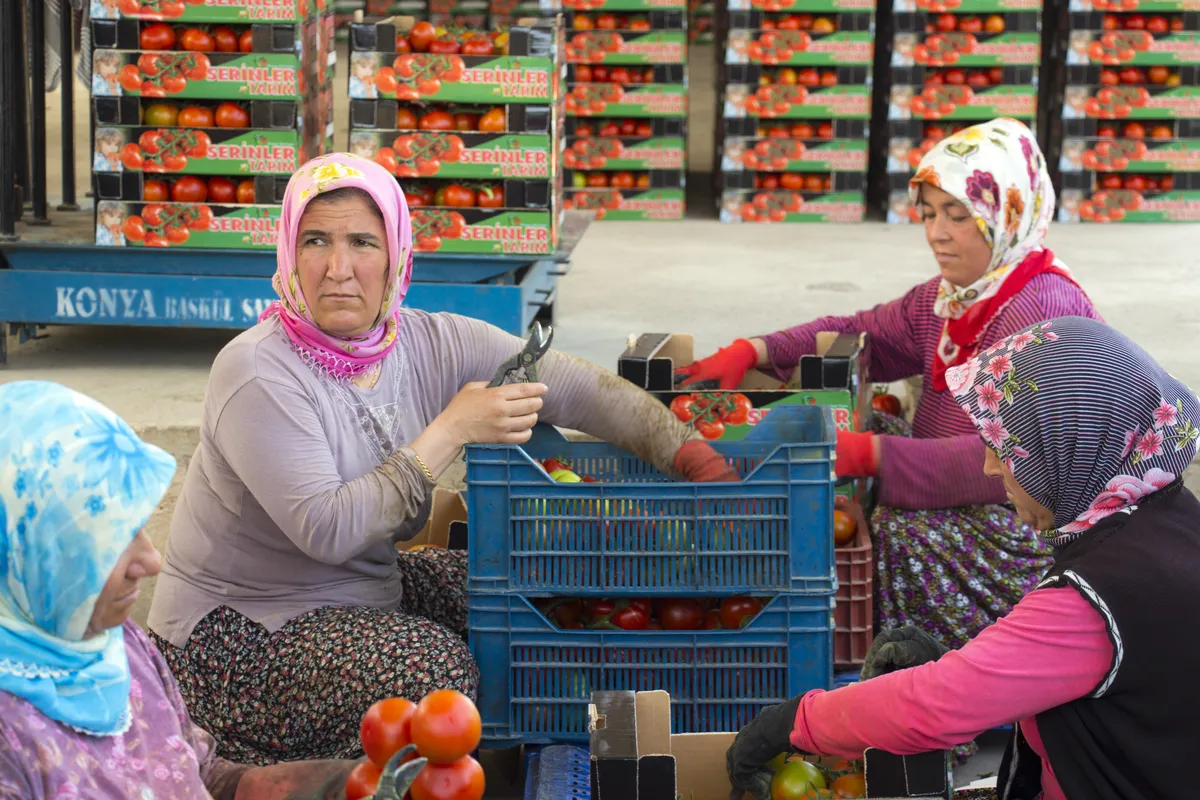
Before the goods travel
- Notify first. The notification comes before dispatch from the production place.
- Then the künye. It travels with the goods, on the crate or packaging or at the sales area.
- Ask at the stall. The question is «Künyesi var mı?» (Does it have a künye?).
Hal bulletin of 26.10.2026 (data of 25.10.2026), average price per kilo
5.23 to 96.24 TL a kilo, by kind.
Salçalık, the paste tomato, averaged 5.23 TL a kilo and cherry 96.24 TL.
| Kind, as the bulletin prints it | Average price, TL per kilo |
|---|---|
| Ayaş | 5.37 |
| Beef | 30.57 |
| Cherry | 96.24 |
| Pembe | 48.40 |
| Petemek (erik) | 14.84 |
| Salkım | 51.54 |
| Yeşil (turşu) | 12.71 |
| Salçalık | 5.23 |
Hal bulletin of 26.10.2026 (data of 25.10.2026), average price per kilo · Ministry of Trade, hal.gov.tr «Ürün Fiyat Detayları», bulletin date 26.10.2026 · checked 26.10.2026 · today’s list.
Selling abroad
The figures follow the marketing year (pazarlama yılı), which runs from 1 July to 30 June. Exports are what Türkiye sells to other countries, imports what it buys.
In the marketing year 2023/24 Türkiye sold 533,374 tonnes of tomatoes abroad, which earned USD 459.3 million (TÜİK figures). Imports were 463 tonnes.
| Marketing year | Exports (t) | Value (USD thousand) |
|---|---|---|
| 2019/20 | 551,016 | 318,187 |
| 2020/21 | 561,064 | 334,535 |
| 2021/22 | 575,557 | 391,842 |
| 2022/23 | 558,160 | 452,492 |
| 2023/24 | 533,374 | 459,349 |
TÜİK figures as printed in TEPGE report no. 396 · checked 26.10.2026 · report.
| Buyer, 2023/24 | Tonnes |
|---|---|
| Ukraine | 72,497 |
| Romania | 63,257 |
| Syria | 55,649 |
| Russia | 51,616 |
| Bulgaria | 45,825 |
The five buyers that took the most tonnes in 2023/24 · TEPGE report no. 396 · checked 26.10.2026.
- The 2023 export ban
- After abnormal price rises and the earthquake that hit 11 provinces, an export ban ran from 2 March to 14 April 2023 to keep food supply and prices steady. The part on fresh tomatoes was lifted after 3 days. TEPGE report no. 396, checked 26.10.2026
- Self-sufficiency (yeterlilik derecesi)
- 117.5 % in 2022/23, down from 123.7 % in 2021/22. A figure above 100 % means Türkiye grows more than it uses at home.
| Marketing year | Home use (thousand t) | Losses (thousand t) | Per person (kg) | Self-sufficiency (%) |
|---|---|---|---|---|
| 2018/19 | 10,604 | 1,591 | 109.9 | 110.6 |
| 2019/20 | 11,190 | 1,678 | 114.4 | 110.7 |
| 2020/21 | 10,890 | 1,633 | 110.7 | 117.0 |
| 2021/22 | 10,220 | 1,533 | 102.6 | 123.7 |
| 2022/23 | 10,673 | 1,600 | 106.4 | 117.5 |
TÜİK balance tables as printed in TEPGE report no. 396 · checked 26.10.2026 · report.
In the Turkish kitchen
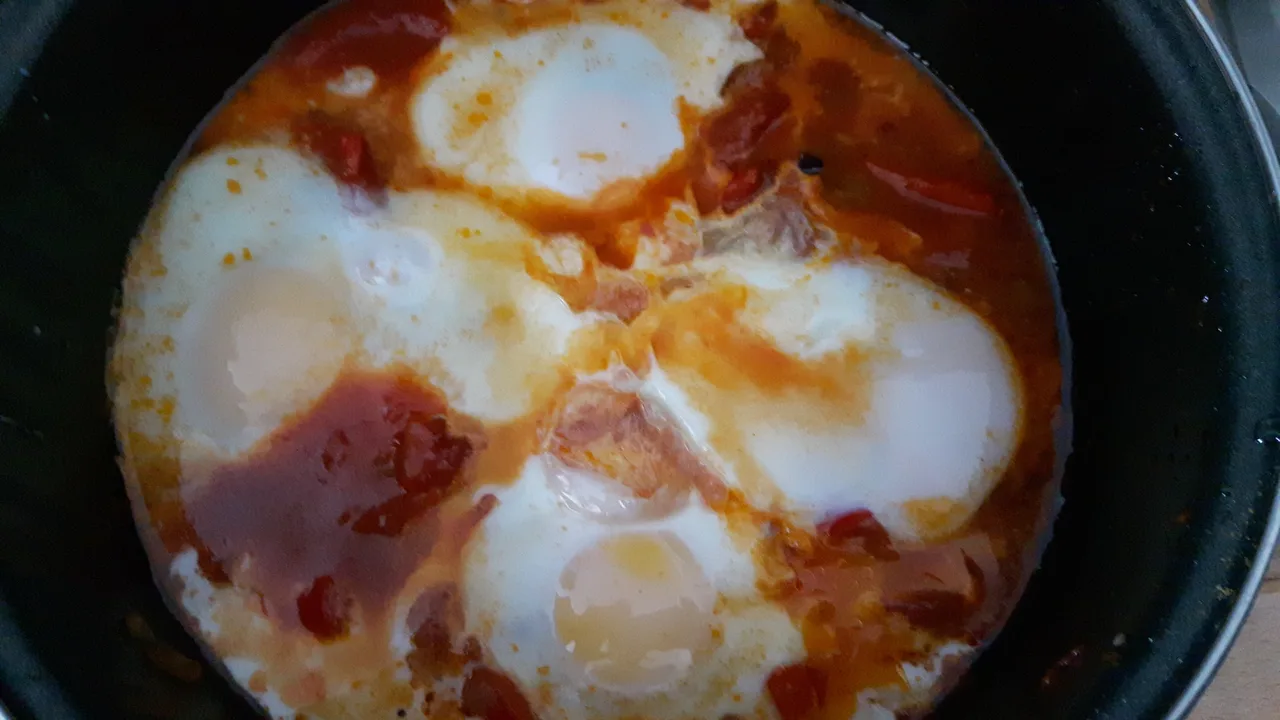
Tomato is eaten stuffed (dolma) and cooked with eggs (menemen).
Domates dolması
Dolma means filled. Domates dolması is a stuffed tomato, listed with pepper, artichoke, cabbage and aubergine dolmas. Sarma means wrapped: a cabbage or vine leaf with a rice filling is sometimes called sarma. Do not say «dolmuş» for dolma: a dolmuş is a shared minibus.
Menemen
Menemen is tomato cooked with eggs (domatesli yumurta: egg with tomato).
At the pazar: what to say
These five lines are for a stall.
Five lines for the stall
Bu domates nereden geldi? Seradan mı, tarladan mı?
boo doh-mah-tes neh-reh-den gehl-dee? seh-rah-dahn muh, tahr-lah-dahn muh
Where did this tomato come from? From a greenhouse or from a field?
Hangi ilin domatesi?
hahn-gee ee-leen doh-mah-teh-see
Which province’s tomato?
Künyesi var mı?
koon-yeh-see vahr muh
Does it have a künye (an origin tag)?
Salçalık domates var mı? Kilosu kaç lira?
sahl-chah-luhk doh-mah-tes vahr muh? kee-loh-soo kahch lee-rah
Do you have paste tomatoes? How many lira is a kilo?
Bir kilo pembe domates, lütfen.
bihr kee-loh pehm-beh doh-mah-tes, loot-fen
One kilo of pink tomatoes, please.
More guides: Agriculture in Turkey, Food Prices in Turkey, Istanbul Markets and Bazaars, Shopping in İzmir, BİM, A101, Migros, CarrefourSA, Turkish Cheese Guide, Ottoman Dishes in Turkey.
Sources and limits
Show the pages checked
- Domates Ürün Raporu 2024, TEPGE publication no. 396 (September 2024) — Ministry of Agriculture and Forestry, TEPGE, checked 26.10.2026
- Ürün Fiyat Detayları: bulletin date 26.10.2026 — Ministry of Trade, hal.gov.tr, checked 26.10.2026
- Hal Kayıt Sistemi home page: the day’s price list — Ministry of Trade, hal.gov.tr, checked 26.10.2026
- Toptancı hali soruları: HKS, künye, hal fee — Ministry of Trade, hal.gov.tr, checked 26.10.2026
- EU registration for Ayaş Domatesi (news, 30.11.2023) — TÜRKPATENT, checked 26.10.2026
- Örtü Altı Domates Yetiştiriciliği (brochure) — Gaziantep Provincial Directorate of Agriculture and Forestry, checked 26.10.2026
- Örtüaltı Domates Yetiştiriciliği (brochure, Mine Bulut, 2022) — Alata Horticultural Research Institute, checked 26.10.2026
- Domates Yetiştiriciliği (farmer brochure) — Yalova Atatürk Horticultural Research Institute, checked 26.10.2026
- Dolmalar (e-book page) — Ministry of Culture and Tourism, checked 26.10.2026
- Mutfak ve Kilerler — Elazığ Provincial Directorate of Culture and Tourism, checked 26.10.2026
Photos are from Wikimedia Commons, each with its author, date, licence and file page in the caption. The drawn tomatoes are drawings, not photos.
This page is general information about tomatoes in Türkiye. The hal prices are one day’s averages: the Ministry of Trade’s page has the day’s list.