Ottoman Dishes in Turkey and How to Ask for Them
Six dishes and sweets that Turkish state pages link to Ottoman cooking, what each page says, and the Turkish line to ask for each one.
Table of Contents
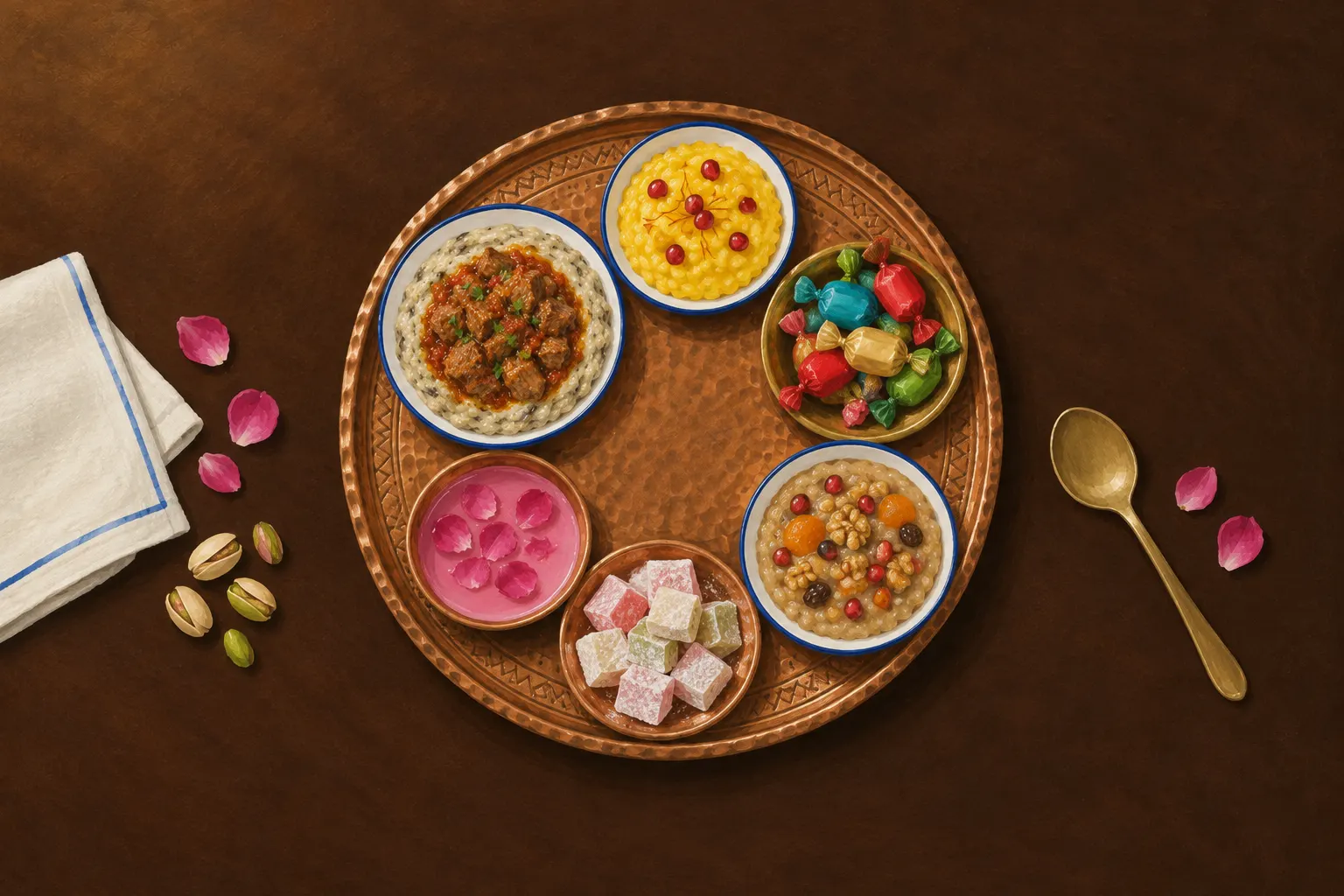
Turkish state pages link some single dishes to Ottoman cooking. Put the ones you want on the tray below, copy the Turkish message and show it at the table.
The short version
Six dishes, each with its source,
and one Turkish message to copy.
- Zerde is the one dish here that a state page puts in the palace kitchen. The page is from the Gaziantep culture and tourism office, on Kültür Portalı, Türkiye’s culture portal.
- Aşure, lokum and gül şerbeti are in the Ministry of Culture and Tourism’s book Türk Mutfağı, among forgotten Ottoman dishes that master cooks adapted for today.
- Hünkâr beğendi is one of the first dishes people name for Ottoman cooking, but the story of its name is only a rumour.
- Mesir macunu is a Manisa spice paste. Manisa throws it to the crowd at a festival on 21–24 March.
- The lines ask. They do not promise. A place may not have the dish, and then it will tell you.
The Copper Tray
Put dishes on the tray. Copy the Turkish to ask for them.
Tap a dish to put it on the tray or take it off. The paper card shows what a Turkish state page says about it. The order card at the bottom writes one Turkish message for your whole tray. Copy it and show it at the table or in the shop.
Main dish
Hünkâr beğendi
Sautéed lamb cubes on a soft purée of grilled aubergine. The purée is stirred with milk, melted butter and roasted flour.
What the state page saysThe Bursa culture and tourism office calls it an Ottoman cuisine dish, and says the name means “the sultan liked it”. The agriculture ministry’s magazine Türktarım says it is one of the first dishes that come to mind for Ottoman cooking, and that the story of its name rests only on rumour. Source: Bursa culture and tourism office · Türktarım.
Ask for it
Hünkâr beğendi var mı?Do you have hünkâr beğendi?Pudding
Zerde
A golden sweet rice pudding. The rice is cooked with sugar and turmeric, safflower or saffron. In Gaziantep, rice pudding (sütlaç) and golden zerde go into a bowl in two layers.
What the state page saysThe Gaziantep culture and tourism office calls zerde one of the important dishes of the Ottoman palace kitchen. In Gaziantep it is a traditional holiday sweet. Source: Gaziantep culture and tourism office, on Kültür Portalı.
Ask for it
Zerde var mı?Do you have zerde?Spice paste
Mesir macunu
A paste of 41 herbs and spices, wrapped in small coloured papers. Manisa makes it for a festival every March.
What the state page saysThe Ministry of Culture and Tourism’s heritage page tells the story of Hafsa Sultan, the mother of Süleyman the Magnificent, who fell ill in Manisa. The head physician of the Sultan Mosque school, Merkez Efendi, made the paste and she recovered. She asked for it to be shared with the people every year in Nevruz week. The page calls this a historical story. Source: Kültür Portalı.
Ask for it
Mesir macunu var mı?Do you have mesir macunu?Fruit and grain pudding
Süzme saray aşuresi
Everyday name: aşure. A sweet pudding of wheat, chickpeas, beans, dried fruit and nuts. It is topped with cinnamon, walnuts, pistachios and pomegranate seeds or rose petals.
What the state page saysThe Ministry of Culture and Tourism’s book Türk Mutfağı lists Süzme Saray Aşuresi among the forgotten Ottoman dishes that master cooks adapted for today. The Isparta cuisine book, printed by the Isparta governorate, gives the everyday aşure recipe. Source: Ministry of Culture and Tourism · Isparta governorate’s cuisine book.
Ask for it
Aşure var mı?Do you have aşure?Sweet
Lokum
A soft sweet of sugar, water and starch with a little citric acid. Some kinds have other things added, such as hazelnuts, saffron or rose.
What the state page saysThe ministry’s book Türk Mutfağı lists Rahatü’l-Hulkum among the forgotten Ottoman dishes. The Istanbul culture and tourism office gives rahat ul-hulküm as another name of lokum, of Arabic origin. The Safranbolu tourism office says lokum was known in Anatolia from about the 15th century and became common in the Ottoman lands in the 17th. Source: Ministry of Culture and Tourism · Istanbul culture and tourism office · Safranbolu tourism office.
Ask for it
Lokum var mı?Do you have lokum?Cold drink
Gül şerbeti
A cold rose drink: rose syrup stirred into cold water, with ice.
What the state page saysThe ministry’s book Türk Mutfağı lists Gül Şerbeti among the forgotten Ottoman dishes. The Isparta cuisine book, printed by the Isparta governorate, gives a rose syrup recipe and says rose sherbet is served to guests. Source: Ministry of Culture and Tourism · Isparta governorate’s cuisine book.
Ask for it
Gül şerbeti var mı?Do you have gül şerbeti?
Sipariş kartı · Order card
- Merhaba, iki kişiyiz.Hello, there are 2 of us.
- Hünkâr beğendi var mı?Do you have hünkâr beğendi?
- Zerde var mı?Do you have zerde?
- Varsa, birer porsiyon alabilir miyiz? Paylaşacağız.If you have them, could you give us one portion of each, to share?
These lines ask. They do not say the place has the dish: if it does not, it will tell you. Turn on JavaScript to change the dishes and the number of people.
What the state pages say dish by dish
Each row gives what the Turkish state page says about the dish, and who published it. On the palace kitchens as a whole, GoTürkiye, the platform of Türkiye’s tourism promotion agency, says that over the centuries thousands of chefs, workers and apprentices lived and worked in them.
| Dish | What the state page says | Where |
|---|---|---|
| Hünkâr beğendi | An Ottoman cuisine dish. The name means “the sultan liked it”. The story of the name is a rumour. | Bursa culture and tourism office · Türktarım |
| Zerde | One of the important dishes of the Ottoman palace kitchen. | Gaziantep culture and tourism office, on Kültür Portalı |
| Mesir macunu | A paste of 41 herbs and spices, shared with the crowd at a festival in Manisa that has run for about 400 years. | Kültür Portalı |
| Süzme saray aşuresi | Süzme Saray Aşuresi is listed among the forgotten Ottoman dishes that master cooks adapted for today. | Ministry of Culture and Tourism · Isparta governorate’s cuisine book |
| Lokum | Rahatü’l-Hulkum is listed among the forgotten Ottoman dishes. Rahat ul-hulküm is another name of lokum, of Arabic origin. | Ministry of Culture and Tourism · Istanbul culture and tourism office · Safranbolu tourism office |
| Gül şerbeti | Gül Şerbeti is listed among the forgotten Ottoman dishes that master cooks adapted for today. | Ministry of Culture and Tourism · Isparta governorate’s cuisine book |
Hünkâr beğendi the name is a story
The agriculture ministry’s magazine Türktarım says that how hünkâr beğendi got its name rests only on rumour, because recipes were hardly recorded in the Ottoman archives. It names two rumours:
The two rumours
- A cook from Bursa made it for Sultan Murad IV for the first time, in the early 17th century.
- Empress Eugénie, wife of Napoleon III, visited Istanbul in 1869, in the time of Sultan Abdülaziz. The dish was made for her.
What the state pages do say
- The Bursa culture and tourism office: it is an Ottoman cuisine dish. The name means “the sultan liked it”.
- The Bursa page describes smoked and spiced aubergine, grilled, then puréed and stirred with milk, melted butter and roasted flour, topped with cubes of sautéed lamb.
- Türktarım: one of the first dishes that come to mind when people say Ottoman cuisine.
Both stories are rumours, the magazine says. The Bursa office calls it an Ottoman cuisine dish.
Baklava and lokum two registered names
Türkiye registers where some foods come from. TÜRKPATENT, the state patent and trademark office, keeps the list. Two sweets on it are Antep baklava and Safranbolu lokum. Both are registered as an origin mark (mahreç işareti): it ties the name of a sweet to a place, and the registration names the place and says how the sweet is made there. These records are about where and how the sweets are made, not about the palace.
Antep Baklavası
- Registered on 04.01.2008 as an origin mark for Gaziantep. The registration holder is the Gaziantep Chamber of Industry.
- Thin layers of dough with pistachio and kaymak (here a thickened cream of milk and semolina), then syrup.
- Two kinds: yaş (wet), with kaymak; and kuru (dry), with pistachio only. The dry kind keeps longer. A seller may ask Yaş mı, kuru mu? (wet or dry?).
- Baked 30 to 45 minutes at 200–300 °C, preferably over an oak fire, in stone ovens.
Safranbolu Lokumu
- Registered on 15.07.2014 as an origin mark for Safranbolu in Karabük.
- Made of sugar, water, starch and citric acid, with other things added in some. The cut face is glossy and it does not stick to the teeth.
- The registration says the pack carries the name Safranbolu Lokumu and the emblem of the origin mark. Look for both on the box.
- The Safranbolu tourism office lists plain, saffron, double-roasted, rose and hazelnut kinds.
Mesir macunu the festival in Manisa
Mesir macunu is the one dish here you meet as a festival first. The Ministry of Culture and Tourism’s heritage page gives these facts about the festival in Manisa.
- When
- Nevruz week, 21–24 March, the start of spring. The page says the festival has run in Manisa for about 400 years.
- Where
- Around the Sultan Mosque and its complex in Manisa. The Ministry of Culture and Tourism declared the area a protected site in 1988.
- What
- A paste of 41 herbs and spices. The page names 20 of them, among them aniseed, nigella, cardamom, cloves, cinnamon, saffron, ginger and orange peel.
- How
- At least three tons are made for the festival. At least 14 women wrap it in small coloured papers. The paste is thrown to the crowd from the minaret and domes of the Sultan Mosque. People race to catch it in the air.
- Heritage
- The festival was added to UNESCO’s Representative List of the Intangible Cultural Heritage of Humanity in 2012.
Words to know a short list
These are the Turkish words in the order card.
| Turkish | It means |
|---|---|
| Var mı? | Is there…? Do you have…? |
| Varsa | If there is, if you have it |
| Alabilir miyiz? | Could the group have…? (one person: alabilir miyim? = could I have…?) |
| Porsiyon | One portion |
| Birer | One each |
| Paylaşacağız | It is for sharing |
| Tatlı | Sweet, dessert |
| Şerbet | A sweet cold drink |
Quick answers
How do I ask for one of these dishes?
Use the lines on the tray. They ask whether the dish is there and then ask for a portion. A place may not have it, and then it will tell you.
Where can I eat these dishes?
Ask at the table or in the shop. The lines on the tray ask first and do not assume: if a place does not have the dish, it will say so.
Was hünkâr beğendi really made for a sultan?
The story of its name rests only on rumour, says the agriculture ministry’s magazine Türktarım. The Bursa culture and tourism office calls it an Ottoman cuisine dish.
What does the registered name on baklava or lokum mean?
It is an origin mark in TÜRKPATENT’s list: the sweet is tied to a place, here Gaziantep for Antep baklava and Safranbolu for lokum. The lokum registration says the pack carries the name and the emblem of the origin mark.
When is the mesir festival?
In Nevruz week, 21–24 March, in Manisa.
Related: Turkish cheese and its protected names · Turkish tea
Sources
Open the source list
- Türk Mutfağı — Ministry of Culture and Tourism, Libraries and Publications directorate: the book page: forgotten Ottoman dishes adapted for today, among them Süzme Saray Aşuresi, Rahatü’l-Hulkum and Gül Şerbeti, checked 22.10.2026
- Bursa’dan hünkar sofralarına uzanan lezzet hünkar beğendi — Türktarım, the agriculture and forestry ministry’s magazine, 18.09.2018: the two rumours about the name of hünkâr beğendi, checked 22.10.2026
- Hünkârbeğendi — Bursa culture and tourism office: the English page on hünkârbeğendi, checked 22.10.2026
- Gaziantep’in Ramazan’a Özel Lezzetleri — Kültür Portalı, text from the Gaziantep culture and tourism office: zerde and the Ottoman palace kitchen, checked 22.10.2026
- Mesir Macunu Festivali — Kültür Portalı, text from the Living Heritage and Cultural Events directorate of the Ministry of Culture and Tourism: Hafsa Sultan, the paste, the dates and the UNESCO listing, checked 22.10.2026
- Antep Baklavası — Kültür Portalı, the page on Antep baklava: what Antep baklava is made of and the dry and wet kinds, checked 22.10.2026
- Antep Baklavası (kayıt 95) — TÜRKPATENT, Türkiye’s patent and trademark office: the portal of registered origin names: registration number 95, 04.01.2008, checked 22.10.2026
- Safranbolu Lokumu (kayıt 183) — TÜRKPATENT: the registration document: registration number 183, 15.07.2014, checked 22.10.2026
- Safranbolu Lokumu — Safranbolu tourism office of the Ministry of Culture and Tourism: the kinds of lokum and its history, checked 22.10.2026
- Beyoğlu / Fatih Eminönü / Kadıköy – Lokum — Istanbul culture and tourism office: rahat ul-hulküm as another name of lokum, checked 22.10.2026
- Isparta Mutfağı — Isparta governorate: the cuisine book, hosted on the culture and tourism office site: the aşure recipe and the rose syrup recipe, checked 22.10.2026
- Topkapi Palace Istanbul Guide — GoTürkiye, the platform of Türkiye’s tourism promotion agency: the palace kitchens, checked 22.10.2026