
Kazakhstan Food: 20 Dishes, From Beshbarmak to Kumis
Twenty Kazakh dishes and drinks, what is in each, who gets which piece of the meat platter, how tea is poured, and two recipes.
Table of Contents
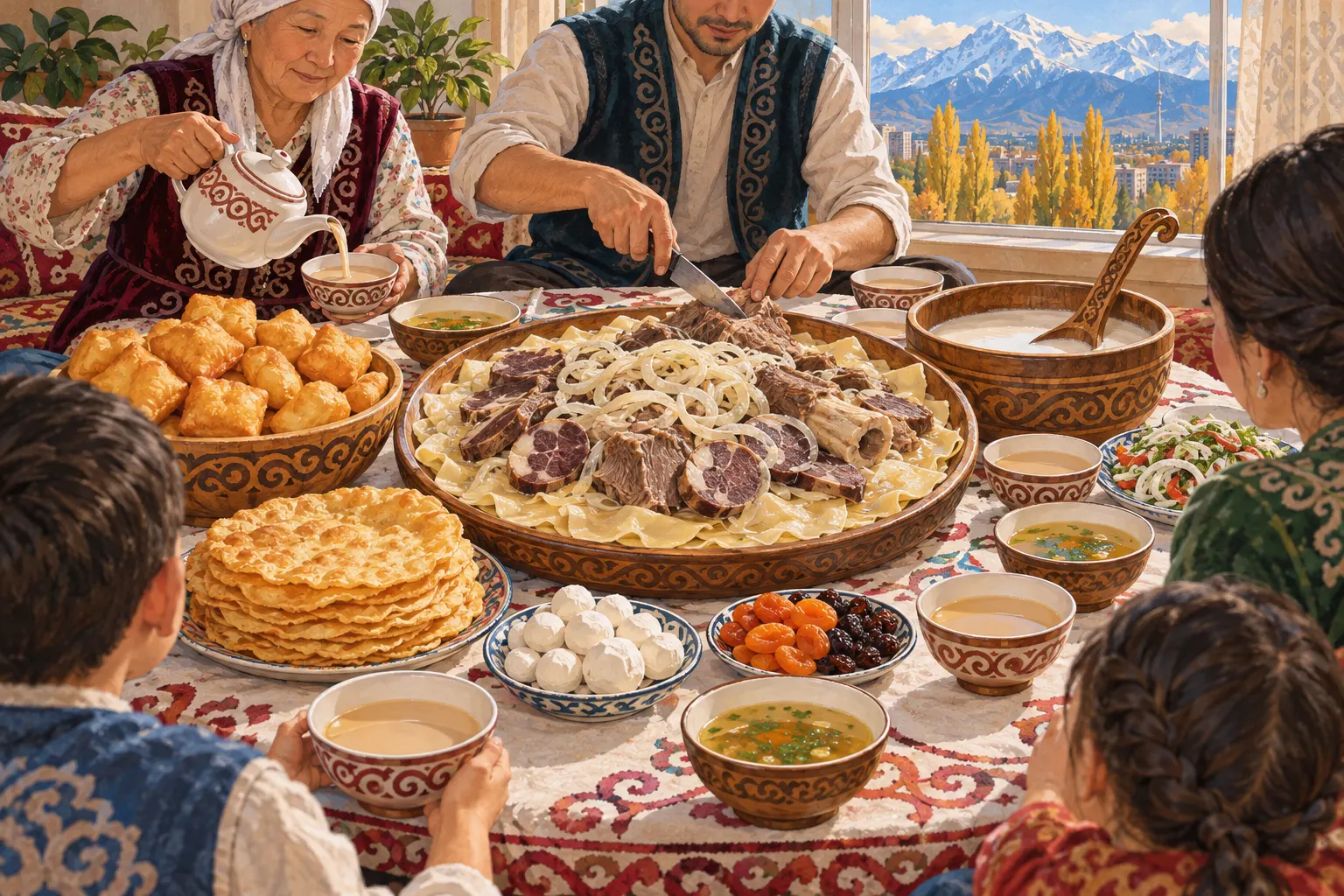
Kazakh food is built on what the herds give: meat from sheep, cattle and horses, milk turned into kumis, ayran and hard little balls of kurt, and wheat dough, fried or boiled. The best-known dish is beshbarmak, boiled meat on thin squares of dough, which Kazakhs simply call et, “meat”. Around it come fried baursak, sliced horse-meat kazy and tea with milk.
Kazakhstan food, in short · checked 17.10.2026
Meat, milk and dough: a herders’ kitchen, served with tea.
- Beshbarmak – boiled meat on thin dough squares with onions; its broth, sorpa, comes in bowls. The meat is shared out piece by piece.
- Baursak – fried dough, the first thing put before any guest.
- Horse meat – kazy, karta, zhal and zhaya are festive delicacies, and beshbarmak, plov or sorpa can be horse too. Ask if you don’t eat it.
- Kumis and shubat – fermented mare’s and camel’s milk; with ayran and kurt they are the “white foods”.
- Tea with milk – milk first, then tea, half a bowl at a time.
- Shared with neighbours – plov, manty and samsa are just as much part of the table.
Dish finder · 20 dishes
Twenty dishes on one dastarkhan
Tap a plate to see what it is, what it is made with and what a Russian-language menu calls it. Switch on what you don’t eat: plates that may hold it turn amber, plates that do hold it fade.
Meat
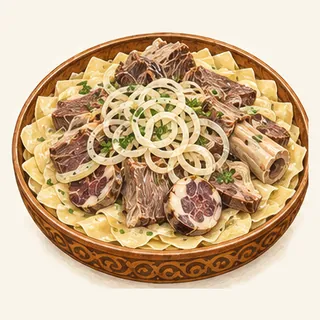
Beshbarmak
Бешбармақ · етMenu: Бешбармак
The national dish: big pieces of boiled meat on thin squares of dough cooked in the broth, under onions softened in broth (tuzdyk). In Kazakh it is asylgan et, or simply et, “meat”.
- Made with
- Mutton, beef or horse · flour, water, salt, sometimes egg · onion
- When
- Guests, family gatherings, holidays
Meat
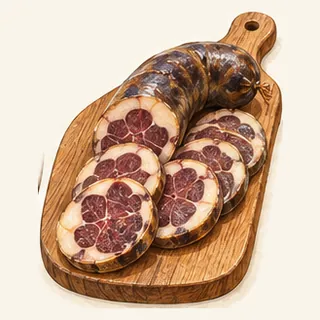
Kazy
ҚазыMenu: Казы
Horse-meat sausage: rib meat kept with its fat, salted, packed into casing, aired, smoked and boiled. Each round slice shows red meat ringed with white fat.
- Made with
- Horse rib meat and fat · salt · casing
- When
- Festive tables, not every day
Meat
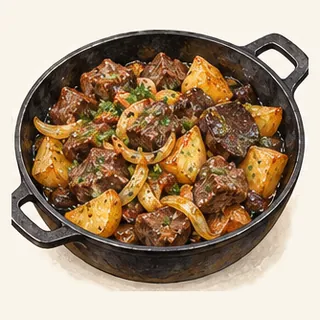
Kuyrdak
ҚуырдақMenu: Куырдак
Fresh meat and offal (heart, liver, lungs, kidneys) fried in tail fat with lots of onion, potatoes added later. A dish of the slaughter day.
- Made with
- Meat and offal · tail fat · onion · potatoes
- When
- The day an animal is slaughtered, cold days
Meat
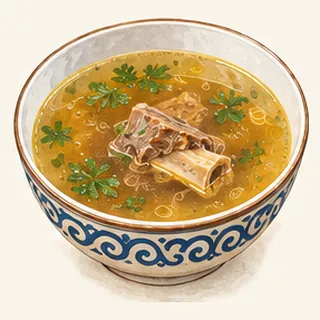
Sorpa
СорпаMenu: Сорпа
The broth the meat was boiled in, served in bowls with beshbarmak. There are many kinds of sorpa, each with its own name.
- Made with
- Meat broth · salt
- When
- With every meat meal
Meat
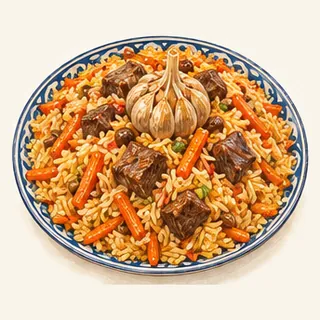
Plov
ПалауMenu: Плов
Rice cooked in one pot with meat, carrots and onion, a dish shared with the rest of Central Asia. Some cooks add kazy.
- Made with
- Rice · mutton or beef · carrots · onion · oil or fat
- When
- Family meals, weddings
Meat
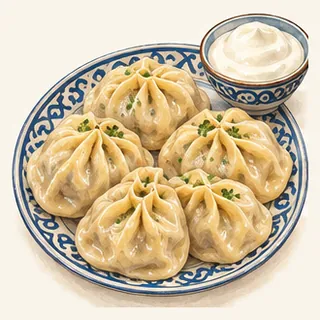
Manty
МантыMenu: Манты
Large steamed dumplings: thin dough around chopped meat and onion, sometimes with pumpkin. Often served with sour cream.
- Made with
- Flour · mutton or beef · onion · sometimes pumpkin
- When
- Everyday meals
Meat
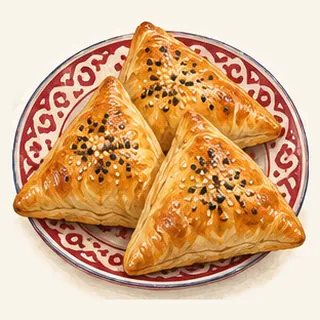
Samsa
СамсаMenu: Самса
A baked pastry, usually a triangle, filled with chopped meat and onion. Bakeries make other fillings too.
- Made with
- Pastry · mutton or other meat · onion
- When
- A snack any time
Bread and dough
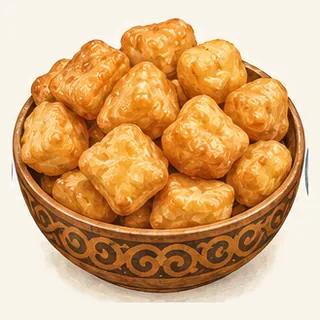
Baursak
БауырсақMenu: Баурсаки
Puffy pieces of dough fried in a kazan of hot oil, round or square. The first thing put before a guest, with tea, honey, sour cream or the meat.
- Made with
- Flour · water or milk · yeast · egg · salt and sugar
- When
- Every table, every guest
Bread and dough
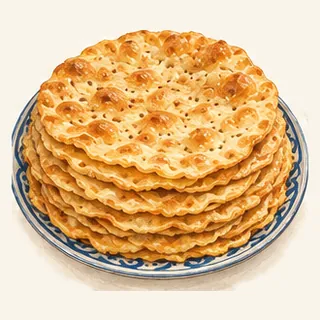
Shelpek
ШелпекMenu: Шелпек
Very thin round bread fried fast in hot vegetable oil or animal fat. Usually made in sevens, for Fridays, Eid and memorial meals.
- Made with
- Flour · water or milk · egg · oil or animal fat
- When
- Fridays, Eid, remembrance
Bread and dough
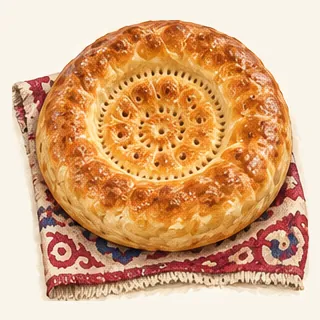
Taba nan
Таба нанMenu: Таба нан
Round bread baked between two pans buried in hot coals or in an oven. The dough can hold milk, ayran, butter or horse fat.
- Made with
- Flour · milk or ayran · butter or horse fat
- When
- Home, the road
Bread and dough
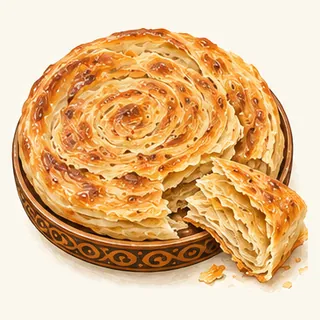
Kattama
ҚаттамаMenu: Каттама
Layered bread: dough spread with butter, sour cream or fat, rolled up, rolled out again and baked on a hot pan. Torn by hand at the tea table.
- Made with
- Flour · butter, sour cream or fat
- When
- Tea for honoured guests
Milk
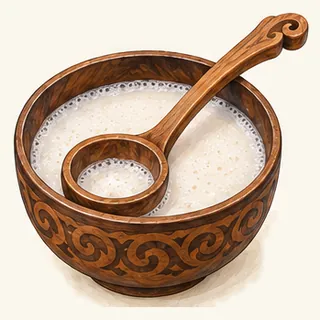
Kumis
ҚымызMenu: Кумыс
Fermented mare’s milk, sour and slightly fizzy.
Fermented: not suitable if you avoid alcohol. Choose ayran instead.
- Made with
- Fresh mare’s milk · lactic bacteria and yeast
- When
- From spring, when the mares are milked
Milk
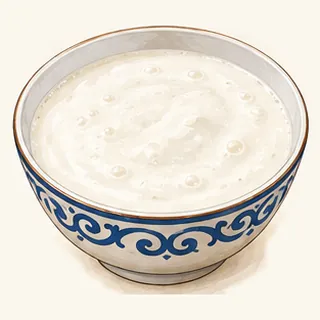
Shubat
ШұбатMenu: Шубат
Fermented camel’s milk, thicker than kumis.
Fermented: not suitable if you avoid alcohol. Choose ayran instead.
- Made with
- Camel’s milk · starter
- When
- Where camels are kept, and in shops

Milk
Ayran
АйранMenu: Айран
Boiled milk soured with a starter: thick and tangy, drunk at the tea table and after a heavy meat meal. Thinned with water it becomes shalap.
- Made with
- Milk · starter
- When
- Every day, hot days
Milk
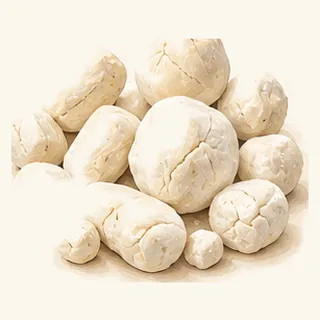
Kurt
ҚұртMenu: Курт
Strained sour milk, boiled, shaped by hand and dried hard in sun and wind. Salty or unsalted; it keeps for a long time and can be melted into soup.
- Made with
- Ayran or katyk · sometimes salt
- When
- Snacks, the road, soups
Milk
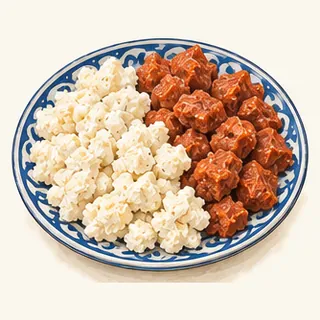
Irimshik
ІрімшікMenu: Иримшик
Curd from heated, curdled milk: white and fresh, or boiled until the whey is gone, red-brown and sweetish, then dried.
- Made with
- Milk · starter or rennet
- When
- Tea table
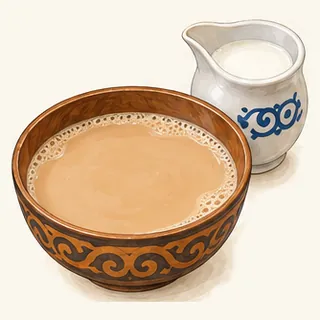
Tea
Tea with milk
Сүтті шайMenu: Чай с молоком
Strong black tea poured onto milk in a wide bowl, the kese, a little at a time. There is no dastarkhan without it.
- Made with
- Black tea · milk or cream
- When
- Every meal
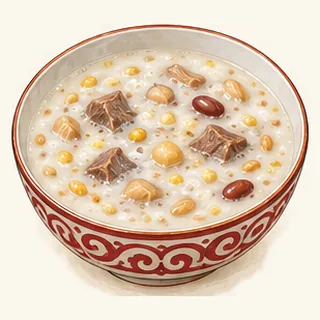
Holiday and sweet
Nauryz kozhe
Наурыз көжеMenu: Наурыз коже
The spring holiday soup of at least seven things, such as wheat, millet, meat, beans, milk, water and salt. Cooked for Nauryz, 21–23 March.
- Made with
- Seven or more: grains, meat, milk, water, salt…
- When
- Nauryz, 21–23 March
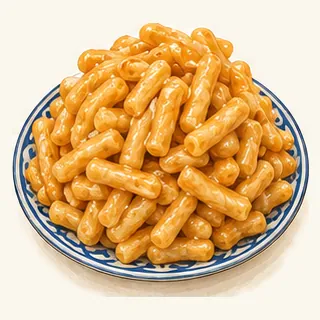
Holiday and sweet
Chak-chak
Menu: Чак-чак
Short sticks of fried dough stuck together with honey: a favourite sweet of the Kazakh table.
- Made with
- Flour · egg · honey
- When
- Weddings, holidays
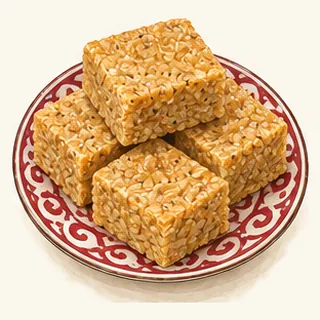
Holiday and sweet
Zhent
ЖентMenu: Жент
Crushed wheat or barley pressed with butter and honey or sugar into a sweet, without cooking. Made for weddings and honoured guests.
- Made with
- Crushed wheat or barley · butter · honey or sugar
- When
- Weddings, honoured guests
Recipes differ from home to home and from restaurant to restaurant. “Fits” means the usual recipe has none of what you picked; for allergies, halal or a strict diet, ask about the dough, the broth and the frying fat.
Beshbarmak and who gets which piece
Beshbarmak is boiled meat, mutton, beef or horse, laid over thin squares of dough cooked in the fatty broth, with onions softened in broth, tuzdyk, on top. In Kazakh it is asylgan et, “boiled meat”, or just et: Qazaqstan tarihy notes that all meat dishes went by that one word. Lamb was the everyday meat; horse was for special guests.
The meat is not simply heaped up. One person, the et turaushy, cuts it and knows which piece goes to whom, and each platter, a tabaq, fits its guests’ age, standing and family ties. Pick a guest below to see their pieces.
Tabaq tartu · who gets which piece
One platter, a piece for every guest
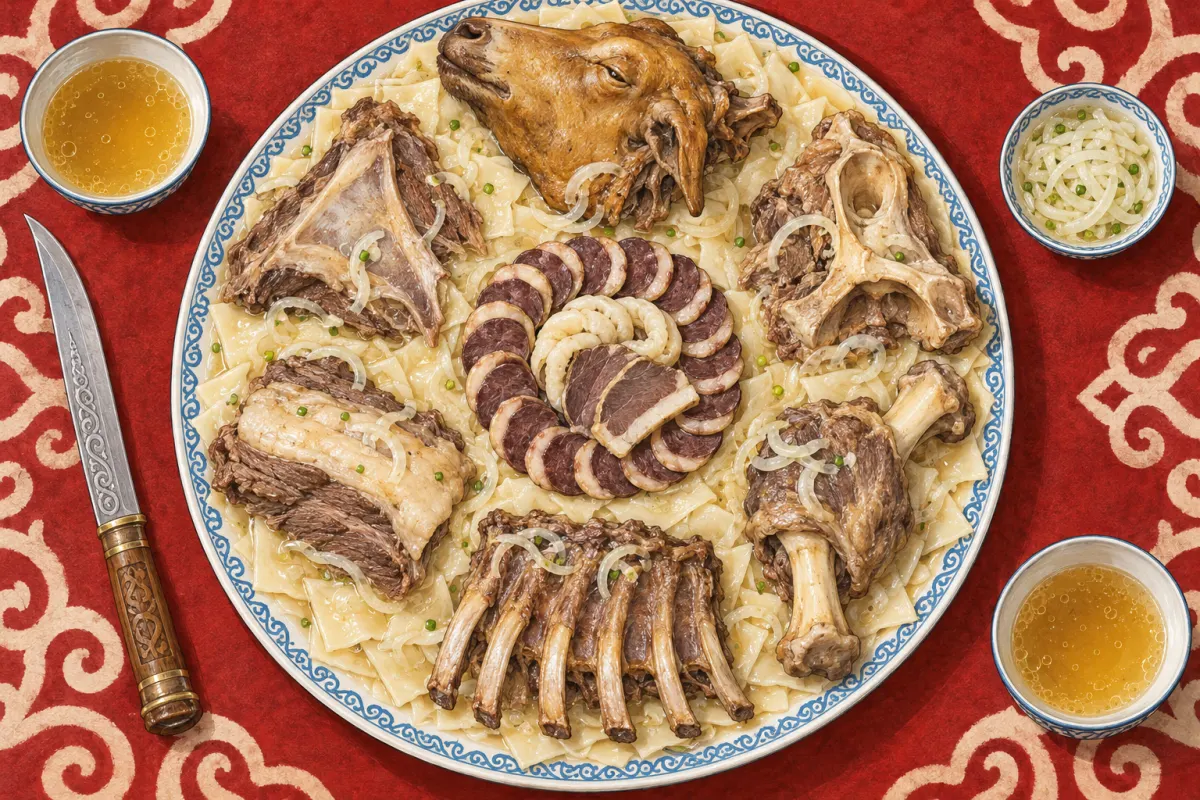
Bas tabaq бас табақ
The first platter, for elders and the most honoured guests: the pelvic bone, the thigh bone, the ribs, the lumbar meat and, from a horse, kazy, karta, zhal and zhaya. The sheep’s head goes to the eldest too.
Qos tabaq қос табақ
For the in-laws, the quda: the same pieces as the first platter, plus a second thigh bone.
Syi tabaq сый табақ
For people owed respect after the elders: honoured pieces, but never the shoulder blade or the shin bone.
Kuyeu tabaq күйеу табақ
The son-in-law’s own platter always holds the brisket, tös: a wish that his life be rich and soft as the brisket.
The ears құлақ
From the head, the right ear goes to the youngest in the house. Ears go to children, and never both ears to one child.
The tongue тіл
The tongue goes to the daughter-in-law or to the children.
The palate таңдай
The carver lays the palate on the right palm and gives it to the youngest daughter, or to a singer.
Sybaga сыбаға
Anyone who stays the night is owed a share of the meat, the sybaga.
- Head басA boiled sheep’s head, simmered for four to six hours. The eldest or the guest of honour, who carves it and shares it out in order.
- Pelvic bone жамбасThe wide pelvic bone with its meat, one of the honoured pieces. The first platter (bas tabaq) and the in-laws’ platter.
- Thigh bone ортан жілікThe thigh bone with a thick piece of meat. The first platter; the in-laws get a second one.
- Ribs сүбе қабырғаThe fillet with five ribs above the kidney. The first platter.
- Brisket төсThe breastbone piece with its fat. Always the son-in-law: it goes on his own platter.
- Shoulder blade жауырынThe flat shoulder blade with thin meat. Never on the platter for respected guests, the syi tabaq.
- Kazy, karta, zhal, zhaya қазы, қарта, жал, жаяSlices of the horse-meat delicacies, when a horse was slaughtered. The first platter, the in-laws’ and the respected guests’.
After the National Museum of Kazakhstan’s inventory of meat customs. Families and regions differ; at a table, the host and the eldest decide.
With it comes sorpa, the broth, in bowls; there are many kinds of sorpa, each with its own name. On the day an animal is slaughtered, the first dish is often kuyrdak: fresh meat, liver, heart, lungs and kidneys fried in tail fat with plenty of onion. Sources: the Abai Institute’s national dishes, Qazaqstan tarihy and the National Museum’s inventory of meat customs.
Horse meat kazy, karta, zhal, zhaya
Horse meat is festive food. Kazy, karta, zhal and zhaya are salted and smoked at the winter slaughter, the sogym, and go onto the platters for the most honoured guests. Kazakhstan counted 4.6 million horses on 1 January 2026, 6.7% more than a year earlier, by the Bureau of National Statistics.
Horse meat · four delicacies
Which part of the horse?
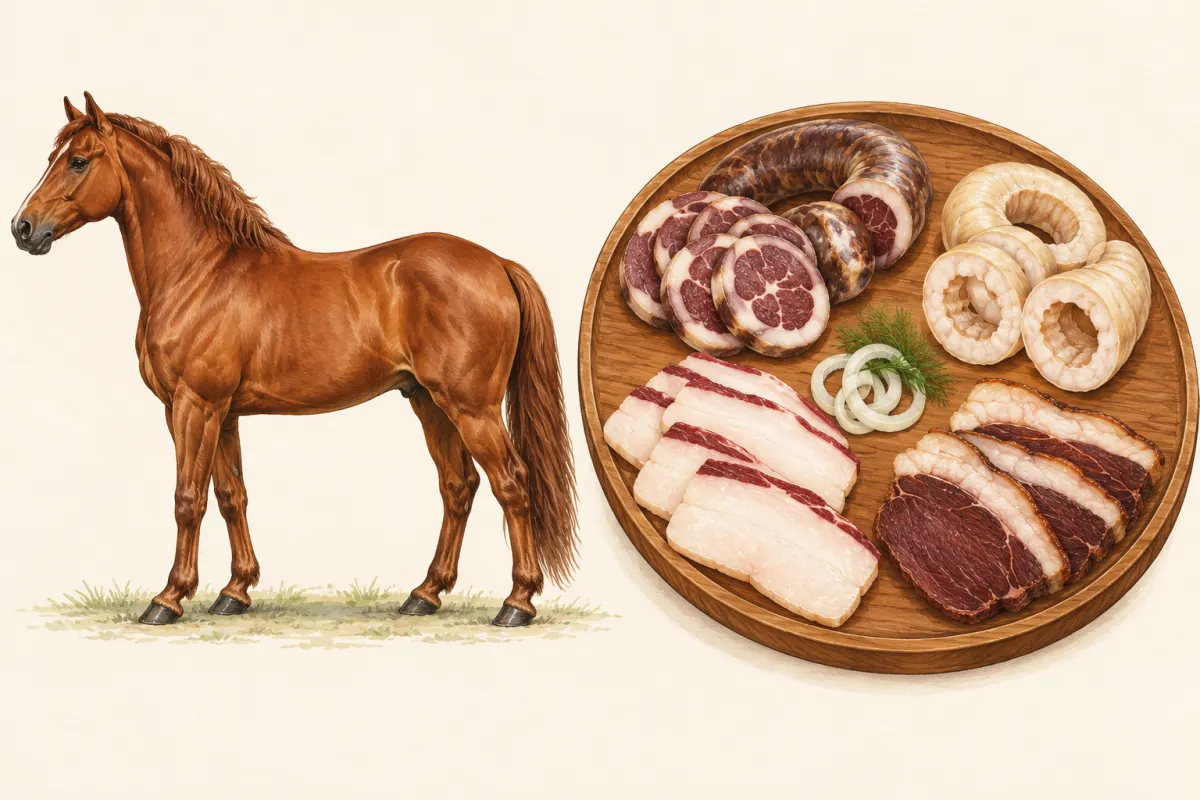
Kazy қазы
From: Ribs and loin
Rib meat is cut from the ribs with its fat, salted, packed tight into a cleaned gut casing and tied at both ends. It is boiled slowly and eaten hot or cold, often beside beshbarmak.
- Salt2–3 days
- Air8–10 h
- Smoke13–27 h
- Boil2–2½ h
Karta қарта
From: The rectum
The thick end of the gut, cleaned many times, salted, tied, smoked and dried. Boiled gently, it is cut into rings and topped with onion and dill.
- Salt1–2 days
- Smoke12–18 h
- Dry2–3 days
- Boilslowly
Zhal жал
From: Neck, under the mane
The thick strip of fat along the neck, cut whole from the neck bones and salted. Made at the winter slaughter, it goes on the platters for the most respected guests, hot or cold.
- Saltnotched and rubbed
- Juniper smoke1–2 h
Zhaya жая
From: Hip and rump
Meat from the hip, cut in one piece into layers about 10 cm thick, 0.5 to 5 kg each, salted and smoked to a brown colour. Served with kazy and karta on the first platters.
- Salt1–2 h
- Smoke14–18 h
Times are those the Abai Institute gives for home curing; makers differ.
Kazy is a holiday sausage rather than an everyday one: it is sliced as a snack, laid on beshbarmak or added to plov. If you don’t eat horse, ask before you order beshbarmak, plov, sorpa or kuyrdak, and ask about taba nan, which can be kneaded with horse fat.
Kumis, shubat and kurt the white foods
Kazakhs call dairy aq, “white”. Kumis is fermented mare’s milk, shubat fermented camel’s milk, ayran soured milk, and kurt is sour milk strained, shaped and dried hard. After tea, kumis and then shubat were the most popular drinks, Qazaqstan tarihy writes.
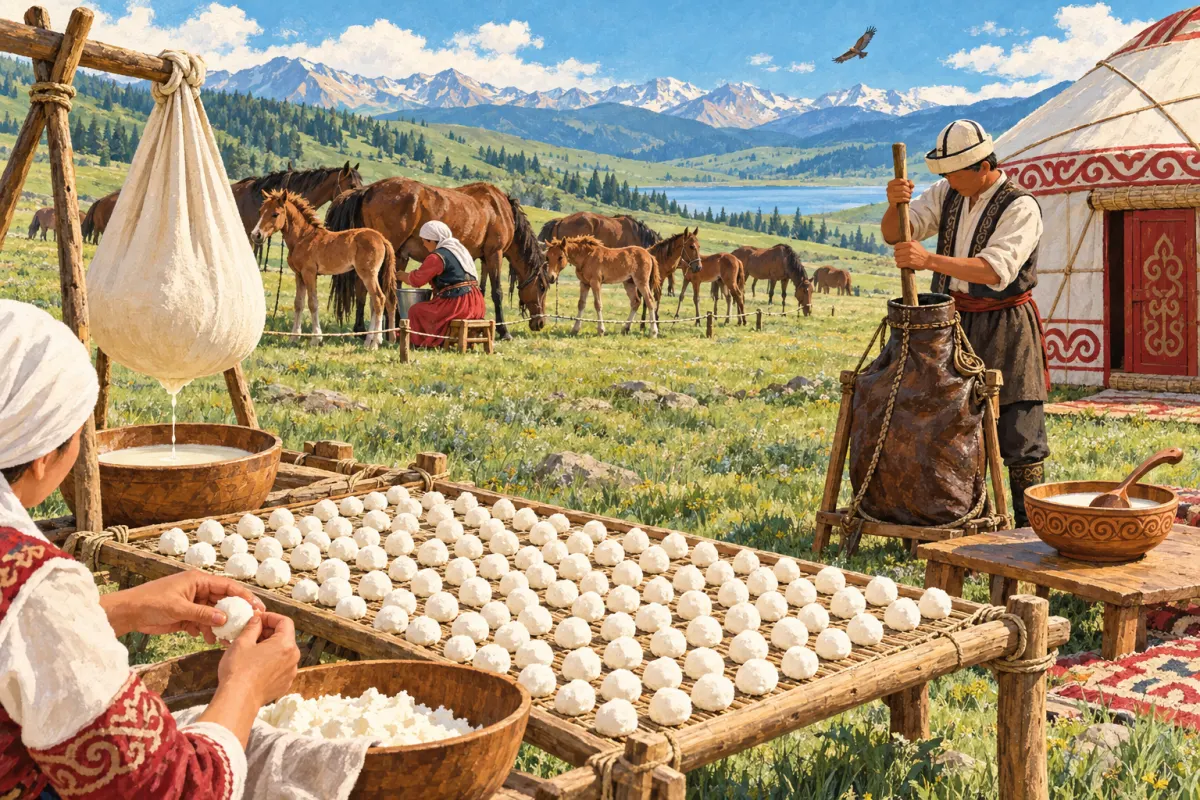
- In springThe foals are tied to a long rope pegged to the ground, so the mares stay near and can be milked. The first milking, biye baylau, is one of the Kazakh horse breeders’ spring rites that UNESCO listed in 2018.
- Mare’s milkThe fresh milk, saumal, goes into a leather saba or a wooden kuby with a starter and is beaten for a long time with a wooden staff, the pispek.
- The first kumisKymyz muryndyk, the first sharing of kumis, opens the season; every household holds its own. Lactic bacteria and yeast turn the milk sour and lightly fizzy.
- StrainFor kurt, ayran or katyk is poured into a canvas bag and hung up until the whey drips out. What stays in the bag is suzbe, a thick, sour curd.
- Shape and dryThe suzbe is boiled, shaped by hand into balls or ovals and laid on a rack, the ore, to dry hard in sun and wind. Dry kurt keeps for a long time.
Kumis and shubat are traditionally made from raw milk: shubat without heating the camel’s milk first, and kumis from fresh mare’s milk. The CDC warns that products made from raw milk can carry germs such as Brucella and Listeria, and that children under 5, adults over 65, pregnant women and people with weak immunity are most at risk. Kurt is boiled before it is shaped and dried; a 2026 study describes it as a firm, sun-dried cheese made from cow’s, goat’s, sheep’s, camel’s or mare’s milk, salty or not.
Tea with milk half a bowl at a time
Tea is the main drink, and pouring it has rules. Milk goes into the wide bowl, the kese, first, then strong tea, and only a little at a time, half the bowl or just the bottom. A bowl filled to the brim once told a guest they were not welcome, the National Museum’s inventory records.
Pour the tea
Milk first, then tea, never to the brim
Small bowls are the custom in Atyrau and Mangystau and in parts of Aktobe and West Kazakhstan regions; elsewhere medium or large ones.
Milk goes into the kese first, then strong tea, and only a little at a time.
- Milk first. Then the tea on top.
- Half a bowl or less. A little at a time, and the host pours again.
- Never to the brim. A full bowl once told a guest they were not welcome.
Tea reached the Kazakhs through Russia and spread to everyone in the second half of the 19th century. Cream, kilegei or thicker kaimak, gives it its taste, and with it come flatbread, kaimak, dried fruit, butter, nuts and sweets: “Without a traditional tea party, there was never a dastarkhan,” writes Qazaqstan tarihy.
Baursak, shelpek, taba nan the breads
Kazakh bread is fried as often as it is baked: baursak and shelpek in a kazan of hot oil, taba nan between two pans in the coals, kattama layered on a hot pan. A tandyr oven bakes flat tandyr nan on its inner wall.
Four breads from the Kazakh table
Baursak бауырсақ
Dough of flour, water or milk, yeast, egg, salt and sugar (sometimes ayran or sour cream), rolled, cut into rounds or squares and fried in a kazan of hot oil until golden on both sides. Yeast dough makes it soft and puffy, unleavened dough dense and crisp.
Too hot a fire leaves baursak raw inside or too dark, the National Museum’s inventory warns.
Shelpek шелпек
Dough of flour with water or milk, egg, a little salt and sugar, rolled perfectly round and very thin and fried in a moment in hot vegetable oil or animal fat.
Shelpek is made in sevens, sometimes nines, for Fridays, Eid and meals in memory of the dead.
Taba nan таба нан
A round, dense bread baked between two hot pans buried in the coals of a fire or set in a stove. Kneaded with warm milk or thick ayran and a little butter or horse fat, it gets a golden crust and a soft middle.
The name says how it is made: taba is the pan.
Kattama қаттама
Dough rolled thin, spread with butter, sour cream or fat, rolled into a log and rolled out again into a round, then baked on a hot pan with a little oil, so it falls into many thin layers.
Served hot with tea, with thick cream, honey or jam, and torn by hand.
Baursak is the first treat served to every guest who enters a Kazakh home.
Flatbread making and sharing, with the Kazakh katyrma, has been on UNESCO’s list of intangible heritage since 2016, together with Azerbaijan, Iran, Kyrgyzstan and Türkiye: it takes at least three people, often from one family. The recipes above follow the Abai Institute and the National Museum.
Cook it at home beshbarmak and baursak
Both work in an ordinary kitchen. Beshbarmak needs a big pot and about three hours, most of it gentle simmering; baursak needs a dough that rises for an hour and a deep pan of oil. Choose the number of people and the amounts change.
Cook it at home · quantities are ours
Two recipes, scaled to your table
Beshbarmak
Serves 4
- 1.2 kg mutton, beef or horse meat on the bone (or a mix), in large pieces
- 3 L cold water
- 3 onions (one for the broth, the rest for tuzdyk)
- 2 tsp salt, plus a pinch for the dough
- 0.5 tsp ground black pepper
- 2 bay leaves
- 300 g plain flour for the dough
- 1 egg
- 120 ml water or cooled broth for the dough
- 10 minCover the meat with cold water in a big pot and bring it to the boil. Skim off the grey foam until the broth runs clear.
- 2½–3 hAdd one whole onion and the bay leaves and simmer very gently, lid ajar: about 2½ hours for mutton, 3 for beef or horse. Salt in the last half hour.
- 30 minMeanwhile knead flour, egg, a pinch of salt and the water into a firm dough. Cover it and let it rest.
- 15 minRoll the dough very thin, 1 to 2 mm, and cut it into squares or diamonds about 6 cm across. Dust them with flour so they don’t stick.
- 10 minTuzdyk: slice two onions into thin half-rings, pour over a ladle of hot fatty broth, add the pepper and leave them to soften.
- 10 minLift out the meat, take it off the bone and slice it. Keep it warm under a little broth.
- 5 minBoil the dough squares in the broth in batches, 3 to 5 minutes each, until tender. Lift them out with a slotted spoon onto a wide platter.
- Pile the meat on the dough, spoon the onions over it and serve the remaining broth, the sorpa, in bowls.
Baursak
Serves 6
- 500 g plain flour
- 250 ml warm milk (or half milk, half water)
- 7 g dried yeast
- 1 tbsp sugar
- 1 tsp salt
- 1 egg
- 30 g melted butter
- 5 cm neutral oil, that deep in a heavy pot, for frying
- 10 minStir the yeast and sugar into the warm milk and leave it until it froths.
- 10 minBeat in the egg, butter and salt, then the flour, and knead a soft dough that no longer sticks.
- 1 hCover and leave it somewhere warm until it has doubled.
- 10 minRoll it out 1 cm thick and cut squares or rounds about 4 cm across. Let them rest 10 minutes.
- 20 minHeat the oil, at least 5 cm deep, in a heavy pot to about 170 °C. Fry a few at a time, turning them, until puffed and deep golden. Drain on paper.
- Serve warm with tea, honey or sour cream, or beside the meat.
Our home-kitchen version; the method follows the Abai Institute’s description of asylgan et and baursak. Never leave hot oil alone, and keep a lid nearby.
No horse meat? Use mutton or beef on the bone: the bones give the broth its body. If you can buy kazy, boil it slowly for about two hours with the meat and slice it into rounds on top.
Nauryz kozhe and the holiday table
Nauryz, the spring new year, is a public holiday in Kazakhstan on 21–23 March under the Law on holidays (article 3). Its dish is Nauryz kozhe, a soup of at least seven things; the lists differ from source to source.
Nauryz kozhe · seven in the pot
Put at least seven things in the pot
Two Kazakh lists of the seven: the National Museum names wheat, millet, meat, beans, milk, water and salt; Qazaqstan tarihy names meat, fat, kurt, irimshik, wheat, onions and salt.
For sweets, the table has chak-chak, fried dough in honey, talkan, roasted crushed wheat mixed with sugar, and zhent, crushed grain pressed with butter and honey or sugar. Balkaimak is cream boiled with a little flour and honey or sugar. And the apple has deep roots here: the wild apple of the Tien Shan, Malus sieversii, is considered the ancestor of today’s apples.
Sources and limits
We read the National Museum of Kazakhstan’s inventory of intangible heritage, the Abai Institute’s national-dishes page, Qazaqstan tarihy, UNESCO’s lists, the Bureau of National Statistics, the Law on holidays, the CDC and two papers on shubat and kurt on 17 October 2026. Recipes differ between families, regions and restaurants: the dish finder shows the usual recipe, not a promise about the plate in front of you. The recipe quantities and times are ours.
- Tradition of cooking and serving meat (tabaq tartu) – National Museum of the Republic of Kazakhstan, checked 17.10.2026
- Kazakh ritual traditions of table setting – National Museum of the Republic of Kazakhstan, checked 17.10.2026
- Nauryz – an ancient holiday – National Museum of the Republic of Kazakhstan, checked 17.10.2026
- Culture of making flatbreads – National Museum of the Republic of Kazakhstan, checked 17.10.2026
- Tea drinking culture (in Kazakh) – National Museum of the Republic of Kazakhstan, checked 17.10.2026
- Tying mares, preparing kymyz – National Museum of the Republic of Kazakhstan, checked 17.10.2026
- National dishes – Abai Institute, Otandastar Foundation, checked 17.10.2026
- The most delicious holiday – Nauryz – Qazaqstan tarihy (e-history.kz), checked 17.10.2026
- Traditional spring festive rites of the Kazakh horse breeders – UNESCO, checked 17.10.2026
- Flatbread making and sharing culture: Lavash, Katyrma, Jupka, Yufka – UNESCO, checked 17.10.2026
- Livestock: main figures for 2025 (in Russian) – Bureau of National Statistics, checked 17.10.2026
- Law No. 267 “On holidays in the Republic of Kazakhstan”, article 3 – Adilet, checked 17.10.2026
- A study of shubat, fermented camel’s milk, from Kazakhstan – Ishii, Nurtazin, Milk Science 63(2), 2014, checked 17.10.2026
- Kurt (dried fermented milk product) – Kalibekkyzy et al., Foods 15(2), 2026, checked 17.10.2026
- Raw milk – CDC, checked 17.10.2026
- Western Tien-Shan – IUCN World Heritage Outlook, checked 17.10.2026
The illustrations were made for this page and show no real person.