
Kütahya Porcelain and Çini: How to Tell Them Apart
Kütahya Porselen is a company; çini is hand-painted craft with a registered name. Read the mark underneath and learn when a plate is only decoration.
Table of Contents
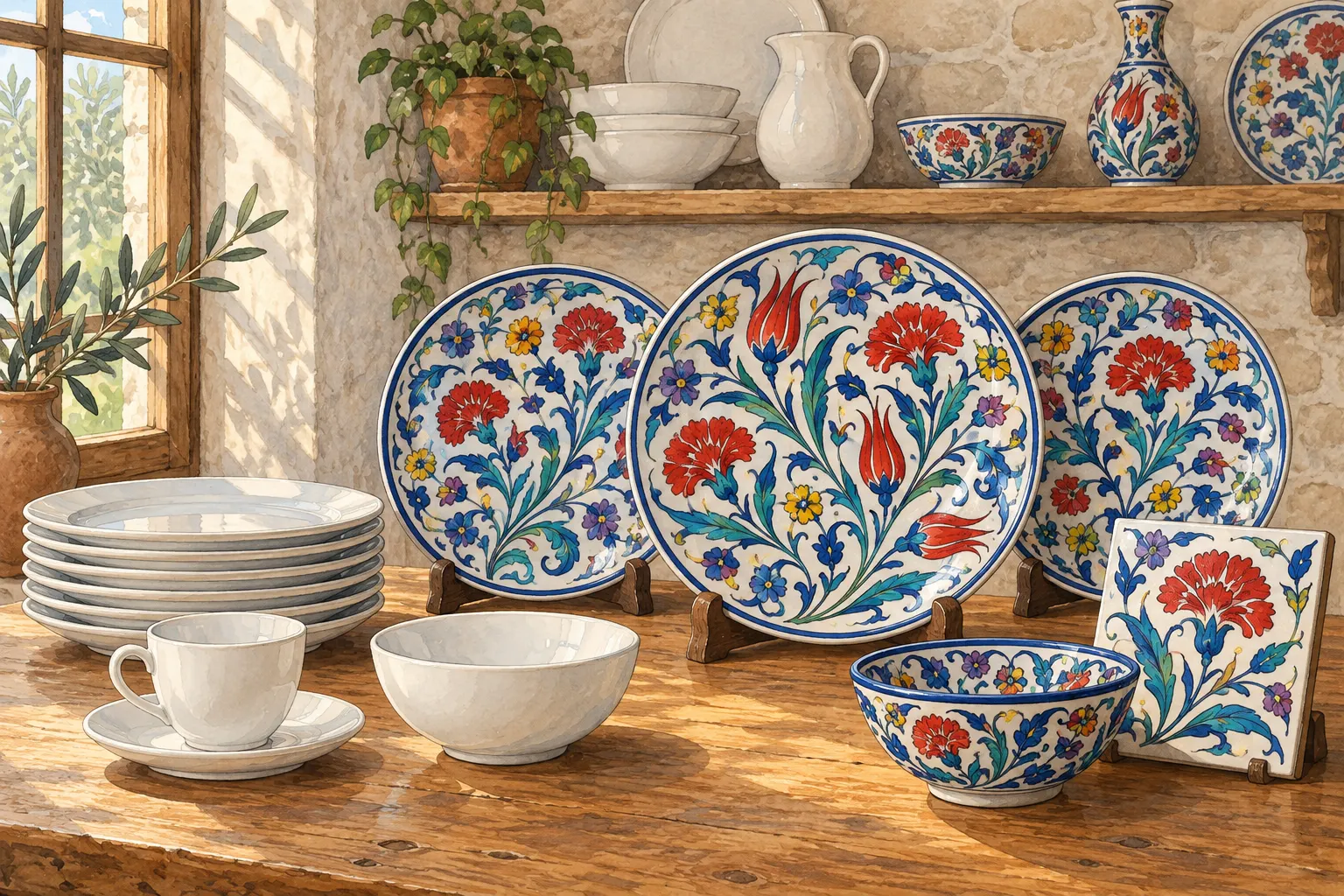
The word “Kütahya” on a plate means one of two things. Kütahya Porselen is a company that makes porcelain tableware; its website says its foundations were laid in 1970. Çini (pronounced “chee-nee”) is hand-decorated ceramics from the city of Kütahya, and its name is registered as an indication of origin with TürkPatent under No 77. Porcelain tableware is for eating from. Çini with lead in the glaze, as the register states, is only for decoration.
At a glance · checked 20.10.2026
Two crafts, one word: tableware or decoration?
- Kütahya Porselen is a company making tableware: home collections and a separate line for hotels and restaurants (HORECA).
- Kütahya çini is hand-decorated ceramics; the name “Kütahya Çinisi” is indication of origin No 77 in the TürkPatent register, in force since 25.04.2005.
- The mark underneath: a seal pressed into the clay beneath the glaze, with the maker’s name or brand; not a sticker.
- Lead in the glaze: çini containing lead is decoration, not tableware (register No 77).
Turn the plate over front and back
The pattern is visible from a distance, but the back tells you about its origin. The TürkPatent register describes both: the colors and pattern on the front and the seal in the clay on the back. Turn the plate over, tap the dots, then select what the seller says about the glaze below.
Çini plate · TürkPatent register No 77 · checked 20.10.2026
Look at both sides of the plate
Tap a dot on the plate or turn it over with the “Back” button. Below, select what the seller or maker says about the glaze.
Below: the front and back of the plate, an explanation of each mark, and three possible answers from the seller.
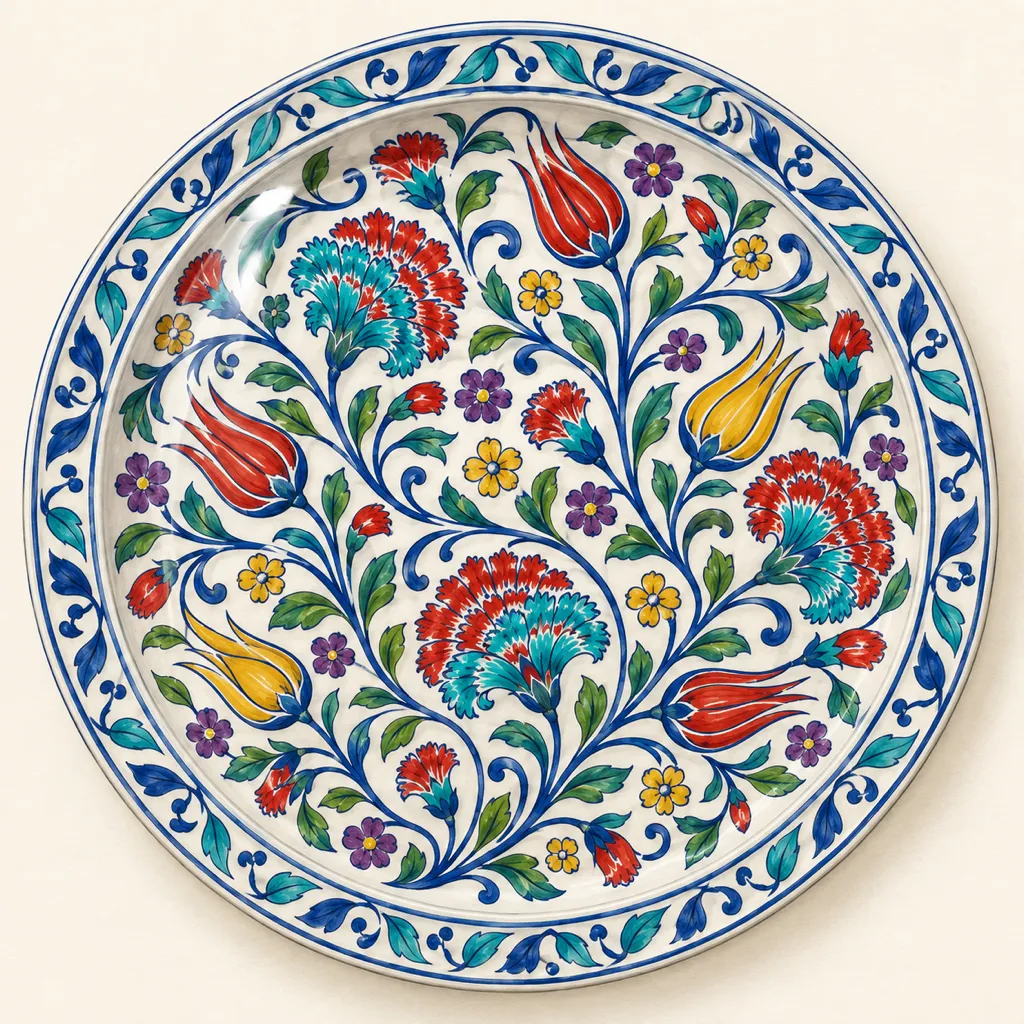
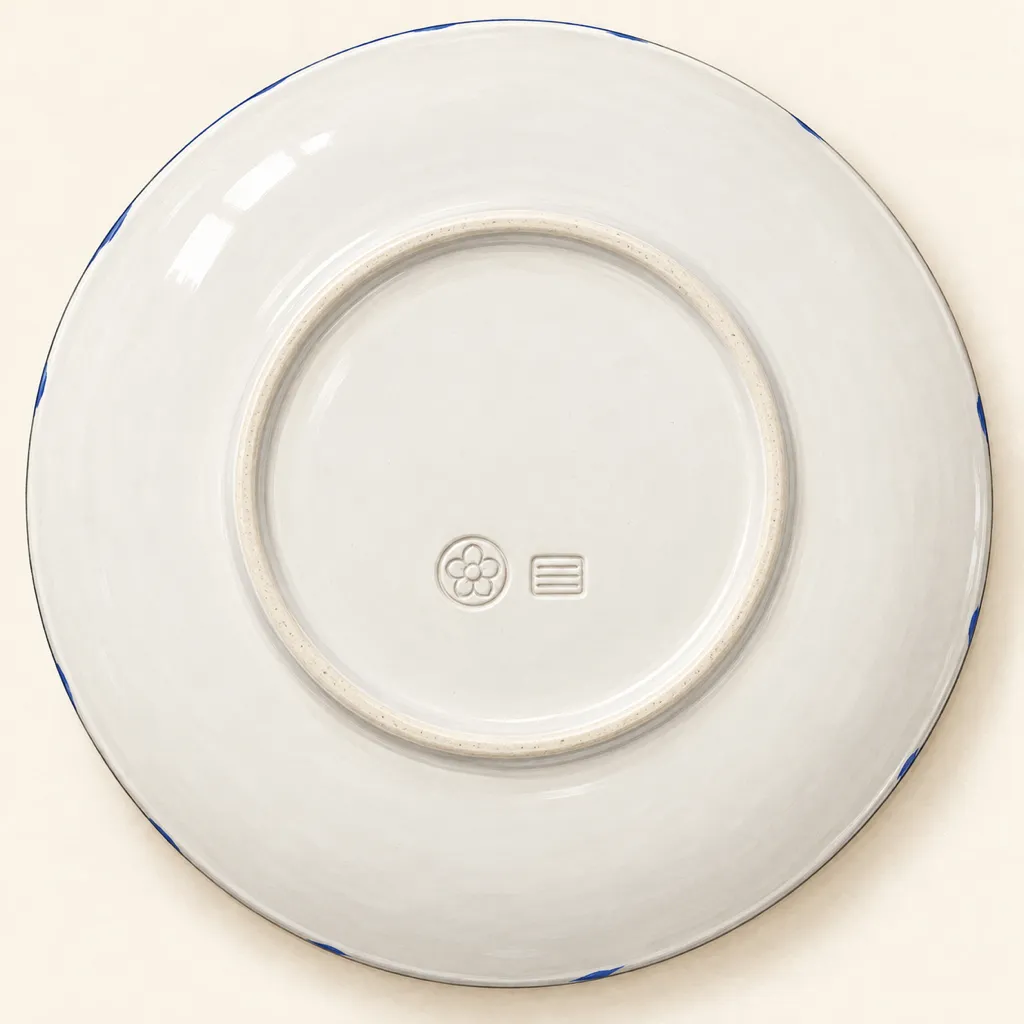
Illustration: both sides of a çini plate.
- 1FrontColors
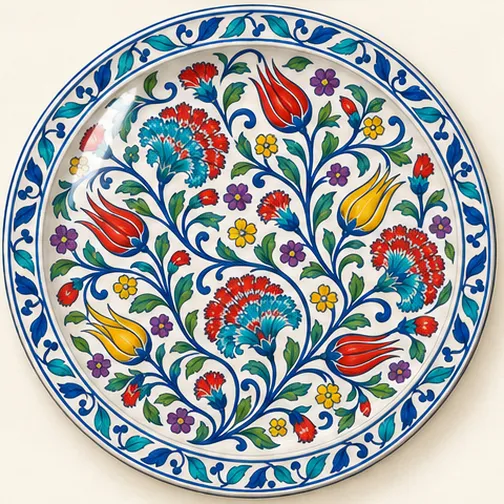
The register lists six pattern colors: red, green, turquoise, cobalt (blue), yellow, and purple.
- red
- green
- turquoise
- cobalt
- yellow
- purple
- 2FrontPattern
Carnations and tulips on spiraling branches with no beginning or end. The register describes this style as found only in çini from Kütahya.
- 3FrontGlaze
The pattern lies beneath transparent glaze. The register explains that this keeps the colors from fading over time. The shine and reflections on the plate come from this layer of glass.
- 1BackSeal in the clay
The origin mark must be pressed into or inserted into the damp clay during forming. After glazing, it therefore lies beneath the glaze and cannot be rubbed off.
- 2BackMaker’s name or brand
The maker’s name or brand must appear beside the mark. A sticker or a print on top of the glaze does not match this description in the register.
Table or wall?
Select what the seller or maker says about the glaze.
Decoration, not tableware.
This is what the register says about çini with lead in the glaze:
“Çini objects that contain lead (in the glaze) cannot be used as tableware. They may, however, be used as decorative and ornamental objects.”TürkPatent geographical sign register, No 77
Tableware, if you have it in writing.
Ask for a written declaration of compliance. In the EU, ceramic objects intended for contact with food must be accompanied by such a declaration up to and including retail sale under Directive 84/500/EEC (art. 2a, inserted by Directive 2005/31/EC). The provision refers to a manufacturer or seller in the EU, so a shop in Turkey is not guaranteed to provide one. Without a written statement, treat the plate as decoration.
Decoration until the seller states it clearly.
The register says çini glaze may be lead-based or boron-based, and you cannot tell which just by looking at the plate. Ask the seller:
Sır kurşunsuz mu?Is the glaze lead-free?Sofra eşyası olarak kullanılabilir mi?Can it be used as tableware?Yazılı bir beyan verebilir misiniz?Can you provide a written statement?Sources: TürkPatent geographical sign register, No 77 (checked 20.10.2026); Directive 84/500/EEC (art. 2a, inserted by Directive 2005/31/EC).
Two crafts, one word Kütahya Porselen and çini
Both come from the city of Kütahya, but they are different things: one is a company, the other a craft with a registered name of origin. For shops, delivery abroad and breakage, see Turkish Dinnerware Brands; for the city and its Tile Museum, see Kütahya: The City of Tiles & Thermal Springs.
Kütahya Porselen
- Type
- A manufacturer of porcelain tableware.
- Origins
- The company says on its website that its foundations were laid in 1970.
- Range
- Home collections (Porselen, Bone, Renkli & Nano, Özel Tasarımlar) and a separate line for hotels and restaurants (HORECA).
- Where to buy
- In the company’s online store and in shops. The sales outlets listed on its website include, among others, the “Bulvar” store and the “Avantaj” outlet (end-of-line items) in Kütahya.
- For eating
- Yes, it is tableware. Dishwasher and microwave information is in the description of each set: read it before buying.
Kütahya çini
- Type
- Hand-decorated ceramics from the city of Kütahya: white clay, a pattern beneath the glaze, two firings.
- Name
- “Kütahya Çinisi” is indication of origin No 77 in the TürkPatent register, in force since 25.04.2005.
- Registered by
- The artisans’ chamber: Kütahya Çiniciler, Fotoğrafçılar ve El Sanatları Esnaf Odası.
- Who uses the mark
- Makers in Kütahya province, together with the maker’s name or brand.
- For eating
- No, if the glaze contains lead: then it is decoration.
How a çini plate is made two firings
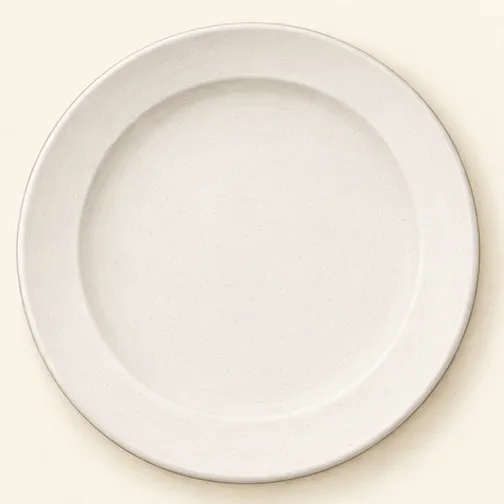
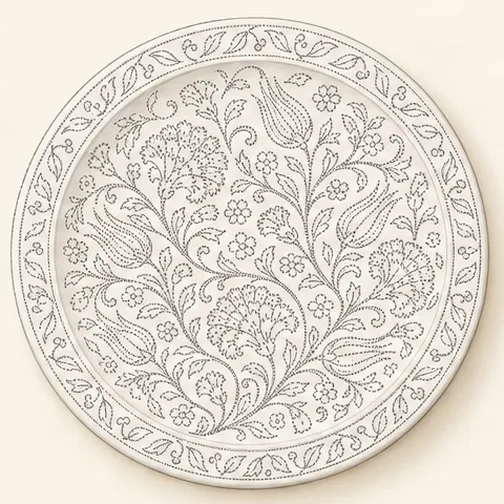
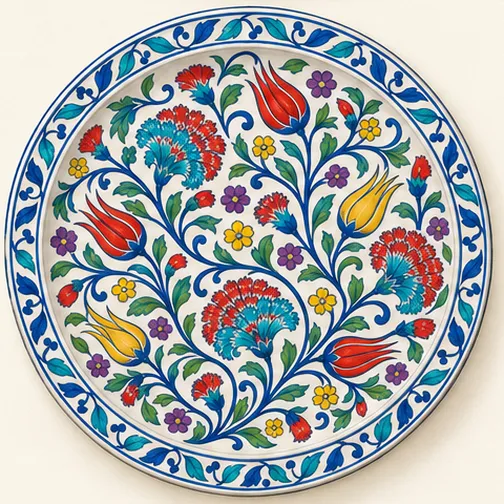
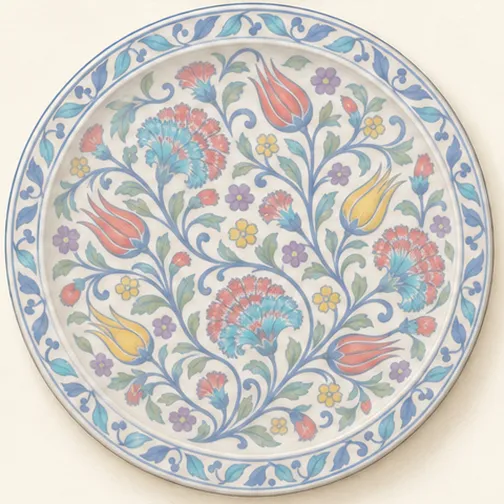
The register describes the sequence: clay, shaping, first firing, pattern, glaze, second firing. Move the slider: it shows the same plate in six steps, with temperatures and times from the register.
TürkPatent register No 77 · checked 20.10.2026
The same plate in six steps
Move the slider or tap a step’s bar. The bar’s height represents the kiln temperature, and its width the firing time.
Below are the six steps in order; the kiln is used in the first and last.
Step 1 of 6 · Clay and shaping
Clay, kaolin, quartz, feldspar, and limestone
The ingredients are ground in water. Flat tiles are dry-pressed, plates are shaped over plaster molds on a wheel, and tall forms are cast in plaster molds or shaped by hand on a wheel.
Step 2 of 6 · First firing
Bisque
The piece is fired in a chamber kiln. The result is a white, partially finished piece called bisque, still without a pattern.
1050–1100 °C · 12–20 h
Step 3 of 6 · Pattern
Paper, needle, and charcoal
The pattern is drawn on paper and pierced with a needle at close intervals. The paper is placed against the bisque and a bag of charcoal dust is passed over it, letting dust through the holes to leave dotted outlines.
Step 4 of 6 · Color
A brush and six colors
The outlines are traced with a brush and filled with vivid colors: red, green, turquoise, cobalt, yellow, and purple.
Step 5 of 6 · Glaze
A layer of glass
The pattern is covered with transparent or colored glaze. The register says it may be lead-based or boron-based, and its composition table lists lead oxide (PbO) at 30–40 %.
Step 6 of 6 · Second firing
Pattern under glass
The glaze forms a glassy layer, with the pattern beneath it. This is why, according to the register, the pattern and colors do not fade and çini lasts for centuries.
900–1000 °C · 8–12 h
Source: TürkPatent geographical sign register, No 77 (checked 20.10.2026). The ranges come from the description of the production method; elsewhere the register gives approximate values (around 1000 °C and 870–950 °C). Steps without kiln firing have no temperature, so their bars are low.
Colors and flowers six plus six
The register lists six pattern colors and, in its description of the craft, names six flowers: tulip, rose, carnation, crocus, lily, and hyacinth. Each appears on a tile below, with its Turkish name, as that is what you will hear from the seller.
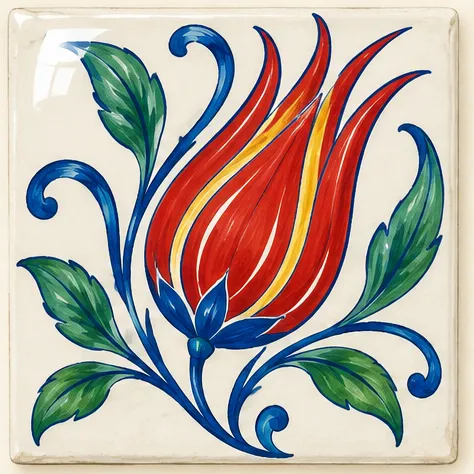
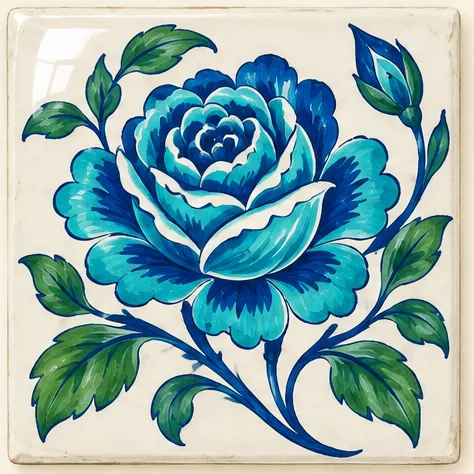
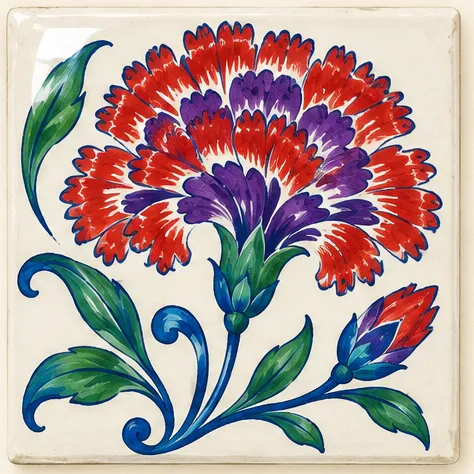
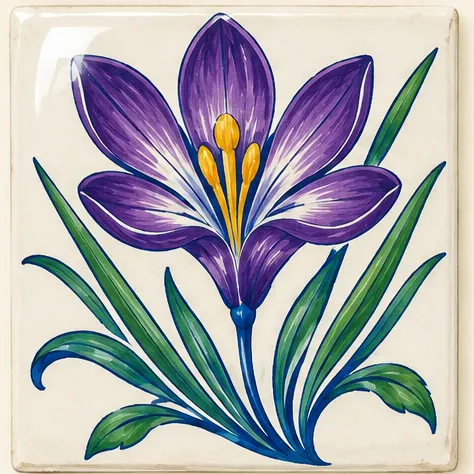
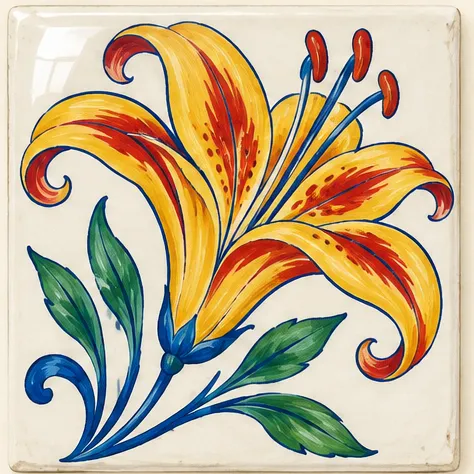
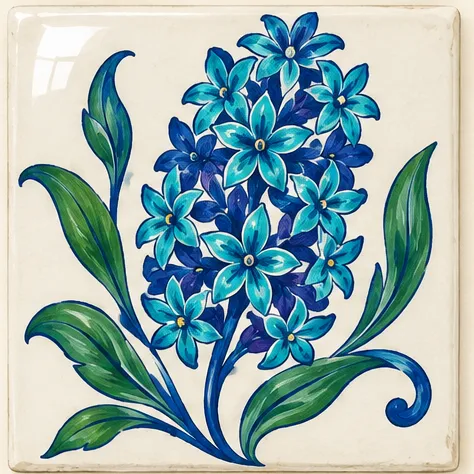
According to the register, the styles fall into four families:
Only in Kütahya
Carnations and tulips on spiraling branches, painted directly onto the form. The pattern has no beginning or end and, as the register states, is found only in Kütahya çini.
16th century
A broad family of anonymous patterns that have become part of Turkish culture. Workshops reproduce them faithfully.
New patterns
New compositions in the classical style, rather than repeating the same thing. The register considers this important for the development of the craft.
Own style
Styles developed by individual masters, from patterns with turquoise glaze to the use of ebru art in çini.
The mark underneath a seal beneath the glaze
“Kütahya Çinisi” is a mark of origin, not a quality rating: it says that the piece was made in Kütahya province. The register describes what it should look like.
- A seal in the clay. The mark is pressed into or inserted into the damp clay during forming. After glazing, it therefore lies beneath the glaze and cannot be rubbed off.
- Name or brand. The maker’s name or brand appears beside the mark; the mark alone is not enough.
- Not a sticker. A sticker or a print on top of the glaze is not the mark described in the register.
Who checks this? The register provides for a committee with representatives from the governor’s directorate of culture and tourism, the university’s faculty of fine arts, the municipality, the chamber of commerce and industry, and the çiniciler chamber. According to the register, it inspects workshops in the province once a month and looks for counterfeits nationwide every three months.
What the mark does and does not tell you
The mark tells you where the piece comes from. Whether it can be used for eating depends on the glaze: see the next section.
Can you eat from a çini plate? Glaze and lead
The short answer: no, if the glaze contains lead. That is what register No 77 says.
TürkPatent geographical sign register, No 77
“Çini objects that contain lead (in the glaze) cannot be used as tableware. They may, however, be used as decorative and ornamental objects.”
The same register says the glaze may be lead-based or boron-based, and its glaze composition table lists lead oxide (PbO) at 30–40 %. You cannot tell just by looking at the plate.
In the EU, ceramic objects intended for contact with food must be accompanied by a written declaration from a manufacturer or seller in the EU up to and including retail sale under Directive 84/500/EEC (art. 2a, inserted by Directive 2005/31/EC). The manufacturer or importer must have test documentation showing that the piece meets the limits for lead and cadmium migration. A shop in Turkey is not necessarily a seller in the EU, so you need to ask for the document.
What to do in the shop:
- Ask about the glaze. Sır kurşunsuz mu?Is the glaze lead-free?
- Ask about its intended use. Sofra eşyası olarak kullanılabilir mi?Can it be used as tableware?
- Ask for a written statement. Yazılı bir beyan verebilir misiniz?Can you provide a written statement? Without an answer, treat the plate as decoration.
Questions briefly
Is Kütahya Porselen the same as çini?
No. Kütahya Porselen is a company that makes porcelain tableware. Çini is a craft from the city of Kütahya with a registered name of origin (No 77).
How can you tell çini comes from Kütahya?
Look for a seal pressed into the clay beneath the glaze, with the maker’s name or brand beside it. A sticker on the glaze is not that mark. The mark tells you only about origin.
Can you eat from a çini plate?
No, if the glaze contains lead: the register calls such objects decorative. If the seller says the glaze is lead-free and the plate is for food, ask for a written statement.
Can Kütahya Porselen tableware go in the dishwasher?
It depends on the set: dishwasher and microwave information is in the description of each set. Read it before buying.
What does çini mean?
The register explains that older documents call this art “kaşi”, and that the word çini, “Chinese work”, entered Turkish literature in the late 18th and early 19th centuries.
Sources
- TürkPatent geographical sign register, No 77, “Kütahya Çinisi” (amendment announced in bulletin No 47 of 15.02.2019) — TürkPatent, checked 20.10.2026
- Company history — Kütahya Porselen, checked 20.10.2026
- Home page and product lines — Kütahya Porselen, checked 20.10.2026
- Sales outlets — Kütahya Porselen, checked 20.10.2026
- Commission Directive 2005/31/EC of 29 April 2005 amending Directive 84/500/EEC (art. 2a) — legislation.gov.uk, checked 20.10.2026