Blue Flag Beaches in Turkey: What the Flag Means and Where
What a Blue Flag on a Turkish beach asks of the operator, what it leaves out, and how many beaches fly it in 2026, province by province.
Table of Contents
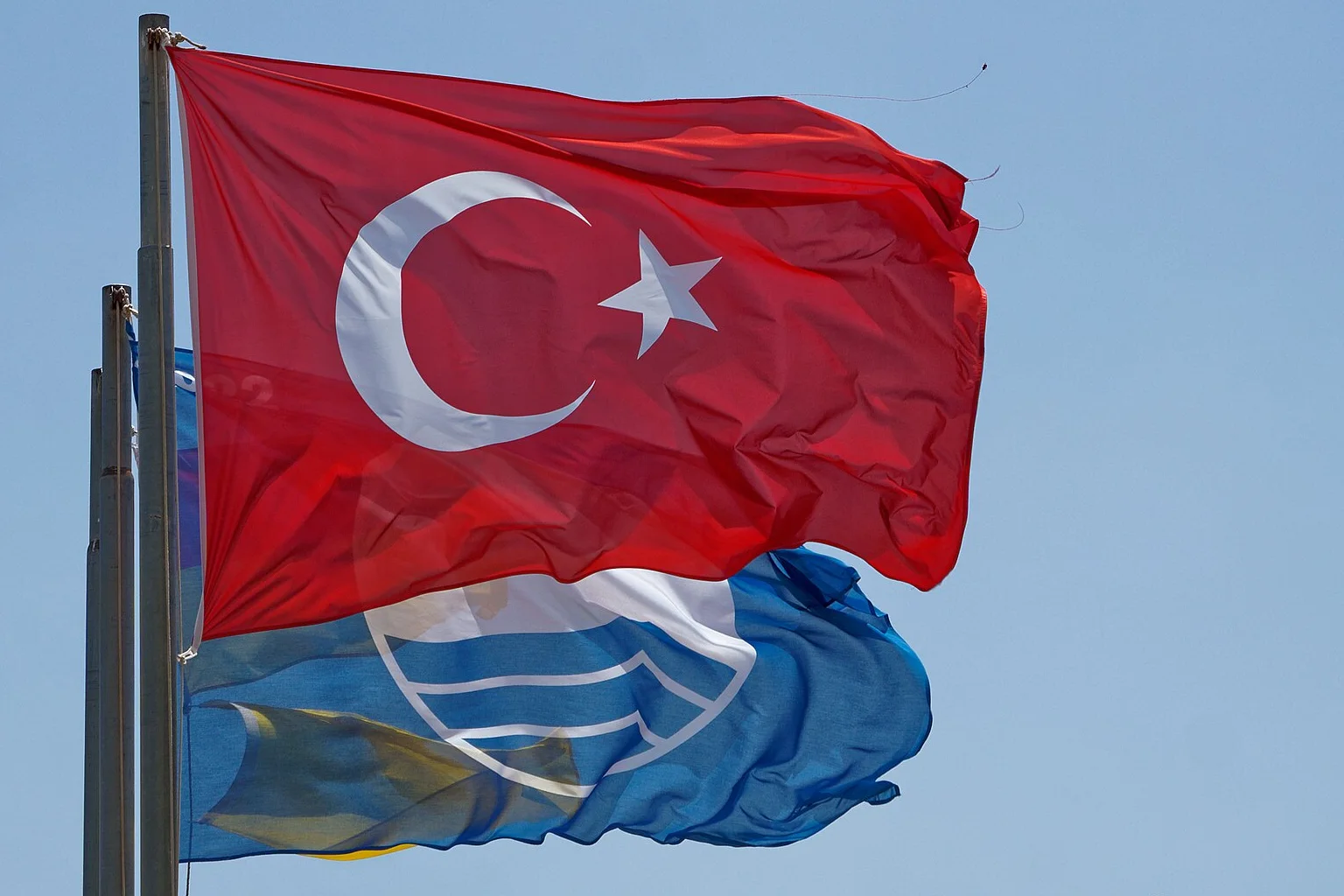
The Blue Flag (Mavi Bayrak) is a yearly award for a beach (plaj) that meets a fixed list of rules. The Foundation for Environmental Education (FEE) runs it worldwide and TÜRÇEV (Türkiye Çevre Eğitim Vakfı, the Turkish Environmental Education Foundation) runs it in Türkiye. A flag on the pole says the beach is in the programme this season and has to keep meeting the criteria until the season ends; it is not a promise about the sea on a given day.
The short version · checked 27.10.2026
A Blue Flag beach meets a list of rules, all season.
- 33 criteria. TÜRÇEV’s list for beaches has 33; 29 are marked mandatory, 3 are guidance (a beach-management committee, sustainable transport, drinking water) and one has no mark.
- The board on the sand. It has to show the water results, a map, the conduct rules, and the lifeguard and first-aid hours.
- 580 beaches in 2026. TÜRÇEV’s 2026 list has 580 beaches in 22 provinces; 232 of them are in Antalya.
- What it leaves out. It does not rank beaches; showers and changing cabins are encouraged, not required; and the flag is not a promise about the sea on a given day.
- It can come down. A flag can be lowered for up to 10 days or cancelled for the season, and the board has to say so.
Tool · checked 27.10.2026
The beach entrance
Tap a part of a Blue Flag beach entrance: the flag, the board, the tower, the toilets, the gate. Each part says what TÜRÇEV’s criteria ask for. Turn the flag down or cancel it, change the pennant on the tower, and copy the arrival list with the Turkish lines to ask staff.
- The Blue Flag on the pole
The flag flies through the beach’s swimming season. It may fly 24 hours a day, with signs that show when the lifeguards and toilets are open, or only in the hours when the beach meets every criterion.
Look for: a flag that is up. If it is down or missing, the board has to give the reason.
Mavi Bayrak = Blue Flag
- Flying The beach is in the programme this season. The notice strip on the board is empty.
- Down for now Lowered after damage or an emergency, or for a fault not fixed the same day: up to 10 days to put it right, and the board gives the reason.
- Cancelled A serious fault cancels the flag for the rest of the season. The beach is listed as İPTAL (cancelled) on mavibayrak.org.tr and blueflag.global, and the board shows it.
- Programme and nature panel
The board explains the Blue Flag programme and tells visitors about the local ecosystem, sensitive natural areas and cultural sites. It also lists the environmental activities of the season; the criteria ask for at least five.
Look for: the programme text and the list of activities.
pano = board
- Water results
The bathing-water results are shown on the board. The beach has to stay inside the limits for two bacteria (chapter 04).
Look for: how recent the results are.
yüzme suyu = bathing water
- Map of the beach
A map of the beach’s equipment and facilities is on the board. TÜRÇEV’s guidance book wants the toilets, the lifeguard tower and the swimming area on it.
Look for: the toilets, the tower and the swimming area.
harita = map
- Conduct rules
The beach’s conduct rules are on the board, and the laws that govern the beach are kept where visitors can ask to see them. The rules cover pets, camping, fires, vehicles and waste.
Look for: the rule on dogs. They may enter only the park or walking area behind the beach, and only where the operator and the law allow.
plaj kuralları = beach rules
- Lifeguard and first-aid hours
The hours when lifeguards and first aid are available have to be on the board and at the lifeguard tower, next to an explanation of the tower’s flags.
Look for: the hours, and whether they cover the time you are there.
cankurtaran = lifeguard · ilk yardım = first aid
- Tower, pennant and border flags
TÜRÇEV’s standard tower is wooden, with a 3 m pole for the pennant, a flag-information sign, an hours sign and first-aid signs. Border flags in the shallows mark the swimming area.
Look for: the pennant that is flying, and its key on the tower’s sign.
bayrak = flag · cankurtaran kulesi = lifeguard tower
- Red and yellow TÜRÇEV’s chart: Cankurtaran görevde. Denize girmek GÜVENLİ. “Lifeguard is on duty. Swimming is SAFE.”
- Red and yellow, then yellow TÜRÇEV’s chart: Deniz ve hava şartları RİSKLİ. “Sea and weather conditions are RISKY.” The border flags are put up the same way.
- Red TÜRÇEV’s chart: Denize girmek TEHLİKELİ ve YASAKTIR. “Swimming is DANGEROUS and FORBIDDEN.” The border flags are removed.
- Toilets, washbasins and bins
Enough toilets and washbasins, with soap and a towel or dryer, kept clean and connected to the waste-water system. Enough bins, emptied regularly, and a way to sort recyclables.
Look for: signs to the toilets. Showers (duş) and changing cabins (soyunma kabini) are encouraged, not required.
tuvalet = toilet
- Entrance and fees
TÜRÇEV’s list says the public has the right of free access. Its 2025 guidance book adds that visitors have to be able to enter without being a hotel or beach-club customer, and that a beach rented and run by a private business may charge a fee for its services, not more than 30 dollars.
Look for: how to enter without being a guest, and whether a fee is posted.
halk plajı = public beach (halk = the public)
Arrival list
- Is the Blue Flag up? If it is down, ask why.Mavi Bayrak neden indirildi?Why was the Blue Flag taken down?
- Are the environmental activities of the season listed?Çevre etkinlikleri ne zaman?When are the environmental activities?
- Where are the water results, and how recent are they?Yüzme suyu analiz sonuçları nerede?Where are the bathing-water results?
- Where are the first-aid point and the tower on the map?İlk yardım noktası nerede?Where is the first-aid point?
- What is the rule on dogs?Plaja köpek getirebilir miyim?Can I bring a dog to the beach?
- When is the lifeguard on duty?Cankurtaran hangi saatlerde görevde?At what hours is the lifeguard on duty?
- Which pennant is flying, and what does it mean?Kuledeki bayrak ne anlama geliyor?What does the flag on the tower mean?
- Where are the toilets and the showers?Tuvalet ve duş nerede?Where are the toilet and the shower?
- Is entry free?Plaja giriş ücretli mi?Is entry to the beach paid?
Who stands behind the flag: a foundation, a national operator, the beach
FEE owns the programme, TÜRÇEV runs it in Türkiye, and the authority responsible for each beach applies and has to keep the criteria all season. The award is voluntary and given per beach and per season; marinas, tourism boats and individual yachts have their own criteria.
- FEE writes the criteriaA non-profit international organisation. The programme began in France in 1985, reached the rest of Europe in 1987 and countries outside Europe in 2001. Its international criteria are minimums: a national operator may set stricter ones.
- TÜRÇEV runs it in TürkiyeThe foundation has coordinated the programme since 1993. A national jury decides; its members come from four ministries (culture and tourism, environment, health, agriculture and forestry) and from bodies such as the municipalities’ union and the travel-agency association.
- The beach appliesThe applicant is the authority responsible for the beach: a municipality (belediye), a private hotel, a national park or a private beach operator. The municipality has to approve and take responsibility. TÜRÇEV says FEE is satisfied on the day the flag is raised, and from then on the owner or operator carries the responsibility for meeting the criteria all season.
- Health bodies test the waterThe Health Ministry’s provincial directorate takes the samples and its public-health laboratory tests them; the Ministry of Culture and Tourism pays for the analyses. The results go on the board and, in the state’s bathing-water system, on yuzme.saglik.gov.tr.
FEE adds one line to every list of criteria: meeting the Blue Flag requirements “does not replace or constitute confirmation of compliance with all applicable legal requirements”.
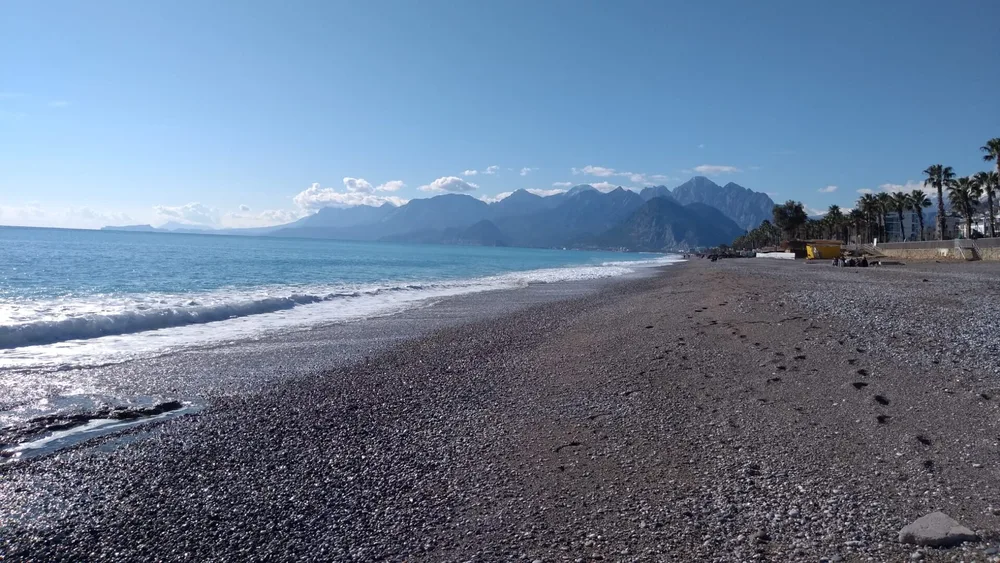
One season at a time: when the flag flies and when it comes down
The flag flies for the beach’s swimming season (sezon), the dates on which its water is sampled. It can come down while the season runs. TÜRÇEV’s 2025 guidance book sorts faults into three levels.
- A small fault, fixed the same dayThe flag stays and the inspection report records the fault.
- Not fixed that day, or two or three small faultsThe beach has 10 days to meet every criterion. The flag is down until all the problems are fixed, and the national and international websites say so.
- A serious faultThe flag is cancelled at once for the rest of the season. The beach is listed as İPTAL (cancelled) on mavibayrak.org.tr and blueflag.global, and the board has to show that the flag was withdrawn.
A beach also lowers the flag by itself after storm damage, an oil spill or another emergency, and gives the reason on the board. If an accident such as a sewage leak pollutes the water, the book says the public has to be told and the beach closed to swimming.
Since 2012 TÜRÇEV has judged the award on the water results of the past four years; FEE asks for the results of the previous four seasons with every application.
“Getting a Blue Flag is hard; losing it is very easy.”
TÜRÇEV’s chairman, at the national award ceremony of 22.05.2026
The 33 criteria: four groups, mostly mandatory
TÜRÇEV’s list for beaches has 33 criteria in four groups. 29 are marked z (zorunlu, mandatory), three k (guidance) and criterion 24 has no mark. FEE’s English overview groups the same ground in six areas: education and information, resource management, biodiversity and sensitive areas, water quality and waste, accessibility and visitor facilities, safety and services.
Pick a group
A tick marks a mandatory criterion; a dot marks guidance or no mark.
- 1 The Blue Flag programme and other FEE eco-label information are shown on the beach.
- 2 At least five environmental awareness activities in the season.
- 3 The bathing-water results are shown on the beach.
- 4 The board tells users about the local ecosystem, sensitive natural areas and cultural sites.
- 5 A map of the beach’s equipment and facilities is on the board.
- 6 The conduct rules are on the board; the laws on beach use can be seen on request.
You can see this on the board at the entrance.
- 7 Sampling method and calendar follow the rules.
- 8 The analyses follow the standards.
- 9 Industrial and sewage waste may not affect the beach area.
- 10 Microbiological results stay inside the limits.
- 11 Physical and chemical results stay inside the limits.
You can see the results on the board; chapter 04 has the limits.
- 12 A beach-management committee for the locality (guidance).
- 13–14 The beach follows the laws on land and coastal use and the rules for sensitive areas.
- 15–18 The beach is kept clean; enough bins, emptied regularly; separate collection of recyclables.
- 19–21 Enough toilets and washbasins, kept clean, connected to the waste-water system.
- 22–23 No unauthorised camping, driving or dumping; dogs and other pets strictly controlled.
- 24 Buildings and equipment kept in order (no mark).
- 25 A programme to watch wildlife where sensitive marine or freshwater areas lie nearby.
- 26 Public transport and bicycles encouraged (guidance).
You can see bins, toilets, signs about dogs and tidy equipment.
- 27 Measures for public safety.
- 28 First-aid supplies on the beach.
- 29 Emergency plans for pollution accidents and risks.
- 30 Measures against accidents between swimmers, boats and other uses.
- 31 Measures for users’ safety, and free access for the public.
- 32 Drinking water on the beach (guidance).
- 33 At least one Blue Flag beach in each locality with a toilet and an access ramp for disabled visitors.
You can see the tower, the first-aid sign and the border flags.
TÜRÇEV · checked 27.10.2026 · the 33 criteria · guidance book 2025 (PDF)
The water: how it is sampled and what the limits are
A Blue Flag beach has to stay inside two bacteria limits, and its results have to be on the board. The limits are measured in colony-forming units (cfu), the bacteria that grow into a visible colony in the laboratory, per 100 ml of water.
250
cfu per 100 ml on the coast; 500 in lakes.
100
cfu per 100 ml on the coast; 200 in lakes.
At least 5 a year
No more than 30 days apart; the first in the 30 days before the season.
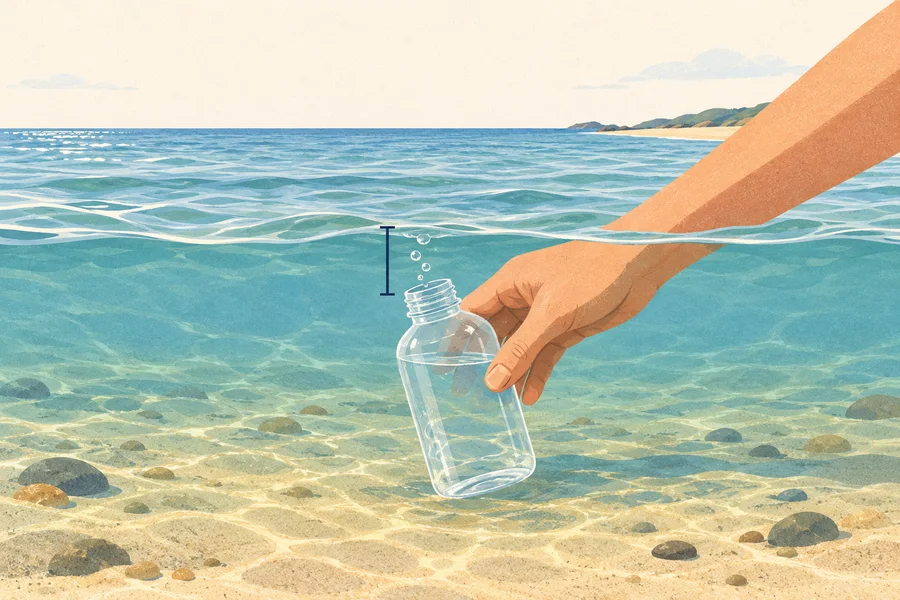
30 cm
below the surface, except for samples of mineral oil, which are taken at the surface.
The limits are judged on the 95th percentile: roughly, 95 results in 100 have to stay under the limit, each bacterium on its own.
There is at least one sampling point where most people swim, and extra points near streams, drains and other possible sources of pollution. The criteria ask for a trained, independent person to take the samples and an accredited laboratory to analyse them; in Türkiye that is the provincial health directorate and its public-health laboratory. The book notes that the Health Ministry samples every 15 days.
The results are on the board, on the beach’s own page at mavibayrak.org.tr and in the Health Ministry’s bathing-water system, yuzme.saglik.gov.tr. Check the date next to each result.
Lifeguards and first aid: the people, the kit and the flags on the tower
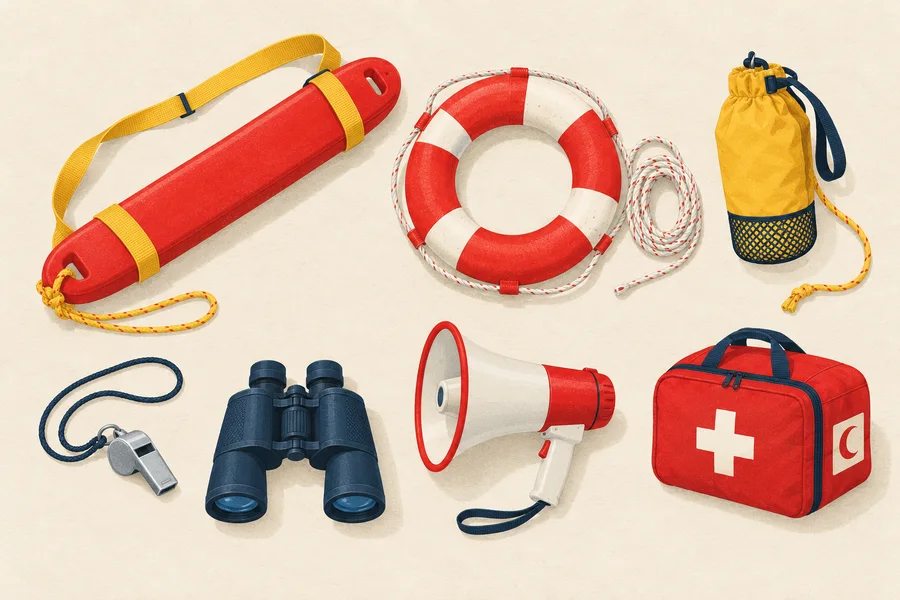
A Blue Flag beach has to provide first aid and safety measures, and a busy one needs enough lifeguards (cankurtaran). TÜRÇEV’s book and FEE’s notes word the lifeguard rule differently, as the facts below show.
- Certificate
- A silver lifeguard certificate (gümüş bröve), checked before hiring, with a copy on the board.
- Duty
- Lifeguards do only lifeguard work: no water sports, rentals, services or cleaning.
- Uniform
- Red shorts and a yellow shirt marked cankurtaran.
- Numbers
- TÜRÇEV’s book: where no risk assessment was made, two lifeguards for every 200 m, more as use grows. FEE’s notes call the 200 m figure a recommendation.
- Where lifeguards are few
- FEE’s notes: at a beach with low hazard and few users (under 50 a day on average over four weeks of the high season) public rescue equipment can replace lifeguards, unless national law or the risk assessment says otherwise.
- Antalya
- TÜRÇEV’s emergency page quotes a circular of the Antalya provincial drowning-prevention commission: a lifeguard is compulsory at all beaches in the province.
- Hours
- The hours of lifeguard and first-aid service are on the board and at the tower.
- Kit at the station
- Tower, ring buoy on a line of at least 10 m, rescue tube, throw rope of at least 15 m, whistle, binoculars, megaphone, floating stretcher and a radio for each lifeguard.
First aid (ilk yardım, the first treatment given on the spot before medical care) can come four ways: a lifeguard with first-aid supplies, a permanent first-aid station with trained staff, supplies at businesses on the beach, or supplies the public can use directly. For emergency care after that, see Healthcare in Turkey.
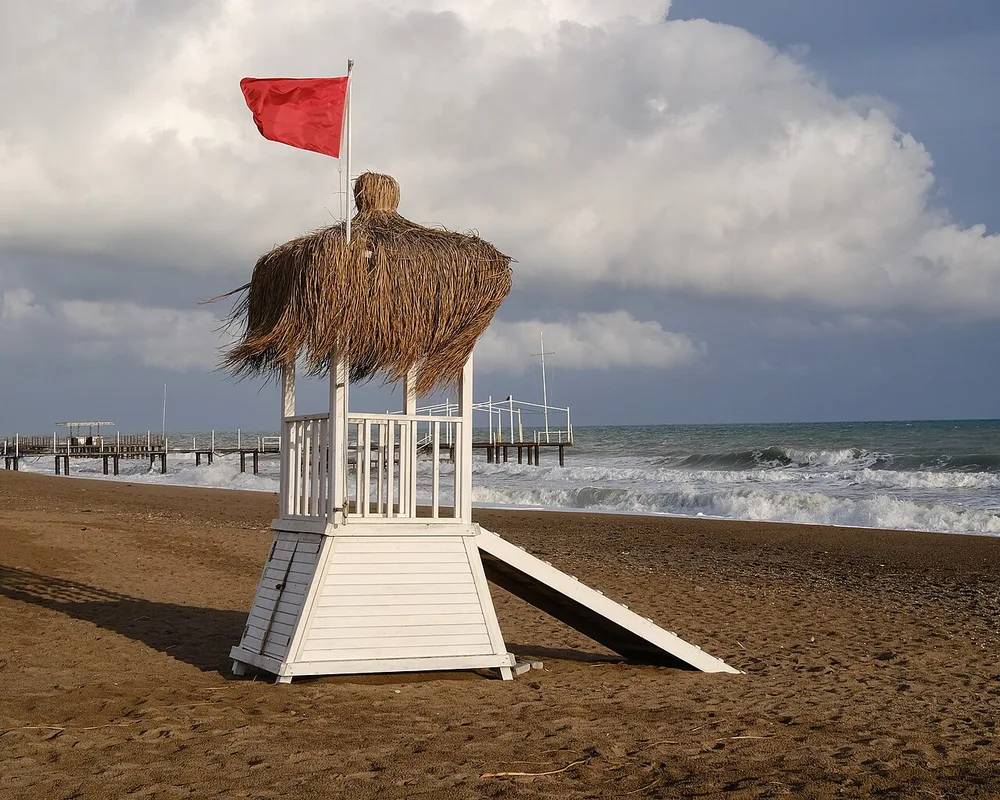
The pennant on the tower follows TÜRÇEV’s flag chart. Its words are quoted here as the chart prints them. Border flags stand 2 m apart, 3 m from the shoreline and 50–200 m from the tower; black-and-white chequered flags mark the corridor for surf and water sports, where swimming is forbidden.
Red and yellow
Chart: “Cankurtaran görevde. Denize girmek GÜVENLİ.” = “Lifeguard is on duty. Swimming is SAFE.”
Red and yellow, then yellow
Chart: “Deniz ve hava şartları RİSKLİ.” = “Sea and weather conditions are RISKY.” Border flags the same way.
Red
Chart: “Denize girmek TEHLİKELİ ve YASAKTIR.” = “Swimming is DANGEROUS and FORBIDDEN.” Border flags are removed.
Who may enter, and what the flag leaves out
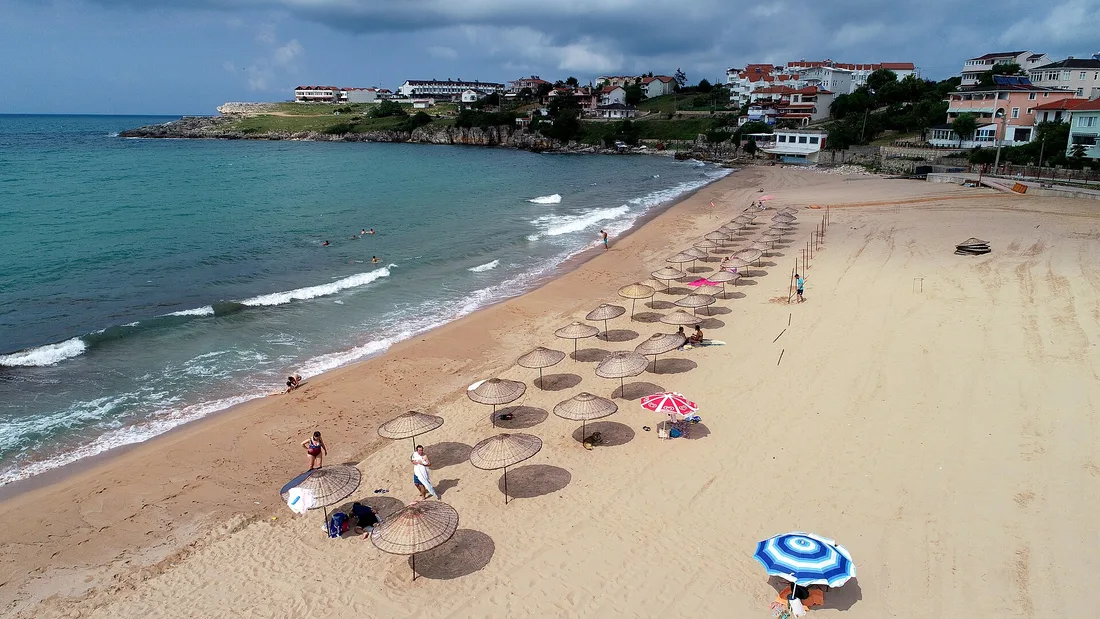
The public has to be able to enter a Blue Flag beach without being a guest of a hotel or beach club. A beach rented and run by a private business may charge for its services, up to 30 dollars in TÜRÇEV’s 2025 book. The flag does not rank beaches and promises nothing about the sea on a given day.
| Topic | What TÜRÇEV’s text says | Status |
|---|---|---|
| Toilets and washbasins | Enough for the number of visitors, with soap and a towel or dryer, kept clean, connected to the waste-water system. | Required (19–21) |
| Showers, changing cabins, baby-changing place | Showers (duş) and changing cabins (soyunma kabini) are “encouraged”, with a baby-changing place. | Encouraged (19) |
| Drinking water | A tap, hose or bottled water on the beach. | Guidance (32) |
| Dogs and other pets | Only in the park or walking area behind the beach, and only where the operator and the law allow; guide dogs for blind visitors are excepted. | Required control (23) |
| Ramp and toilet for disabled visitors (engelli rampası) | At least one Blue Flag beach in each locality (belde) has them; every beach is strongly advised to. | Required at one beach per locality (33) |
| Access | The list: the public has the right of free access. The 2025 book: entry without being a hotel or club customer; a fee for services at a privately run beach of not more than 30 dollars. | Required (31) |
The programme is voluntary and each beach applies. A beach that did not apply has no flag, and a missing flag says nothing about its water or its safety. For dogs on a trip to Türkiye, see Travelling with Pets to Turkey.
Where the flags are: TÜRÇEV’s counts, by province
2026 · TÜRÇEV
580 beaches in 22 provinces.
The ceremony news of 22.05.2026 adds 30 marinas, 18 tourism boats and 26 individual yachts. TÜRÇEV says Türkiye stays the third country in the world by number of Blue Flag beaches. Counts checked 27.10.2026.
Antalya (232) and Muğla (113) hold more than half of the 580. For their coasts see Beaches in Antalya, Lara Beach and Marmaris Beaches. Istanbul has three rows: Karaburun and Yeniköy in Arnavutköy and Kumluk in Silivri (Beaches in Istanbul). Van has one, Tuşba Belediyesi Molla Kasım Halk Plajı on Lake Van, where the lake limits of chapter 04 apply.
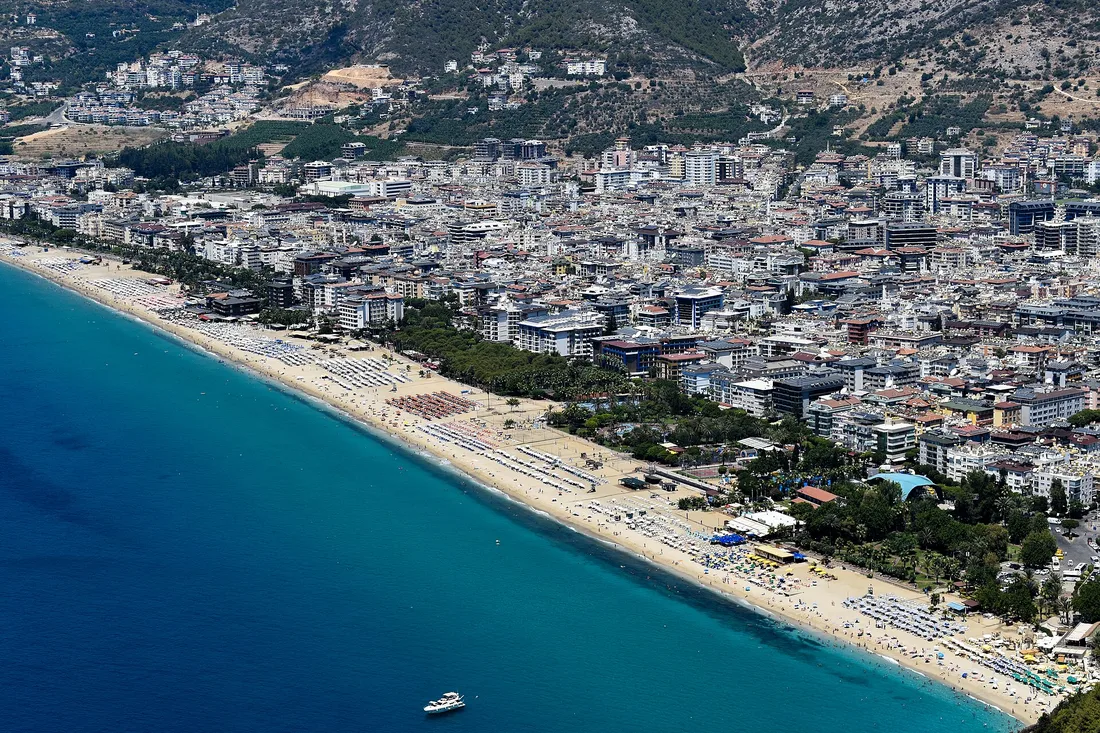
To check one beach, look it up by name in the 2026 list on TÜRÇEV’s numbers page and open its page there. Both Kleopatra public beaches in Alanya are on the list.
Quick answers to what readers ask
Does every Blue Flag beach have a lifeguard?
Not by one rule for every beach. TÜRÇEV’s book requires enough lifeguards at busy beaches, and FEE’s notes let public rescue equipment replace them at low-hazard beaches with few users, unless law or the risk assessment says otherwise. In Antalya province a circular makes a lifeguard compulsory at all beaches. The hours are on the board.
What does it mean if a beach has no Blue Flag?
The programme is voluntary, so a beach that did not apply has no flag. A missing flag says nothing about its water or its safety.
Is a Blue Flag beach free?
TÜRÇEV’s list says the public has the right of free access. Its 2025 book lets a beach rented and run by a private business charge a fee for its services, not more than 30 dollars, and says visitors need not be hotel or club customers.
Can I bring a dog?
Only to the park or walking area behind the beach, and only where the operator and the law allow. Guide dogs for blind visitors are excepted.
Are showers and changing cabins always there?
No. TÜRÇEV’s book encourages them, with a baby-changing place, but requires only toilets, washbasins, soap and a towel or dryer.
Is there a ramp at every Blue Flag beach?
Not required at every beach: at least one Blue Flag beach in each locality has a toilet and a ramp for disabled visitors, and every beach is strongly advised to. Where the ground allows, TÜRÇEV also recommends a chair that works on sand and in the sea, a pier lift or a ramp into the sea, a reserved sunbed (şezlong) and umbrella (şemsiye), parking and signs.
Where do I find the water results?
On the board at the beach, on the beach’s own page at mavibayrak.org.tr and at yuzme.saglik.gov.tr.
What if the flag is down?
Ask why. A flag lowered after damage or an emergency needs its reason on the board; a fault not fixed the same day gives the beach 10 days; a serious fault cancels the flag for the season. Chapter 02 has the three levels.
Does the flag fly all year?
It flies through the beach’s swimming season, the dates on which its water is sampled, either 24 hours a day or only in the hours when the beach meets every criterion.
Sources and limits
This page does not rank beaches or say whether a given beach holds the flag today. For that, use TÜRÇEV’s list and the beach’s own page, and read the board on arrival.
Show the pages checked
- Plajlar İçin Mavi Bayrak Kriterleri — TÜRÇEV, checked 27.10.2026
- Plajlar için Mavi Bayrak Kriterleri Kılavuz Notlar Kitabı (2025) — TÜRÇEV, checked 27.10.2026
- Sayılar, with the 2026 Yılı Ödül Alan Plajlar Listesi — TÜRÇEV, checked 27.10.2026
- 2026 Ulusal Mavi Bayrak Ödül Töreni Foça’da Gerçekleştirildi (22.05.2026) — TÜRÇEV, checked 27.10.2026
- Genel Bilgiler — TÜRÇEV, checked 27.10.2026
- Yüzme Suyu Analizleri — TÜRÇEV, checked 27.10.2026
- Plajlar İçin Mavi Bayrak Panosu — TÜRÇEV, checked 27.10.2026
- Plajlar İçin Standart Cankurtaran Kulesi — TÜRÇEV, checked 27.10.2026
- Plajlarda Bulundurulması Gerekenler — TÜRÇEV, checked 27.10.2026
- Plajlarda Acil Durum — TÜRÇEV, checked 27.10.2026
- Engelli Olanakları — TÜRÇEV, checked 27.10.2026
- Blue Flag — FEE, checked 27.10.2026
- Criteria — FEE, checked 27.10.2026
- Blue Flag Beach Criteria and Explanatory Notes (2024, PDF) — FEE, checked 27.10.2026
- ÇSBS Yüzme Suyu Takip Sistemi — Sağlık Bakanlığı, checked 27.10.2026
- Güncel Türkçe Sözlük: plaj, cankurtaran, ilk yardım — TDK, checked 27.10.2026
Photos are from Wikimedia Commons, each with its author, date, licence and file page in the caption. The picture of the sample bottle, the picture of the lifeguard kit and the beach-entrance drawing were made for this page; the flags in them follow TÜRÇEV’s charts and show no real beach.