Enderun: Palace Education, Chambers and Routes into Ottoman Service
Table of Contents
A palace page might spend part of the day with a book and another part serving at the sultan’s table. At Enderun, these were connected parts of an education. Languages, religion, the arts and physical training sat alongside the daily work of the Ottoman court.
The Enderun School, or Enderûn Mektebi, helped prepare men for palace, military and administrative service. Its best-known home was Topkapı Palace’s inner courtyard in Istanbul. To understand it, follow the work of its chambers and the lives of its people: a simple ladder of seven school grades misses how much the institution changed.
Where Enderun fitted into the palace
Enderun means the inner part or interior. It described a court institution as well as an educational setting, so picturing a freestanding school building is misleading. Dormitories, places of worship, service rooms and the sultan’s apartments belonged to a closely supervised palace world.
At Topkapı, the Gate of Felicity leads into the third courtyard, also called the Enderun Court. The Audience Chamber and rooms associated with the treasury and close royal service help explain why education here was so closely tied to government. The palace’s official museum guide distinguishes this inner institution from the outer service area, the Imperial Council and the Harem. These were connected parts of court life, with different functions.
Enderun also differed from a medrese, a school associated especially with religious scholarship and the learned professions. Religion mattered deeply in both, but Enderun’s defining feature was the combination of learning and service inside the ruler’s household. It was one route into Ottoman power, rather than the training place of every official or every educated person.
One institution, several stages of formation
There is no single uncontested founding moment. A careful account places important foundations at Edirne under Murad II and fuller organization under Mehmed II. Calling either ruler the founder without explanation conceals that development. Mehmed’s new palace in Istanbul provided the setting with which the school became most closely associated; it does not follow that palace education began only when Topkapı was built.
How boys entered the palace system
Many entrants came through devşirme, the Ottoman levy of boys from Christian subject families. This involved compelled removal, conversion to Islam and service to the ruler. The possibility of an exceptional career did not make it a voluntary scholarship scheme. Nor should the legal and personal dependence of palace servants be reduced to the bland claim that they were simply “subjects.”
The levy had detailed rules, regional exceptions and changing practices. The history of devşirme recruitment includes Muslim Bosnian recruits as a specific exception. Enderun also received people through captivity and other channels. Consequently, “Christian boys only until one sultan opened the doors” is too tidy a description of several centuries.
Preparation came before Topkapı
Palace selection was not the same thing as being collected through the levy. Young people could first learn Turkish and Islamic practice in Muslim households, then continue at preparatory palaces such as Edirne, Galata or İbrahim Paşa. Further selection determined who entered the inner palace and who went to other service.
Galata’s preparatory palace school taught language, religion, recitation, calligraphy and music alongside weapons practice and sport. Its relationship with Enderun is useful to remember: the education system extended beyond Topkapı’s walls. A student could spend years in preparation without following the same timetable or reaching the same destination as another.
Selection considered conduct, ability and physical appearance according to the values of the court. These were not modern standardized intelligence tests. Teachers, supervisors, vacancies and the ruler’s decisions shaped advancement. A description of the system can recognize demanding training without praising coercion or pretending that influence and patronage never mattered.
Explore the chambers, learning and changes
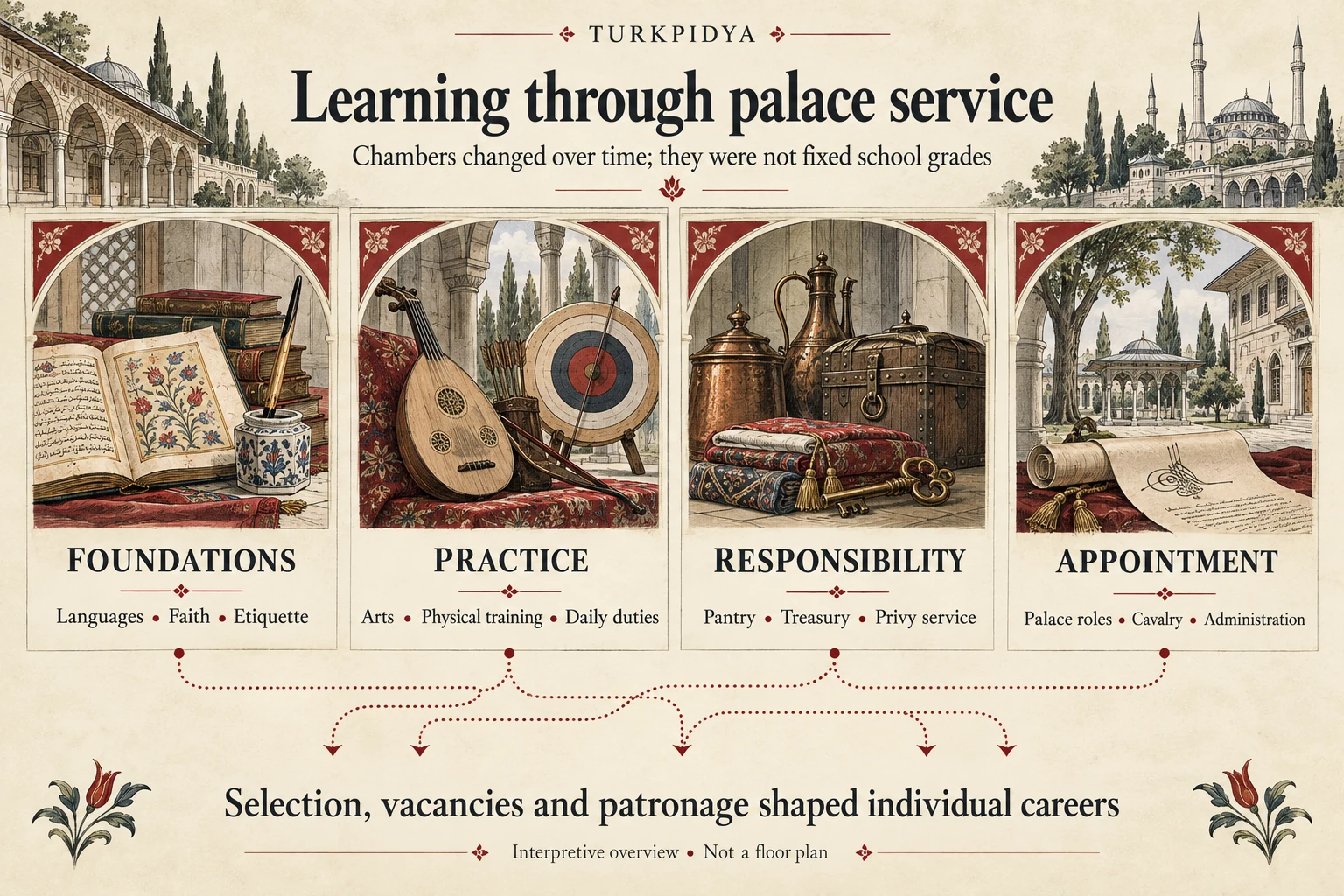
The names of the chambers tell you what people did. A pantry appointment and a treasury appointment were distinct responsibilities, not interchangeable classroom courses. Use the explorer to compare two chambers, trace a learning theme or follow the chronology. Its diagrams are conceptual; they are neither a measured floor plan nor a guaranteed career route.
Turkpidya · History explorer
Inside the palace system
Compare what chambers did, connect duties with learning, and see why dates matter.
Choose a chamber for the left-hand card
Events appear in sequence, not on a proportional time scale. Approximate dates remain approximate.
Historical guide, not a reconstructed floor plan or an admission test. Nothing is sent or stored.
The complete reference is shown below. With JavaScript enabled, you can compare chambers and select learning themes or timeline events.
Chambers and duties
Small Chamber
Küçük Oda
Service: An entry setting for further palace education.
Learning: Language, religious instruction and physical training prepared pages for the demands of palace life.
Period: Part of the earlier organization. TDV reports its removal, together with the Great Chamber, in 1675.
Possible route: Further selection could lead to another chamber or service elsewhere. Entry was no guarantee of reaching the Privy Chamber.
Evidence: Enderun organization · Inner-palace pages
Great Chamber
Büyük Oda
Service: Another major setting for introductory study and supervised training.
Learning: Books, language and bodily training belonged to the same institutional education.
Period: Do not read “Great” as a modern final-year class. Its organization and size changed; TDV reports removal in 1675.
Possible route: Later chamber appointments depended on selection and vacancies, rather than a fixed graduation date.
Evidence: Enderun organization · Inner-palace pages
Falconers’ Chamber
Doğancı Koğuşu
Service: Care and training of birds used in royal hunting.
Learning: Specialist practice was tied to actual household duties.
Period: TÜBİTAK dates abolition to 1675. This chamber cannot be part of every later Enderun career.
Possible route: An office in the hunting establishment had its own responsibilities; it was not a universal subject taken by all pages.
Evidence: Palace life and service
Campaign Chamber
Seferli Koğuşu
Service: Established with practical service responsibilities, including clothing and laundry.
Learning: It later became especially associated with music, poetry and other skills.
Period: Established in 1635 under Murad IV. It did not exist throughout the earlier institution’s history.
Possible route: Its members could leave for military service. Artistic ability could also shape a palace career.
Evidence: Enderun organization · Palace education
Pantry Chamber
Kiler Odası
Service: Provision, storage and service of food and drink for the royal household.
Learning: Daily work required attention to arrangements and palace practice.
Period: A long-standing service unit, rather than a classroom teaching general cooking to every student.
Possible route: Transfers into the chamber depended on openings; departure could lead to cavalry service.
Evidence: Palace education
Treasury Chamber
Hazine Odası
Service: Care of precious objects belonging to the ruler and palace.
Learning: Service involved supervised responsibility for valuable property.
Period: Its history belongs to the changing organization of the imperial household and treasury.
Possible route: Treasury service was a particular appointment, not proof of a modern finance qualification.
Evidence: Palace education
Privy Chamber
Has Oda
Service: Service close to the sultan, including care of the sacred relics.
Learning: Ceremony, responsibility and proximity to the ruler shaped its work.
Period: The highest chamber in the usual organizational descriptions. Duties and personnel still changed over time.
Possible route: It offered access to important appointments, but favorable outcomes were never automatic.
Evidence: Palace education · Topkapı Palace
Changes through time
15th century · An institution takes shape
Important foundations at Edirne under Murad II; fuller organization under Mehmed II. A process of formation, not one uncontested founding day.
Evidence: Enderun organization
1635 · Seferli is established
Murad IV establishes the Campaign Chamber. This is why a seven-chamber list should not be projected unchanged into earlier centuries.
Evidence: Enderun organization
1675 · The room system changes
TÜBİTAK dates the Falconers’ Chamber’s abolition to 1675; TDV reports the Great and Small Rooms removed that year. The references describe changes to particular units, not the end of Enderun as a whole.
Evidence: Palace life and service · Enderun organization
23 November 1719 · The library opens
Ahmed III’s Enderun Library opens after construction began in February 1719. The library’s date is not the school’s founding date.
Evidence: Ahmed III’s library
Early 1830s · Palace service is reorganized
Mahmud II’s reforms change the court’s offices and Enderun arrangements. Specialist accounts distinguish the 1831 abolition of silâhdarlık from the 1833 Mâbeyin reorganization.
Evidence: Palace reorganization
1856 · The court moves to Dolmabahçe
Dolmabahçe becomes the main royal residence. This is not the date when the entire Enderun school moved or closed.
Evidence: Dolmabahçe Palace · Study of Enderun’s abolition
1908–09 · The remaining school ends
Accounts date the final closure differently: TÜBİTAK gives 1908; Akkutay and the parliamentary report give 1 July 1909. Simit’s focused study identifies the Enderun-specific decree as 15 July 1909, distinguishing it from the general 1 July law. The exact date is attributed rather than silently standardized.
Evidence: Palace life and service · Akkutay’s historical account · Parliament-hosted historical discussion · Study of Enderun’s abolition
3 April 1924 · Topkapı becomes a museum
The palace begins its museum phase. Museum conversion is distinct from the closure of the palace school.
Evidence: Topkapı Palace
Learning themes
Languages and books
Turkish, Arabic, Persian, religious learning and reading were part of palace education. Introductory study and later reading were not identical stages. Look first at the Small and Great Chambers, then at learning that continued during service. A list of languages does not establish identical fluency for every individual.
Evidence: Inner-palace pages · Preparatory palace education
Music and the arts
Instruction and practice could develop artistic careers. The Seferli Chamber became particularly associated with music and poetry. Compare Seferli’s specialist associations with the introductory chambers. Do not equate every palace artist with a documented Enderun pupil.
Evidence: Palace education · Ali Ufkî’s music and writings
Physical training
Archery, wrestling, riding and other exercises belonged to palace training. Foundational training and specialist activities differed. Falconry was also a service responsibility. Hunting-bird care was not a compulsory “grade” for every page.
Evidence: Preparatory palace education · Inner-palace pages
Learning through duties
Working in pantry, treasury or close royal service meant practicing particular responsibilities inside the court. Compare the objects and people entrusted to each chamber. These connections are an interpretive guide, not a standardized syllabus or a promise of promotion.
Evidence: Palace education · Topkapı Palace
What the chamber names actually mean
The Small and Great Chambers are associated with foundational study and physical training. The Falconers’ Chamber dealt with hunting birds. The Seferli, often translated as Campaign Chamber, was established in 1635 and developed from practical service into an important setting for arts and specialist skills. Pantry, Treasury and Privy Chamber appointments brought their own work and responsibilities.
Rank mattered, and the Has Oda, or Privy Chamber, stood at the top. But a historical list of seven chambers should not be turned into seven timeless grades. Seferli did not exist throughout the early period; the Falconers’ Chamber later disappeared. Transfers and appointments also depended on openings. The scholarly account of Enderun’s organization is best read together with its dates and examples, rather than as a universal school prospectus.
Take the Treasury Chamber. Its name points to custody and responsibility, rather than a modern degree in economics. The wider history of the Ottoman inner treasury describes the careful control of access and records. Palace treasure included precious objects as well as money, and the inner and outer treasuries had different institutional histories. Serving there exposed a page to a particular kind of trust and supervision.
What students learned
Enderun’s education joined book learning, repeated practice, personal conduct and service. The balance depended on the period, the chamber and the individual. Lists of subjects describe the institution’s range; they do not prove that every boy followed an identical syllabus or mastered every discipline.
Languages, religion and written culture
Turkish, Arabic and Persian were central to the learning described in historical accounts. Qur’anic study and religious instruction accompanied language and literary education. Reading, recitation and writing belonged to a court culture in which the choice of words, a well-formed script and a knowledge of accepted behavior all carried weight.
A page’s education continued after introductory lessons. The history of the inner-palace pages describes students moving from language learning to reading works in those languages. It also records calligraphy, music and other arts, chosen according to ability. That is more informative than claiming universal fluency or a fixed list of required masterpieces for every era.
Numbers, knowledge and practical judgment
Accounts include arithmetic, geography and history among the subjects studied. They belong in the story alongside religion and literature. Yet an attractive explanation such as “every governor mastered geometry to design fortifications” needs evidence of its own. Enderun trained for an imperial world; it was not a modern university with a published, uniform engineering syllabus.
The practical point is the connection between learning and a setting. Lessons took place in an institution handling stores, valuables, ceremony and official business. Being educated there meant seeing how a large household worked and learning how to carry out an assigned duty. Specific service experience varied considerably from one chamber to another.
Music, calligraphy and physical training
Artistic skill was more than decoration at court. Music and fine writing could become important parts of a person’s reputation and work. The Seferli Chamber is particularly associated with musicians and poets, while the wider palace supported many kinds of artists and craftspeople. This does not establish that every palace craft was a compulsory Enderun subject.
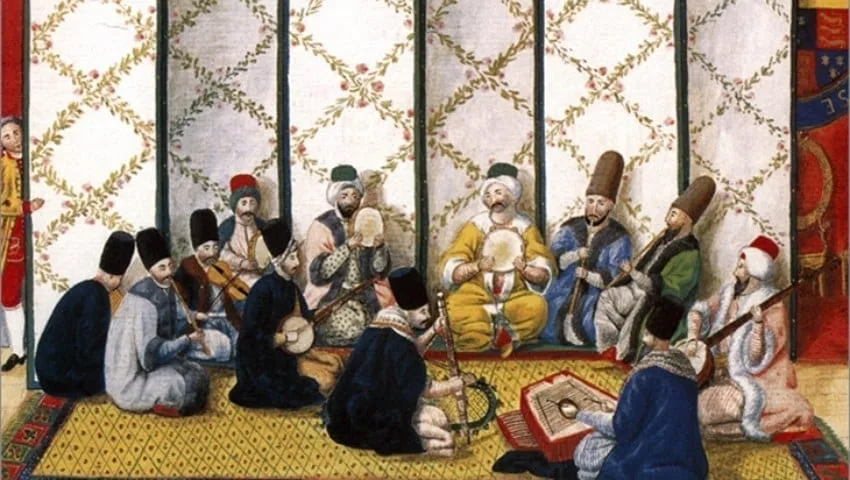
One revealing example is the musician and writer Ali Ufkî Bey, also known as Albert Bobowski. He developed musical and language skills in the palace, and his collection Mecmûa-i Sâz ü Söz preserved Ottoman vocal and instrumental pieces using Western notation. His writings about palace life are another form of evidence for its cultural world. An individual like this makes the connection between education, practice and artistic work much clearer than an unsupported list of famous “graduates.”
Archery, riding, wrestling and other physical exercises also belonged to palace training. Intellectual study and bodily training were treated as connected parts of a palace education. But it is better to describe the documented activities than to invent a rule that someone unable to excel at a sport could never lead troops.
A day structured by worship, work and supervision
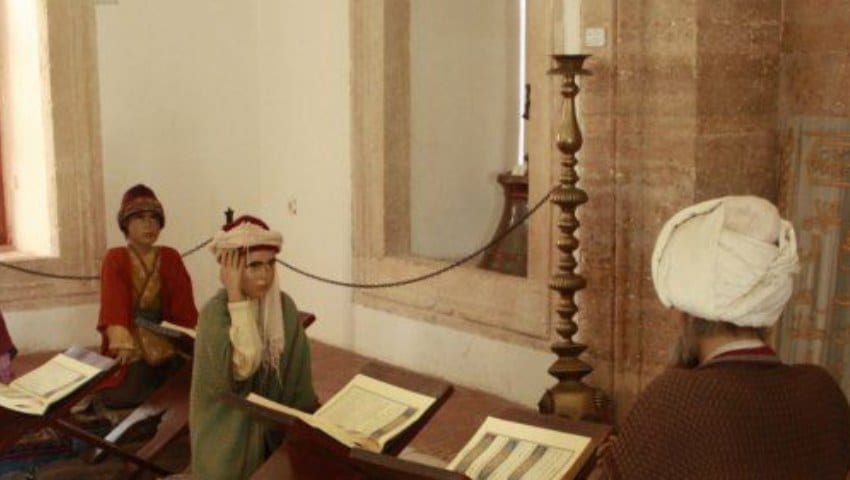
Shared quarters, supervised conduct, religious observance and assigned service structured the day. Young men were expected to learn how to speak, eat, dress and behave in a highly formal household. Teachers and senior attendants were part of that system of instruction and oversight. Palace discipline could be harsh; acknowledging this is essential to understanding the experience, rather than celebrating it as character building.
The TÜBİTAK account of palace life describes rising before morning prayer, lessons, duties and periods of recreation. It also describes restrictions on leaving the palace. This gives a useful rhythm, but not an hour-by-hour timetable valid for four centuries. Seasons, ceremonies, campaigns and changes in the institution make a single universal daily schedule implausible.
Enderun was a lived community as well as a disciplinary system. Hızır İlyas’s nineteenth-century account includes appointments, festivities, music, games and relations between court personnel. It brings people back into a history too often told only through rules and ranks. A student’s world could be restrictive and culturally rich at the same time.
The library was a later addition
The building commonly called the Enderun Library is Ahmed III’s library in Topkapı’s third courtyard, behind the Audience Chamber. Work began on 17 February 1719, and its opening ceremony took place on 23 November that year. Neither date is the founding of the Enderun institution.
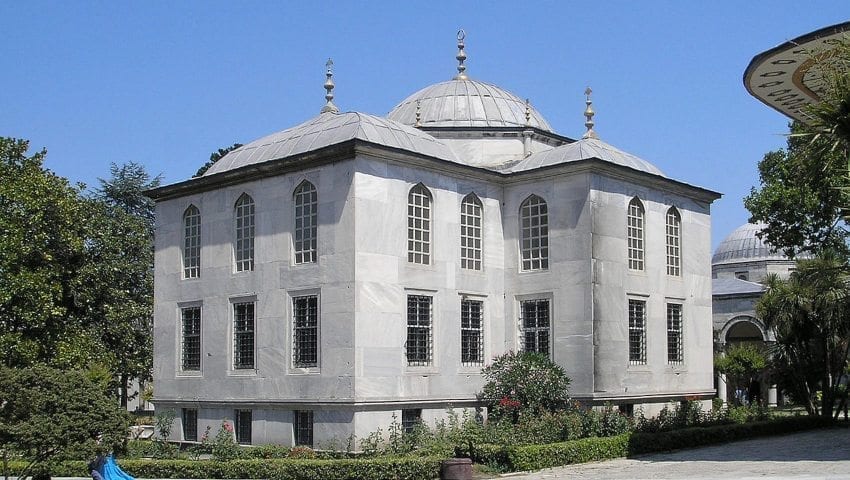
Ahmed III’s purpose-built palace library brought books together in a dedicated building. Its foundation arrangements regulated access, staffing and use, and books were not to be taken outside. Architectural measures also helped protect them from damp. The library makes an important point visible: the palace’s educational spaces developed over time, rather than appearing all at once under Mehmed II.
When looking at a photograph of the library, separate the age of the building from the much longer history of palace learning. A beautiful surviving room can illustrate part of that history without standing for every chamber, lesson or century.
Where an Enderun education could lead
Çıkma described departure or transfer into an appointment. It was not simply a failure notice, and it did not necessarily wait until a person reached the highest chamber. Men could move into cavalry units, palace roles or other service. Openings also allowed those who remained to advance. Think of an institution managing people and posts, rather than a graduation ceremony at the end of a fixed course.
The connection to high office was real. It is still misleading to give a precise total of grand viziers, admirals or religious leaders without stating how “Enderun graduate” is defined and which people were counted. Individual careers are easier to check and make the institution’s influence more understandable.
Sokollu Mehmed Paşa: from palace service to government
Sokollu Mehmed Paşa was educated at Edirne before entering Enderun, where his service included the Small Chamber and inner treasury. A sequence of palace and government appointments followed; he became grand vizier in 1565. His documented route into high office shows why Enderun mattered, without suggesting that every entrant could expect the same career.
Hızır İlyas: a witness from a different century
Hızır İlyas entered Enderun in 1812 and left in 1831. He gained recognition for his voice, served in palace posts and later pursued a scholarly and judicial career. His Târîh-i Enderûn is valuable because it describes the court world he knew. The biography of this palace historian also makes clear that family connections helped his entry and departure. His story is a useful corrective to the idea that patronage was absent.
These two careers should not be collapsed into one model. The routes available to a sixteenth-century statesman and a nineteenth-century court chronicler belonged to different political and institutional circumstances.
Mobility and dependence existed together
Enderun could open striking opportunities to people without hereditary Ottoman office. That matters. So do compulsory recruitment, household dependence, unequal access, discipline and the ruler’s favor. A successful official’s rise cannot tell us what every entrant experienced. Nor does success prove the existence of a classless society or a perfectly fair competition.
Instead of calling Enderun a “leadership factory,” it is more revealing to ask three questions: what did someone learn, whom did they serve, and how did they obtain their next appointment? Those questions connect education to the realities of court power.
Why Enderun changed and eventually ended
The institution did not remain frozen from the fifteenth century until its closure. New chambers appeared, others were removed, recruitment changed and new schools took on important roles in preparing officials and military officers. The story is broader than a moral lesson about a once-perfect system ruined by laziness or corruption.
In the nineteenth century, the palace and the state were reorganized. Enderun administration itself changed during Mahmud II’s early-1830s palace reforms. The court’s move to Dolmabahçe in 1856 also belongs to this changing setting. Moving the court, ending particular forms of service and closing the remaining institution are related events, but not identical dates.
Even the final date needs a little care. TÜBİTAK gives 1908, while Akkutay’s historical account and a parliamentary report give 1 July 1909. A specialist study of Enderun’s abolition by Muhammed Enes Simit distinguishes the general retrenchment law from the Enderun-specific decree, which it dates to 15 July 1909. The safest broad description is closure during the 1908–09 reorganization, with the precise dating attributed to its source.
Topkapı became a museum on 3 April 1924. That is a separate milestone again. Its rooms and collections now help visitors understand palace service, scholarship, ceremony and art; they should not be mistaken for an unchanged school preserved exactly as it operated in every period.
How to read Enderun at Topkapı today
Start with the relationship between spaces. The Gate of Felicity marks a transition into the inner court. The library represents an eighteenth-century investment in books. The treasury and Privy Chamber show different forms of responsibility and proximity to the sultan. Looking for these connections is more useful than trying to find seven numbered classrooms.
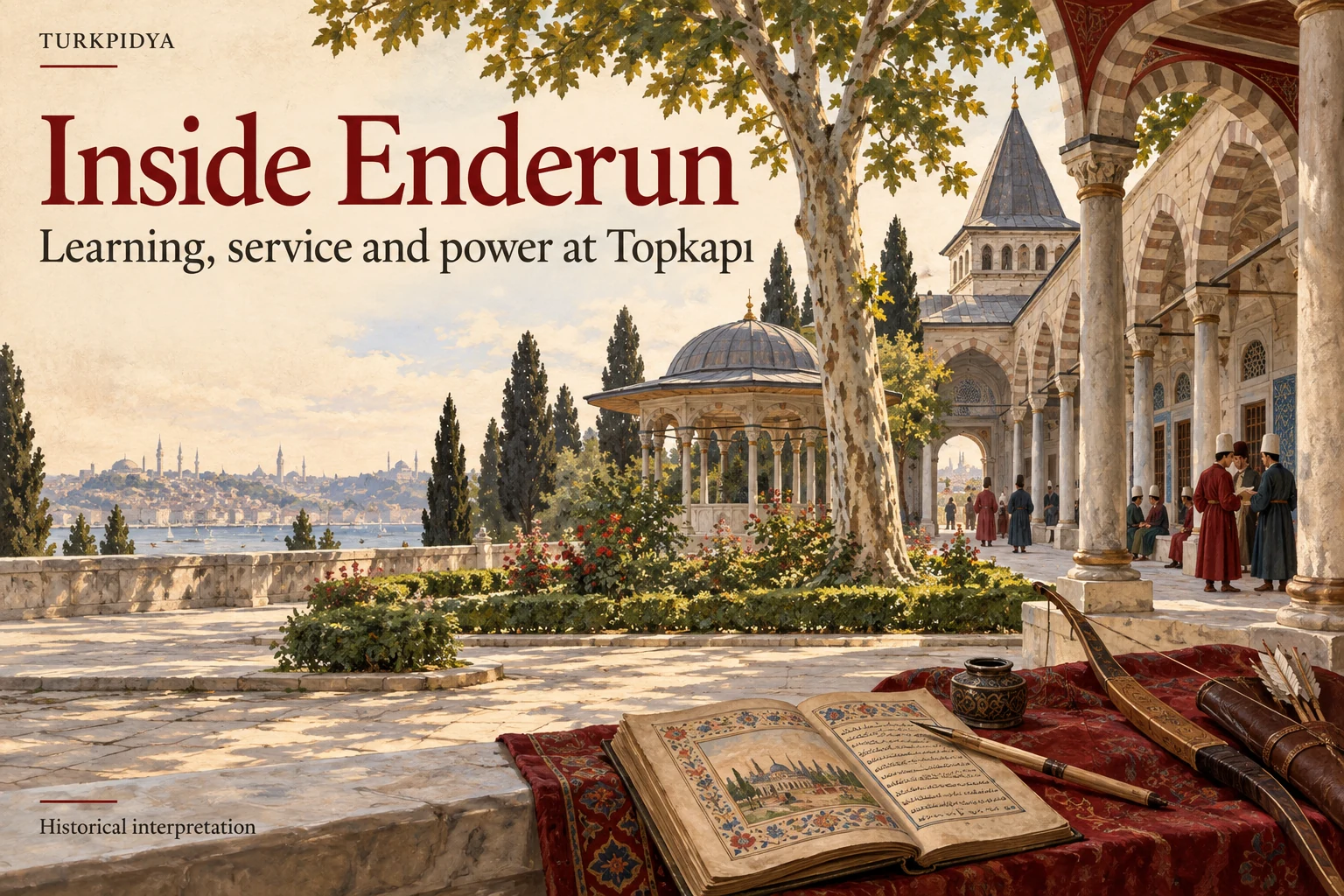
Use the explorer’s chamber names alongside the current official Topkapı visitor information. Room use, displays and access can change, so this historical guide does not promise that every named space is open or presented in its original function. The new cover and infographic are clearly labelled modern interpretations, not historical photographs or architectural reconstructions.
Enderun’s lasting interest is the way it brought education into the workings of a court. Books, skill, service and power were woven together. Understanding both the opportunities and the constraints makes that history richer than a simple success story.
Sources and historical cautions
This guide draws on scholarly reference entries, specialist biographies and the official palace authority. The explorer links evidence for individual chambers and events. It keeps approximate origins approximate and identifies the disagreement about the final closure date.
Historical sources describe different periods and sometimes ideal rules rather than everyday practice. A chamber list is not a complete account of every student’s career. The library image and two Enderun-related illustrations provide context. Where dates or attribution are unverified, the captions say so rather than treating an image as evidence of a specific historical event.