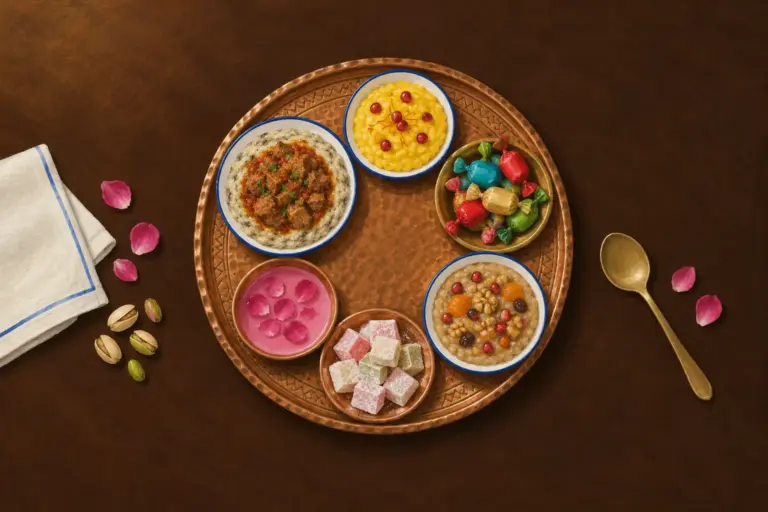
The History of Turkish Coffee and How It Is Made
From Yemen to Istanbul in the 1500s: the first coffeehouses, the bans, how a cup is made and served, and the words to order one.
Table of Contents
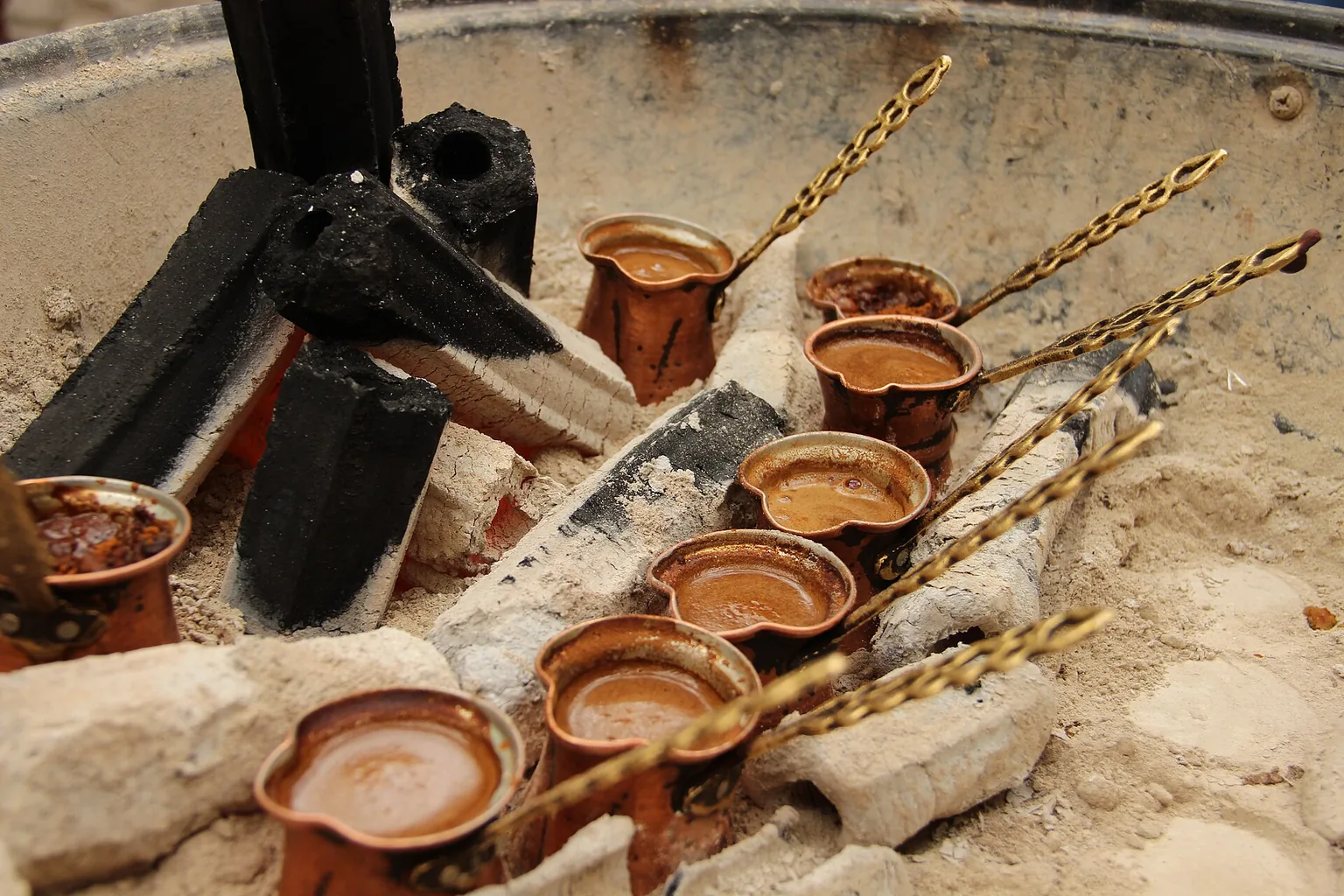
Turkish coffee is coffee ground to a fine powder and brewed slowly with cold water and sugar in a small long-handled pot, the cezve, then served in a small cup with the foam on top. It reached Istanbul in the middle of the 1500s, coffeehouses followed within a few years, and UNESCO inscribed the tradition in 2013. The tool runs the recipe on a cezve and ends in the Turkish line to order a cup.
In short · checked 28.10.2026
A fine powder, a small pot, a cup with foam.
- What it is. Freshly roasted beans ground to a fine powder; coffee, cold water and sugar brewed slowly in a cezve on a stove for the foam; served in a small cup, with a glass of water.
- Istanbul, mid-1500s. The first coffeehouses there are dated 1553 or 1554–55, and the exact first year is disputed.
- Closed more than once. Coffeehouses were shut in town after town between 1559 and 1633, and kept reopening.
- To Europe. Venice in 1615, London in 1650, Paris in 1669; Vienna’s first public licence to serve coffee dates from 17.01.1685.
- UNESCO, 2013. «Turkish coffee culture and tradition» is on the Representative List of the Intangible Cultural Heritage of Humanity.
Tool · the recipe as the GoTürkiye leaflet prints it · checked 28.10.2026
The cezve on the fire
Pick a sugar level, play the eight steps or press them one by one, press any part of the drawing for its card, and end with the Turkish line to order a cup. Amounts are for one cup.
- Coffee
Put one teaspoon of coffee in a small, empty, dry cezve.
The Ministry of Culture and Tourism weighs it: 2 g of finely pulverized coffee for one serving.
- Sugar
Add the sugar of the level you picked: none for sade, one cube for az şekerli, one and a half cubes for orta şekerli, two cubes for çok şekerli.
- Cold water
Add one coffee cup of room-temperature water.
The Ministry of Culture and Tourism weighs it: 60 g for one serving.
- Stir
Stir well before the pot goes on the fire. Do not stir again once it is on.
- Low heat
Set the pot on a low heat for about 3 minutes.
- First rise
When the foam first rises, at about 80 °C, lift the pot before it reaches the rim. Spoon equal amounts of foam into the cups and put the pot back on the fire.
- Second rise
At the second rise, at about 90 °C, spoon in more foam, lift the pot and let it rest a few seconds. Do not let it boil: the coffee turns bitter and watery.
- Serve
Pour the coffee into the cups and serve each with a small glass of water and a piece of lokum. The water is drunk first, to cleanse the palate.
- Cezve
The small pot with a long handle that the coffee is brewed in. It starts dry and empty. A pot holds four or five cups at most, and the fresher the grind, the better the coffee.
GoTürkiye leaflet
- Köpük
The foam on top of the cup, and the reason the coffee is brewed slowly: it is spooned in equal parts into the cups at the first rise, with more at the second.
GoTürkiye leaflet; UNESCO
- Low heat
A low heat, about 3 minutes to the first rise. The pot is lifted at about 80 °C and again at about 90 °C, and never left to boil.
GoTürkiye leaflet
- Fincan
The small coffee cup, on a saucer. In the Ministry’s recipe it is a porcelain demitasse holding about a quarter of a cup.
Ministry of Culture and Tourism
- Water glass
A small glass of water comes with every cup. It is drunk first, to cleanse the palate before the coffee.
GoTürkiye leaflet; UNESCO
- Lokum
A piece of lokum, a soft sweet, is served with the coffee. Bonbons or chocolate may come in its place.
GoTürkiye leaflet; Ministry of Culture and Tourism
Your order
- sade plain no sugar Ministry of Culture and Tourism: «Sade Kahve», blackBir Türk kahvesi, sade, lütfen.One Turkish coffee, plain, please.
- az şekerli a little sweet 1 cube, 2–3 g Ministry of Culture and Tourism: about ½ teaspoon (2 g)Bir Türk kahvesi, az şekerli, lütfen.One Turkish coffee, a little sweet, please.
- orta şekerli medium sweet 1½ cubes, 3–4.5 g Ministry of Culture and Tourism: 1 teaspoon (4 g)Bir Türk kahvesi, orta şekerli, lütfen.One Turkish coffee, medium sweet, please.
- çok şekerli very sweet 2 cubes, 4–6 g Ministry of Culture and Tourism: 1½ teaspoons (6 g)Bir Türk kahvesi, çok şekerli, lütfen.One Turkish coffee, very sweet, please.
For two, three or four cups say İki, Üç or Dört in place of Bir. Nothing you press is stored or sent, and the tool makes no sound.
What Turkish coffee is: a method and a custom
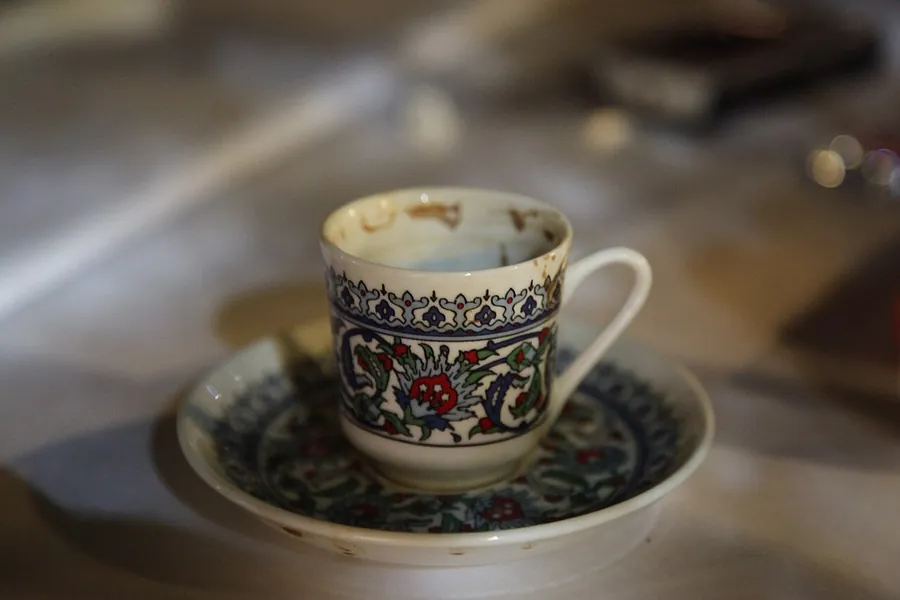
Turkish coffee, Türk kahvesi, is a way of brewing and a way of serving. Freshly roasted beans are ground to a fine powder. The coffee, cold water and sugar go into the cezve and are brewed slowly on a stove until the foam, the köpük, rises. It is served in a small cup, the fincan, with a glass of water beside it, and the grounds stay in the empty cup.
It is also a place and an occasion. The coffeehouse, hospitality and friendship, engagement ceremonies and holidays all belong to it, and people learn to make it in the family, by watching and taking part.
UNESCO, 2013 · GoTürkiye leaflet
Türk kahvesi
Turkish coffee: the drink and the way of brewing it, slowly, in a pot, with the foam kept on top.
Cezve
A small pot with a long handle. The coffee is brewed in it and poured from it.
Fincan
The small coffee cup, served on a saucer.
Köpük
The foam on top of the cup. Brewing slowly is what makes it.
Lokum
A soft sweet, known in English as Turkish delight. A piece comes with the cup.
Kahvehane
A coffeehouse. The first of the kind stood in Mecca, Cairo and Damascus in the early 1500s.
Kıraathane
A reading room: a coffeehouse for newspapers, magazines and later books. The first opened in Istanbul in 1857.
Tahtakale
A quarter of old Istanbul where the first coffeehouses are placed.
Kahve falı
Reading the grounds left in the empty cup for pictures, as a pastime among friends.
Kız isteme
The request visit: the groom’s family comes to ask for the bride’s hand, and the bride-to-be serves the coffee.
Kahverengi, kahvaltı
Two everyday words carry the word for coffee: kahverengi, brown, and kahvaltı, breakfast.
From Yemen to Istanbul: a drink of the 1500s
Five stops
- AbyssiniaCoffee is known first as a food.
- Yemen, the 1400sKnown in the early 1400s and drunk from the late 1400s. Sufi circles, the gatherings of the mystical orders, favoured it to stay awake for night worship.
- Mecca and Cairo, early 1500sScholars begin to debate whether the drink is allowed.
- Istanbul, mid-1500sThe exact first year is disputed. The historian Kâtib Çelebi has ships bringing coffee in 1543; the first coffeehouses are dated 1553 or 1554–55.
- Europe, from 1615Venice first, the big trading centres from the mid-1600s.
The trade
- Route
- Yemen ports, Jeddah, Suez, Egypt (Alexandria, Damietta, Rashid), then ship to Istanbul and other Ottoman cities.
- Volume
- 30,000 to 40,000 ferde, a unit of load, about 5,000 tonnes, came from Yemen to Egypt each year. Half went on to Istanbul and other Ottoman cities.
- In Istanbul
- Customs first, then storage in a han (inn). The attars, the guild of herb and spice sellers, bought the coffee and had it pounded at the tahmis, the pounding house, before the shops sold it. In the day of the traveller Evliya Çelebi Istanbul had 500 coffee tradesmen and about 300 shops.
- The duty
- Twice the normal customs duty, because the scholars did not much approve of coffee and it was seen as a luxury. European merchants paid the usual 3 %.
- When it ran short
- Demand outran supply and the price rose. Chickpeas, chestnuts, bulgur and almonds were used to make coffee.
- Later
- From the mid-1700s plantation coffee from the Far East and Latin America pushed Yemen coffee out.
TDV, Kahve · checked 28.10.2026
The first coffeehouses: schools of knowledge
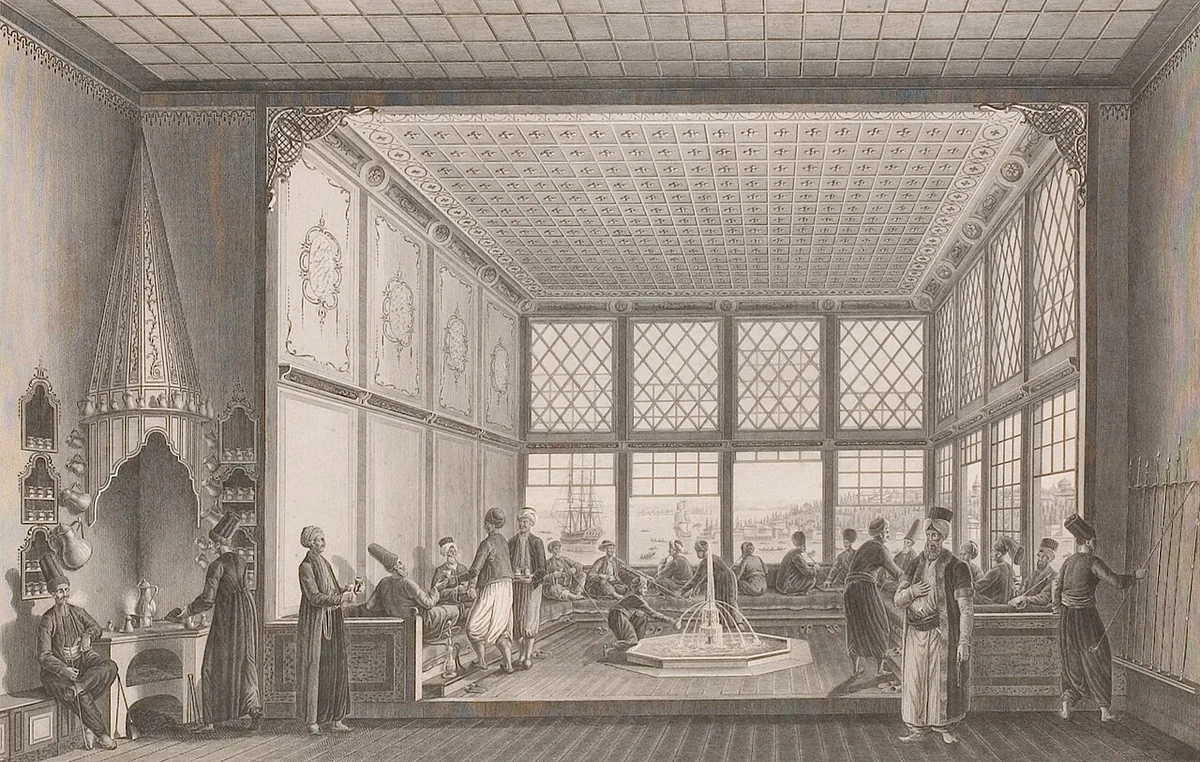
Istanbul’s first coffeehouses are dated to the early 1550s. The historian Âlî Mustafa Efendi has them in 960 AH (the Muslim calendar), 1553. The chronicler Peçuylu İbrâhim names a merchant, Hakem of Aleppo, and Şems of Damascus, who opened one in Tahtakale, a quarter of Istanbul, in 962 AH, 1554–55. Vienna’s city history also puts Istanbul’s first coffeehouse in 1554. Houses of the same kind had stood in Mecca, Cairo and Damascus since the early 1500s.
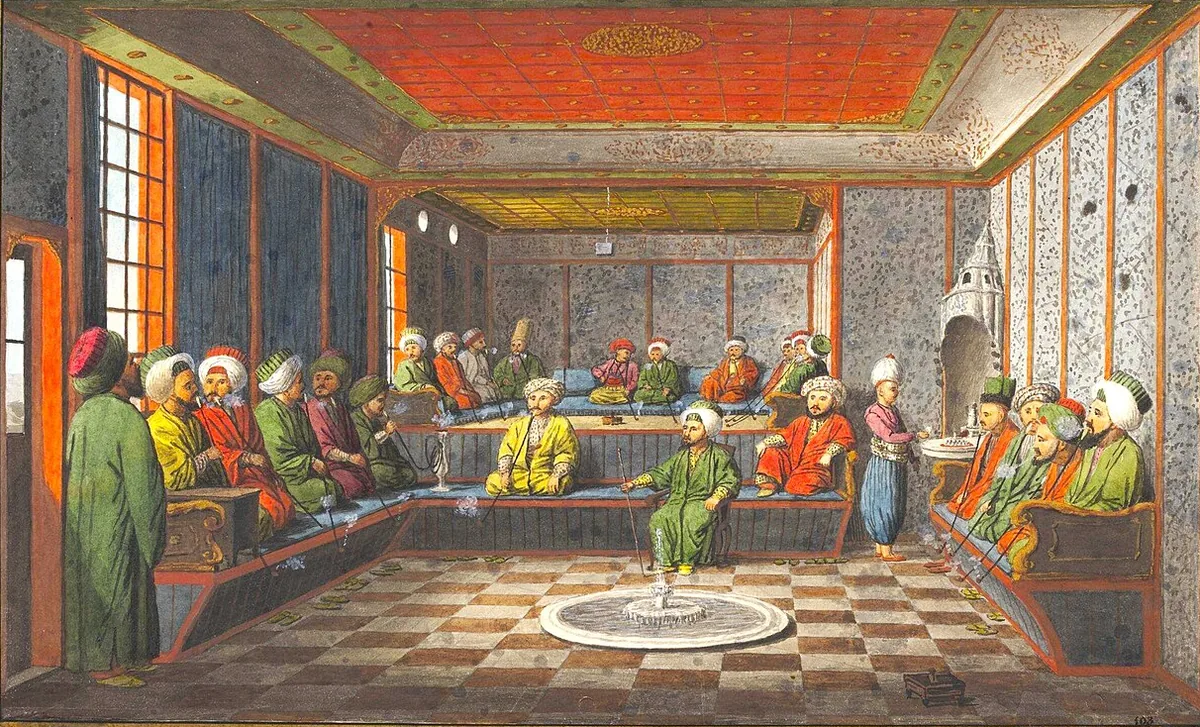
Inside
- Talk. People of every background came to drink coffee and talk. The talk was devlet sohbeti, «state talk»: gossip and rumour about the state.
- Games and books. They read, played tavla (backgammon) and chess, and went over poems. Epics such as the Muhammediyye, the Battalnâme and the Hamzanâme were read aloud.
- Shows. Shadow plays (karagöz), storytellers (meddah) and bards (âşık) performed.
- Names. Kâtib Çelebi’s names for the houses were «mekteb-i irfan», school of knowledge, and «medresetü’l-ulemâ», school of the scholars.
TDV, Kahvehane
Istanbul, counted
About 50, then about 600, 1,631 and 2,076.
About 50 coffeehouses in Süleyman’s last years. About 600 under Selim II and Murad III, small coffee hearths included (Ignatius Mouradgea d’Ohsson). 1,631 in the registers of 1792, and 2,076 in 1821. In the 1600s Kâtib Çelebi found almost one at every street corner.
TDV, Kahve and Kahvehane
After the reforms of the Tanzimat a new kind appeared: the kıraathane, a reading room where newspapers and magazines, later books, were read over coffee. The first was Sarafim Kıraathanesi on Divanyolu in Istanbul, in 1857.
Tea came into the coffeehouses late in the 1800s, after the war of 1877–78, and tables and chairs replaced the kerevet, the raised wooden sitting platform. Tea Culture in Turkey tells that story. An American survey of 1922 sorted Istanbul’s coffeehouses into seven kinds: han (inn), mosque-side, kıraathane, neighbourhood, tradesmen’s, restaurant and village.
The bans: 1559 to 1633
Coffeehouses were closed in town after town in the 1500s and 1600s, and kept reopening. Scholars were divided over the drink itself. Most held it permitted, mubah; a few forbade it for what went on in the houses, such as lying, backbiting and gambling, and even they allowed it where none of that happened. The TDV Encyclopaedia of Islam puts the bans down mostly to politics.
- 1559Homs closes its coffeehouses.
- 1565Aleppo and Damascus.
- 1566–67Egypt, and in the same year the Eyüp district of Istanbul.
- 1568Istanbul and Galata.
- 1592Bostanzâde Mehmed Efendi answers a question about coffee in a 52-line verse fatwa in its favour.
- Under Ahmed IThe viziers Derviş and Nasuh Pasha close the coffeehouses.
- 2 September 1633A fire at Cibali burns a fifth of Istanbul. An edict closes the coffeehouses of every Ottoman city, on the urging of the preacher Kadızâde Mehmed Efendi and with a fatwa of the şeyhülislâm (the empire’s chief religious authority), Ahîzâde Hüseyin Efendi. In Eyüp alone 120 shops are pulled down, and rooms for bachelors, tanners and farriers are built where coffeehouses stood. Tobacco is banned in the same measures.
- Mehmed IV’s early yearsThe ban is lifted. The historians Solakzâde and Kâtib Çelebi, who had disapproved of the ban, are glad.
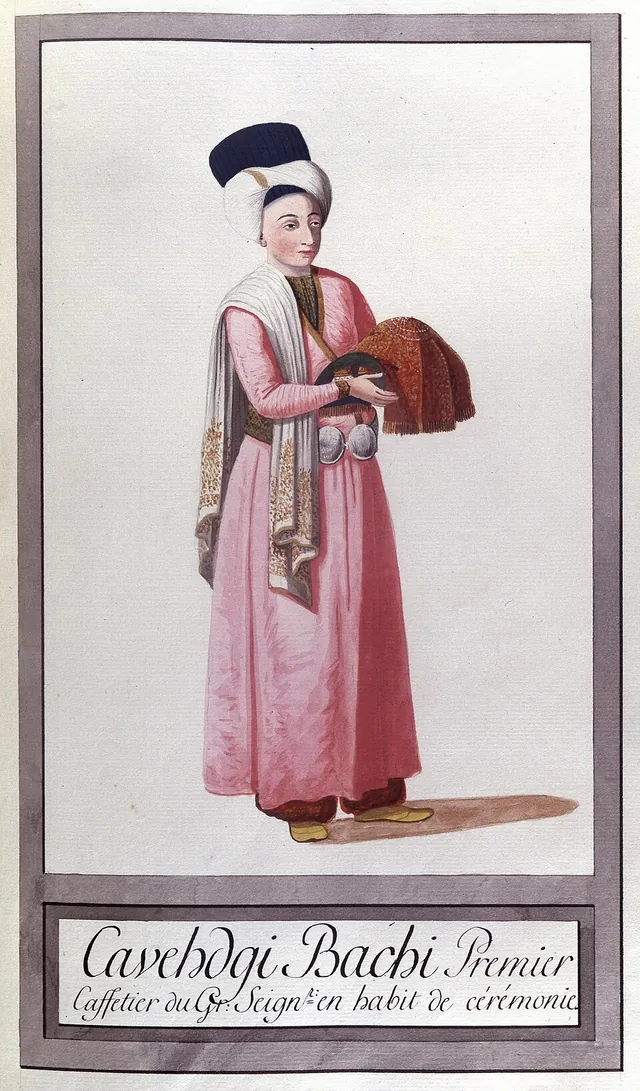
The closure of 1633 was the last decision to close all the coffeehouses. Afterwards they were closed only where misconduct was found, and the state turned to controlling and taxing them. Viziers invested in large coffeehouses, and janissaries, the sultan’s infantry, were among the coffee tradesmen.
TDV Encyclopaedia of Islam: Kahve, Kahvehane, Murad IV, Kadızâdeliler · checked 28.10.2026
To Europe, and one legend
Coffeehouses reached the great European cities in the middle of the 1600s. Vienna has two dates, from two sources: TDV dates its coffeehouses to 1651, and the city’s own history dates the first licence to serve coffee in public to 17 January 1685, given to the Armenian merchant Johannes Deodat (Diodato) for his house on the Haarmarkt. Armenian traders did most to settle coffee in the city.
- About 1580A coffeehouse in Buda, then under Ottoman rule.
- 1615Venice. The coffeehouse spreads over Italy in 1645.
- 1644Marseille.
- 1645The imperial court in Vienna buys coffee for Turkish embassies.
- 1650London.
- 1669Paris.
- 1685Vienna: the first public licence, 17 January.
TDV, Kahve · Wien Geschichte Wiki, «Kaffeehaus» · checked 28.10.2026
Three claims, checked
«After 1683 Georg Franz Koltschitzky opened the first coffeehouse in Vienna.»
Vienna’s city history calls this a legend, refuted by the historian Karl Teply. The first privilege went to Johannes Deodat on 17 January 1685.
«Coffee was banned once, and then never again.»
The closures came in waves, from Homs in 1559 to the whole empire in 1633. After 1633 houses were closed only where misconduct was found.
«Turkish coffee grows in Türkiye.»
The name belongs to the method; the first coffee came from Yemen. BATEM, a state agricultural research institute in Antalya, grows coffee at Gazipaşa–Alanya in the open field and in Antalya under cover. Its director said in March 2025 that the institute planned to take its first beans the next year.
How a cup is made: the pot, the foam, the grind
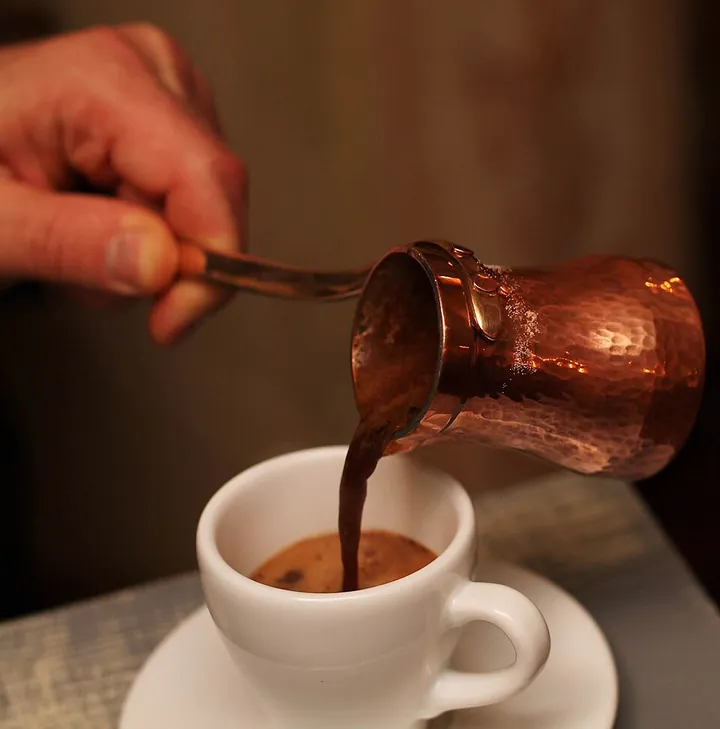
One cup, in numbers
- Coffee
- One teaspoon, 2 g of finely pulverized coffee. The fresher the grind, the better.
- Water
- One coffee cup of room-temperature water, 60 g.
- Sugar
- Sade: none. Az şekerli: 1 cube (2–3 g), about ½ teaspoon. Orta şekerli: 1½ cubes (3–4.5 g), 1 teaspoon. Çok şekerli: 2 cubes (4–6 g), 1½ teaspoons.
- Heat
- Low, about 3 minutes to the first rise. Lift at about 80 °C and again at about 90 °C. Never boil.
- The pot
- Four or five cups at most.
GoTürkiye leaflet · Ministry of Culture and Tourism · checked 28.10.2026
The grind
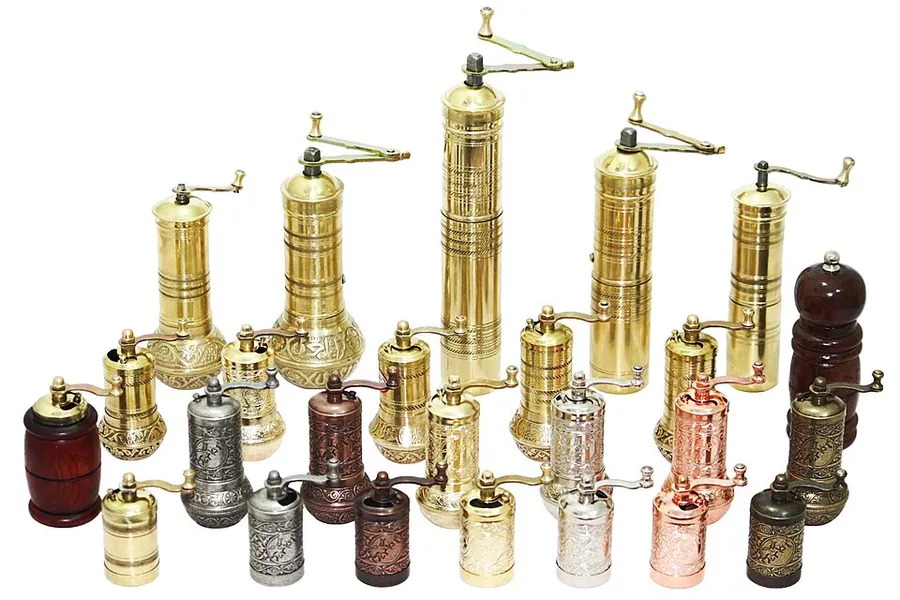
The beans are ground to a powder so fine that it stays in the cup and settles. The old coffeehouses ground by hand in a brass mill; today the mill is usually electric.
Ministry of Culture and Tourism
How it is served: the cup, the water, the lokum
On the tray
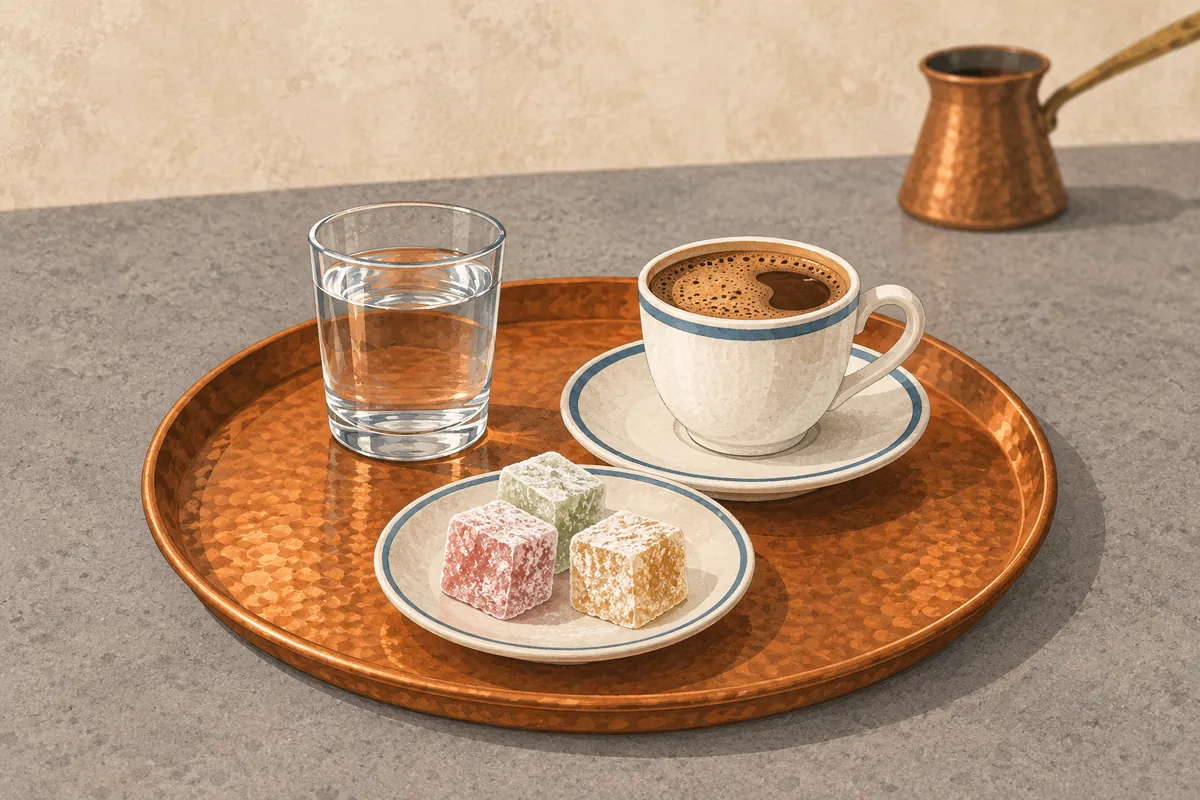
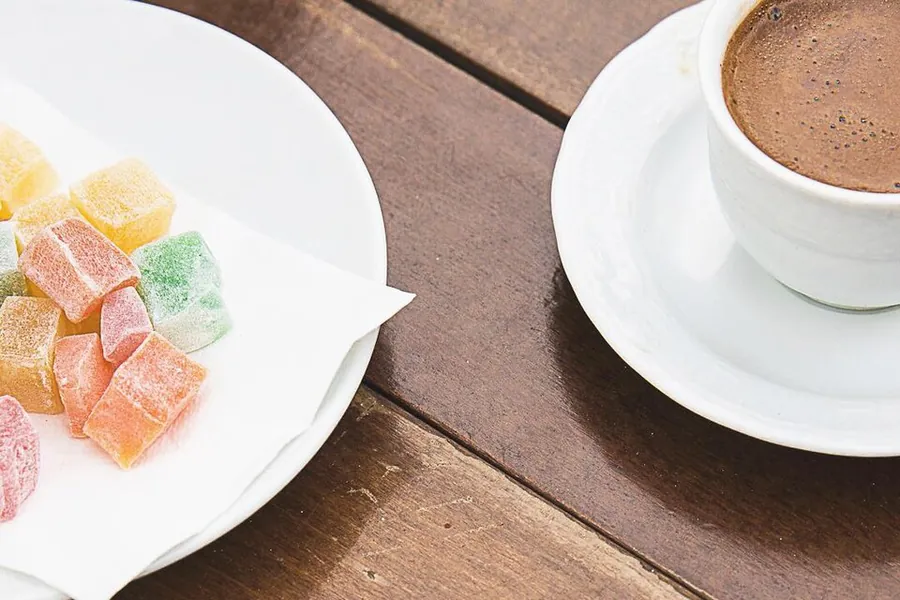
- The cup. A small porcelain fincan on a saucer, about a quarter of a cup.
- The water. A small glass of water, drunk first to cleanse the palate.
- The sweet. Lokum, or bonbons or chocolate. Coffee is usually served at midday or after lunch or dinner.
- Additions. In some cities the coffee is made with pistachio, almond, «turpentine» (menengiç, the seeds of the terebinth tree) or carob.
GoTürkiye leaflet · Ministry of Culture and Tourism
How to ask for one
The sugar level comes in four words: sade, az şekerli, orta şekerli and çok şekerli. Say the count, then the coffee, then the level.
Bir Türk kahvesi, sade, lütfen.One Turkish coffee, plain, please.
Bir Türk kahvesi, az şekerli, lütfen.One Turkish coffee, a little sweet, please.
Bir Türk kahvesi, orta şekerli, lütfen.One Turkish coffee, medium sweet, please.
Bir Türk kahvesi, çok şekerli, lütfen.One Turkish coffee, very sweet, please.
Lütfen means «please» and Bir means «one». The last strip of the tool builds the line for one to four cups and copies it. Ministry of Culture and Tourism · GoTürkiye leaflet
Customs: the guest, the visit, the grounds
Three customs around the cup
Pick one.
A cup of coffee goes to a guest. The Turkish proverb: «Bir fincan kahvenin kırk yıl hatırı vardır», one cup of coffee commits one to forty years of friendship. The Italian writer Edmondo De Amicis found in the 1800s that coffee could be had within three minutes anywhere in Istanbul.
GoTürkiye leaflet · Ministry of Culture and Tourism
In kız isteme, «asking for the girl», the groom’s family visits the bride’s family to ask for her hand. The bride-to-be prepares the coffee and serves it to the suitor and the elders, and her manner and the taste are watched. Engagement ceremonies are among the occasions UNESCO names for the coffee.
GoTürkiye leaflet · UNESCO
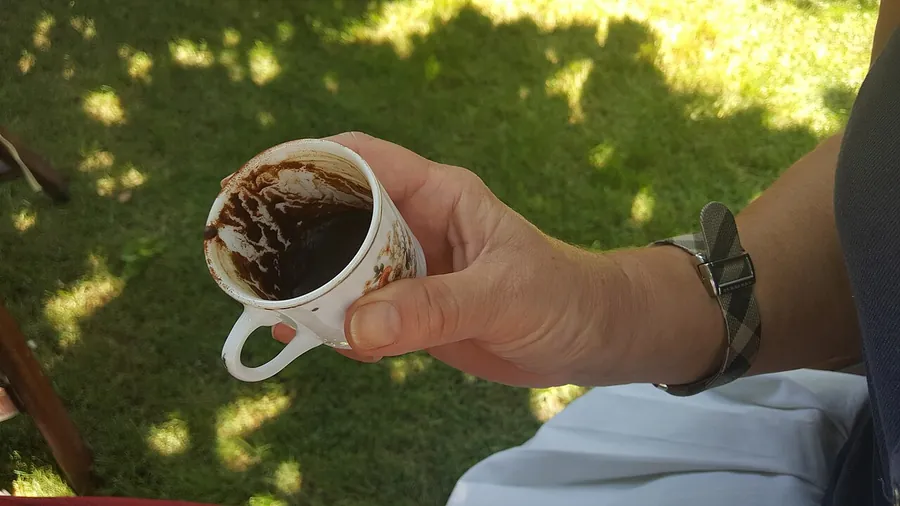
The grounds left in the empty cup are read for pictures as a pastime among friends, with a hope of good news. UNESCO adds that they are often used to tell a fortune.
GoTürkiye leaflet · UNESCO
UNESCO and today: the 2013 listing
In 2013, at its eighth session in Baku, the UNESCO Committee for the Safeguarding of the Intangible Cultural Heritage inscribed «Turkish coffee culture and tradition», put forward by Türkiye, on the Representative List of the Intangible Cultural Heritage of Humanity.
- In the family. The knowledge and skills pass from generation to generation within families. They give a sense of identity and continuity and reinforce social cohesion through hospitality.
- Seen. The listing could promote greater visibility of intangible heritage and offers an example of a social institution that favours dialogue.
- Kept up. Local and national authorities, coffee aficionados and associations are committed to safeguarding it. Türkiye’s national inventory of intangible heritage has held it since 2010, under the authority of the Ministry of Culture and Tourism.
- In words and song. The coffee is celebrated in literature and songs.
UNESCO, listing and decision 8.COM 8.28
Quick answers in a few lines
How do I order a Turkish coffee?
Say the count, the coffee and the level: «Bir Türk kahvesi, orta şekerli, lütfen» (one Turkish coffee, medium sweet, please). The levels are sade (plain), az şekerli (a little sweet), orta şekerli (medium) and çok şekerli (very sweet).
Why does the coffee come with a glass of water?
The water is drunk first, to cleanse the palate before the coffee.
What is the foam for?
The foam, köpük, is the point of the slow brewing. It is spooned in equal parts into the cups at the first rise, with more at the second.
Who opened the first coffeehouse in Istanbul?
The sources disagree on the year, 1553 or 1554–55. The chronicler Peçuylu İbrâhim names Hakem of Aleppo and Şems of Damascus, in Tahtakale, in 962 AH (1554–55).
Is the story of Vienna’s first coffeehouse true?
No. Vienna’s city history calls the Koltschitzky story a legend. The first licence went to Johannes Deodat on 17 January 1685.
Is coffee grown in Türkiye?
BATEM, a state agricultural research institute in Antalya, grows coffee at Gazipaşa–Alanya in the open field and in Antalya under cover. Its director said in March 2025 that the institute planned to take its first beans the next year.
Sources checked 28.10.2026
Show the sources
- Turkish coffee culture and tradition (inscription 2013) — UNESCO, Intangible Cultural Heritage, checked 28.10.2026
- Decision 8.COM 8.28 — UNESCO, Intergovernmental Committee, checked 28.10.2026
- Kahve (İdris Bostan, 2001) — TDV İslâm Ansiklopedisi, checked 28.10.2026
- Kahvehane (Ahmet Yaşar, 2019) — TDV İslâm Ansiklopedisi, checked 28.10.2026
- Murad IV — TDV İslâm Ansiklopedisi, checked 28.10.2026
- Kadızâdeliler — TDV İslâm Ansiklopedisi, checked 28.10.2026
- Turkish Coffee (leaflet, 2 pages) — GoTürkiye, checked 28.10.2026
- Turkish Coffee — Ministry of Culture and Tourism, checked 28.10.2026
- Kahve Yemen’den değil BATEM’den gelecek (Akdeniz Manşet, 07.03.2025, on BATEM’s press page) — BATEM, Ministry of Agriculture and Forestry, checked 28.10.2026
- Kaffeehaus — Wien Geschichte Wiki, City of Vienna, checked 28.10.2026
General information on a tradition and a drink; recipes and amounts are for one cup.