Souvenirs from Turkey: Crafts, Foods and Customs Rules
Kilim, çini, copper, lokum, tea and more: what each thing is, where it is made, what may not leave Türkiye and how the tax refund works.
Table of Contents
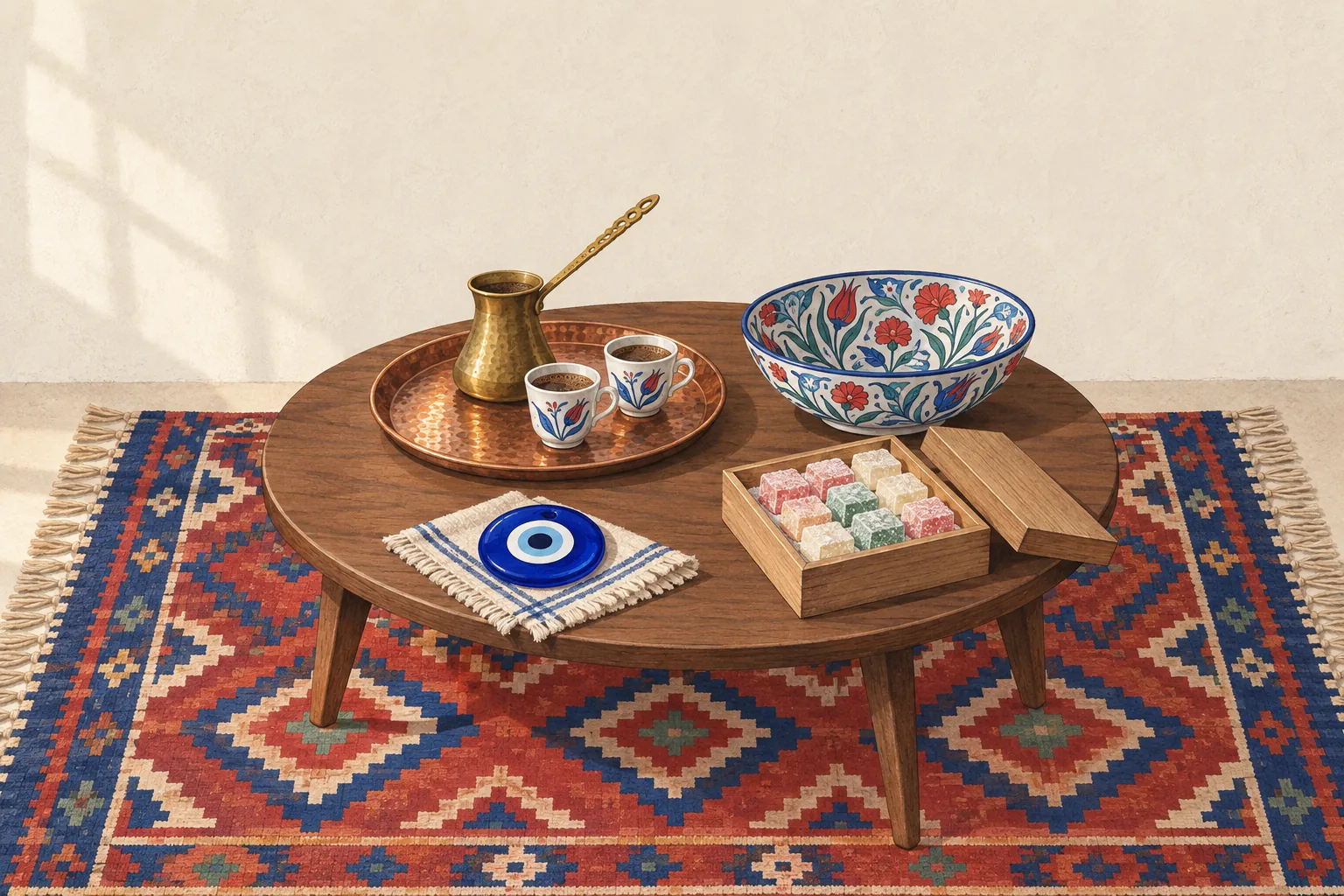
What people bring home from Türkiye is mostly made by hand: a kilim (a flat-woven rug), çini (painted ceramic and tile), copper, silver wire jewellery, coffee, tea and lokum (Turkish delight). The state pages say what each one is and where it comes from; one rule says which old pieces may not leave the country, and another says how the VAT on new goods comes back at the border.
In short · read 30.10.2026
Know the name of the place, keep the paper.
- A registered name says where a thing is from. A coğrafi işaret (geographical indication) names the area a product is known for, and its emblem goes on the product or its package. The Culture Portal lists 39 hand-crafts, 227 foods and 92 farm products.
- Old or registered pieces cannot simply leave. Cultural property that must be protected in Türkiye cannot be taken abroad. A piece that the museum directorate (müze müdürlüğü) certifies as outside registration can leave when that document is shown.
- The VAT can come back on new goods. KDV (value-added tax) is refunded to foreign nationals and to Turkish citizens living abroad when the invoice is above 1,000 TL before VAT and the goods leave within 3 months. Keep the e-fatura (electronic invoice) printout for the customs tax-free desk.
- One question does most of the work: Bu el yapımı mı? means «Is this handmade?». El yapımı is handmade; makine yapımı is machine-made.
Tool · read 30.10.2026
The room
An oda is a room. Thirteen things stand in this one, each where it ends up at home. Press a thing in the drawing, or its name in the row, to see what it is, where the state pages say it is made, one check before buying, what happens when it leaves Türkiye and a Turkish line to copy.
Kilim flat-woven rug
A rug woven flat: weft threads pass between warp threads from the front and the back. A halı is the knotted pile rug (chapter 1).
- Made in
- Karatepe (Osmaniye), Beytüşşebap (Şırnak) and Bayat kilim are registered. Karatepe · Beytüşşebap · Bayat · read 30.10.2026
- Check
- The registered name and emblem go on the rug or its package; a Beytüşşebap Jirki logo sits on the back. Beytüşşebap · read 30.10.2026
Çini painted ceramic and tile
Ceramic with a white body and traditional motifs painted under a clear glaze. Evani is çini for dishes, kaşi for wall tiles (chapter 2).
- Made in
- İznik Çinisi, a registered name of origin, no. 137. İznik Çinisi · read 30.10.2026
- Check
- Hand-painted motifs under one clear glaze; the coral red is İznik’s own. İznik Çinisi · read 30.10.2026
Nazar boncuğu blue eye bead
A bead of blue glass with rings like an eye. Nazar is the evil eye, the harm a look is believed to bring; the bead is the charm against it.
Bakır copper
Copper trays, pots, coffee pots and the tea urn, the semaver.
- Made in
- Mardin’s Coppersmiths’ Bazaar; Amasya Semaveri, registered no. 1298. Mardin · Amasya · read 30.10.2026
- Check
- The Amasya Semaveri logo and emblem go on the urn or its package. Amasya Semaveri · read 30.10.2026
Telkari silver wire filigree
Jewellery of very fine twisted metal wire, silver or gold, in open lace-like patterns. Tel means «wire».
- Check
- Silver is graded in ayar (fineness). Van’s registered savatlı silver, a different craft, asks for at least 900 ayar, 950 ideal. Van Savatlı Gümüş · read 30.10.2026
- Leaving
- Personal, non-commercial jewellery up to 15,000 US dollars in value may leave; more needs the entry declaration or proof of purchase (chapter 6).
Sedef kakma mother-of-pearl inlay
Sedef is mother-of-pearl, kakma is inlay: pieces of the shell are set into hollows cut in dark wood (chapter 2).
Yemeni soft hand-sewn shoe
A light shoe with no heel and a toe curled up like a spur. It has no left and right (chapter 3).
- Made in
- Kahramanmaraş, a registered hand-craft. Kahramanmaraş Yemenisi · read 30.10.2026
Tavla backgammon
The board game on a folding board of 24 triangles with 30 round pieces and two dice.
Cezve long-handled coffee pot
The small pot in which Turkish coffee is made (chapter 3).
- To know
- Coffee is ordered by sugar: sade none, az şekerli a little, orta şekerli medium, çok şekerli a lot.
Çay tea
Black tea, served in small tulip-shaped glasses (chapter 3).
- Made in
- Rize. Rize Çayı is a registered name of origin. Rize Çayı · read 30.10.2026
- Leaving
- Keep the e-fatura printout (chapter 7). Food follows the rules of the country you fly to.
Lokum Turkish delight
A soft sweet of sugar and starch, cut in pieces (chapter 4).
- Made in
- Safranbolu is known for it; Bafra Kaymaklı Lokum is registered, no. 482. Safranbolu · Bafra · read 30.10.2026
- Check
- The Bafra name and emblem go on the package. Bafra Kaymaklı Lokum · read 30.10.2026
- Leaving
- Keep the e-fatura printout (chapter 7). Food follows the rules of the country you fly to.
Baharat spice
Spices sold by weight; red pepper comes ground, as flakes or as isot (chapter 4).
- Made in
- Maraş Biberi is a registered name of origin, no. 43; the Mısır Çarşısı (Egyptian Bazaar) in Istanbul was built in 1660. Maraş Biberi · Mısır Çarşısı · read 30.10.2026
- Leaving
- Keep the e-fatura printout (chapter 7). Food follows the rules of the country you fly to.
Sabun soap
Edirne’s mis meyve sabunu, «fragrant fruit soap», is soap hand-shaped and coloured like real fruit (chapter 4).
- Made in
- Edirne, registered no. 452. Edirne Mis Meyve Sabunu · read 30.10.2026
- Check
- The name Edirne Mis Meyve Sabunu must be easy to see on the soap.
- Leaving
- Keep the e-fatura printout for the tax-free desk (chapter 7).
Rugs: kilim and halı
A kilim and a halı are both rugs, made in different ways. The Culture Portal’s page on Beytüşşebap describes kilim weaving: weft threads passed between warp threads from the front and the back. Its page on Yağcıbedir describes a halı, a pile rug tied in knots: the Turkish double knot, 1,050 knots per square decimetre and a wool pile 5–7 mm high.
A kilim is just a thin carpet.
Beytüşşebap’s page describes kilim as woven with weft threads passed between warp threads from the front and the back. Yağcıbedir’s page describes a halı tied in Turkish double knots, wool, with a pile 5–7 mm high. They are two kinds of rug, not two thicknesses.
The colour tells you whether a rug is handmade.
They name plant dyes (kök boya) for the registered Karatepe, Beytüşşebap, Bayat and Çanakkale rugs. Bayat’s page adds that its colours start dark and matt and brighten with washing and use. A page describes a registered product; it gives no test for a single rug.
A registered rug carries a mark.
Karatepe’s and Çanakkale’s pages say the name and the emblem go on the rug or its package, or are kept where they are easy to see at the workshop. Beytüşşebap’s page puts the logo on the back of the kilim.
The patterns are only decoration.
Beytüşşebap’s page gives meanings: the wolf’s foot and the scorpion for jealousy and fear, the ram’s horn for manliness and courage, the hand on the hip (el belinde) for productivity, the tree of life for immortality.
Registered rugs, as the Culture Portal prints them
- Karatepe Kilimi
- No. 785, mahreç işareti. Karatepe village, Kadirli district, Osmaniye. Wool dyed with plants such as pomegranate rind, onion skin, walnut leaf, oak and olive. Karatepe · read 30.10.2026
- Beytüşşebap Jirki Kilimi
- No. 1568, mahreç işareti. Beytüşşebap, Şırnak. Fine pure wool and plant dyes, woven on an upright loom; rugs were woven as çeyiz, a bride’s dowry. Beytüşşebap · read 30.10.2026
- Bayat Türkmen Kilimi
- No. 29, mahreç işareti. Plant-dyed wool, woven by hand on metal looms by trained master weavers. Bayat · read 30.10.2026
- Yağcıbedir El Halısı
- No. 17, mahreç işareti. A wool pile rug in navy, dark blue, red and brown with plant and geometric motifs set in a double mihrap (prayer niche) shape; a white line runs down the middle. Yağcıbedir · read 30.10.2026
- Çanakkale El Halısı
- No. 19, mahreç işareti. Only geometric patterns, among them the eight-armed star in a circle; usually plant dyes and three borders, one wide and two narrow. Çanakkale · read 30.10.2026
- Also listed
- Halı names Yahyalı, Kars, Taşpınar, Akçadağ and Fethiye. El Sanatları · read 30.10.2026
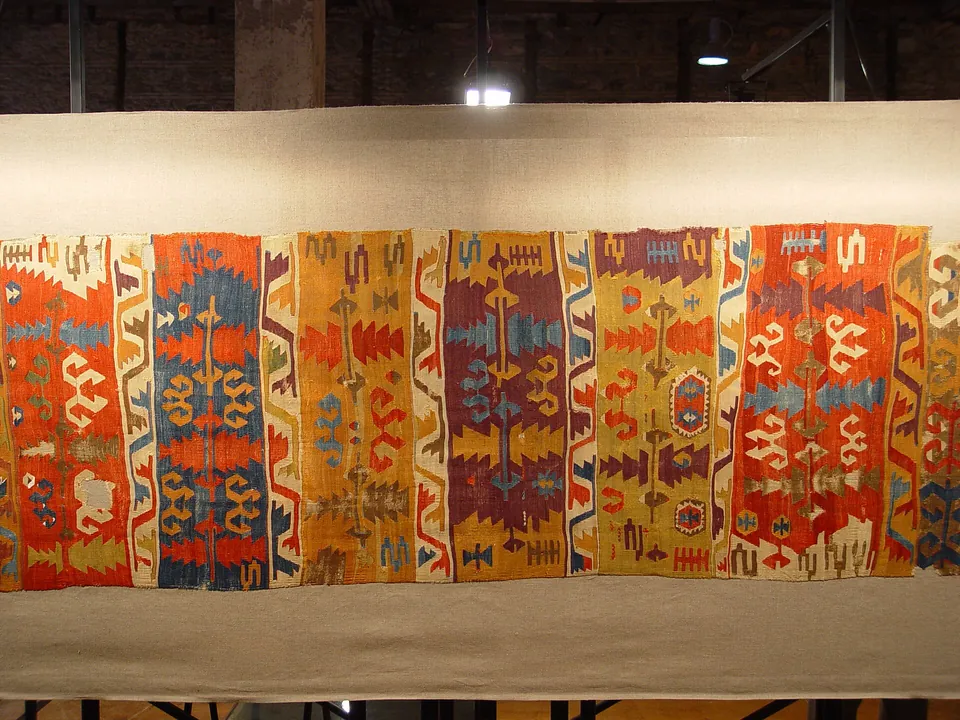
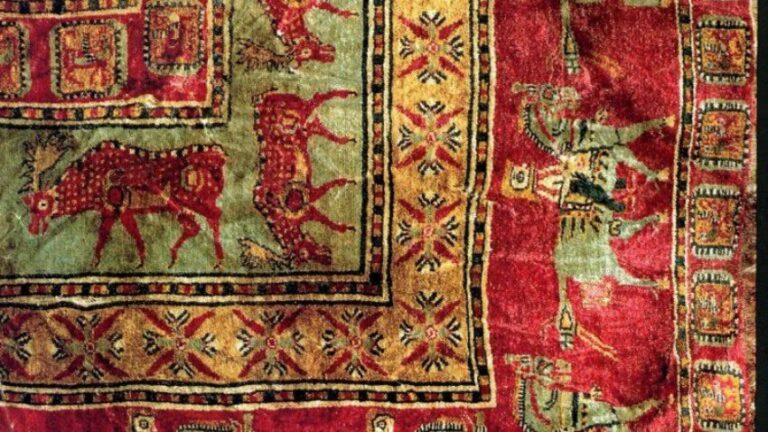
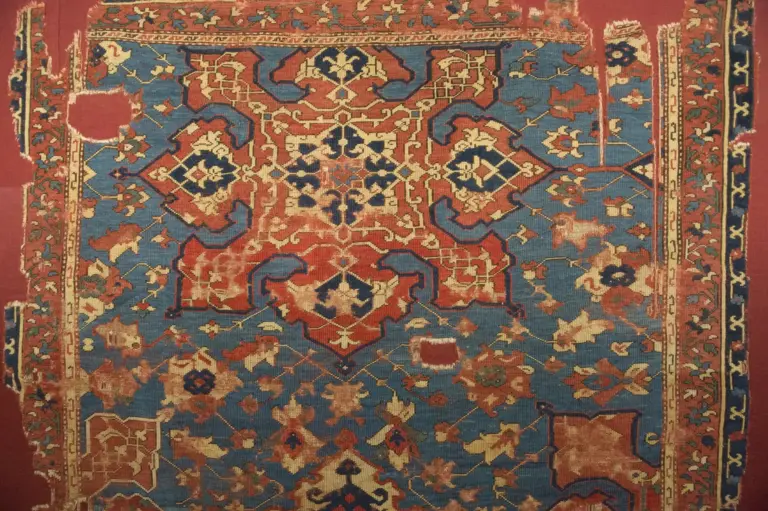
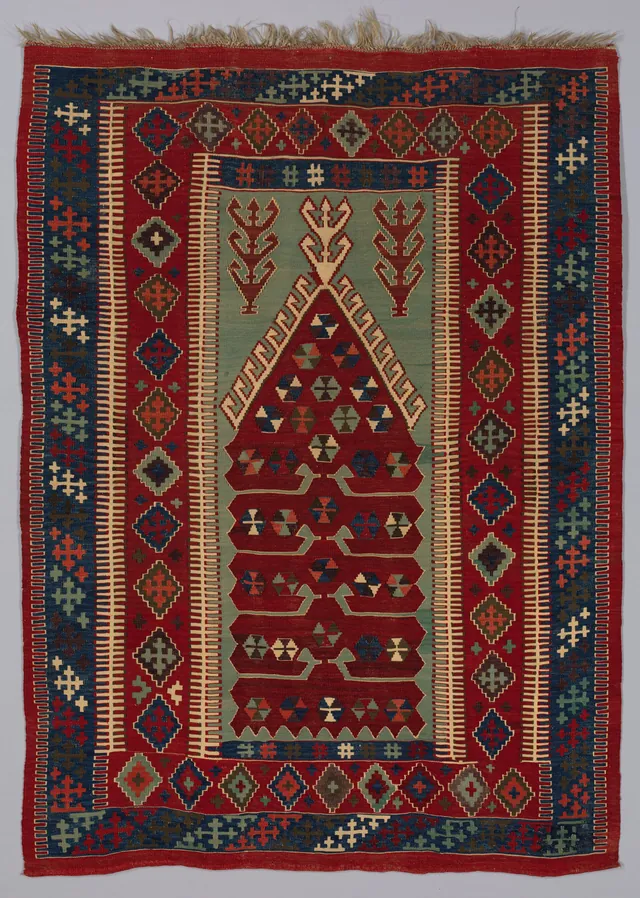
A kilim on show
Flat-woven kilim are often made in strips that are sewn together. The picture shows one half of a floor kilim; the second half was to be woven to match and joined by sewing, says the file description.
Wikimedia Commons file description
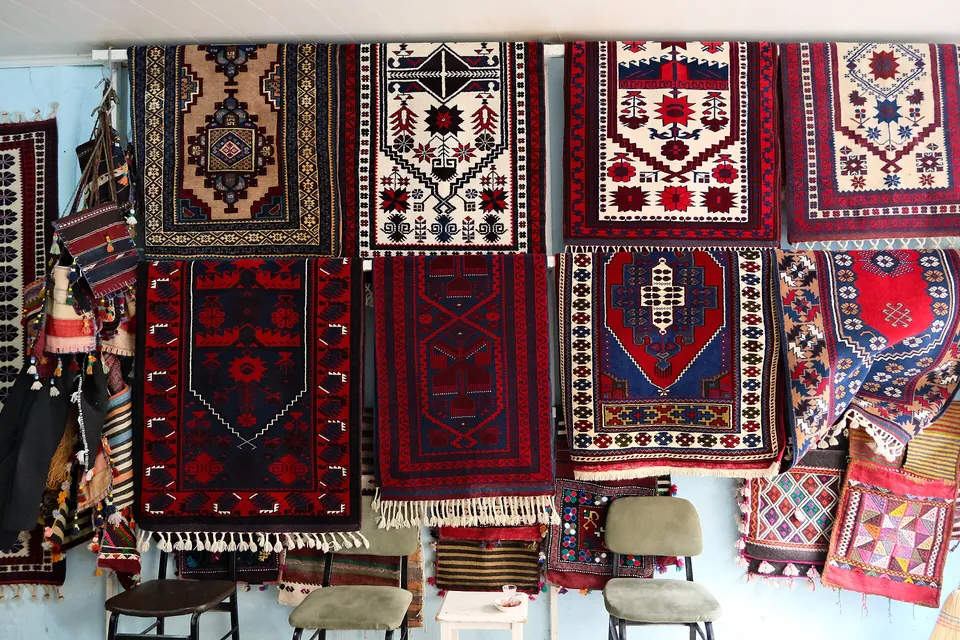
A wall of halı
The Yağcıbedir page names navy, dark blue, red, brown and fez-red as the main colours, with white as the line of the «road» and the water-shaped border. The carpets in the picture show those colours.
read 30.10.2026 · Kültür Portalı, Yağcıbedir El Halısı
Tile, glass, metal and shell: five things for the wall and the shelf
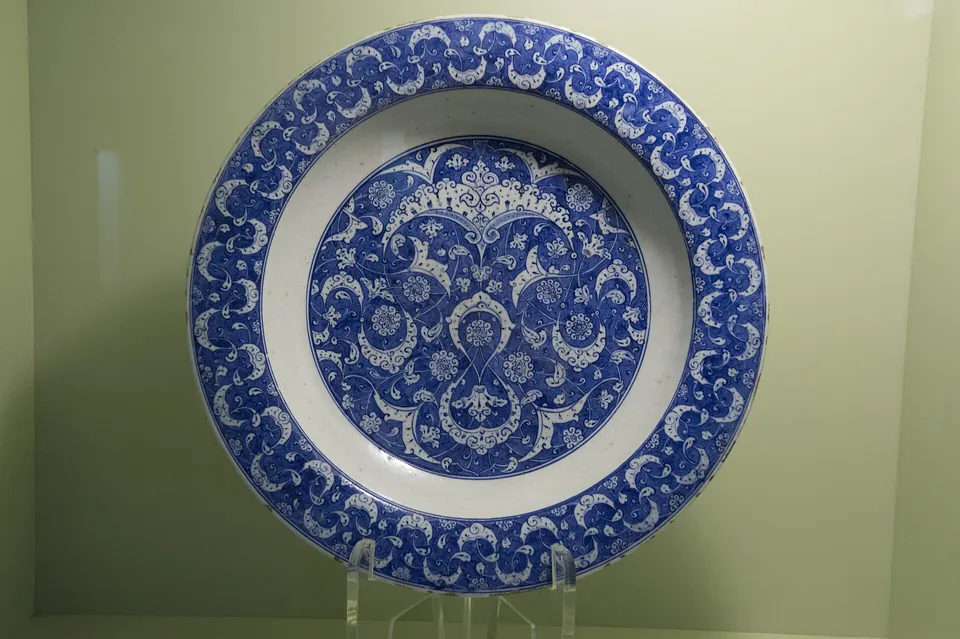
Çini: the painted tile
- The word
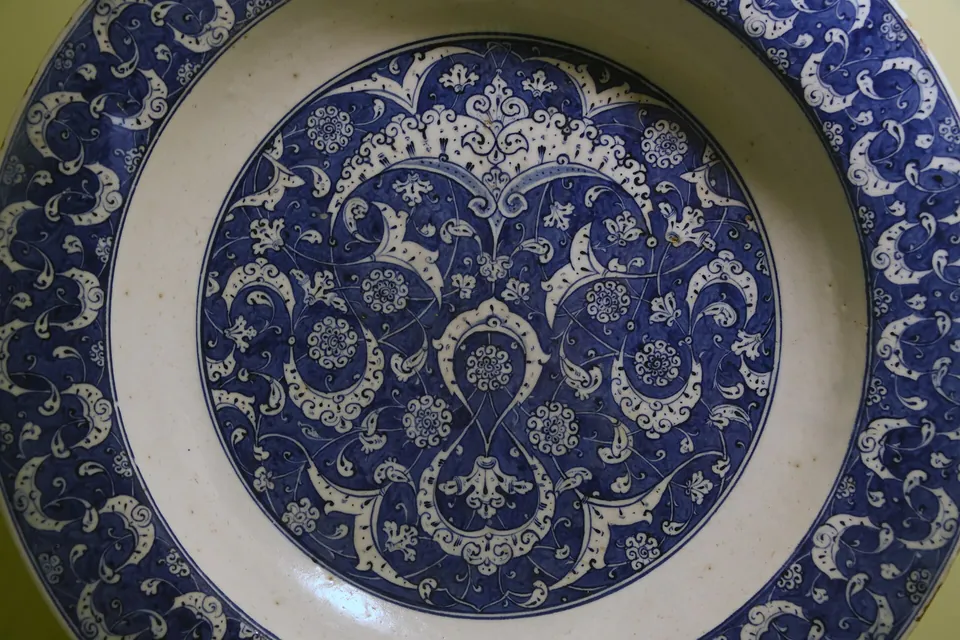
- An Ottoman-Persian word meaning «from China». Çini is ceramic with a white body, decorated with traditional motifs painted under a clear glaze. Evani is çini for dishes, kaşi is çini for wall tiles.
- İznik Çinisi
- Registered no. 137, menşe adı (name of origin): the features owe to the area and all production steps happen there.
- Made of
- Body, slip and glaze together are 75–85 % quartz.
- What sets it apart
- Motifs hand-painted under one clear glaze in cobalt blue, turquoise, purple and a black outline on a pure white slip. The coral red, also called tomato red, is İznik’s own: the page says no other tile or ceramic has it.
- In use
- The glaze does not take up water, so the tile can stay outdoors and in wet rooms for years.
- Listed
- UNESCO lists traditional çini-making craftsmanship since 2016.
read 30.10.2026 · Kültür Portalı, İznik Çinisi · ministry list of UNESCO intangible heritage
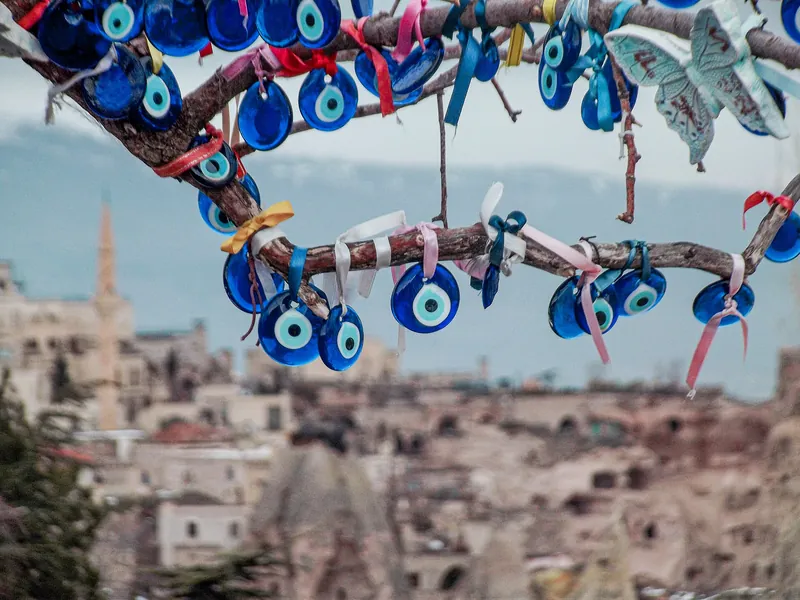
Nazar boncuğu: the blue eye bead
A bead of blue glass with rings like an eye. Nazar is the evil eye, the harm a look is believed to bring, and the bead is the charm against it.
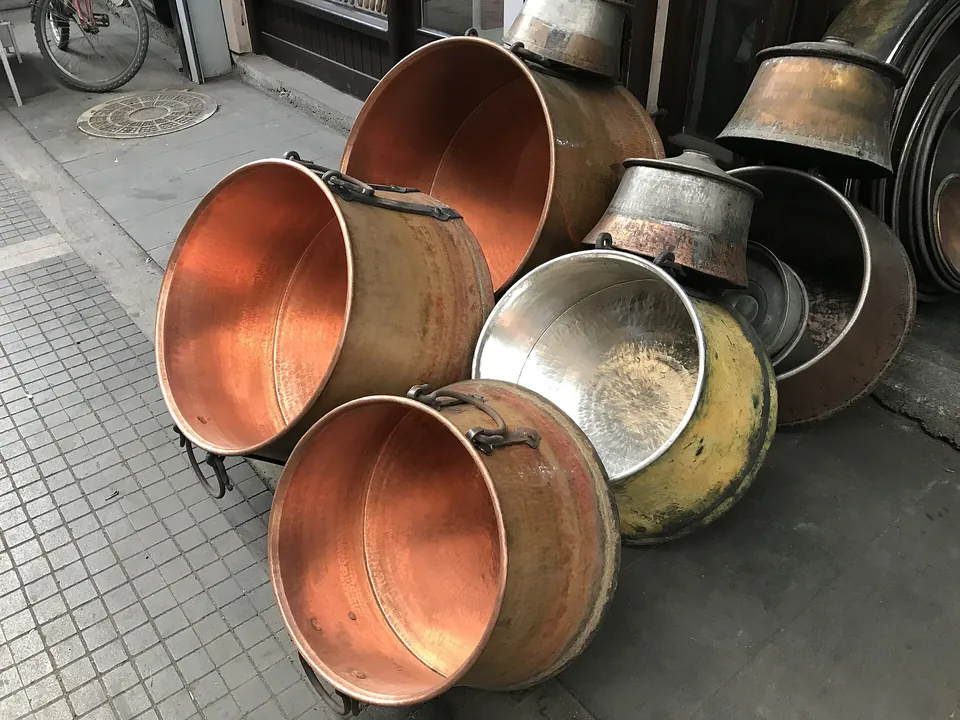
Bakır: copper
- Mardin
- The Coppersmiths’ Bazaar, Bakırcılar Çarşısı or Kazancılar Çarşısı, lies east of the Ulu Cami (Great Mosque). Most Mardin kitchenware was once copper, made from melted ingots into everything from the smallest plate to the largest cauldron. The page says the craft is being kept alive. Kültür Portalı · read 30.10.2026
- Amasya Semaveri
- Registered no. 1298, mahreç işareti. A semaver is a tea urn: a water tank round a central fire tube, a tap, and on top the demkeş, a seat for the teapot. Amasya’s are made by hand of copper or tin sheet 0.40 or 0.60 mm thick, about 35 or 50 cm tall. Amasya Semaveri · read 30.10.2026
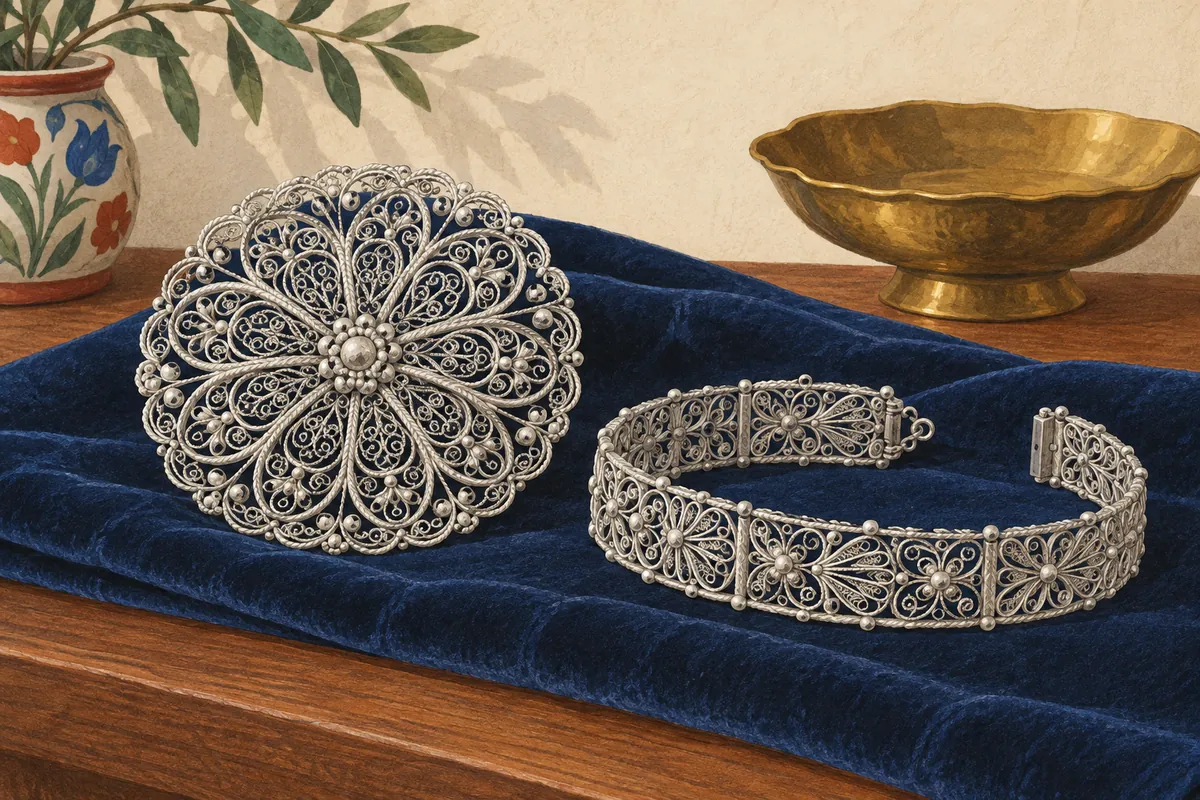
Telkari: silver wire
- What it is
- Jewellery made of very fine metal wire, silver or gold, twisted and coiled into open, lace-like patterns. Tel means «wire».
- Silver grade
- Van’s savatlı gümüş is silver with a black inlay called savat, a mixture of copper, lead, silver and sulphur. Its registered page, no. 242, sets the silver at no less than 900 ayar (grade of fineness), 950 ideal: lower grades blacken or turn red and hide the inlay. The motifs are cut with fine steel-tipped pens, and the page counts four workshops in Van today. Van Savatlı Gümüş İşlemesi · read 30.10.2026
- Leaving
- Jewellery has its own line: chapter 6.
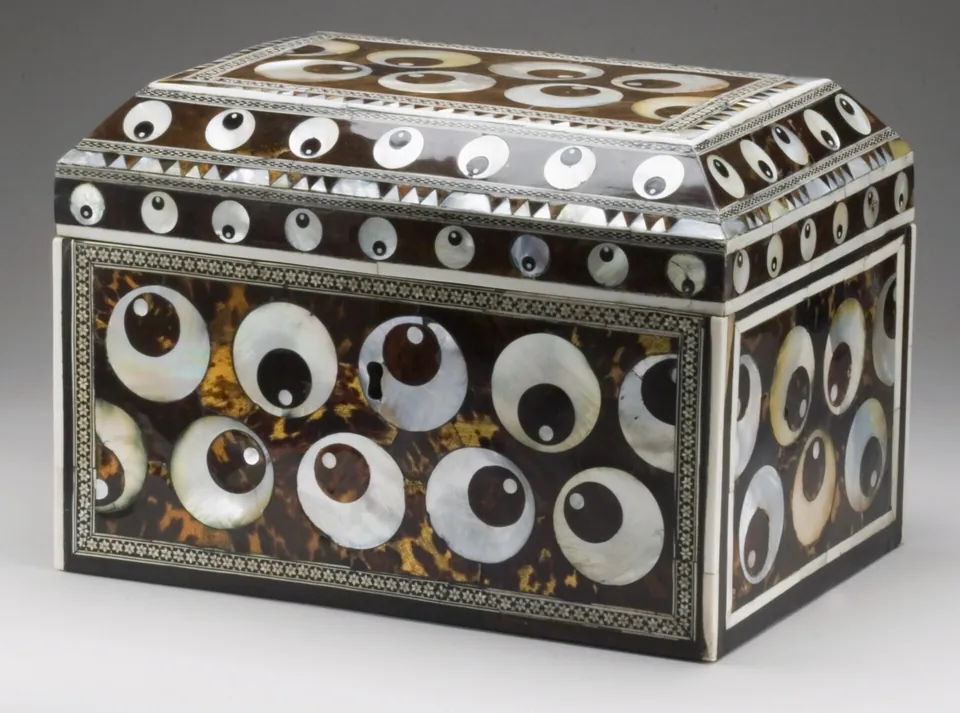
Sedef kakma: mother-of-pearl inlay
- What it is
- Sedef is mother-of-pearl, the shining inner layer of oyster and mussel shells; kakma is inlay. The maker is a sedefkâr.
- How
- Pieces of mother-of-pearl are set into hollows cut in dark wood, walnut, ebony or mahogany, and thin gold, silver or brass wire follows the motifs: geometric, floral or calligraphic. A fine file, sandpaper and polish finish the surface.
- Objects
- Sticks, mirrors, frames, candle holders, combs, tavla sets, tables and chairs, and tourist goods.
- Listed
- UNESCO lists it since 2023, for Türkiye and Azerbaijan.
read 30.10.2026 · Yaşayan Miras ve Kültürel Etkinlikler Genel Müdürlüğü, Sedef Kakma Sanatı
To wear, play and drink: yemeni, tavla, coffee and tea
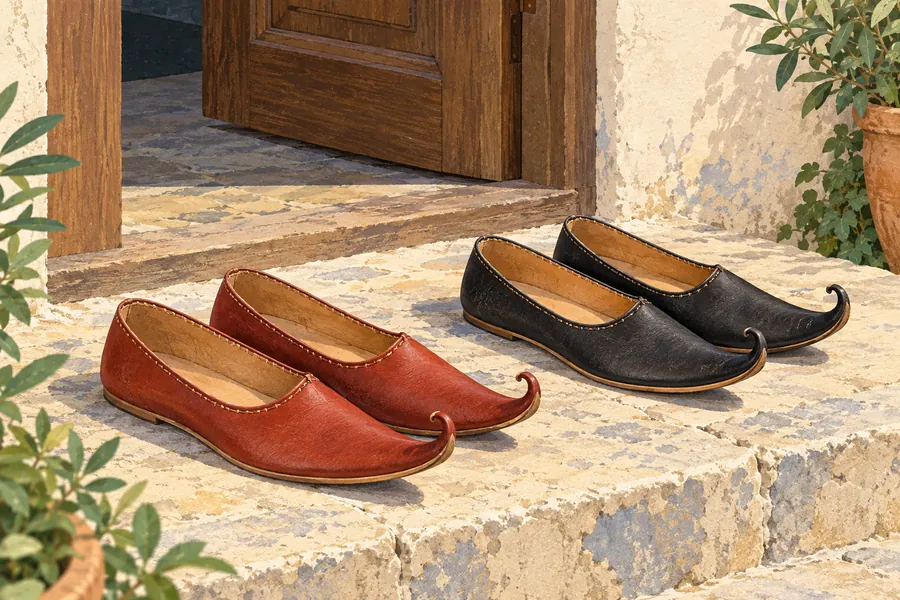
Yemeni: the soft shoe of Kahramanmaraş
- What it is
- A light shoe worn for centuries in Kahramanmaraş: no heel, a toe curled up like a spur, with ears (kulaklı) or without. It has no left and right.
- How it is made
- Calf leather upper (saya), thin goat-skin edging, sheep skin on top and water-buffalo skin below for the sole lining, clay between the layers, all sewn by hand with cotton thread.
- Colours
- Plant dyes: yellow from walnut shell, green from olive branch and leaf, purple from roots. Black (tulum yemeni) and red (gül şeftali, «rose peach») are the special colours.
read 30.10.2026 · Kültür Portalı, Kahramanmaraş Yemenisi
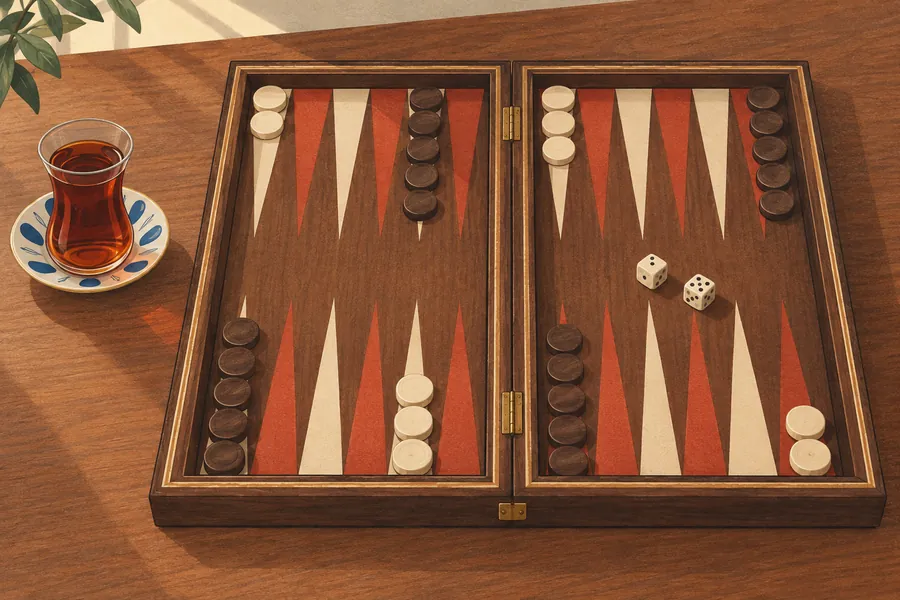
Tavla: the board game
Tavla is backgammon: a folding board of 24 narrow triangles, 30 round pieces and two dice. The ministry’s page on sedef kakma lists tavla sets among the everyday objects that carry mother-of-pearl inlay.
Turkish coffee in four steps, as the ministry gives it
- Into the cezvePut the finely ground coffee and the sugar into the cezve, add the water and stir.
- Heat slowlyHeat over low heat until the surface is frothy. Do not let it boil.
- Pour the frothPour the froth into the cup, a small porcelain demitasse. Return the cezve to the heat and bring it to a rising boil; pour some more.
- Once moreHeat once more to a rising boil, pour all into the cup and serve hot.
- Sweetness
- Sade is none, az şekerli about half a teaspoon, orta şekerli one teaspoon, çok şekerli one and a half.
- With it
- Lokum, a sweet or chocolate; usually served at midday or after a meal.
- A saying
- Bir fincan kahvenin kırk yıl hatırı vardır. The ministry gives it as: whoever has been offered one cup of coffee is obliged to the host for forty years.
- Listed
- UNESCO lists Turkish coffee culture and tradition since 2013.
read 30.10.2026 · Ministry of Culture and Tourism, Turkish Coffee · ministry list of UNESCO intangible heritage
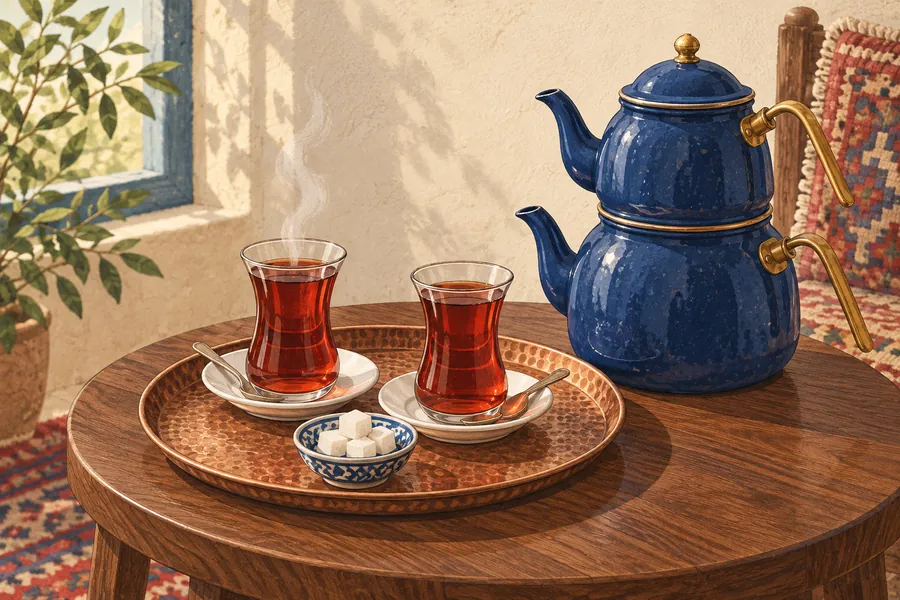
Çay: Rize tea
- What it is
- Black tea. The leaf is withered, rolled, left to oxidise and dried.
- Rize Çayı
- A registered name of origin: applied for on 15.08.2017, registered on 26.03.2021. The page explains that a picked leaf starts to spoil at once, so the growing area and the processing plants must lie in the same area.
- Listed
- UNESCO lists tea culture, a symbol of identity, hospitality and social interaction, since 2022.
read 30.10.2026 · Rize İl Kültür ve Turizm Müdürlüğü, Rize Çayı
More: Tea Culture in Türkiye · The History of Turkish Coffee
Sweets, spice and soap: lokum, baharat and sabun
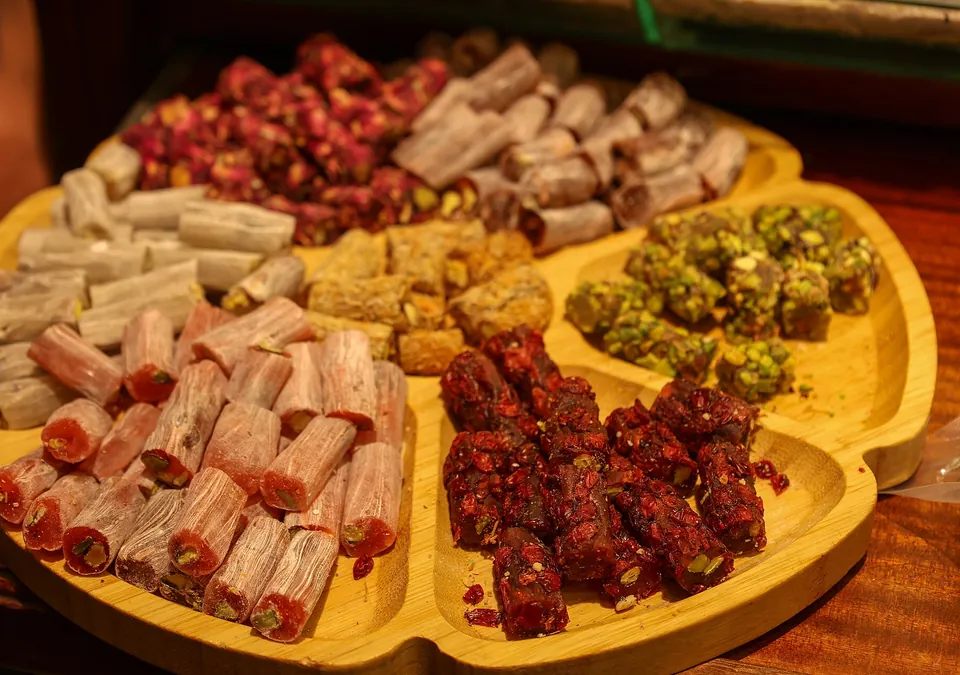
Lokum: Turkish delight
- The word
- From the Ottoman rahat ul-hulküm, «what soothes the throat». Known in Anatolia since about the 15th century and widespread under the Ottomans in the 17th; it reached Europe as «Turkish Delight» through an English traveller in the 18th century.
- Safranbolu
- The tourism office calls its lokum lighter than other lokum, with no sugary taste left in the mouth. Kinds: plain and with saffron, hazelnut, double-roasted pistachio, rose or coconut. Safranbolu Turizm Danışma Bürosu · read 30.10.2026
- Bafra Kaymaklı Lokum
- Registered no. 482, mahreç işareti. A dough of sugar, starch and limon tuzu (citric acid) joined with kaymak, clotted cream, from the milk of water buffalo raised in the Kızılırmak Delta. Bafra Kaymaklı Lokum · read 30.10.2026
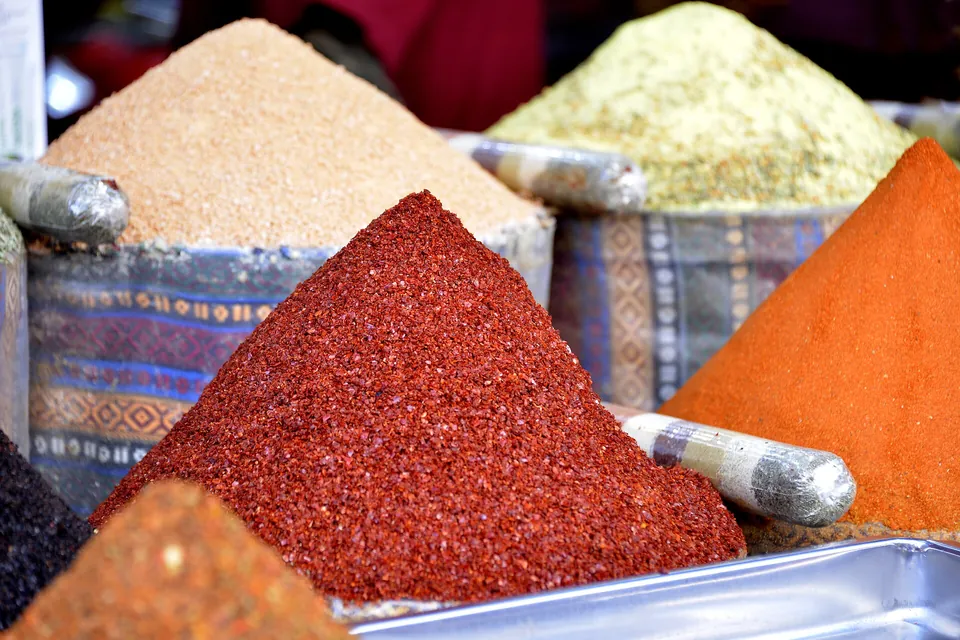
Baharat: spice
- Mısır Çarşısı
- The Egyptian Bazaar, by the Yeni Cami in Eminönü, Istanbul, was built in 1660 under Valide Turhan Sultan by the architect Kasım Ağa. In the 1600s spices from Egypt were distributed from it; today it sells spices from Türkiye and the world, and gifts. İstanbul İl Kültür ve Turizm Müdürlüğü · read 30.10.2026
- Maraş Biberi
- Registered no. 43, menşe adı. A thin-fleshed red pepper sold ground (toz), as flakes (pul) and as isot. It is sown in February–March and picked red from August; dried, it loses 75–80 % of its weight as water, in 8–12 days in the sun or 3–4 hours in a fan oven. Maraş Biberi · read 30.10.2026
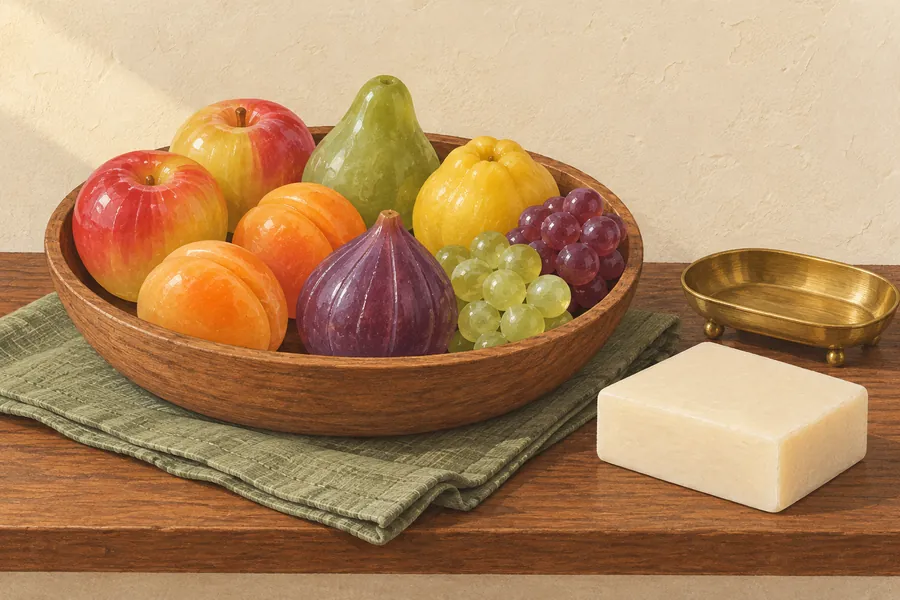
Sabun: Edirne fruit soap
- What it is
- Mis meyve sabunu, «fragrant fruit soap»: soap hand-shaped and coloured like real fruit, among them melon, quince, peach, lemon, banana, pomegranate, apples, plum, apricot, grapes, pears, figs and cherry.
- History
- The Culture Portal dates it to the 1600s, when musk, amber and rose scent went into it and it was given at the Ottoman court. A district of Edirne was named Sabuni. Kept dry, the page says, it keeps its look for 10–15 years.
- Registered
- Edirne Mis Meyve Sabunu, no. 452, mahreç işareti. The name must be easy to see on the product.
read 30.10.2026 · Kültür Portalı, Edirne Mis Meyve Sabunu
Olive oil and food in general
Ayvalık, Aydın Memecik and Kilis olive oils are on the Culture Portal’s list of registered foods; more in Olive Production in Türkiye. Food that crosses a border follows the rules of the country you fly to: Shopping in Edirne has a tool for food into the EU. Kültür Portalı, Gıda · read 30.10.2026
A name on the product: coğrafi işaret
A coğrafi işaret, a geographical indication, marks a product whose features or fame come from the area it is named after. The Culture Portal’s own examples are Antep baklavası, Malatya kayısısı and Aydın inciri.
- Menşe adı
- Name of origin. The features owe to the area and all production steps happen there. İznik çinisi, Maraş biberi and Rize çayı are of this kind.
- Mahreç işareti
- Indication of source. A clear feature or the fame comes from the area. The kilim, the yemeni, the semaver, the fruit soap and Bafra lokum are of this kind.
- Geleneksel ürün adı
- Traditional product name. A name used for at least thirty years to describe a product, outside the first two.
- The emblem
- With a geographical indication on a product, the emblem must be shown. For a traditional product name it is optional.
read 30.10.2026 · Kültür Portalı, Coğrafi İşaretli Ürünler
On the Culture Portal’s lists
39 hand-crafts, 227 foods, 92 farm products.
The rugs, çini, yemeni, semaver, savat silver, fruit soap, lokum, tea and pepper on this page come from those lists, which credit the Türk Patent ve Marka Kurumu.
Counted on 30.10.2026 · El Sanatları · Gıda · Tarım
Where the name is on a product
- The nameThe product is sold under its registered name, for example Karatepe Kilimi or Edirne Mis Meyve Sabunu.
- The emblemThe emblem sits on the product or its package. For Karatepe, Çanakkale, Amasya Semaveri and Bafra lokum the pages add: if that is not possible, the name and emblem are kept where they are easy to see at the workplace.
- The pageEach registered product has its own page on the Culture Portal, with its number and what sets it apart.
read 30.10.2026 · Kültür Portalı
What may not leave: old pieces and jewellery
- Protected cultural property cannot be taken abroad. Under law 2863, movable cultural and natural property that must be protected inside Türkiye cannot leave the country.
- A piece outside registration can leave with the document. Objects that the museum directorates (müze müdürlükleri) certify as outside registration (tescil dışı) can be taken abroad if the prepared document is shown.
- Jewellery has its own line. Personal, non-commercial jewellery (ziynet eşyası) of precious metal and stones up to 15,000 US dollars in value may leave; above that, leaving depends on the entry declaration or proof of purchase in Türkiye.
read 30.10.2026 · Kültür Varlıkları ve Müzeler Genel Müdürlüğü · Ticaret Bakanlığı, Gümrük Muhafaza SSS
Who decides
Whether an old rug or object is protected is for the museum directorate to say. The ministry’s page names no age limit, no penalty and no steps for applying, so none is given here.
Eser means «work» or «piece»; belge is the document.
read 30.10.2026
- Bu eserin müze müdürlüğünden alınmış belgesi var mı?Does this piece have a document from the museum directorate?
Getting the tax back: KDV iadesi
KDV is the value-added tax; KDV iadesi is its refund. When a traveller who does not live in Türkiye buys goods and takes them out of the country, the tax paid on them is refunded as the goods leave through customs. Shops call this «tax-free».
- Who
- Foreign nationals who do not live in Türkiye, and Turkish citizens who live abroad and hold a residence document from that country. The Customs Guide and the Ticaret Bakanlığı FAQ count someone who has not lived in Türkiye for more than 185 days, counting back.
- The minimum
- The prices on the invoice add up to more than 1,000 TL, VAT not counted. Different goods on the same invoice count together. GİB, KDV Genel Uygulama Tebliği, II/A-5.3 · read 30.10.2026
- What counts
- Goods, not services.
- The time
- The goods leave Türkiye within 3 months of the invoice date.
- The shop
- A seller with a permit (izin belgesi) from the tax office, which hangs in a visible place in the shop, or one that works with a company authorised by the Revenue Administration (Gelir İdaresi Başkanlığı, GİB).
- The invoice
- The seller adds the VAT as a separate line and writes your passport type and number on it.
- How it is paid
- At the bank branch at customs, against the seller’s cheque, in foreign currency or lira; or after you leave: the stamped invoice goes back to the seller within 3 months and the seller pays within 10 days; or through an authorised intermediary company.
read 30.10.2026 · GİB, KDV Genel Uygulama Tebliği, 5.1–5.6 (PDF) · Gümrük Rehberi, Tax-Free · Ticaret Bakanlığı SSS
The rule in one line
Above 1,000 TL, out in 3 months, one stamp.
The invoice is above 1,000 TL before VAT, the goods leave Türkiye within 3 months of the invoice date, and customs sees the goods and approves the invoice.
The minimum was 100 TL until the GİB amendment of series no. 49 took it to 1,000 TL from 01.02.2024. GİB · read 30.10.2026
At the border, in four steps
- At the shopThe authorised shop gives you a printout of the e-fatura, the electronic invoice.
- At the deskWhen you leave, go to the customs tax-free desk (tax-free bankosu) with the goods and the printout.
- The checkThe customs officer looks at the goods and the e-fatura. If the conditions are met, customs approves the invoice and sends it on to the intermediary company (aracı firma).
- The refundThe intermediary company pays the VAT back to you.
read 30.10.2026 · Gümrük Rehberi, Tax-Free (Ticaret Bakanlığı), page stamp 04.01.2019, used for the steps only
Shopping in Ankara has a calculator for this refund and a warning about old pieces.
Words to say: seven lines to copy
Fatura is an invoice and fiş is the receipt from a till. Press Copy and show the line on the screen.
- Bu el yapımı mı?Is this handmade?
- Bu hangi yöreden?Which area is this from?
- Tax-free fatura alabilir miyim?Can I have a tax-free invoice?
- E-fatura çıktısı alabilir miyim?Can I have the e-fatura printout?
- Yurt dışına götüreceğim.I will take it abroad.
- Paketler misiniz?Could you wrap it?
- Orta şekerli, lütfen.Medium sugar, please (coffee).
Where to look: bazaar, market and the city pages
- Çarşı
- A market street or bazaar, a place of shops.
- Kapalı çarşı
- A covered bazaar.
- Pazar
- A market, often one that sets up on a fixed day.
- Pazarlık
- Bargaining. Only the word is given here.
- Istanbul
- Markets and Bazaars in Istanbul
- Ankara
- Shopping in Ankara, with the tax-free calculator and the old-piece warning.
- İzmir
- Shopping in İzmir
- Konya
- Shopping in Konya
- Antalya
- Shopping in Antalya
- Edirne
- Shopping in Edirne, with the tool for food into the EU.
- Supermarkets
- Supermarkets in Türkiye
Sources and limits
The page gives no price, names no shop and ranks nothing. Nazar boncuğu, telkari and tavla are given by meaning only; sedef kakma is placed no closer than «Anatolia». Rules of the country you fly to and the rules for cash at the border are not covered. Rules change, so read the sources before you travel.
Show the pages checked
- Coğrafi İşaretli Ürünler — T.C. Kültür ve Turizm Bakanlığı, Kültür Portalı, read 30.10.2026
- El Sanatları (39 registered hand-crafts, counted) — Kültür Portalı, read 30.10.2026
- Gıda (227 registered foods, counted) — Kültür Portalı, read 30.10.2026
- Tarım (92 registered farm products, counted) — Kültür Portalı, read 30.10.2026
- İznik Çinisi — Kültür Portalı, read 30.10.2026
- Karatepe Kilimi — Kültür Portalı, read 30.10.2026
- Beytüşşebap Jirki Kilimi — Kültür Portalı, read 30.10.2026
- Bayat Türkmen Kilimi — Kültür Portalı, read 30.10.2026
- Yağcıbedir El Halısı — Kültür Portalı, read 30.10.2026
- Çanakkale El Halısı — Kültür Portalı, read 30.10.2026
- Kahramanmaraş Yemenisi — Kültür Portalı, read 30.10.2026
- Amasya Semaveri — Kültür Portalı, read 30.10.2026
- Van Savatlı Gümüş İşlemesi — Kültür Portalı, read 30.10.2026
- Edirne Mis Meyve Sabunu — Kültür Portalı, read 30.10.2026
- Bafra Kaymaklı Lokum — Kültür Portalı, read 30.10.2026
- Maraş Biberi — Kültür Portalı, read 30.10.2026
- Bakırcılar Çarşısı, Mardin — Kültür Portalı, read 30.10.2026
- Safranbolu Lokumu — Safranbolu Turizm Danışma Bürosu, T.C. Kültür ve Turizm Bakanlığı, read 30.10.2026
- Fatih Mısır Çarşısı — İstanbul İl Kültür ve Turizm Müdürlüğü, read 30.10.2026
- Rize Çayı — Rize İl Kültür ve Turizm Müdürlüğü, read 30.10.2026
- Turkish Coffee — T.C. Kültür ve Turizm Bakanlığı, read 30.10.2026
- UNESCO Somut Olmayan Kültürel Miras Listelerinde Türkiye — Yaşayan Miras ve Kültürel Etkinlikler Genel Müdürlüğü, read 30.10.2026
- Sedef Kakma Sanatı — Yaşayan Miras ve Kültürel Etkinlikler Genel Müdürlüğü, read 30.10.2026
- Yurtdışına kültür varlığı çıkarmak istiyorum ne yapmalıyım? — Kültür Varlıkları ve Müzeler Genel Müdürlüğü, read 30.10.2026
- Katma Değer Vergisi Genel Uygulama Tebliği, II/A-5 (PDF, with amendments) — Gelir İdaresi Başkanlığı, read 30.10.2026
- Tax-Free (page stamp 04.01.2019) — Gümrük Rehberi, T.C. Ticaret Bakanlığı, read 30.10.2026
- Gümrük Muhafaza: Sıkça Sorulan Sorular — T.C. Ticaret Bakanlığı, read 30.10.2026
General information on goods and rules that change; check the current rules before you buy or travel.