Pharmacist Careers in Turkey: Qualification Routes, EUS and 2026 Fees
Table of Contents
PROFESSION & CAREERS · SOURCES CHECKED 2 OCTOBER 2026
A pharmacy degree is the starting point. To build a pharmacist career in Turkey, you also need to understand the right to practise, diploma registration and the rules for the work you want to do.
This guide separates the Turkish-degree and foreign-degree routes, explains YÖK equivalence and the STS exam, and shows where EUS specialty training and community-pharmacy ownership fit. Use the route and cost planner to prepare questions for the relevant authority. It does not decide a personal application.

Can a foreign citizen work as a pharmacist in Turkey?
The ordinary conditions in Article 2 of Law 6197 include Turkish citizenship, a qualifying pharmacy diploma, Ministry of Health registration and the absence of the law’s professional impediments. Having a Turkish degree does not remove the citizenship condition. The Ministry of Labour’s work-permit annotations explicitly state that an ordinary work permit does not authorize a foreign national to practise pharmacy.
That distinction matters before you pay for translations or exams. Residence permission, a job offer and academic equivalence answer different questions; none of them, by itself, establishes the right to carry out a regulated pharmacist role.
Mavi Kart and other special cases
The official Mavi Kart explanation preserves certain work rights while keeping professional obligations and special laws in force. A retained-rights or special-status case therefore needs review by the competent authority. This page cannot turn a card, an exemption or a nationality description into an automatic approval or rejection.
The useful first enquiry
Ask the Ministry of Health registration unit and the provincial health directorate about the exact job you want. Give your citizenship or special-status basis, diploma country and intended duties. Request a written explanation of the procedure that applies. If you are considering an industry role, include the job description: working for a pharmaceutical company and practising as its responsible pharmacist can involve different requirements.
For ordinary foreign-national cases, resolve the professional restriction before treating the practice route as available. For special cases, keep the authority’s reply with your file. The planner deliberately stops at that status review.
Diploma, denklik and tescil mean different things
Diploma
Your university award records the education you completed. Turkish and overseas qualifications follow different administrative routes.
Denklik
YÖK assesses the equivalence of a foreign diploma. Recognition of the institution, or tanıma, does not alone establish diploma equivalence.
Tescil
Ministry of Health diploma registration is a separate step. It does not replace the legal conditions for the profession.
Start the administrative checklist with the Ministry’s pharmacy registration unit. Its published remit includes Turkish graduates, foreign-degree holders after equivalence and relevant cases of later acquisition of citizenship. Confirm your own category and document list there.
If you study pharmacy in Turkey
Check the faculty’s curriculum, teaching language, tuition and practical-training arrangements before applying. As a concrete example, Hacettepe’s pharmacy program lasts five years, uses Turkish, includes laboratory work and internships, and requires at least 300 ECTS credits for graduation. Those facts describe that program; use the chosen university’s current information for your own application.
Study admission and permission to practise should both be checked at the start. An international student can otherwise complete a degree while still facing a separate professional-status question afterward. Do not use a university acceptance letter as a substitute for that answer.

If your pharmacy degree is from another country
Use YÖK’s category-specific application checklists. They distinguish Turkish and foreign citizens and include special country or document situations. Assemble a file against the relevant list rather than copying a graduate’s old application.
- Identify the qualification precisely. Record the university, campus, program, study dates and any transfer between institutions. Check institutional recognition before assuming the diploma will be accepted.
- Match the evidence to the checklist. Group the diploma and certified Turkish translation, transcript and study details, identity evidence, required forms and consent. Check the category-specific requirements for original documents, study-country residence or entry and exit records.
- Prepare the pharmacy internship evidence. YÖK’s checklist requests proof of a one-month internship in a pharmacy registered with the pharmacists’ chamber in Turkey. Confirm how to arrange and document it for your case.
- Complete the official application stages. Use the online preliminary application and the appointment procedure described by YÖK. Keep receipts and submission records; respond to requests for additional evidence.
- Follow the actual academic decision. Verification, STS or missing academic and practical requirements may affect the next step. Avoid setting a job start date around an assumed processing time.
One month is not one year. The internship in YÖK’s equivalence checklist and the qualifying assistant-pharmacist service for covered community-pharmacy applicants serve different purposes. Do not assume one replaces the other.
YÖK’s assessment information identifies ÖSYM as the pharmacy STS examination authority. The result for your file determines which requirements apply; a foreign-degree selection in a website tool cannot make that decision.
Plan the route and the fees you actually select
Start with legal status. The map organizes topics to confirm; it does not approve eligibility, require an exam or instruct you to pay. Choices stay on this page.
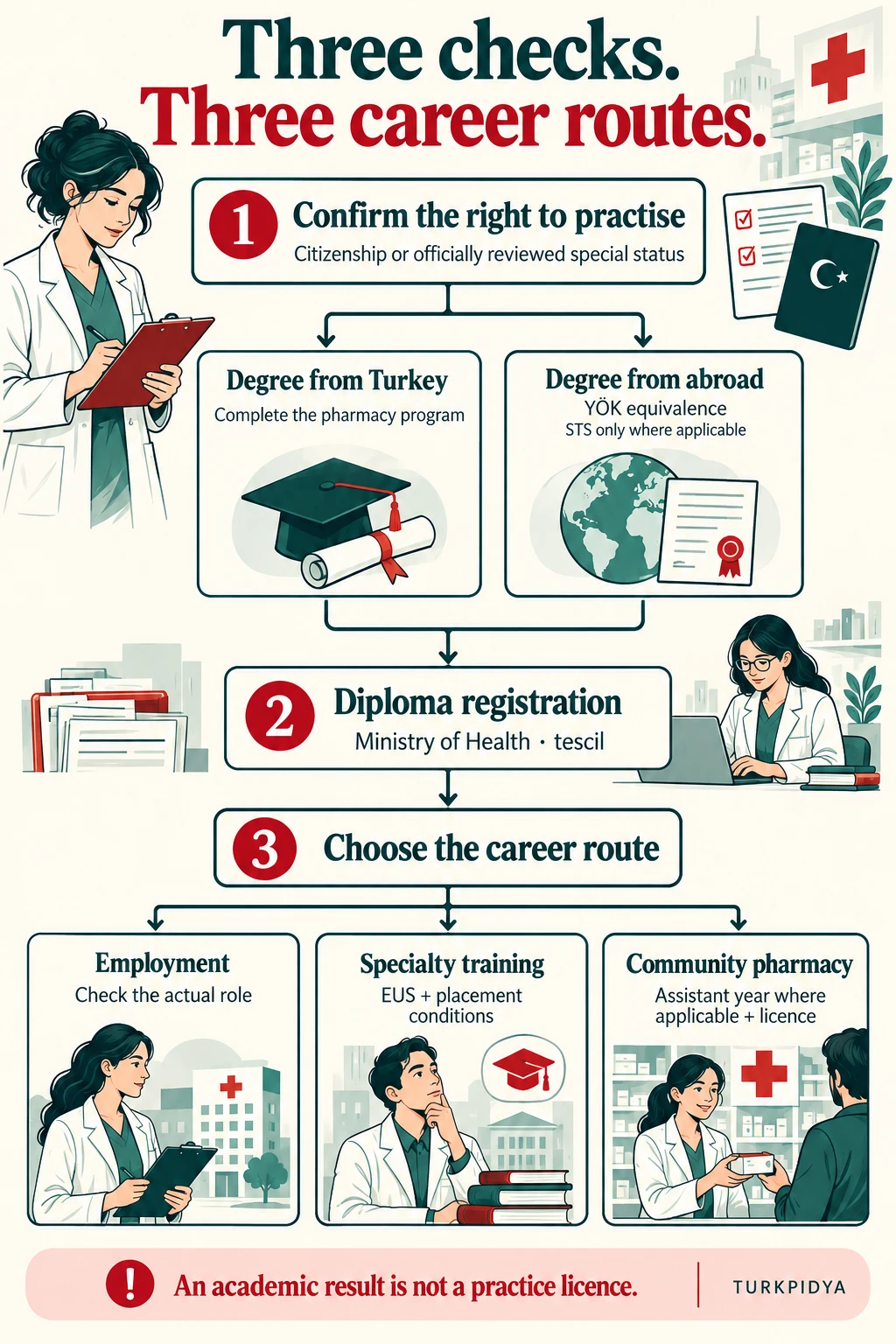
STS checks a foreign qualification; EUS is for specialty training
STS Eczacılık
The 2026 STS Pharmacy guide places STS within the overseas-diploma equivalence process. It describes candidates directed to the exam by YÖK and a provision for taking it before a file’s STS decision, with validity conditional on the later decision. That is a rule to verify with YÖK and ÖSYM, not a reason to assume every overseas graduate must register.
The 2026 guide specifies 75 multiple-choice questions, 110 minutes and at least 40 points out of 100 for success. It also ties the equivalence document to completion of any missing courses and internship training. Passing STS alone therefore does not finish every equivalence file or grant the right to practise.
EUS
The 2026 EUS guide governs selection for pharmacy specialty training. Placement requires the professional conditions in Law 6197 and English-language evidence: at least 50 in the specified examination or an accepted equivalent. The guide gives language results a five-year validity period, calculated using the first day of the relevant EUS application period.
The Ministry’s specialty-training pages list Clinical Pharmacy and Phytopharmacy curricula. Available places must come from the current EUS program table. Read that table, preference instructions and appointment conditions together. An exam score or placement is not a promise that an institution will appoint an applicant who does not meet its conditions. EUS does not replace denklik and is not a universal entrance exam for every pharmacy job.
The dated 2026 exam snapshot
The ÖSYM announcement gives 23 September–1 October for standard applications and 7 November for both exams. The guides give 2 October as the fee deadline for standard applications already made, and 8 October as the late-application day. Late fees are paid that day. Both exams are scheduled for 13:45 on 7 November, so a subtotal containing both exams describes separate planned stages, not two same-day bookings. Check for later official notices before acting.
What the published fees do—and do not—cover
| Item | Standard fee | Scope |
|---|---|---|
| YÖK equivalence application | 1,250 TL | 2026 application or reconsideration fee; the appointment date determines the fee period. |
| STS Pharmacy | 2,500 TL | Separate exam application, if relevant. Late application: 3,750 TL. |
| EUS | 2,500 TL | Separate specialty-training exam. Late application: 3,750 TL. |
The YÖK fee notice applies from 1 January to 31 December 2026. It also says school-recognition letters are free. The 1,250 TL amount is an application charge, not a package including translations, certification, travel or further training.
For example, selecting a 1,250 TL equivalence application and a standard 2,500 TL STS application produces a 3,750 TL known-fee subtotal. Selecting the late STS fee instead produces 5,000 TL. Neither figure establishes that you need STS or captures your entire budget.
The exam guides list specific fee exemptions. Enter an exemption in the planner only after confirming it applies. If you do not know a fee or have not decided to apply, leave that choice unknown. “Not planned,” “confirmed exemption,” “already completed” and “cost unknown” are different situations.
Get separate quotes for document preparation, travel, any required academic or practical completion and registration or licensing costs. For pharmacy ownership, also budget for the property, equipment, stock, insurance and working capital. No universal current opening or tescil price is supplied here; an unknown amount is excluded from the subtotal rather than treated as zero.
Employment is a different decision from pharmacy ownership
Compare job duties before comparing titles. A hospital post, a second-pharmacist position, a responsible-manager role and an industry vacancy can lead to different document and recruitment questions. Ask what professional responsibility you will carry and how the position will be recorded.
| Setting | What to establish before accepting |
|---|---|
| Hospital pharmacy | Professional authorization, recruitment terms, duties and whether documented service can count toward the next stage you need. |
| Community pharmacy | Whether the role is assistant pharmacist, second pharmacist or responsible manager; the contract and official service records. |
| Pharmaceutical industry | The actual regulated duties, required qualifications, language and employer recruitment conditions. |
| Specialty training | Current EUS requirements, language evidence, program conditions and appointment procedure. |
How to assess an offer without a misleading salary average
Ask for gross and net pay, working hours, duty shifts, social-insurance registration and the treatment of overtime or other payments. Check any current professional minimum for the exact role with the regional chamber. A job advertisement, a responsible-manager minimum and a pharmacy’s turnover are not interchangeable income figures.
For an owner, sales revenue is not take-home pay. Rent, staff, stock, operating costs and financing can change the result. This guide does not give an undated national salary range or a guaranteed pharmacy profit.
Language is part of everyday work
Discuss the language expected for patient conversations, prescriptions, records and internal procedures during an interview. A program taught in another language does not establish readiness for every Turkish workplace. For specialty training, use the separate formal English-language rule in the current EUS guide; do not confuse it with the communication demands of the job.

When does the assistant-pharmacist year start?
The TİTCK rules revised on 21 July 2026 cover relevant entrants to pharmacy studies in 2013 or later seeking community-pharmacy ownership or responsible management. They require at least one qualifying year unless an applicable exception or accepted service applies. Hospital-pharmacy work and second-pharmacist service can be relevant; confirm the recorded role and evidence rather than counting any pharmaceutical-industry job automatically.
- Before starting: ask the regional chamber and provincial directorate whether the requirement applies and how the role must be registered.
- At the start: complete the required notifications and document submission. Keep the directorate’s record, the contract and social-insurance evidence.
- During service: retain documentation of periods worked and changes of workplace or status.
- After service: request the official completion confirmation. A signed contract alone does not establish that a year has been accepted.
For a self-arranged position, section 7.1.4 uses the date when the complete required documents reach the provincial health directorate as the recorded start date. The July revision also addresses specified İŞKUR support and earlier missed-notification cases. Ask the directorate to assess those provisions rather than calculating retrospective credit yourself.
If you cannot arrange a placement, the TEB placement notices explain the chamber and Eczacı Bilgi Sistemi process. The September 2026 notice describes a completed round; use the next announced timetable rather than treating past dates as an open application window.
Opening an eczane adds placement, premises and licensing
A community pharmacy is both a regulated professional establishment and a business. Law 6197 sets the ordinary district population criterion at one pharmacy for at least 3,500 residents, with exceptions and preserved rights. Available locations and placement procedures still have to be checked; dividing a town’s population by 3,500 does not establish an opening right.
Resolve the assistant-year requirement or an applicable preserved right, then check the current TİTCK placement route and the province’s opening procedure. Do that before relying on a lease, a transfer offer or a promise that a suitable shop is enough.
The Trabzon checklist updated on 17 July 2026 is a useful provincial example. It describes premises requirements, including the ordinary minimum area, building-use evidence and other documentation. Ask your own directorate for its current list and applicable exceptions. Copy counts or document-validity periods from one province should not be treated as a nationwide promise.
Before committing money to premises
Get answers to four concrete questions: Do I have the professional right for this role? Is the assistant-service requirement completed or inapplicable? Which placement or preserved-rights basis will the application use? Can this property satisfy the directorate’s current requirements?
Then build the business budget separately. A completed qualification route does not guarantee a licence, a location or commercial success.

The next steps to put in your file
- Write down the role: employment, specialty training or community-pharmacy ownership. Include the duties, not just the vacancy title.
- Resolve status first: keep the competent authority’s response on citizenship, special rights or the professional restriction.
- Build the qualification checklist: use the current university or YÖK route. Record missing documents and the authority responsible for each next decision.
- Separate the confirmations: equivalence, registration, accepted service and licensing are distinct records. Keep each decision with its date.
- Price only the chosen steps: note the official fee, the applicable application period and your separate quotes. Do not pay an exam charge merely because an online planner shows it.
That gives you a practical starting file: a clear target role, the status answer, the relevant document list and a partial budget with unknowns still visible.
Official sources and dates
Checked 2 October 2026. Follow later notices and the procedure for your actual file.
- TEB: Law 6197 — professional conditions, community-pharmacy placement and licensing framework.
- Ministry of Labour: work-permit annotations and Mavi Kart — ordinary professional restriction and special-status context.
- YÖK: equivalence application and assessment system — checklists and pharmacy-specific internship evidence; 2026 fee notice — 1 January–31 December 2026.
- Ministry of Health registration unit — remit published 22 July 2025; Hacettepe program — one Turkish-degree example.
- 2026 STS Pharmacy guide and 2026 EUS guide — fees, deadlines and their separate conditions; 23 September 2026 announcement.
- TİTCK assistant-pharmacist rules — 21 July 2026 revision; TEB’s 11 September placement notice.
- Trabzon opening checklist — updated 17 July 2026, used as a provincial example.