

AFAD in Turkey: Before, During and After a Disaster
What AFAD and other state bodies tell residents and visitors to do before, during and after an earthquake, with a plan tool for your flat.
Table of Contents
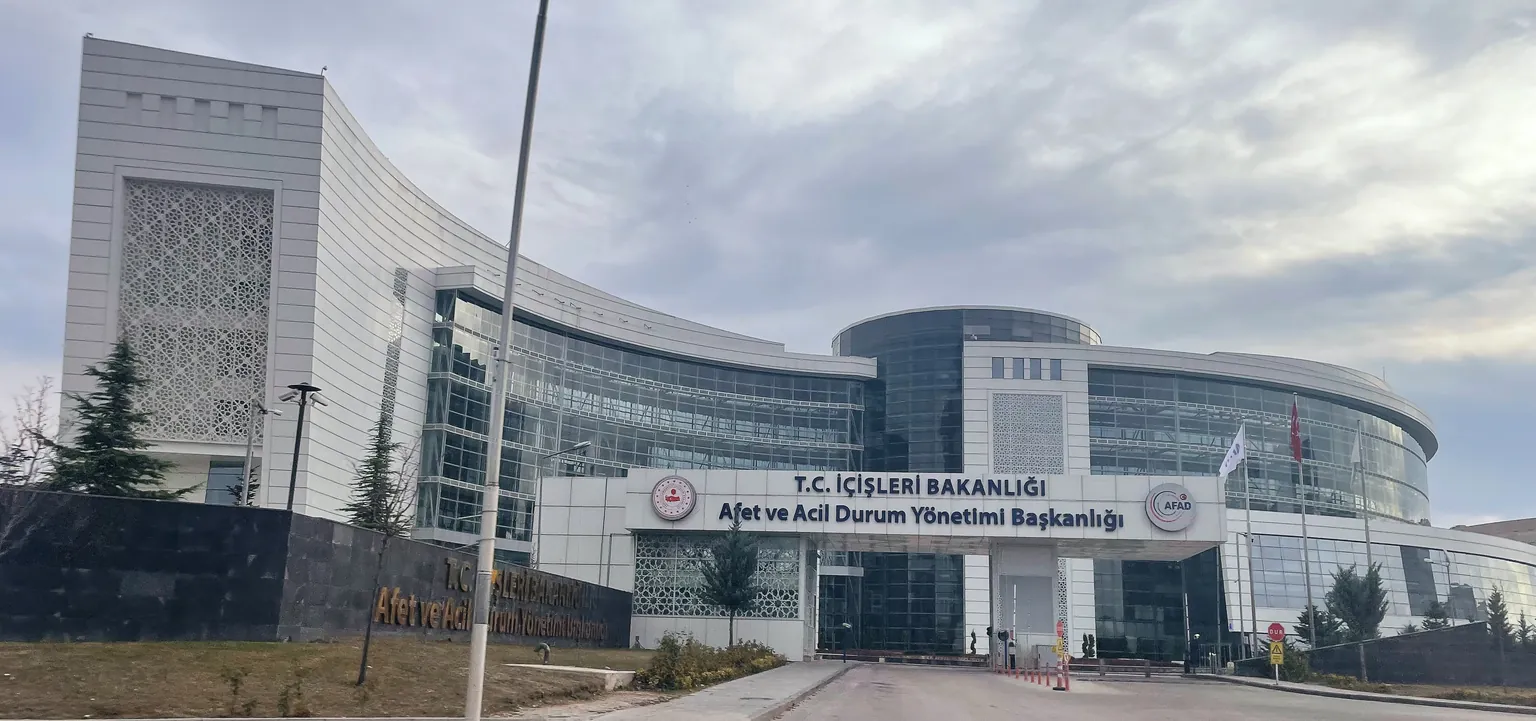
AFAD, the Disaster and Emergency Management Presidency (Afet ve Acil Durum Yönetimi Başkanlığı), is Türkiye’s state body for disasters and emergencies and is attached to the Interior Ministry. Its leaflets and web pages set out one set of instructions for everyone in the country: how to prepare, what to do while the ground shakes, and what comes after.
In short · checked 02.11.2026
Before, during, after.
- Earthquake: kneel, cover the head and neck, hold on to something fixed (ÇÖK-KAPAN-TUTUN) and stay where you are until the shaking stops.
- First 72 hours: in the first minutes everyone is on their own, so AFAD asks every household to be ready for 72 hours (3 days).
- Emergencies: 112. A text message to 112 is free; a call is more reliable and faster. The AFAD Acil app reaches the 112 centres.
- Before: a family plan, a bag, an information card, a meeting place, fixed furniture, the compulsory earthquake insurance, and the shut-off points of water, gas and electricity.
- Insurance: DASK’s compulsory policy covers the building, not its contents. For 100 m² the premium runs from 893 to 4,063 TL by risk group (policies starting 01.11.2026).
Try it · your flat
Your flat, ten checks
A cutaway of a flat with ten things from AFAD’s checklist. Tap a number or a thing to see AFAD’s line and the Turkish word, mark it done, and copy the list.
of 10 checks done
Check 1 of 10
Tehlike AvıHazard hunt
Do a hazard hunt at home and at work. Everything that can move, slide, fall or break in a quake is dangerous, so every item is fixed in place or moved.
Tespit et: find what could slide or fall onto you. Belirle: decide how to cut each risk. Sabitle or Yer değiştir: fix it or move it. Each person in the family takes a task.
AFAD · checked 02.11.2026
Check 2 of 10
Aile Afet PlanıFamily disaster plan
Prepare the plan together with the family. Draw a sketch of the home and mark the exit route. Decide where to meet after a disaster, and who to call to reach each other, in and outside the region.
AFAD · checked 02.11.2026
Check 3 of 10
Afet ve Acil Durum ÇantasıDisaster and emergency bag
Food, water, copies of important documents, clothes, hygiene items, a first-aid kit, a sleeping bag or blanket, a knife, whistle and small scissors, paper and pencil, a battery radio, a torch and spare batteries.
It also holds what babies, older and disabled people need, and pets. Keep it where it is easy to reach.
AFAD · checked 02.11.2026
Check 4 of 10
Acil Durum Bilgi KartıEmergency information card
Fill in the card and carry it at all times, so that expert teams can help more accurately in an emergency.
Front: name, blood group, date of birth, ID number, address, a contact person’s name and phone. Back: long-term conditions, medicines, operations, organ donation, the family meeting point.
AFAD · checked 02.11.2026
Check 5 of 10
Acil Durum Telefon NumaralarıEmergency phone numbers
Learn the emergency numbers. On a call, state the exact place and address, the number you are calling from and, if you know, what happened. Never call without need.
AFAD · checked 02.11.2026
Check 6 of 10
TesisatWater, gas and electricity
Learn where the home’s water, natural gas and electricity installations are and how to shut them off.
After the shaking stops, shut off the electricity, gas and water valves and put out stoves and heaters.
AFAD · checked 02.11.2026
Check 7 of 10
YangınFire
Identify the fire risks that can arise before and after a disaster where you live.
Have a fire detector and a fire extinguisher in the building, serviced periodically, and take fire-protection training.
AFAD · checked 02.11.2026
Check 8 of 10
Zorunlu Deprem Sigortası · iskân ruhsatıCompulsory earthquake insurance · occupancy permit
Make sure the building was built to the regulations and has its occupancy permit (iskân ruhsatı) and other permits. Take out the compulsory earthquake insurance.
Copies of the title deed, insurance and licence papers and the compulsory earthquake policy go in the bag.
AFAD · checked 02.11.2026
Check 9 of 10
Toplanma alanıAssembly area
Decide where to meet family members after a disaster, and learn the assembly area. Save its address and coordinates, add it to the plan, see it beforehand and decide alternative routes.
On the day: take the bag, switch on the battery radio and stay until temporary shelter centres are set up.
AFAD · checked 02.11.2026
Check 10 of 10
EğitimTraining
Join training that teaches how to prepare for and protect yourself from disaster risk: the Basic Disaster Awareness Training (Temel Afet Bilinci Eğitimi) of AFADEM, AFAD’s Disaster and Emergency Training Centre, and the provincial directorates, and first-aid training at centres the Health Ministry has authorised. Check, update and practise the plans.
AFAD · checked 02.11.2026
The copied list holds the ten checks as ticks, with the Turkish words, and the three things to state on a call to 112. Nothing is saved or sent. The flat is a sample drawing: where things stand in it is not an instruction.
Who AFAD is, and who else answers
AFAD describes itself as the only authority (tek yetkili kurum) for disasters and emergencies, working as an umbrella body with the General Staff, other ministries and civil-society organisations. In the provinces it works through provincial disaster and emergency directorates under the governor; 11 provinces also have search-and-rescue union directorates.
Erzincan
Policies for natural disasters began to be developed in Türkiye after the 1939 Erzincan earthquake.
Law no. 7269
A law on measures and aid for disasters that affect public life tried to close the legal gap.
A regulation
A regulation on the emergency aid organisation and its planning aimed to bring all the state’s means to the disaster area fastest and make the first response most effective.
Marmara earthquake
The turning point in disaster management and coordination in Türkiye.
Law no. 5902
AFAD was set up under the Prime Ministry. The Civil Defence directorate (Interior Ministry), the Disaster Affairs directorate (Public Works and Settlement Ministry) and the Emergency Management directorate (Prime Ministry) were closed, and their powers came under one roof.
Decree no. 4
A presidential decree attached AFAD to the Interior Ministry.
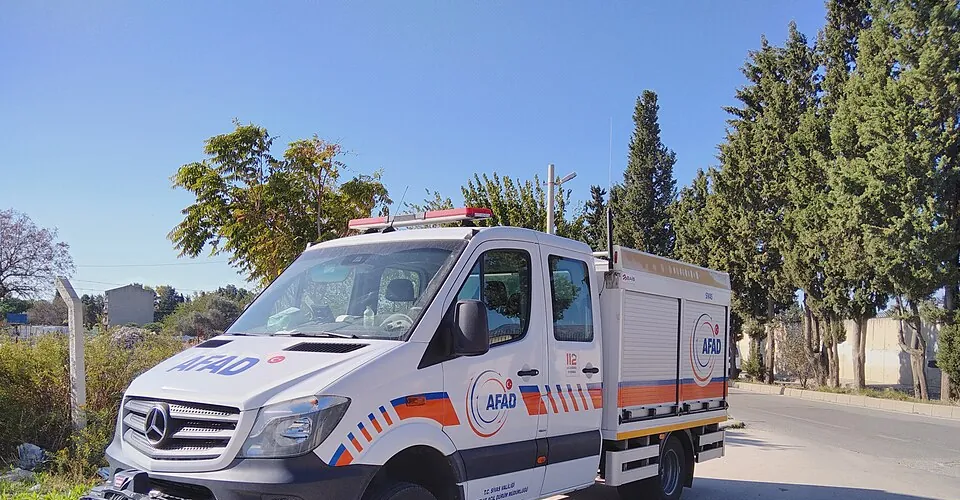
Who answers what
- AFAD
- Plans and coordinates disaster work.
- 112
- The Interior Ministry’s emergency call centre, one number in place of several.
- Municipalities
- Find and check the assembly areas.
- Health Ministry
- Authorises the first-aid training centres.
- DASK
- The compulsory earthquake insurance.
DASK · checked 02.11.2026
98 % of the land.
98 % of Türkiye’s land lies on active earthquake belts. No system or technology anywhere warns of an earthquake in advance, and news that a quake will come on a given date is without basis.
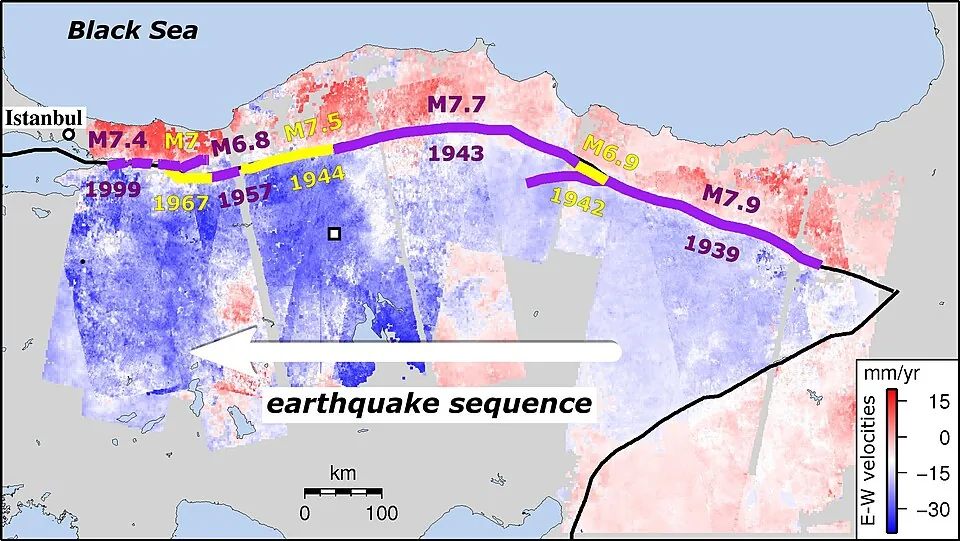
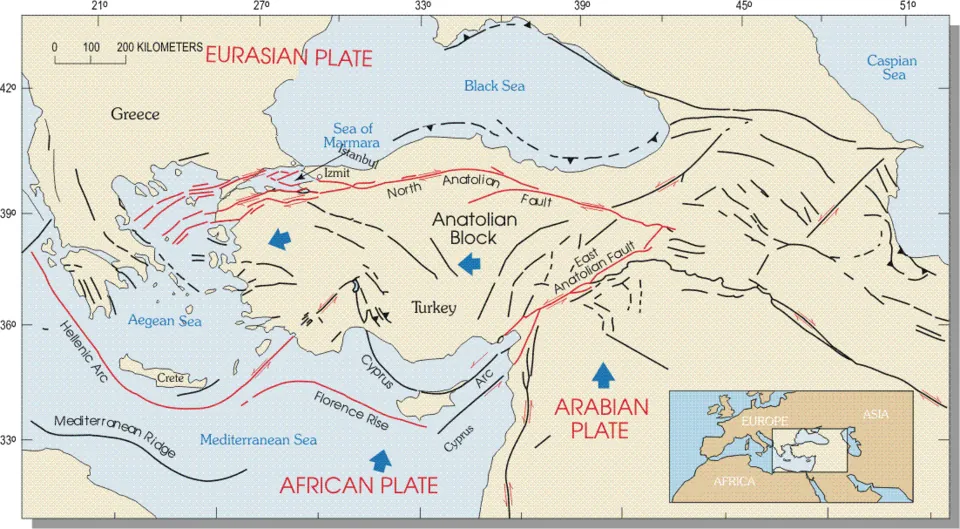
Recent earthquakes are on the earthquake monitor.
Before: AFAD’s checklist
AFAD’s poster Bilgilen, Planla, Hazırla (Learn, Plan, Prepare) is a checklist of 15 points. Its closing line: the most important step against disasters is to learn about them and how to prepare, and to carry out the preparations within a plan.
Training
Join training programmes that teach how to prepare for disaster risk and how to protect yourself.
The building
Make sure the building was built to the regulations and has its occupancy permit (iskân ruhsatı) and other permits.
Family plan
Prepare the Family Disaster Plan (Aile Afet Planı) together with family members.
The bag
Prepare the Disaster and Emergency Bag (Afet ve Acil Durum Çantası).
Information card
Prepare an Emergency Information Card (Acil Durum Bilgi Kartı) for yourself and each family member.
Meeting places
Decide where to meet family members after a disaster or emergency.
Hazard hunt
Do a hazard hunt (Tehlike Avı) at home and at work: fix in place, or move, things that could hurt you.
Insurance
Take out the compulsory earthquake insurance (Zorunlu Deprem Sigortası).
Installations
Learn where the water, natural gas and electricity installations (tesisat) are and how to shut them off.
Behaviour
Learn how to behave during disasters.
Fire risks
Identify the fire risks that can arise before and after a disaster where you live.
Evacuation
Learn how you would evacuate (tahliye) from where you live.
First aid
Learn the first-aid knowledge you may need in daily life or in disasters and emergencies.
Plans
Check, update and practise your plans.
Own safety
Do not behave in ways that put your safety at risk in disasters and emergencies.
AFAD · checked 02.11.2026
72 hours on your own.
In no country can health, fire and rescue teams reach everyone at once after a disaster; in the first minutes everyone is on their own. AFAD asks every household to be ready for the first 72 hours (3 days), the altın saatler, the golden hours.
Your home: hazard hunt, plan, card and bag
Tehlike Avı, the hazard hunt, is a task for every member of the family. Everything that can move, slide, fall or break in a quake is dangerous, so every item is fixed against the shaking or moved.
- Tespit et Find the things that could slide or fall onto you.
- Belirle Decide how to cut the risk of each one.
- Sabitle · Yer değiştir Fix it in place, or move it.
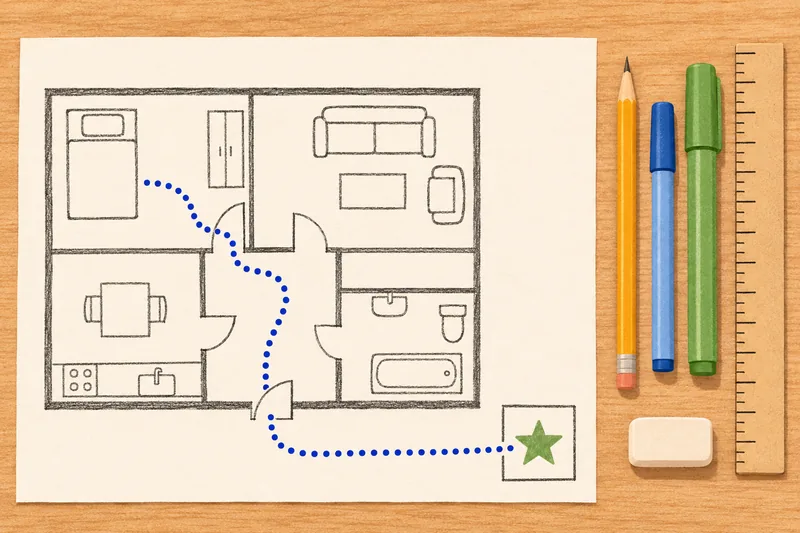
The family disaster plan · Aile Afet Planı
- A sketch of the home, with the exit route marked.
- Where to meet after a disaster, with alternatives.
- Who to call, and their numbers, in and outside the region, decided in advance.
- Whether the school and the workplace have a Disaster and Emergency Plan: how they reach you, how a child is kept safe, and to whom and when a child is handed over.
The information card · Acil Durum Bilgi Kartı
Filled in and carried at all times, it lets expert teams help more accurately in an emergency.
- Front
- Name, blood group, date of birth, ID number (T.C. Kimlik No), address, and the name and phone of a contact person.
- Back
- Long-term conditions, medicines, operations, organ donation, the family meeting point in a disaster.
- Child at school
- Decide beforehand who collects the child. The card of the collector holds a name, a phone number and a photo taken in the last 6 months.
The bag · Afet ve Acil Durum Çantası
It holds what is needed in the first 72 hours, until help teams arrive, and valuable papers. It also holds what babies, older people, disabled people and pets in the family’s care need. It is kept where it is easy to reach: at home, at work, and at school, where the contents are chosen with the teacher. Food and drink are checked regularly.
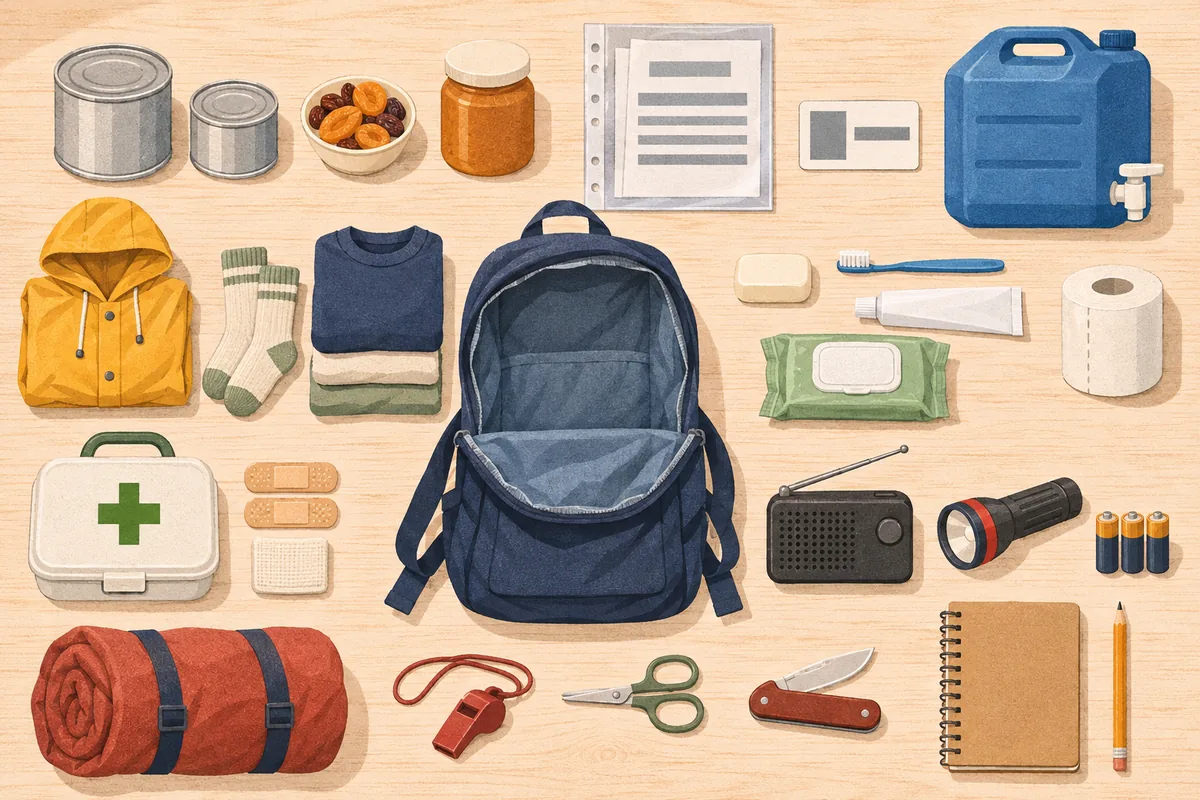
- Food · GıdaHigh in calories, vitamins and carbohydrates, helps against water loss, lasts without spoiling: tins, dried fruit, tahini-molasses (tahin–pekmez), fruit juice.
- Copies of important papers · Önemli belge fotokopileriIdentity cards, title deed, insurance and licence papers, the compulsory earthquake policy, diplomas, passport, bank book; a pet’s health record.
- Water · SuEnough drinking water for every family member.
- Clothes · GiyeceklerUnderwear, socks, a raincoat, clothes for the climate.
- Hygiene items · Hijyen malzemeleriSoap and disinfectant, toothbrush and toothpaste, wet wipes, toilet paper, sanitary pads.
- First-aid kit · İlk yardım çantasıA first-aid kit for small injuries.
- Battery radio · Pilli radyoTo listen to the instructions of the bodies in charge.
- Torch and spare batteries · El feneri ve yedek pillerA durable, long-life battery is chosen.
- Sleeping bag or blanket · Uyku tulumu veya battaniye
- Knife, whistle, small scissors · Çakı, düdük, küçük makas
- Paper and pencil · Kâğıt, kalem
The assembly area, toplanma alanı
A toplanma alanı is a safe area where people can gather, away from the danger zone, until temporary shelter centres are ready. It prevents panic and lets correct information reach people. There are assembly areas in 81 provinces, in every suitable district and neighbourhood. Municipalities find and check them, and they are set under the Türkiye Disaster Response Plan (Türkiye Afet Müdahale Planı).
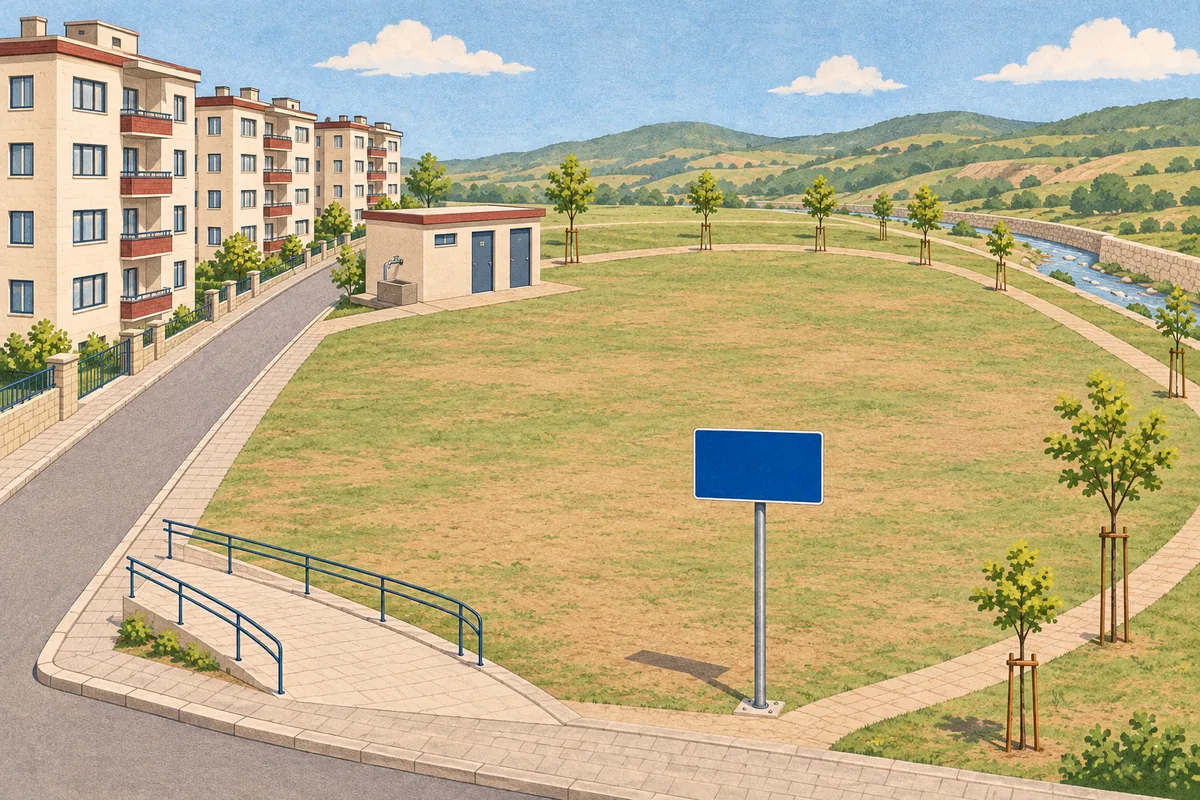
- Population densityWhere many people live.
- Reach and evacuationReachable, and easy to evacuate.
- Older and disabled peopleSuited as far as possible to their access.
- Secondary hazardsAway from the effects of fire, flood, tsunami and infrastructure, from the sea and stream banks, from liquefaction and from fault lines.
- Flat groundLevel land as far as possible.
- Near housingClose to residential areas but not affected by structural and non-structural elements.
- Basic needsClose to buildings where electricity, water and toilets are available.
Public land is chosen as far as possible. To find and prepare for the nearest area there are nine steps; the day itself has four.
- Sign in to e-Devlet with the T.C. ID number.
- Choose Afet ve Acil Durum Toplanma Alanları (Disaster and Emergency Assembly Areas) among AFAD’s services.
- Find the area nearest to the home address.
- Map its location on the map.
- Save its address and coordinates.
- Add it to the Disaster and Emergency Plan.
- See the area beforehand and decide alternative routes to it.
- Share it with family members, as an address or through the QR code on the area’s sign.
- Agree to meet there in a disaster or emergency.
On the day
- Take the bag on the way to the area.
- Switch on the battery radio from the bag.
- Stay in the area until temporary shelter centres are set up.
- In the area you are away from dangers, and correct information will reach you.
The sign
A sample sign carries the words AFET VE ACİL DURUM TOPLANMA ALANI, the municipality and AFAD logos, latitude (Enlem) and longitude (Boylam), an area code, the province and district, and a QR code.
During: Çök-Kapan-Tutun
Stay calm and do not panic. As soon as the shaking starts, and until it stops, protect yourself with ÇÖK-KAPAN-TUTUN, in the way that suits the place you are in: three words, in this order.
ÇÖK
Find a safe place and kneel (diz üstü çök).
KAPAN
Cover the head and neck (baş ve enseyi koruyacak şekilde kapan). Hands, or a pillow or book, protect the head.
TUTUN
Hold on to something fixed so as not to fall (sabit bir yere tutun). Stay where you are until the shaking stops.
Where are you when it shakes?
AFAD’s lines for each place, checked 02.11.2026. Touch a tab.
- Find a safe place; kneel, cover the head and neck, hold on.
- In bed, stay there and protect the head with a pillow, unless something heavy can fall; then move to the nearest safe place.
- In a wheelchair, lock the wheels and protect the head and neck.
- In a kitchen or workshop, switch off cookers and ovens and move away from things that can spill.
- Keep away from unfixed wardrobes and shelves, windows, glass, outside walls and doors, and light fittings.
- Do not use a doorway unless it is known to be very strong; most inner doors are simply built.
- Do not run to the stairs or exits or try to leave during the shaking: most injuries come while moving about inside or trying to get out.
- Do not use the lift or the balcony or jump from a balcony or window.
- Do not light matches or lighters, touch electric switches or use the phone, except to report emergencies and fires.
- Stay outside and crouch in the open, ready for dangers from around.
- Move away from the sea shore.
- Keep away from power lines, other buildings, poles, trees and the foot of walls.
- Do not stay under slopes where soil, stones or rock can fall; if there, move quickly to a safe place.
- Watch for chimneys, broken glass and plaster falling from buildings, and for sewer, electricity and gas lines under the ground.
The greatest danger is the outer walls of buildings falling.
- On a road in a safe place (not beside buildings, trees or poles, not under an overpass): pull to the right, stop without blocking the road, leave the key in, close the windows and stay inside until the shaking passes.
- In a built-up or unsafe place: stop, leave the vehicle with the key in and go to open ground.
- In a tunnel, away from the exit: stop, get out and lie sideways beside the vehicle, legs drawn to the stomach, hands joined over the head.
- In a closed car park: get out and lie beside the car. A ceiling can crush a car but will not flatten it; inside, a falling piece can crush you.
- Do not use roads, bridges or ramps damaged in the quake.
- Hold a fixed strap, rail or other fixed thing inside.
- Follow the staff’s instructions.
- Do not get off the metro or train unless needed: there is the risk of electric shock and of another train.
- Cover the mouth and nose with a handkerchief or clothing.
- Knock on pipes or walls and whistle, to tell the rescue teams where you are.
- Shout only as a last resort: shouting can make you breathe in dangerous amounts of dust.
- Do not light matches or lighters.
- Do not move and do not raise dust.
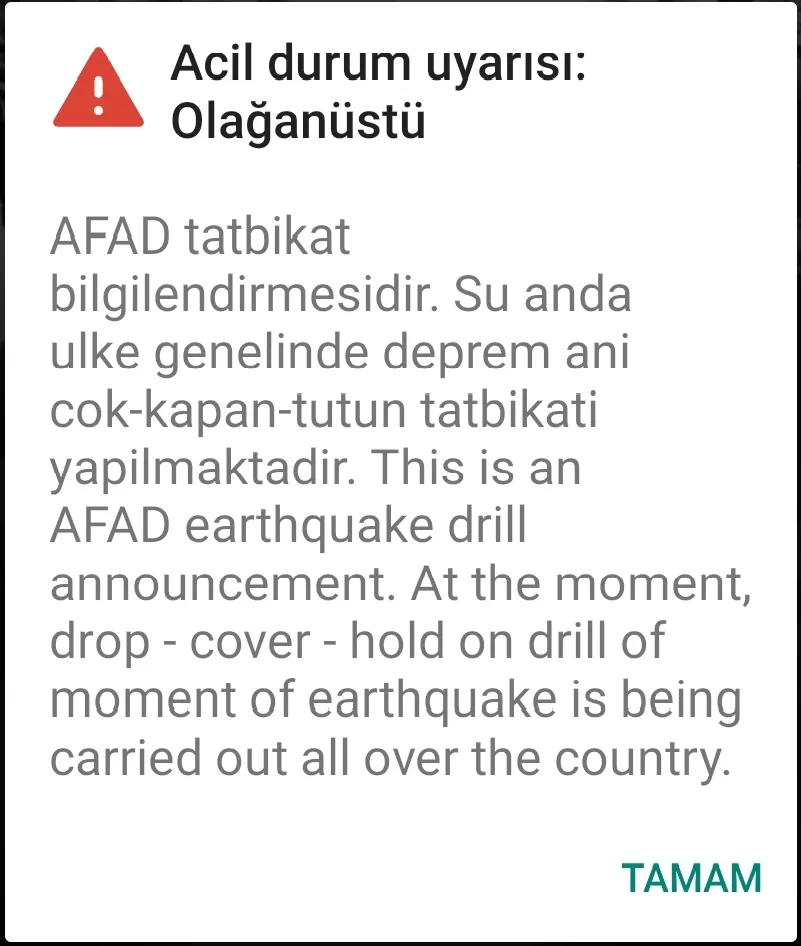
After the shaking
Shut off the electricity, gas and water valves and put out stoves and heaters. Take the bag and leave the building at once by the route chosen beforehand, to the assembly area. Aftershocks follow every big quake; they get rarer and smaller over time but can harm damaged buildings.
Flood, landslide or avalanche?
AFAD’s lines for before, during and after, checked 02.11.2026.
- Before
- Learn whether the place is at flood risk. Do not settle on flood beds. Follow flood warnings on radio and TV.
- During
- Stay calm and go to a high place at once. Leave river beds and low areas at once. Never cross flood water on foot or by car. Keep away from power lines and from water fallen wires may touch.
- After
- Use no food that touched flood water, packaged food included. Use bottled water where possible. Keep away from buildings surrounded by flood water.
- Before
- Learn the local landslide risk. In heavy and continuous rain follow the authorities’ announcements.
- During
- Warn the people around you and move away from the landslide’s path, to higher ground if possible. With no time to get out, stay inside and do Çök-Kapan-Tutun under or beside sturdy objects. Stay until the movement ends.
- After
- Check whether others need help. Move away from the area in case of a repeat or secondary risk.
- Before
- Learn the local risk. Do not choose a settlement place at avalanche risk. Do not remove the tree and plant cover of slopes. In snowy months follow the weather and road conditions.
- During
- Stay calm and, if possible, move toward a safer place. A skier throws off the ski gear and holds on to a fixed tree or rock. If caught, use the ground for support to reach the surface and make wide swimming movements to stay on top of the flowing snow. With the head under snow, close the mouth, hold the breath and make an air pocket in front of the face with the hands and arms.
- After
- Cover those affected and never put them straight into a hot place. If near the surface, shout for help.
After: checks, 112 and aid
- Check Check whether you and the people around you are hurt. Be ready for aftershocks.
- Gas and light Do not light matches or lighters or switch on lights until sure there is no gas or flammable leak.
- Listen Listen to the instructions of the bodies in charge on the radio from the bag.
- Tell If you leave where you are, tell the people around you. Call the contact person in or outside the region when possible.
- Aftershocks Do not enter damaged buildings until the shaking has completely stopped. During an aftershock, do what you do in the main quake.
112: one number
Before 112, help calls went to separate numbers of several bodies (155, 156, 158, 110, 177 and 112), and the many numbers made it hard to tell which body was concerned and caused delay. 112 is the single emergency number, in line with an EU decision of 29.07.1991 on 112 as the single European emergency call number. The 112 centres belong to the Interior Ministry.
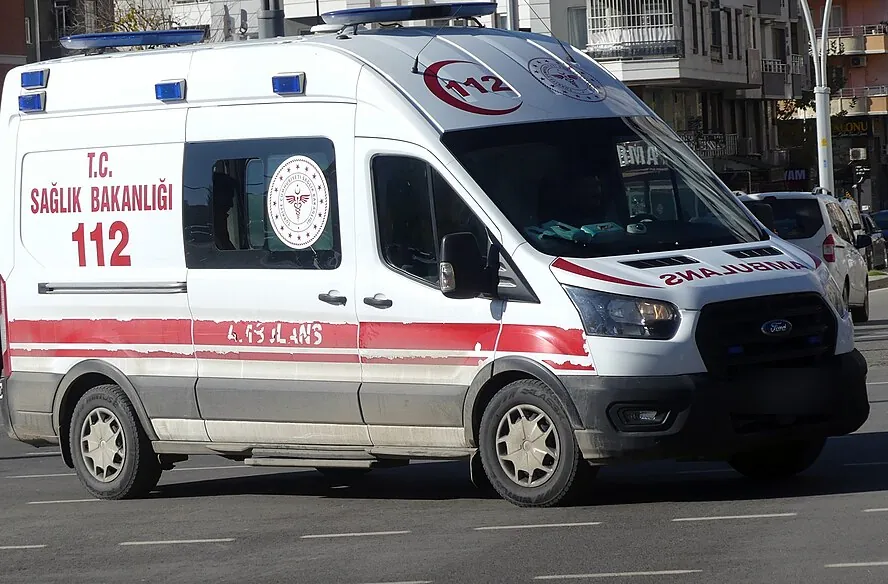
Call or text · checked 02.11.2026
- On a call, state the exact place and address, the number you call from and, if you know, what happened.
- Always call if you can: a call is more reliable and faster than a text.
- A text message is for when you cannot speak. It is free once written, cannot be sent from a phone with no SIM card, and goes to the 112 centre of the province it is sent from.
- The first text carries as much as possible: the location or open address, what the emergency is, and detail. The call-taker may answer and ask for more.
- False alarms and needless calls bring legal action.
AFAD Acil
Free, in the App Store and Google Play. It sends the location and status of people affected by a disaster, by voice and message over the data connection, to the 112 centres, which pass them to field teams. Up to 10 contacts can be entered; 112 staff see them during the call. The map shows the assembly areas, the nearest chosen automatically, with directions on foot or by vehicle.
Buttons: Acil arama (emergency call), Yaralıyım (I am injured), Kayboldum (I am lost), Enkaz altındayım (I am under rubble), Yakınıma ulaşamıyorum (I cannot reach someone close to me). The last four send an automatic message. It works only when a disaster has occurred in the region where you are; outside a disaster region, call 112.
Hayat 112 Acil
The Interior Ministry’s app, which brings the ministry’s mobile apps under one roof (as of 12.10.2026). It sends location-based emergency notifications to the 112 centres; a photo and a 10-second video can be attached. Sign-in is with e-Devlet details.
AFAD notifications: Enkaz Altındayım (I am under rubble), Mahsur Kalma (being stuck), Hasar Tespit Talebi (damage assessment request), and other situations such as a shelter request. A 112 Acil button makes a voice call.
On 31.10.2026 the Interior Ministry announced that a presidential decree had set up a 112 Emergency Call and Coordination General Directorate, and that the 81 provincial 112 centres had become provincial 112 directorates under the governorships. More on emergency care: Healthcare in Türkiye.
Damage assessment and aid
Damage assessment (hasar tespit) grades the damage a disaster did to a building by observation: none (hasarsız), light (az), moderate (orta), heavy or collapsed (ağır/yıkık). It is the groundwork for emergency aid, rent aid (kira yardımı), entitlement (hak sahipliği) and the choice of settlement site.
- Apply In city centres, to the Provincial Disaster and Emergency Directorate or the Provincial Directorate of Environment and Urbanisation. In districts, towns and villages, by petition to the Kaymakamlık (the district governor’s office).
- Visit Technical teams appointed by the governorate visit the building. First comes the question whether the disaster affected general life (etkili or etkisiz). If it did, the teams return for the full check (Kesin Hasar Tespit).
- Result The results are posted at the muhtarlık (the neighbourhood head’s office) and/or the Kaymakamlık for 30 days.
- Objection Within the 30 days from posting, if a name is missing, the result seems wrong or no assessment was made. A different team re-inspects, and the new result (İtiraz Hasar Tespit) is posted for 30 days. An objection to that final result is not accepted under law no. 7269; the route is the administrative court.
Not a strength check
Damage assessment is not an assessment of the building’s strength against a later disaster, such as an aftershock.
Emergency aid funds · acil yardım ödeneği
They meet disaster victims’ urgent basic needs (shelter, food) and bring damaged infrastructure back to minimal working order. Requests are sent for damage to homes, roofs, contents and infrastructure. Not for a single lightly damaged home, a home not actually lived in (a second home, a summer house), workplaces, vehicles, farm produce or livestock.
The municipality or special provincial administration sends the application form (Afet Müracaat Formu) within 15 days. Requests the Provincial Directorate has not passed to AFAD within 15 days are not evaluated.
AFAD’s home page runs donation campaigns by SMS to 1866.
Earthquake insurance, DASK
DASK (Doğal Afet Sigortaları Kurumu, the Natural Catastrophe Insurance Pool) runs the compulsory earthquake insurance, Zorunlu Deprem Sigortası (ZDS), under law no. 6305. It is a state guarantee against an earthquake and the fire, explosion, landslide and tsunami it causes directly, and not a tax. Whoever declares the home and ID details can hold a policy, at the nearest insurance agent or bank branch.
Covered · checked 02.11.2026
- Material damage to the building from the earthquake, and from the fire, explosion, tsunami and landslide that result, paid in cash within the policy limits.
- Full or partial damage; foundations, main walls, roofs, stairs, lifts, chimneys and similar parts.
Not covered
- Movable property and contents, rent loss, the cost of another home or workplace, debris removal, loss of profit.
- Bodily harm and death.
Contents, and extra cover beyond the maximum, need a private home insurance policy.
- Term
- One year, renewed each year before it ends. The premium is paid in cash, up front.
- Information
- Name, address, phone and ID number of the policyholder; the building’s open address, title-deed details, year built, building style, number of floors and damage status; the flat’s gross area and use. The insurance rests wholly on the policyholder’s declaration, and losses from a wrong declaration are the policyholder’s.
- Not insured
- Buildings of public bodies, buildings in village settlement areas, buildings used wholly for commercial or industrial purposes, unfinished buildings, buildings on land with no title or on state land, derelict and unlicensed buildings.
The premium is the sum insured times the tariff rate per mille. The sum insured is the unit cost per m² for the building style times the flat’s gross area, up to a maximum. DASK raises the unit cost every month: from 01.11.2026 it is 12,288 TL per m² for reinforced concrete and 8,192 TL for other buildings, and the maximum cover is 2,605,100 TL.
- Risk group
- The group comes from the earthquake zone map, the ground conditions and the building’s features.
- Building style
- Reinforced concrete means a steel or reinforced-concrete frame; other means all other buildings.
A 100 m² flat, policy starting 01.11.2026, any province. Each cell is the rate per mille · the premium:
| Risk group | Reinforced concrete | Other buildings |
|---|---|---|
| I | 2.82 ‰ · 3,465 TL | 4.96 ‰ · 4,063 TL |
| II | 2.51 ‰ · 3,084 TL | 4.25 ‰ · 3,482 TL |
| III | 2.13 ‰ · 2,617 TL | 3.73 ‰ · 3,056 TL |
| IV | 2.00 ‰ · 2,458 TL | 3.49 ‰ · 2,859 TL |
| V | 1.50 ‰ · 1,843 TL | 2.79 ‰ · 2,286 TL |
| VI | 1.07 ‰ · 1,315 TL | 1.86 ‰ · 1,524 TL |
| VII | 0.73 ‰ · 897 TL | 1.09 ‰ · 893 TL |
- Call After damage, call the ALO DASK 125 call centre. The policy and/or ID number, the open address of the damaged home and a phone number are enough to open the file.
- Visit A DASK damage assessment officer visits after the application.
- Payment DASK sends the compensation to the nearest bank branch, in the name of the right-holder named in the title deed.
Words and lines to say
On a call to 112: the three things to state
- Kesin yerim ve adresim: …My exact place and address is …
- Bu numaradan arıyorum: …I am calling from this number: …
- Olay: …What happened: …
Buttons in the AFAD Acil app
- Yaralıyım.I am injured.
- Kayboldum.I am lost.
- Enkaz altındayım.I am under rubble.
- Yakınıma ulaşamıyorum.I cannot reach someone close to me.
On a call to ALO DASK 125
- Poliçe numaram: …My policy number is …
- Hasarlı konutun açık adresi: …The open address of the damaged home is …
- Telefon numaram: …My phone number is …
How an address is written: Turkish Address Format.
- afet · acil durum
- Disaster · emergency.
- deprem · artçı sarsıntı
- Earthquake · aftershock.
- sel · heyelan · çığ
- Flood · landslide · avalanche.
- enkaz
- Rubble, a collapsed building.
- toplanma alanı · tahliye
- Assembly area · evacuation.
- tesisat · iskân ruhsatı
- Water, gas and electricity installations · occupancy permit.
- hasar tespit · afetzede
- Damage assessment · a person affected by a disaster.
- ilk yardım · ilkyardım
- First aid.
- poliçe · tapu
- Insurance policy · title deed.
Sources and limits
- Bilgilen, Planla, Hazırla — AFAD leaflet listed on afad.gov.tr/brosurler, checked 02.11.2026
- İlk 72 Saat — AFAD leaflet listed on afad.gov.tr/brosurler, checked 02.11.2026
- İlk 72 Saat Yetişkin — AFAD leaflet listed on afad.gov.tr/brosurler, checked 02.11.2026
- Afet ve Acil Durum Toplanma Alanları — AFAD leaflet listed on afad.gov.tr/brosurler, checked 02.11.2026
- Afet Sonrası Hasar Tespit — AFAD leaflet listed on afad.gov.tr/brosurler, checked 02.11.2026
- Afetlerden Sonra Yapılacak Yardımlar — AFAD leaflet listed on afad.gov.tr/brosurler, checked 02.11.2026
- AFAD ve Tarihçesi — AFAD, checked 02.11.2026
- Deprem Anında Neler Yapmalısınız? — AFAD, page of 28.02.2018, checked 02.11.2026
- Afet ve Acil Durum Çantası Nasıl Hazırlanmalı? — AFAD, page of 12.03.2019, checked 02.11.2026
- AFAD home page (1866 SMS campaigns) — AFAD, checked 02.11.2026
- Hakkımızda — 112 Acil Çağrı Merkezi, checked 02.11.2026
- 112 SMS İhbarları — 112 Acil Çağrı Merkezi, page of 18.12.2024, checked 02.11.2026
- AFAD Acil Mobil Uygulama Projesi — 112 Acil Çağrı Merkezi, checked 02.11.2026
- Hayat 112 Acil Mobil Uygulaması — 112 Acil Çağrı Merkezi, page of 12.10.2026, checked 02.11.2026
- 112 Acil Çağrı ve Koordinasyon Merkezi Genel Müdürlüğü Kuruldu — Interior Ministry, news of 31.10.2026, checked 02.11.2026
- Tarife ve Primler — DASK, checked 02.11.2026
- Teminat ve Kapsamı — DASK, checked 02.11.2026
- Gerekli Bilgi ve Belgeler — DASK, checked 02.11.2026
- 9 Adımda ZDS — DASK, checked 02.11.2026
- Sıkça Sorulan Sorular — DASK, checked 02.11.2026
- Depremle Yaşamak — DASK, checked 02.11.2026
Limits: the instructions are those of the bodies named, on the dates checked. The AFAD leaflets with the former Prime Ministry masthead are listed on AFAD’s leaflet page; where a newer AFAD or 112 page words a step differently, the newer page is followed. Unit costs, the maximum cover and premiums change every month. The cover and five more pictures are photographs and maps with their credits; the flat in the tool is a drawing, and the bag, plan and open-ground pictures are AI-made.