What Is ASELSAN? Turkey’s Defence Electronics Maker
ASELSAN is a Turkish electronics company that began by building radios for the armed forces. Its history, sites, product areas and who owns it.
Table of Contents
ASELSAN is a Turkish electronics company with its campuses in Ankara. It was founded on 14 November 1975 to build communications equipment for the Turkish Armed Forces, and it began with radios. Its work now runs from communications and radar to health, energy and traffic. Most of it belongs to the Turkish Armed Forces Foundation.

In short · checked 22 October 2026
A Turkish electronics company that began with radios.
- What it is: an electronics company with campuses in Ankara, founded on 14 November 1975 to build communications equipment for the Turkish Armed Forces.
- Who owns it: the Turkish Armed Forces Foundation owns 74.2% (as of 22 October 2026).
- Where it works: three campuses in Ankara, at Macunköy, Akyurt and Gölbaşı, and a precision optics facility in Sivas. It also has its own companies and offices in other countries.
- What it makes: communications first, then radar, electro-optics, navigation, microelectronics, naval systems and civil lines such as health, energy and traffic.
The radio · 31 stations
Turn the dial and stop at a year
Each tick on the dial is one dated step, from 1975 to 2025.
Pick a band to keep only some ticks, then drag along the scale, turn the knob or use the slider. Press Log it to keep a station, then copy your log with its sources.
- 1975ASELSAN is founded on 14 November 1975, to build communications equipment for the Turkish Armed Forces.CommunicationsASELSAN: About Us Foundation history page (Turkish)
- 1976Construction starts on the Macunköy campus in Ankara.SitesASELSAN: About Us
- 1977ASELSAN signs a licence with Philips to build backpack and vehicle radios.CommunicationsASELSAN: About Us
- 1978The first buildings at Macunköy are finished and production starts.SitesASELSAN: About Us
- 1979Research and development work begins. ASELSAN shows its products at trade fairs for the first time.ASELSAN: About Us
- 1980The first backpack and vehicle radios made at ASELSAN are delivered to the Land Forces Command.CommunicationsASELSAN: About Us
- 1981All production units at Macunköy are in service. ASELSAN offers the Kristalli vehicle radio, fixed-site radios, an electronic training set and a bank alarm system, and more units of the 4600 series radios.Communications · Sites · Beyond defenceASELSAN: About Us
- 1982The first mechanical workshop starts work.SitesASELSAN: About Us
- 1983ASELSAN makes its first export: 4600 series radios and intercom systems.CommunicationsASELSAN: About Us
- 1984ASELSAN starts its first electronic warfare work: equipment that deals with radio and radar signals.Chips and sensorsASELSAN: About Us
- 1985ASELSAN builds the first prototype of its electronic field telephone.CommunicationsASELSAN: About Us
- 1989First technology transfer: radios start to be made abroad under an ASELSAN licence.CommunicationsASELSAN: About Us
- 1991Production work on microelectronics, the tiny circuits inside electronic devices, begins.Chips and sensorsASELSAN: About Us
- 1993The Akyurt campus goes into service.SitesASELSAN: About Us
- 1994Production starts of the 4000/4100 series, a new family of radios, and of the Baykuş thermal cameras.Communications · Chips and sensorsASELSAN: About Us
- 1997ASELSAN launches the ASELSAN 1919 mobile phone.Communications · Beyond defenceASELSAN: About Us
- 1998ASELSAN opens its first company abroad, ASELSAN Baku.AbroadASELSAN: About Us
- 2000ASELSAN builds a school in Sakarya, a province hit by the 1999 earthquake.Beyond defenceASELSAN: About Us
- 2011Three companies start work abroad: in South Africa, in Abu Dhabi and in Kazakhstan.AbroadASELSAN: About Us
- 2012ASELSAN Middle East starts work in Amman. ASELSAN also signs an agreement with Bilkent University and a state agency to invest in making gallium nitride transistors and chips.Abroad · Chips and sensorsASELSAN: About Us
- 2014A joint micro-nano technology company is founded with ASELSAN Sivas Precision Optics and Bilkent University. ASELSAN also launches the National Train Project.Chips and sensors · Beyond defenceASELSAN: About Us
- 2015In its 40th year, ASELSAN opens the Gölbaşı campus, which houses its radar and electronic warfare development, production, test and engineering units.Sites · Chips and sensorsASELSAN: About Us
- 2016The Sivas precision optics facility opens. Radio-frequency and antenna test laboratories open at the Gölbaşı radar and electronic warfare centre. A liaison office in Saudi Arabia starts work.Sites · Chips and sensors · AbroadASELSAN: About Us
- 2017ASELSAN Malaysia starts work. ASELSAN also develops its first domestically made base-station antenna for 4.5G mobile networks.Abroad · CommunicationsASELSAN: About Us
- 2018After a contract with the Ministry of National Education, work starts on the ASELSAN Vocational and Technical Anatolian High School. A company in Qatar starts work.Beyond defence · AbroadASELSAN: About Us
- 2019The first students attend the ASELSAN vocational and technical high school. ASELSAN’s social innovation group launches the Tech Adventure and Zero Waste projects.Beyond defenceASELSAN: About Us
- 2020During the COVID-19 pandemic, ASELSAN delivers 100 respirators, made entirely in Türkiye, to the Ministry of Health within 14 days. A company starts work in Kyiv.Beyond defence · AbroadASELSAN: About Us
- 2021ASELSAN X-ray devices enter service. The ASELSAT 3U CubeSat, built with Istanbul Technical University, is launched. The first fully Turkish-made electric bus, developed with TEMSA, enters service. A liaison office in Pakistan and a maintenance centre in Qatar start work.Beyond defence · AbroadASELSAN: About Us
- 2023ASELSAN’s gallium nitride transistors, designed and produced in Türkiye, enter the system-integration stage.Chips and sensorsASELSAN: About Us
- 2024Companies start work in Latin America, Poland, Oman, Indonesia and North Macedonia (ASELSAN Balkans, in Skopje). The first class graduates from the ASELSAN vocational and technical high school.Abroad · Beyond defenceASELSAN: About Us
- 2025ASELSAN turns 50. Work starts on the Oğulbey Technology Base. The TÜRKSAT 6A satellite enters service with communication payloads developed by ASELSAN. Companies start work in Algeria, the Philippines, Nigeria, Albania, Romania and Uzbekistan. A radar integration centre opens, and a Tech Adventure Truck tours Türkiye.Sites · Abroad · Beyond defence · CommunicationsASELSAN: About Us
Why ASELSAN began
The story starts with Cyprus. In the Cyprus crisis of 1964 some of Türkiye’s allies stood in the way of its using its defence equipment as its interests required, which showed the cost of relying on others. The arms embargo that followed Türkiye’s military operation in Cyprus in 1974 set off its push to build a defence industry of its own.
The push began through foundations set up for the branches of the armed forces:
- 1964 The Cyprus crisis shows the cost of relying on others for defence equipment.
- 1965 The Turkish Navy Society leads a campaign called “Build Your Own Ship”, for the building of landing ships.
- 1970 The air force foundation is founded, to develop a national aviation industry.
- 1972 The navy foundation is founded after the Navy Society closes. In 1981 it is renamed the foundation for strengthening the Turkish naval forces.
- 1973 The aircraft maker TUSAŞ is founded, on 28 June 1973, to reduce Türkiye’s dependence on others in the defence industry.
- 1974 Türkiye’s military operation in Cyprus that year is followed by an arms embargo. The land forces foundation is founded, to reduce dependence on others in defence electronics.
- 1975 ASELSAN is founded, on 14 November 1975, to meet the armed forces’ communications needs with national means.
- 1987 A law of 17 June 1987 joins the three foundations into one, the Turkish Armed Forces Foundation. It begins work on 26 September 1987.
ASELSAN was one of several companies set up in these years, each for its own reason:
| Year | Company | Set up for |
|---|---|---|
| 1973 | TUSAŞ | To reduce dependence on others in the defence industry. It makes aircraft, from fixed-wing and helicopter platforms to satellite systems and unmanned aircraft. |
| 1975 | ASELSAN | To meet the armed forces’ communications needs with national means. |
| 1977 | İŞBİR | Generators and alternators for the defence industry and other sectors. It was set up with the savings of Turkish workers abroad. |
| 1981 | ASPİLSAN | Batteries for civil and military needs. It was set up with donations from people and organisations in Kayseri. |
| 1982 | HAVELSAN | Software-heavy systems for command and control, training, simulation and information and communication. |
| 1988 | ROKETSAN | To meet the armed forces’ needs for rockets and missiles, and to have a leading Turkish institution in rocket and missile work. |
Who owns ASELSAN
The Turkish Armed Forces Foundation owns 74.2% of ASELSAN (as of 22 October 2026).
The first radios
The first sets ASELSAN built were VHF/FM radios. VHF means very high frequency and FM means frequency modulation, the way the radio wave carries speech. They came as backpack sets, which one person carries, and as sets fitted into vehicles.
- 1977 ASELSAN signs a licence with Philips to build backpack and vehicle radios.
- 1978 The first buildings at the Macunköy campus are finished and production starts. The first sales contract, for VHF/FM radios, is signed with the Ministry of National Defense.
- 1979 Research and development work begins. ASELSAN takes part in the Kocaeli Industry Fair and the 1st Islamic Countries Trade Fair, and shows its products at a fair for the first time.
- 1980 The first backpack and vehicle radios made at ASELSAN are delivered to the Land Forces Command.
- 1983 First export: a sale of 4600 series radios and intercom systems to Belgium. An intercom lets people in the same vehicle or room talk to each other.
Within six years of the licence, by 1983, ASELSAN was building radios in Ankara and selling them abroad.
The range in 1981
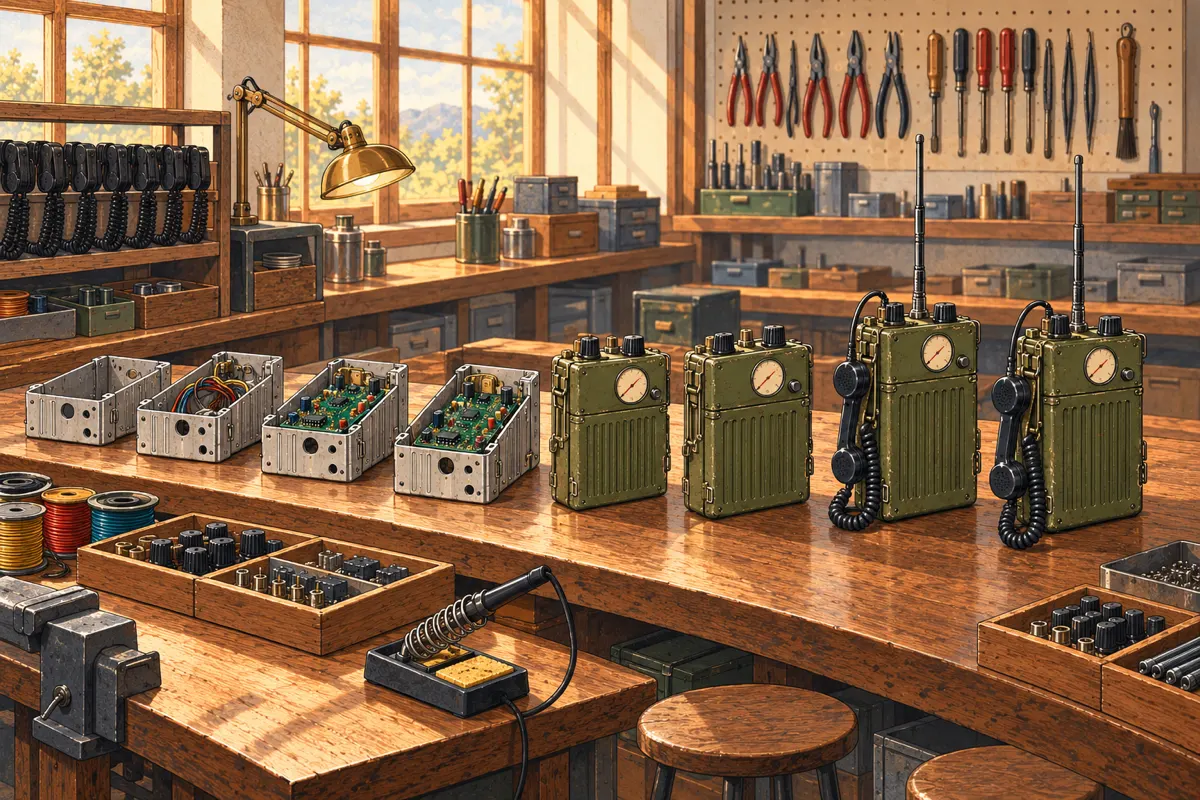
By 1981 every production unit at Macunköy was in service. ASELSAN offered the Kristalli vehicle radio, fixed-site radios, an electronic training set and a bank alarm system, and more units for its 4600 series radios.
In 1982 ASELSAN’s first mechanical workshop started work.
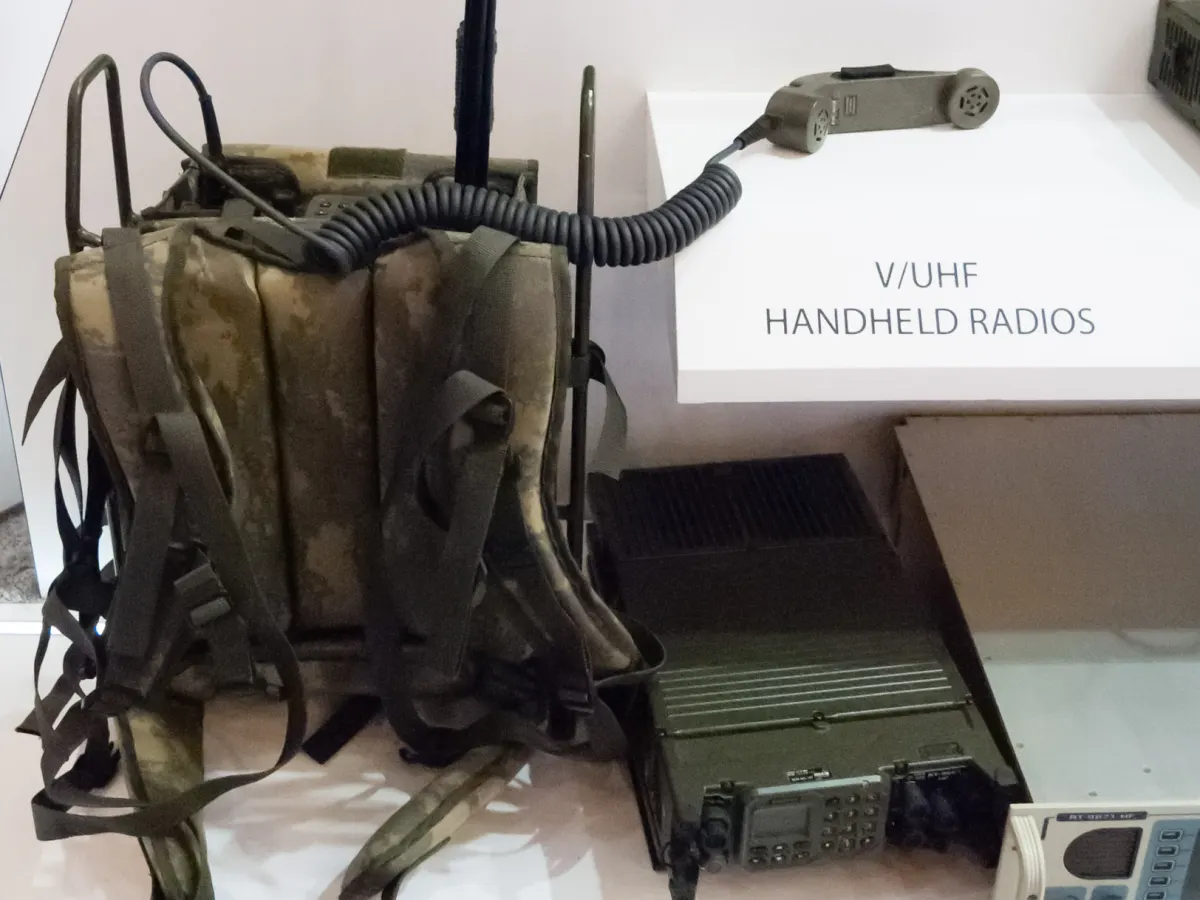
Radios on show in 2018
ASELSAN radio sets on a stand in Kyiv, long after the first radios of 1977 and 1980: on the left a backpack set with its antenna raised, on the shelf above the handset of a handheld radio, on the right a vehicle radio.
As with the first sets, one is carried by a person and the other is fitted into a vehicle.
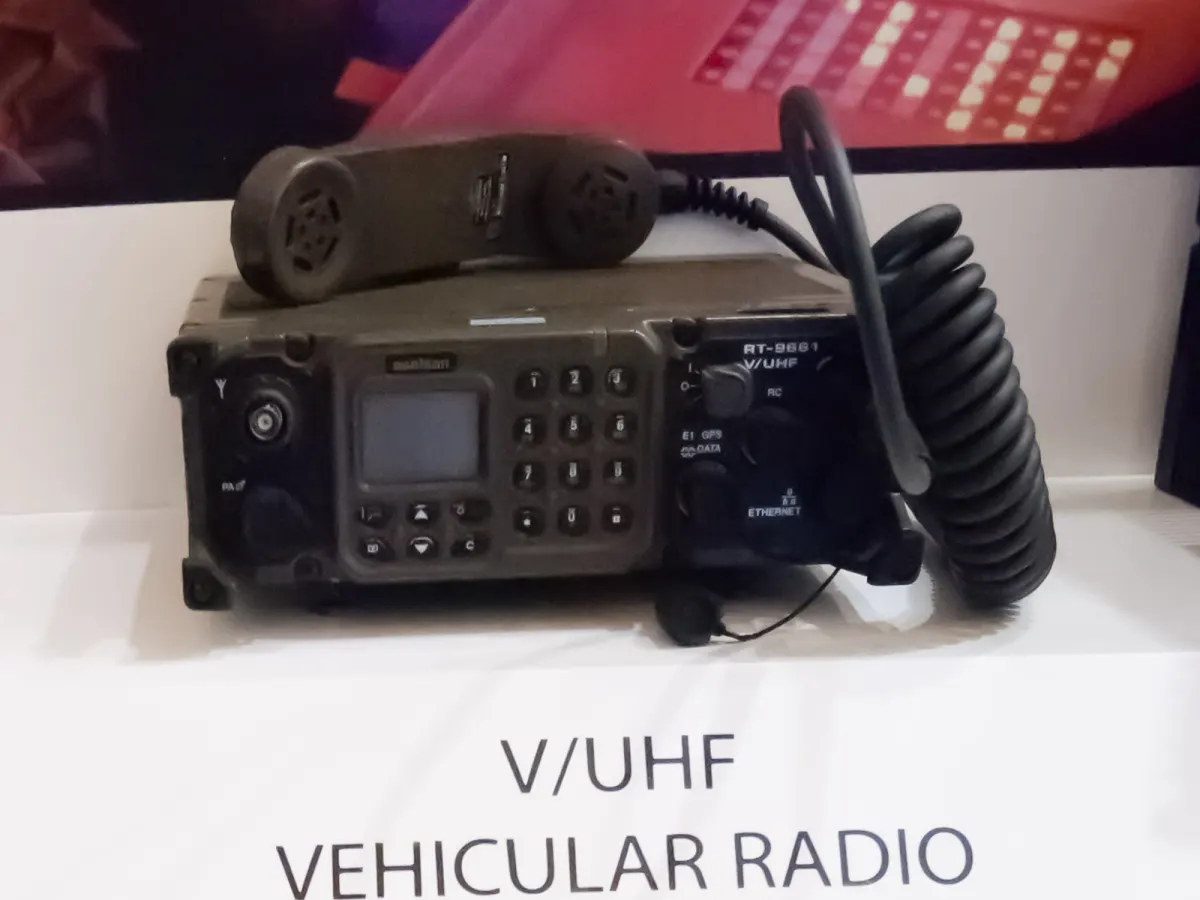
A closer look at a vehicle radio
This vehicle radio has a keypad and a small screen on its front. The handset lies on top, on a coiled cord. A socket on the right is labelled Ethernet, the name of a common network connection. A card on the shelf calls the set a V/UHF vehicular radio.
From radios to electronics
After the radios came other kinds of electronics, each new field with the year it began.
| Year | What began | Field |
|---|---|---|
| 1984 | The first electronic warfare work: equipment that deals with radio and radar signals. | Signals |
| 1985 | The first prototype of an electronic field telephone. | Communications |
| 1989 | The first technology transfer: radios start to be made abroad under an ASELSAN licence. | Communications |
| 1991 | Production work on microelectronics, the tiny circuits inside electronic devices. | Chips |
| 1994 | The 4000/4100 series, a new family of radios, and the Baykuş thermal cameras go into production. | Communications, sensors |
| 1997 | The ASELSAN 1919 mobile phone is launched. | Communications |
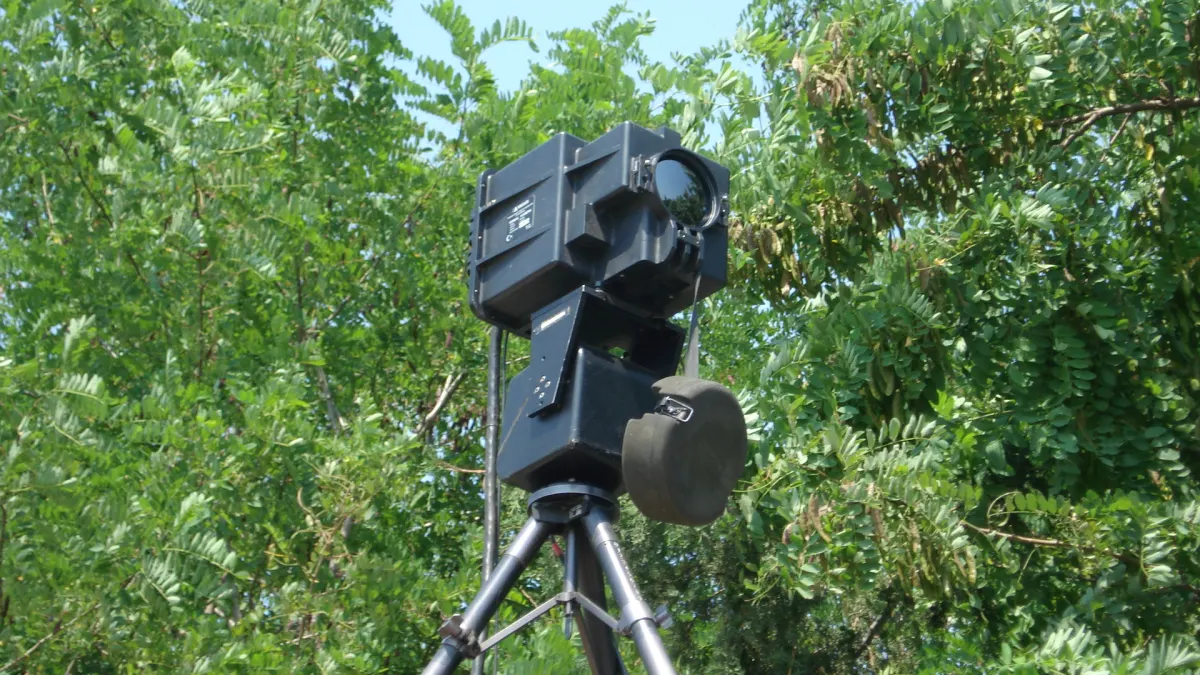
Cameras that see heat
A thermal camera shows heat instead of visible light. Baykuş thermal cameras went into production in 1994, together with the 4000/4100 series, a new family of radios with a frequency synthesizer, which sets the channel electronically.
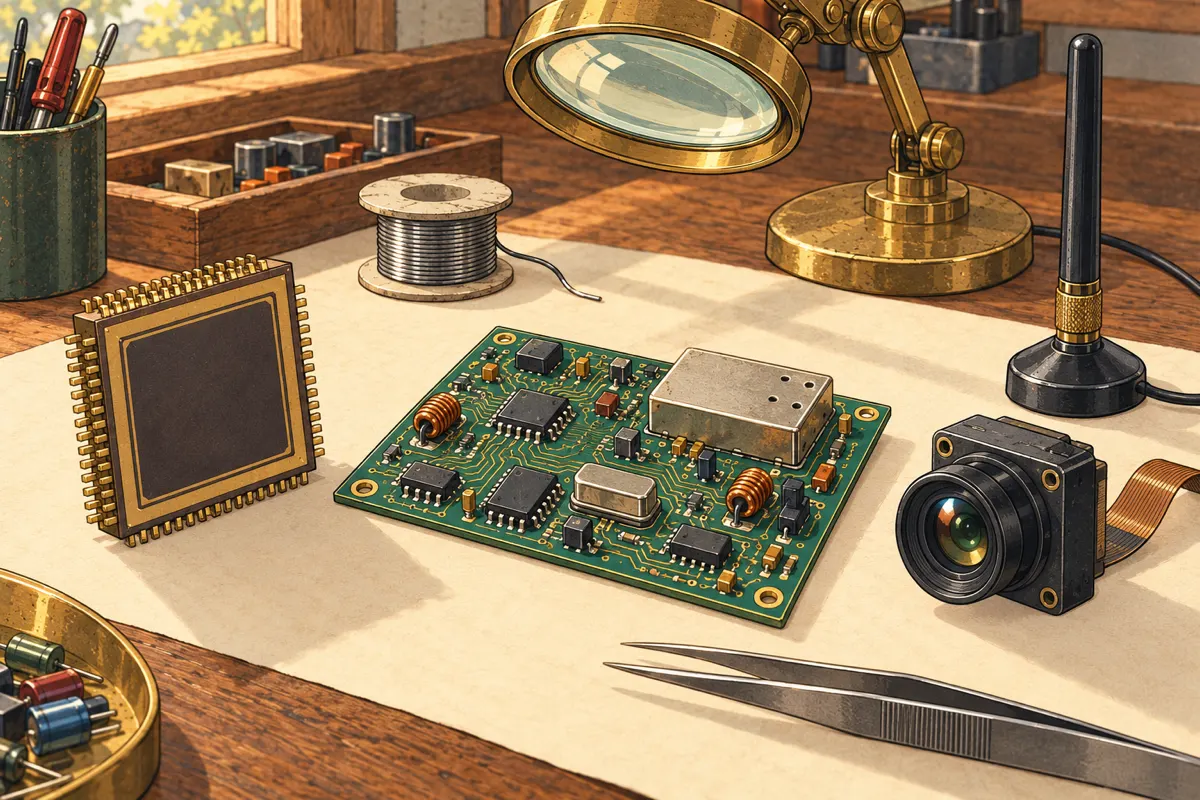
Chips and gallium nitride
Transistors are the tiny switches inside chips, and gallium nitride is a material for making them. In 2012 ASELSAN signed an agreement with Bilkent University and a state agency to invest in making gallium nitride transistors and chips. In 2023 ASELSAN’s gallium nitride transistors, designed and produced in Türkiye, entered the system-integration stage.
Programmes year by year
The programmes ASELSAN has worked on, one line per year:
| Year | What happened |
|---|---|
| 1986 | ASELSAN and the Ministry of National Defense sign the contract for a mine detector project. |
| 1987 | ASELSAN joins a joint project of four countries to produce the Stinger missile. |
| 1988 | The number of countries ASELSAN exports to reaches 15: Pakistan, Algeria, Tunisia, Jordan, the Turkish Republic of Northern Cyprus, Iran, Saudi Arabia, Uruguay, Sudan, Belgium, Nigeria, Bangladesh, the USA, Germany and Switzerland. |
| 1992 | The land surveillance radar project, ASKARAD, is signed with the Ministry of National Defense. |
| 1996 | A contract for the tactical field communication system, TASMUS, is signed between the Turkish Armed Forces and ASELSAN. |
| 1999 | Under the Black Hawk programme with Sikorsky, contracts are signed for the LN100G inertial navigation system and the ASELFLIR-200 thermal imaging system. |
| 2001 | Contracts are signed for the series production of the pedestal-mounted Stinger system (KMS) and for the ADOP-2000 fire-support automation project. |
| 2002 | Contracts are signed for the MWS-TU missile warning system and the Leopard Volkan fire-control system. |
| 2003 | Contracts are signed for JEMUS, the integrated communications and information system for the gendarmerie, and for the SPEWS-II electronic warfare self-protection system. ASELSAN also carries out, for the first time in Türkiye, the avionics and digital modernisation of S-70 Black Hawk and AH-1W Super Cobra helicopters. |
| 2004 | In May a meeting of the Defence Industry Executive Committee launches three projects in which ASELSAN takes part: the ALTAY main battle tank, the ATAK attack and tactical-reconnaissance helicopter and the MİLGEM corvette. |
| 2005 | A contract for helicopter electronic warfare systems is signed. |
| 2006 | Contracts are signed for the modernisation of the navigation and communications subsystems of F-4E aircraft and for the ASELPOD targeting and navigation pod. ASELSANNET is set up. |
| 2007 | A contract is signed with TUSAŞ for the ASELFLIR-300T system in the Turkish unmanned aerial vehicle. A contract is also signed for the MİLGEM national ship combat system. |
| 2008 | Contracts are signed for the ALTAY main battle tank, built with national resources, and for the T-129 ATAK helicopter development project. |
| 2010 | A contract for a software-based radio project is signed with the Ministry of Defence of Pakistan. Contracts are also signed for the ATMACA electronic systems, a naval 3D search radar, a self-propelled air-defence gun and fire-control system and the modernisation of a 35 mm towed air-defence gun. |
| 2013 | A contract for the technology transfer of tactical radios is signed with Saudi Arabia. Contracts are also signed for the HİSAR-A and HİSAR-O air-defence missile systems. ASELSAN completes production of KULAÇ, a depth-measurement sonar, and it is built into AY-class submarines. |
| 2022 | The ASELSAN Konya Weapons Systems Factory begins operations. ASELSAN receives the “Most Effective Employer” award for taking part in the regional career fairs “Talent Everywhere”, run by the Presidential Human Resources Office. |
Where it works
ASELSAN works from three campuses in Ankara and one facility in Sivas.
The map · where and when
Six places across Türkiye
Ankara with its three campuses. Sivas lies to the east of Ankara. Konya lies to the south and Gaziantep to the south-east.
- 1976MacunköyConstruction of the first campus begins.
- 1978MacunköyThe first buildings are finished and production starts.
- 1981MacunköyEvery production unit is in service.
- 1982MacunköyThe first mechanical workshop starts work.
- 1993AkyurtThe campus goes into service.
- 2015GölbaşıThe campus opens, in ASELSAN’s 40th year, for the radar and electronic warfare units.
- 2016SivasThe precision optics facility opens.
- 2016GölbaşıThe radio-frequency and antenna test laboratories open at the radar and electronic warfare technology centre.
- 2021GaziantepX-ray devices enter service.
- 2022KonyaThe Weapons Systems Factory begins operations.
- 2025OğulbeyWork starts on the Technology Base.
- 2025—The Radar Integration Center starts work.
Schematic: directions only, not to scale, with no buildings or site layouts.
18 companies
ASELSAN holds shares in all of them. Six have a city in their name: Malatya, Sivas, Gaziantep, Konya, Adıyaman and Istanbul. One is named after Bilkent University in Ankara.
11 companies
ASELSAN holds shares in these too; they are not its customers. The first, ASELSAN Baku, opened in 1998.
| Year | Started work |
|---|---|
| 1998 | Baku, the first company abroad |
| 2011 | South Africa, Abu Dhabi and Kazakhstan |
| 2012 | Amman (ASELSAN Middle East) |
| 2016 | Saudi Arabia (liaison office) |
| 2017 | Malaysia |
| 2018 | Qatar |
| 2020 | Kyiv |
| 2021 | Pakistan (liaison office) and Qatar (maintenance centre) |
| 2024 | Latin America, Poland, Oman, Indonesia and North Macedonia (ASELSAN Balkans, in Skopje) |
| 2025 | Algeria, the Philippines, Nigeria, Albania, Romania and Uzbekistan |
What it makes
ASELSAN’s work falls into these areas:
Radios and networks
Military and civil communications systems, and command, control, communications, computers and intelligence systems.
Radar and electronic warfare
Radar systems, and electronic warfare and intelligence systems.
Aircraft electronics and defence systems
Avionics, which means the electronics of aircraft, air-defence weapon systems and integrated weapon systems.
Finding the way and naval systems
Navigation and guidance systems, and naval systems.
Circuits and cameras
Microelectronics, the tiny circuits inside devices, and electro-optics, which means systems that work with light and heat, such as cameras.
Homeland and cyber security
Homeland security systems and cyber security.
Health, energy and traffic
Health systems, energy systems and traffic systems.
What the names mean
ASELSAN’s products and projects go by short names. The cards are grouped by subject: communications first, then sensors, navigation, the sea, chips and space. Each card shows the name; turn it over for what it is and the year it first appeared.
4600 series
A series of military radios, with companion units.
Kristalli
A radio for vehicles.
4000/4100 series
A new family of radios with a frequency synthesizer, which sets the channel electronically.
ASELSAN 1919
A mobile phone.
TASMUS
A tactical field communication system, set out in a 1996 contract.
JEMUS
An integrated communications and information system for the gendarmerie.
ASELSANNET
A company set up in 2006 for electronic and communication systems.
Baykuş
Thermal cameras, which show heat instead of visible light.
ASELFLIR
A family of thermal imaging systems: the -200 in 1999, the -300T in 2007.
LN100G
An inertial navigation system, which works out position from its own movement.
KULAÇ
A depth-measurement sonar, built into AY-class submarines.
Gallium nitride transistors
Transistors made of gallium nitride: an agreement in 2012, system integration in 2023.
ASELSAT 3U
A CubeSat, a small standard-sized satellite, built with Istanbul Technical University and launched into orbit.
TÜRKSAT 6A payloads
The communication equipment ASELSAN developed for the TÜRKSAT 6A satellite.
Beyond defence
Several of ASELSAN’s steps are about civil life. Health, energy and traffic are also three of its areas.
- 1981. A bank alarm system joins the range.
- 1997. The ASELSAN 1919 mobile phone is launched.
- 2000. ASELSAN builds a school in Sakarya, a province hit by the 1999 earthquake.
- 2014 and 2021. ASELSAN launches the National Train Project in 2014. In 2021 an electric bus developed with TEMSA enters service; ASELSAN calls it the first fully Turkish-made one.
- 2017. ASELSAN develops its first domestically made base-station antenna for 4.5G mobile networks.
- 2018 to 2024. After a contract with the Ministry of National Education, work starts on the ASELSAN vocational and technical high school in 2018, the first students attend in 2019 and the first class graduates in 2024.
- 2020. During the COVID-19 pandemic, ASELSAN delivers 100 respirators, made entirely in Türkiye, to the Ministry of Health within 14 days.
- 2021. ASELSAN X-ray devices enter service.
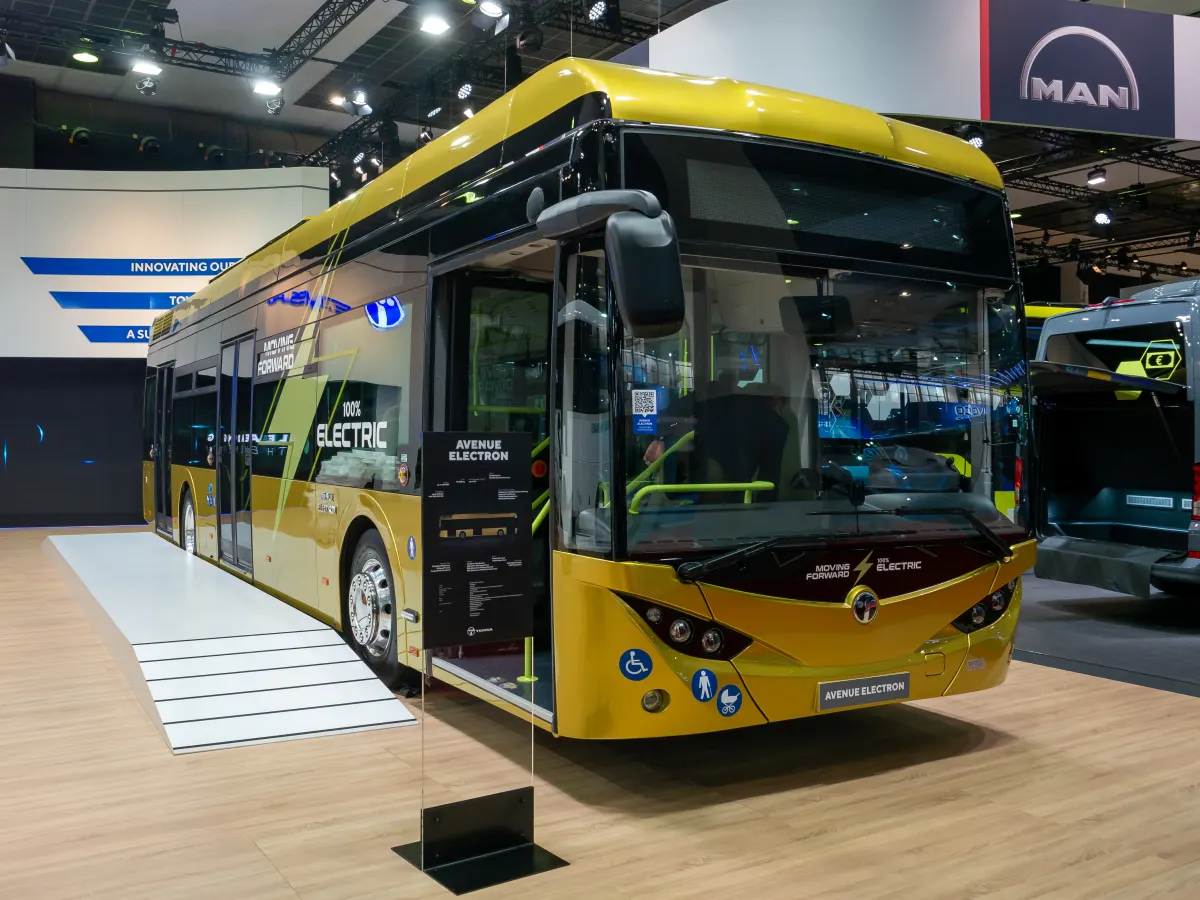
The electric bus
ASELSAN and TEMSA developed the bus together and call it the first completely Turkish-made electric bus; it entered service in 2021. The partnership also covers battery packs and software, and TEMSA builds the battery packs at its plant in Adana.
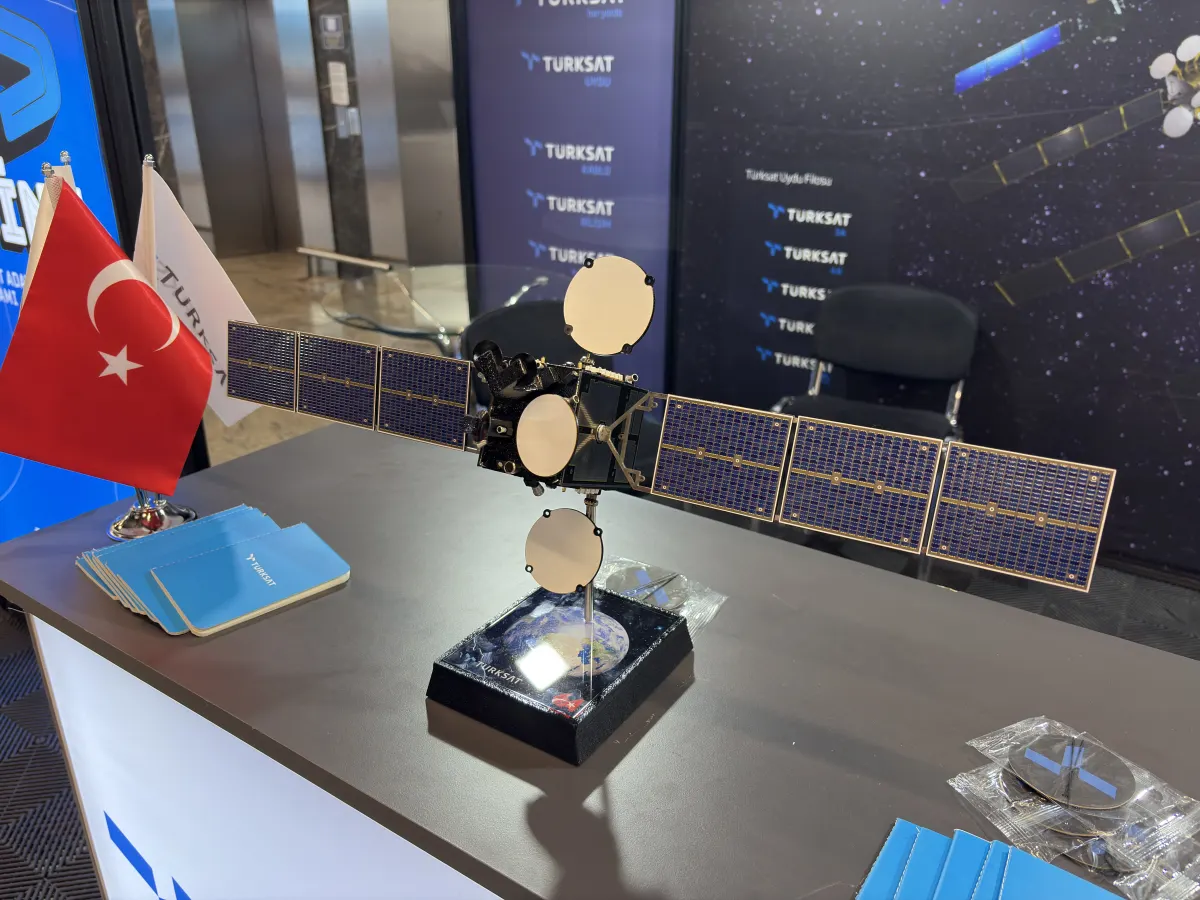
In space
ASELSAT 3U is a CubeSat, a small standard-sized satellite, built by Istanbul Technical University with ASELSAN. A SpaceX rocket put it in orbit in January 2021; it was the sixth CubeSat the university had designed since 2005.
TÜRKSAT 6A is a communication satellite, launched on 9 July 2024 and commissioned on 21 April 2025. TÜBİTAK UZAY, the space research institute, led the project with TUSAŞ, ASELSAN and a company called CTech; ASELSAN built the communication payloads.
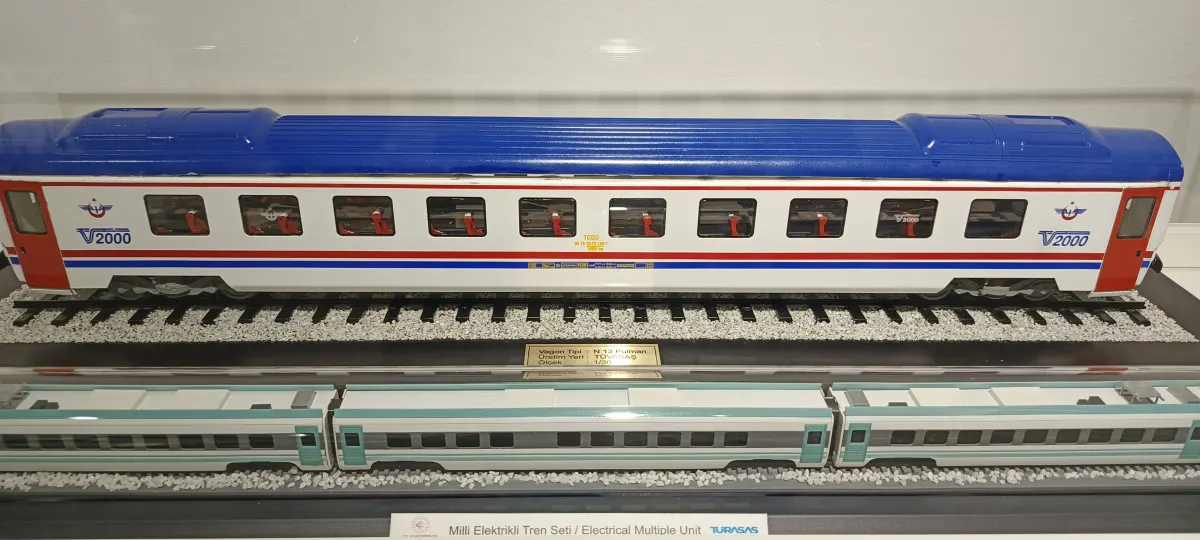
The National Train Project started in 2014.
Schools and universities
ASELSAN also works with universities and schools:
- 2012 ASELSAN, Bilkent University and the state defence industry agency of the time sign a memorandum of understanding on making gallium nitride transistors and integrated circuits. The same year the agency, ASELSAN and four universities sign agreements on road maps for acquiring technology: Middle East Technical University, Cumhuriyet University, Sabancı University and İzmir Institute of Technology.
- 2014 A joint micro-nano technology company is founded with ASELSAN Sivas Precision Optics and Bilkent University.
- 2018 After a contract with the Ministry of National Education, work starts on the ASELSAN Vocational and Technical Anatolian High School.
- 2019 The first students attend the school. ASELSAN’s social innovation group, ASELSAN Social Innovation Leaders, launches the Tech Adventure and Zero Waste projects.
- 2021 The ASELSAT 3U CubeSat, built with Istanbul Technical University, is launched.
- 2024 The first class graduates from the school.
- 2025 To mark ASELSAN’s 50th year, a specially designed Tech Adventure Truck tours Türkiye and brings science and technology to children.
In Turkish, Tech Adventure and Zero Waste are Tekno Macera and Sıfır Atık.
Short answers
What is ASELSAN?
A Turkish electronics company with campuses in Ankara. It was founded on 14 November 1975 to build communications equipment for the Turkish Armed Forces, and it began with radios.
Who owns ASELSAN?
The Turkish Armed Forces Foundation owns 74.2% (as of 22 October 2026).
Where is ASELSAN based?
Its campuses are Macunköy, Akyurt and Gölbaşı, all in Ankara. It also has a precision optics facility in Sivas.
What does ASELSAN make?
It began with radios. Today its work runs from military and civil communications and radar to navigation, naval systems, microelectronics, health, energy and traffic.
Does ASELSAN have offices abroad?
Yes. ASELSAN Baku, opened in 1998, was its first company abroad.
Why was ASELSAN founded?
The arms embargo that followed Türkiye’s 1974 military operation in Cyprus pushed Türkiye to build its own defence industry. ASELSAN was founded in 1975 to meet the armed forces’ communications needs with Turkish-made equipment.
What was ASELSAN’s first product?
Radios. The first were VHF/FM backpack and vehicle radios, built under a licence signed with Philips in 1977. The first of them were delivered to the Land Forces Command in 1980.
When did ASELSAN first export?
In 1983, when 4600 series radios and intercom systems were sold to Belgium. By 1988 it exported to 15 countries.
What did ASELSAN do for TÜRKSAT 6A?
It built the satellite’s communication payloads. TÜRKSAT 6A was commissioned on 21 April 2025; TÜBİTAK UZAY led the project.
Which companies were set up in the same years?
TUSAŞ (1973), İŞBİR (1977), ASPİLSAN (1981), HAVELSAN (1982) and ROKETSAN (1988), beside ASELSAN (1975).
Sources
This page is not investment information.
- About Us (ASELSAN’s timeline, 1975 to 2025) — ASELSAN, checked 22 October 2026
- Affiliates (the companies ASELSAN holds shares in, in Türkiye and abroad) — ASELSAN, checked 24 October 2026
- Tarihçemiz (the foundation’s history) — Turkish Armed Forces Foundation, checked 22 October 2026
- İştirakler (holdings: ownership, sites and areas of work) — Turkish Armed Forces Foundation, checked 22 October 2026
- Türk Silahlı Kuvvetlerini Güçlendirme Vakfı Kanunu (Law no. 3388, accepted 17 June 1987) — Presidency of the Republic of Türkiye, Legislation Information System, checked 22 October 2026
- TÜRKSAT 6A Commissioned (24 April 2025) — TÜBİTAK UZAY, the space research institute of TÜBİTAK, checked 22 October 2026
- 6 Satellites Designed by İTÜ are in Orbit (29 January 2021) — Istanbul Technical University, checked 22 October 2026
- Strategic Partnerships — TEMSA, checked 22 October 2026
Pictures
- ASELSAN logo.svg — ASELSAN, from its 2016 annual report; the file page marks it public domain as a simple text logo. The name and mark are trademarks of ASELSAN. Shown unaltered, to identify the company. Wikimedia Commons, checked 22 October 2026.
- Aselsan comm devices, Kyiv 2018, 01.jpg — VoidWanderer, 11 October 2018; CC BY-SA 4.0. Cropped to the radios. Wikimedia Commons, checked 22 October 2026.
- Aselsan comm devices, Kyiv 2018, 04.jpg — VoidWanderer, 11 October 2018; CC BY-SA 4.0. Wikimedia Commons, checked 22 October 2026.
- Aselsanbaykuş.JPG — KIZILSUNGUR (uploader on tr.wikipedia), 14 June 2007; CC BY-SA 3.0. Wikimedia Commons, checked 22 October 2026.
- Türksat 6A maketi.jpg — Kayra, 13 August 2025; CC BY 4.0. Wikimedia Commons, checked 22 October 2026.
- Temsa Avenue Electron, Busworld Europe 2023, Brussels (P1140014).jpg — MB-one, 12 October 2023; CC BY-SA 4.0. Wikimedia Commons, checked 22 October 2026.
- Milli Elektrikli Tren Seti 01.jpg — Satirdan kahraman, 9 May 2025; CC BY-SA 4.0. Wikimedia Commons, checked 22 October 2026.