Turkey Online Shopping & International Shipping: A Guide
Ordering from a Turkish shop for delivery abroad: two gates, what the EU, UK and US borders add, what cannot go in the box, and what box size costs.
Table of Contents

A parcel from a Turkish shop reaches your door one of three ways: the shop ships it abroad, a forwarder in Turkey sends it on, or an agent buys it for you. Whichever you pick, it passes two gates, Turkey’s and then your country’s. Your country’s gate is where the price changes.
Ordering from Turkey, in short · checked 17.10.2026
One parcel, two gates: Turkey’s, then yours.
- Shop, forwarder or agent – start at the checkout: if it offers your country, the shop sends it. If not, a forwarder or an agent does.
- Your border – EU: €3 for each kind of item in a shop parcel up to €150, whichever carrier, plus a €2 fee expected from 1 November 2026. Customs-union goods with an A.TR and no IOSS are not covered by the €3 duty. Great Britain: no duty on most goods up to £135. United States: no duty-free shortcut.
- Stays out – protected antiques cannot leave Turkey (Law 2863, art. 32); meat and milk products stay out of EU-bound parcels.
- Ask the carrier – perfume, power banks and medicines.
- Box size – the carrier charges the larger of real weight and length × width × height ÷ 3000 (inside Turkey) or ÷ 5000 (abroad).
Route desk · checked 17.10.2026
Two gates, one parcel
Pick where the parcel goes and how it travels. The left card is Turkey’s gate, the right card is yours.
1Gate one · Turkey
The shop exports it
The shop’s courier files the export. Export deliveries are exempt from KDV, Turkey’s VAT.
For parcels to the EU worth up to €150, a simplified A.TR certificate is created automatically when an authorised express carrier or PTT files the simplified customs declaration. This has applied since 3 July 2026.
KDV Law 3065, art. 11/1-a · Ministry of Trade, 5 August 2026. Checked 17.10.2026.
A forwarder sends it on
You order from the shop to the forwarder’s Turkish address. The forwarder packs your orders into one box, declares it and sends it abroad.
That box is one consignment: the €150 and £135 limits count everything in it in total.
Regulation (EU) 2026/382, art. 2 · gov.uk. Checked 17.10.2026.
An agent buys and sends it
A person or company buys the goods for you, then ships them and invoices you. Put the real price on the invoice.
The EU’s regulation says the old €150 relief was abused “through undervaluing and artificially splitting consignments”.
Regulation (EU) 2026/382, recital 2. Checked 17.10.2026.
2Gate two · your border
EU: parcels up to €150
- VAT
- Charged on every parcel. If the seller is registered for IOSS, it is added at checkout. If not, you pay it, usually with the carrier’s clearance fee, before delivery.
- Customs duty
- €3 for each kind of item when a shop sends a parcel worth up to €150 to a private buyer, however the VAT is collected and whichever carrier brings it. Not covered: goods from Turkey declared as customs-union goods on the standard form (H1) with an A.TR, when the VAT did not go through IOSS. They pay no €3, and you pay the VAT at the door.
- Handling fee
- €2 for each kind of item, whatever the value, customs-union goods included. The Commission expects it from 1 November 2026.
- Before you order
- Ask the seller or carrier for the total at your door: VAT, duty and fees.
Your own forwarder: the €3 and the €2 fee are for distance sales, where the seller sends the goods or arranges the transport. The Commission says a sale is not one when you arrange the transport without the seller’s help. Ask the forwarder how it declares your box and what you pay at the door.
Regulation (EU) 2026/382, art. 2 · Commission guidance, 5 October 2026 · EU IOSS page. Checked 17.10.2026.
EU: parcels over €150
- VAT
- Collected at import: IOSS covers parcels up to €150 only.
- Customs duty
- Not the €3. The parcel is declared item by item on the standard form (H1) at the EU tariff rate for each item. Goods with an A.TR can claim the customs-union rate.
- Handling fee
- €2 for each kind of item here too, whatever the value, when it is a distance sale. The Commission expects it from 1 November 2026.
Commission guidance, 5 October 2026 · EU IOSS page. Checked 17.10.2026.
Great Britain: goods up to £135
- VAT
- The seller has usually included it in the total you paid.
- Customs duty
- None on goods that carry no excise duty. Tobacco and other excise goods pay duty at any value.
- Northern Ireland
- Has its own rules: see the source.
gov.uk: tax and customs for goods sent from abroad. Checked 17.10.2026.
Great Britain: goods over £135
- VAT
- You pay the delivery company, before delivery or when you collect. It is charged on the whole package: goods, postage, packaging, insurance and any duty.
- Customs duty
- Charged on the price paid plus postage, packaging and insurance. The rate depends on the type of goods and where they came from.
- Unpaid
- The carrier normally holds the parcel for about 3 weeks. Then it goes back to the sender.
gov.uk: tax and customs for goods sent from abroad. Checked 17.10.2026.
United States
- Duty-free shortcut
- Gone. The $800 de minimis exemption has been suspended for most imports from every country since 29 August 2025, and for mail indefinitely since 24 July 2026.
- What you pay
- Duty at the tariff rate for each item, which depends on the item and where it was made. Mail worth up to $2,500 goes through a new postal informal entry process.
- Before you order
- Ask the seller or carrier for a total with duty included.
Federal Register, 91 FR 37801 (24 June 2026). Checked 17.10.2026.
Everywhere else
Every country sets its own limit and its own fees. This page reads only the EU, Great Britain and US sources. Before you order, open your customs authority’s page on low-value parcels and ask the seller or carrier for the total at your door.
A limit you cannot find is not a free pass.
Before you pay: is your country on the checkout list, and does the total show your VAT?Before you pay: what does the forwarder declare, and who pays the fees at your border? The checklist below has eight questions.Before you pay: ask for the invoice that travels in the box, and check it shows what you paid.
Three ways to get it home pick by what the shop allows
Start at the checkout. If it offers your country, ask the shop to send it. If it takes only Turkish addresses, use a forwarder. If it will not take your card or ship to you at all, use an agent.
The shop ships it
Fits when the checkout offers your country. The shop’s courier files the export and you deal with one company. Check that the total shows your VAT.
A forwarder in Turkey
Fits when the shop delivers only inside Turkey. You get a Turkish address, the shop delivers there, and the forwarder packs and sends it abroad. Orders from several shops can share one box.
An agent buys for you
Fits when the shop will not send to you or take your card. A person or company buys, ships and invoices you.
How to order at each shop is in our guides to Hepsiburada, Amazon Turkey and Trendyol customer service; the clothes guide lists shops that serve your country.
Gate one what can leave Turkey
Most things leave Turkey without a fuss. Export deliveries are exempt from KDV (KDV Law 3065, art. 11/1-a), and for parcels to the EU worth up to €150 the courier’s A.TR certificate is now created automatically. Two kinds of goods do not leave easily: protected antiques, and anything a carrier will not carry.
Pack the box
Can it go in the parcel?
Tap an item. It goes in, needs a check first, or stops at a gate.
- Goes in
Clothes travel like any other parcel goods. In the EU, the €3 counts kinds, not pieces: five identical T-shirts are one item, three T-shirts and a watch are two.
- Ask your carrier
The UPU says perfumes can be flammable and are prohibited from international mail. Express carriers set their own dangerous-goods rules. Ask yours before you pack a bottle.
- Goes in
Glass goes in. Wrap each glass in paper and fill every gap. In the EU count, a glass set is its own kind of item.
- Stops at Turkey’s gate
Law 2863 says movable cultural and natural assets that must be protected in Turkey cannot be taken out (art. 32). Taking them out against the law carries 5 to 12 years in prison (art. 68). Do not pack an antique.
- Ask your carrier
A power bank is a lithium battery. The UPU lets posts accept devices with lithium batteries only under conditions: no more than four cells or two batteries, in strong outer packaging. Ask your carrier first.
- Goes in
Towels go in. In an EU box with clothes they are a different kind of item, so they add their own €3.
- Stays out of EU parcels
The Commission says meat, milk and their products from outside the EU can carry animal disease when “sent by post or carried in the baggage of travellers”, and travellers may not bring them in. Leave cheese and sucuk out of a box for an EU address.
- Check the authority
Rules for medicines differ from country to country. Before you order, check your own medicines authority’s rule for importing them.
- Goes in
Leather goods go in. The value on the invoice decides whether the box is under the €150 and £135 lines, so it must be the real price.
- Goes in
A new plate goes in. Pad both faces and stand it on its edge. If it is an antique, treat it like the rug.
Food rules differ by country. The cheese and sucuk verdict is the EU’s: check your own country’s rule before you pack food.
Box size sets the price the larger of two weights
Carriers charge for the larger of two weights: what the box weighs, and what its size would weigh. The size weight is length × width × height in centimetres, divided by 3000 for parcels inside Turkey or 5000 for parcels abroad (Aras Kargo; DHL Express also divides by 5000). A light, bulky box costs more than a small, heavy one.

- MeasureLength, width and height of the packed box in centimetres.
- DivideMultiply the three and divide by the carrier’s divisor. That is the box-size weight in kilograms.
- CompareThe carrier charges the larger of that and the real weight.
Box-size calculator
What will the carrier charge for?
Set your box and the divisor your carrier uses. The bars show the two weights; the larger one is charged.
Example: a box of 60 × 40 × 40 cm and 3 kg. Box-size weight at ÷ 5000: 19.2 kg. The carrier charges 19.2 kg.
- Aras Kargo: ÷ 3000 inside Turkey, ÷ 5000 abroad, the higher figure is charged
- Kolay Gelsin price list: width × length × height ÷ 3000
- DHL Express: ÷ 5000, the higher of real and volumetric weight
Prices and rounding are on each carrier’s own page. Checked 17.10.2026.
Before you pay anyone eight questions
A forwarder or an agent is a company you hand your money and your parcels to. Ask these eight questions first, and keep the answers in writing. Ticks stay on this device.
Ask first
All eight answered.
Keep reading shops, addresses, messages
Turkish clothes online
Shops that serve your country, overseas returns and sizing.
Hepsiburada in English
Checkout words, delivery options and paying without a Turkish card.
Amazon Turkey in English
Sellers, shipping, Prime, returns and the Global Store.
Trendyol customer service
Phone, chat and ready Turkish messages for your order.
Turkish address format
Write the forwarder’s address the way Turkish couriers read it.
Sources and limits
The rules here come from the EU regulation and the Commission’s guidance, gov.uk, the Federal Register, Turkish laws on mevzuat.gov.tr, the Ministry of Trade’s notice, the UPU and IATA pages and the carriers’ own box-size pages, all checked on 17 October 2026. This page lists no shops that ship abroad and keeps no courier prices: the checkout and the carrier’s price page know both. Border rules change; the EU’s €2 handling fee was still waiting for adoption on 5 October 2026.
- Council Regulation (EU) 2026/382, art. 1–2 and recitals 2 and 6 – EUR-Lex, checked 17.10.2026
- Ensuring fairness and safety: the EUR 3 customs duty on low-value parcels (29 June 2026) – European Commission, checked 17.10.2026
- Guidance and legal text on the temporary flat fee for low-value imports – European Commission, Taxation and Customs Union, checked 17.10.2026
- The temporary EUR 3 customs duty and the Union handling fee (guidance, 5 October 2026) – European Commission, checked 17.10.2026
- Import One Stop Shop (IOSS) – European Commission, checked 17.10.2026
- A.TR belgesi artık otomatik oluşturuluyor (5 August 2026) – Ministry of Trade of Türkiye, checked 17.10.2026
- Tax and customs for goods sent from abroad – gov.uk, checked 17.10.2026
- Indefinite suspension of the de minimis exemption for mail shipments, 91 FR 37801 – Federal Register, checked 17.10.2026
- KDV Law 3065, art. 11/1-a – mevzuat.gov.tr, checked 17.10.2026
- Law 2863 on the protection of cultural and natural property, art. 32 and 68 – mevzuat.gov.tr, checked 17.10.2026
- Dangerous goods: what you cannot send by international mail – Universal Postal Union, checked 17.10.2026
- Frequently asked questions about shipping lithium batteries by air – IATA, checked 17.10.2026
- Personal imports of meat, milk and their products – European Commission, Food Safety, checked 17.10.2026
- Operational transportation standards – Aras Kargo, checked 17.10.2026
- Standard price list – Kolay Gelsin, checked 17.10.2026
- How do I calculate volumetric weight? – DHL Express (Netherlands), checked 17.10.2026
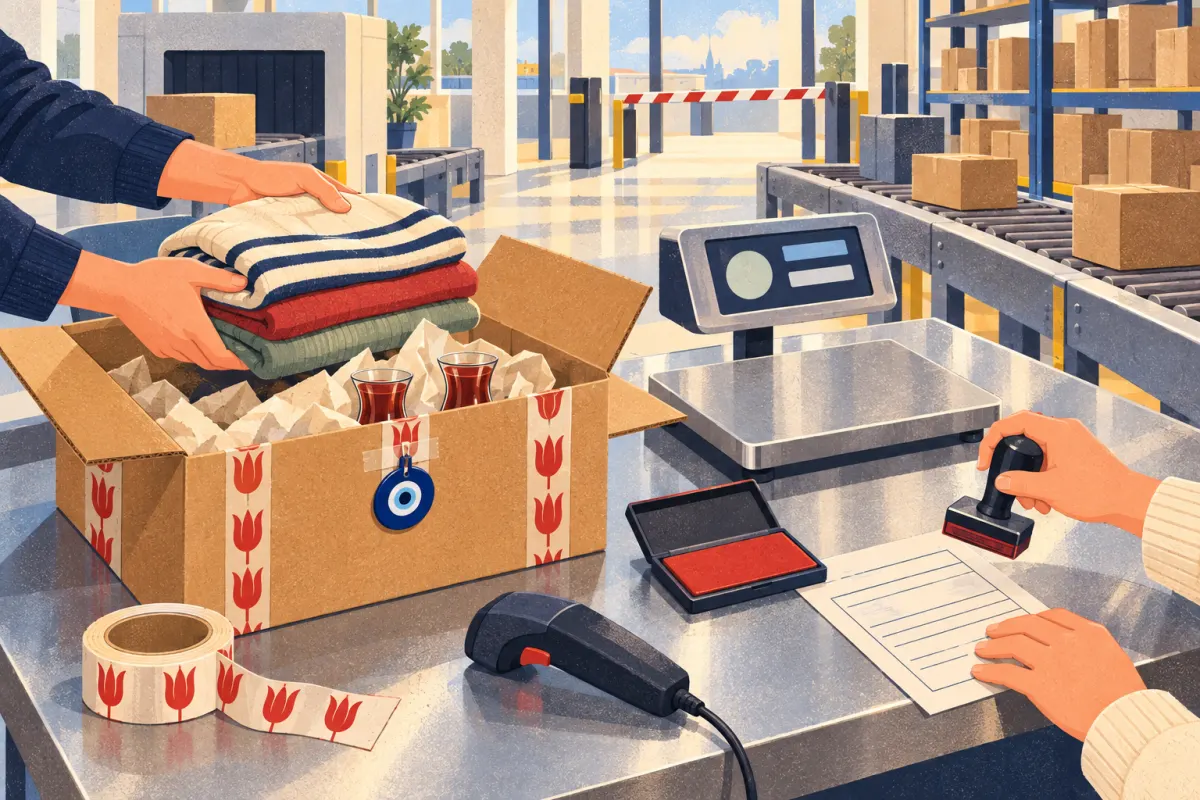
The illustrations were made for this page and show no real person.