Yapı Kredi for Foreign Customers: Accounts, SWIFT and Transfer Costs
Table of Contents
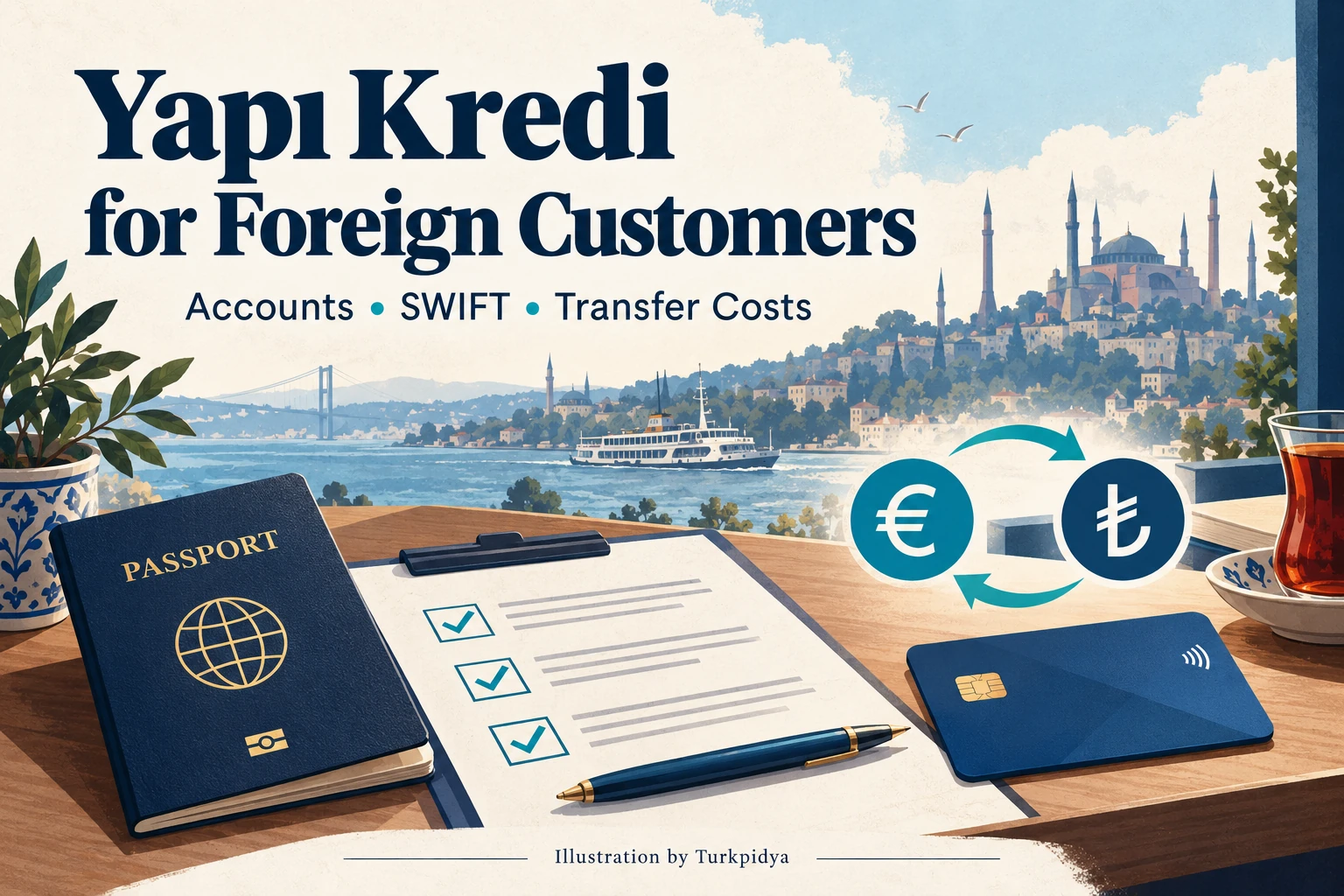
To use Yapı Kredi in Turkey, start with two separate checks. Ask a branch which documents it will accept for your account request. Then ask for the instructions and total cost for each money transfer. A passport, a SWIFT code or a low advertised fee does not answer all three questions.
This guide helps foreign customers prepare for a branch visit, receive money in the correct currency account and compare transfer quotes. It includes the bank’s published SWIFT fee limits and a planner. The bank decides account eligibility. Fees and exchange rates can change.
Checked on 2 October 2026. The retail tariff page shows an update date of 1 October 2026. Its SWIFT fee rows are dated 8 January 2026. Confirm the current quote and receiving instructions with the bank before you send money.
Prepare for an account-opening visit
First choose the account’s purpose. Tell the branch whether you need daily TRY payments, a foreign-currency account to receive money, salary payments or savings. Ask about a current account for everyday use. A time deposit has different terms. The bank’s English deposit-products guide describes both types; it does not promise that every applicant can open every product.
Use the official Yapı Kredi branch and ATM locator. Contact the chosen branch before you travel. Explain your nationality, where you live and whether you have Turkish residence or work documents. Ask if staff can help in English and whether you need an appointment or an interpreter.
The official banking-for-foreigners page lists services. It does not give one complete document list for all applicants. The checklist below is a set of questions to confirm with your branch. It is not a guarantee of approval or a rule that every listed document is always required.
Documents and details to confirm with the branch
| Item | What to ask |
|---|---|
| Identity | Which valid passport or other accepted identity document must I bring? Which pages and copies do you need? |
| Residence or work status | Do you need my Turkish residence or work document for this account? Can you assess a non-resident application? |
| Address evidence | Do you accept my Turkish or overseas address evidence? Which documents and issue dates do you accept? |
| Tax identifier | Should I use my existing Turkish foreigner identifier or a tax number? What evidence do you need? |
| Translation and certification | Which documents need Turkish translation, notarisation or another certification? Must I use a particular translator? |
| Contact details | Which mobile number and email can I use? How will I receive security messages and service notices? |
| Account activity | What evidence do you need for my occupation, source of funds and expected incoming payments? |
| Tax residence | Which countries and tax identifiers must I declare? Which current bank declaration should I use? |
For general context, MASAK’s official identity and address-verification FAQ explains address checks and discusses overseas residents. Examples include recent utility bills and address documents. Your branch must confirm which evidence it can accept and understand. Do not buy a translation just because a general online checklist mentions it.
If the branch asks for a Turkish tax number and you do not have one, use the Revenue Administration’s potential tax-number application for foreigners or ask the tax office for help. Confirm first whether your existing identifier is sufficient. A tax number does not itself approve a bank account.
What to do at the branch
- Take the originals and the copies or translations the branch requested. Keep its checklist with you.
- Explain the purpose of the account and the expected payment currencies. Ask whether each currency needs a separate account.
- Check your name, document number and address in the bank’s records. Correct spelling differences before a payment is sent.
- Read the account terms and fee information. Ask about any initial funding condition, card charge, transfer limit and digital-service restriction that applies to your account.
- Get the IBAN and written receiving instructions for each currency account you will use. Ask how to obtain official account details for a payer.
- Ask how to activate the services you need and how to contact support. Confirm card delivery and accepted security-message arrangements.
If the bank needs more information, ask for a clear list of the missing items. There is no reliable universal opening time, minimum deposit or approval promise in the sources above. Opening a deposit account also does not automatically approve a credit card or a loan.
Keep tax residence separate from nationality
The bank’s CRS and FATCA explanation covers tax-residence declarations. Citizenship, your mailing address and tax residence can differ. Use the bank’s current declaration. Give the relevant tax-residence country or countries and tax identifiers. If an identifier is unavailable, use the stated reason in the bank’s instructions; do not invent one. Ask a qualified adviser if your position spans more than one country.
Use IBAN and SWIFT for different jobs
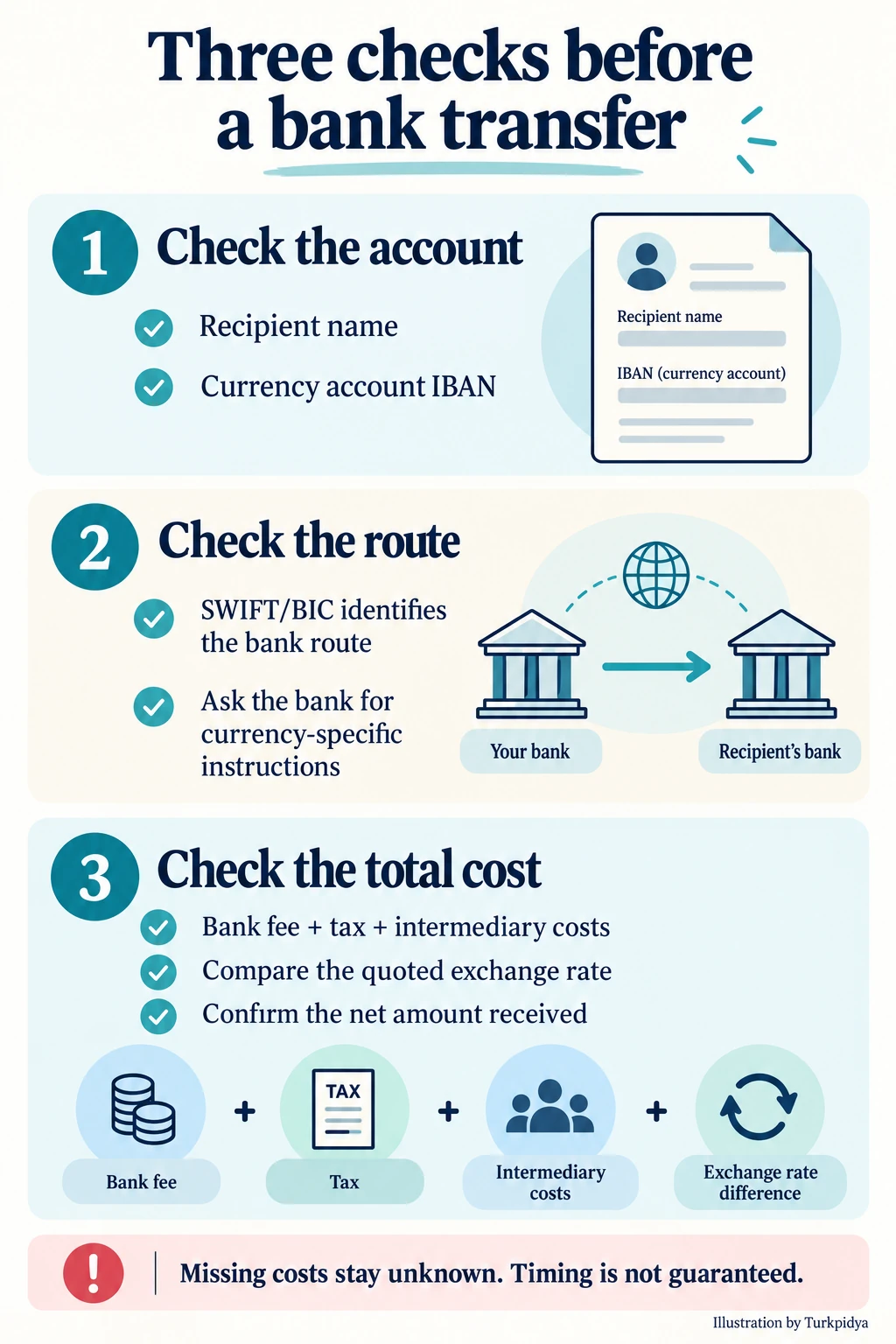
An IBAN identifies a bank account. A SWIFT code, also called a BIC, identifies a bank route. They are not interchangeable. The bank’s explanation of SWIFT and IBAN describes the distinction. Use the recipient’s exact account name, the correct currency account IBAN and the receiving instructions supplied by the bank.
For incoming SWIFT, the detailed official Yapı Kredi SWIFT instructions specify the following currency routes. A short FAQ gives only the XXX code; the detailed page distinguishes FEX.
| Receiving currency | Published BIC | Scope |
|---|---|---|
| USD or EUR | YAPITRISXXX | Incoming SWIFT from other banks. |
| GBP, SEK, JPY, KWD, CHF, AUD, DKK or NOK | YAPITRISFEX | Incoming SWIFT in the listed currencies. |
| TRY from abroad | YAPITRISXXX | Incoming TRY from a bank abroad. |
| Any unlisted currency | Ask the bank | Do not infer a code or assume the currency is supported. |
Do not use the incoming-from-abroad TRY instruction as a domestic EFT or FAST instruction. If you send money from Yapı Kredi to another bank, get the receiving bank’s own BIC and account details. Yapı Kredi’s BIC is not the destination code for every outgoing payment.
Plan the visit and compare transfer quotes
Your banking and transfer planner
Check branch questions, find a published currency route and compare two complete quotes. Enter amounts only. Do not enter account numbers, passport details or other personal information.
Step 1
Confirm the branch questions
0 of 8 branch questions checked. Confirm the unanswered questions with the branch.
Step 2
Find the receiving route and fee row
Published receiving BIC
YAPITRISXXX
For USD, use the recipient’s USD account IBAN and bank-provided receiving instructions.
The receiving-currency selector does not set the currency of an outgoing payment. Choose the fee direction separately.
TRY 1,547.62 to TRY 3,033.33; up to 0.70% in the maximum-rate column. BSMV and other costs are excluded.
This selects a tariff row. It does not calculate a fee for your transfer or promise an arrival time.
| Direction | Channel | Value date | Minimum TRY | Maximum TRY | Rate column |
|---|---|---|---|---|---|
| Outgoing | Internet / mobile / phone | Same day | 1,547.62 | 3,033.33 | 0.70% maximum |
| Outgoing | Internet / mobile / phone | One day | 1,423.81 | 2,909.53 | 0.70% maximum |
| Outgoing | Internet / mobile / phone | Future day | 1,238.09 | 2,785.72 | 0.70% maximum |
| Outgoing | Branch | Same day | 2,785.72 | 12,380.95 | 0.70% maximum |
| Outgoing | Branch | One day | 2,661.91 | 12,195.24 | 0.70% maximum |
| Outgoing | Branch | Future day | 2,538.09 | 12,071.43 | 0.70% maximum |
| Incoming | All listed channels | Not specified | 1,176.19 | 7,335.72 | 0.60% listed |
All seven rows stay visible. Page updated 1 October 2026; rows dated 8 January 2026; checked 2 October 2026. Read the official tariff and footnotes.
Step 3
Compare the total debit and net payout
Use quotes taken at the same time, for the same currency pair and the same total debit. Include every confirmed fee and deduction. Leave missing amounts blank. Confirming the checkbox means you have checked the complete quote; it does not make a provider’s estimate guaranteed.
Enter the total debit in EUR and the net payout in TRY.
Quote A
Unknown: no complete quote entered.
Quote B
Unknown: no complete quote entered.
Use a rate you obtained for the same currency pair and quote time. The percentage difference includes fees and deductions. It cannot isolate the provider’s FX markup.
Comparison unknown. Enter complete quotes and confirm all deductions.
Calculation: all-in net rate = net payout ÷ total debit. Missing costs stay unknown. Rates for different debit amounts do not prove what a provider will pay for a common amount.
Understand the transfer’s full cost
The table gives limits, not a quote for your payment. The outgoing 0.70% entry is a maximum-rate column. It is not a promise that every transfer costs 0.70%. Incoming SWIFT lists 0.60% and TRY 1,176.19–7,335.72, before BSMV.
For same-day outgoing foreign-currency SWIFT, the digital/phone range is lower than the branch range. The bank’s footnotes also allow correspondent charges. Its foreign-currency fee calculations use the day’s branch exchange rate. Outgoing TRY has separate conditions; commission can reach 5%. Erroneous incoming SWIFT research or return is separately listed at TRY 795–4,005 before BSMV, dated 29 January 2026. See the official retail fee page.
Ask for the total debit in the currency you pay and the net amount the recipient will receive. A quote can contain several costs:
- Provider fee: a fixed charge, a percentage or a combination.
- Tax: ask for the tax amount and whether it is included in the displayed fee.
- Intermediary and receiving-bank deductions: ask who pays them and whether the net payout is guaranteed or only estimated.
- Currency conversion: ask which exchange rate applies, when it is fixed and whether conversion occurs more than once.
If a payment stays in the same currency, ask whether the recipient’s account can hold that currency without conversion. If conversion is needed, a lower transfer fee can still produce a lower payout when its exchange rate is less favourable. Compare the complete debit and payout, not the fee alone.
Charge instructions such as sender-pays, shared or recipient-pays affect who bears costs. Ask the provider what each available option covers. An option name by itself does not confirm the recipient’s final amount. Keep any unknown intermediary charge explicit in your comparison.
How to compare a bank with a transfer provider
- Choose one source currency, one payout currency and one total amount you are willing to pay.
- Get both quotes close together. Record the quote time and expiry.
- Check the payment method, provider fee, tax, possible intermediary deductions and receiving-bank fee.
- Confirm whether the displayed payout is final or an estimate.
- Compare net payout for the same total debit. If the debits differ, request matching quotes.
- Compare the delivery estimate, refund conditions and support options as well as the amount.
Use the optional reference rate in the planner only if you have a rate for the same pair and time. Its result is an all-in comparison with that reference. It includes fixed fees, taxes and deductions; it is not a measurement of the exchange-rate spread alone. The planner does not fetch live rates or assume a provider is the cheapest.

Wise is one possible comparison, subject to your route and registered address. Its official restrictions for customers based in Türkiye say that international transfers from a Turkish bank account can continue and that others can send to your Turkish bank account. The same page describes restrictions on Wise balances, account details and other features for customers registered in Türkiye. A transfer service and a multi-currency balance account are different products. Check which service is available to you before relying on it.
Check timing and avoid preventable errors
The official SWIFT page describes instructions before 16:45 during bank working hours as having two-business-day value. Later instructions can be future-dated. The same-day, one-day and future-day categories in the tariff are fee categories. They do not guarantee when the recipient can spend the money.
Ask about currency holidays, the requested value date and the estimated usable arrival date. A transfer can need additional checks. For an urgent payment, get the bank’s current instructions rather than inferring arrival from the fee row.
- Obtain receiving details from the recipient or bank through a trusted channel.
- Check the recipient’s exact name and the currency account IBAN. Do not replace a currency-specific BIC with a generic one.
- Ask how the bank handles a payment sent to the wrong currency account.
- Keep the bank’s receipt and transfer reference. If a payment is delayed, give support the reference through the bank’s secure channel.
- Ask about investigation, amendment and return costs before requesting a change. A return may also involve currency conversion.
Sources and dates
Bank instructions and tariffs were checked on 2 October 2026. The fee table is a dated reference. Recheck the bank’s published information and your own quote before a payment.
- Yapı Kredi banking services for foreign customers and deposit account types.
- Yapı Kredi currency-specific SWIFT instructions and timing.
- Yapı Kredi retail transfer fees and footnotes.
- Yapı Kredi tax-residence declarations under CRS and FATCA.
- MASAK identity and address-verification FAQ and Revenue Administration tax-number application for foreigners.
- Wise service restrictions for Türkiye residents.