Alibaba.com in Turkey: Sourcing, Customs and Buyer Protection
Table of Contents
Sourcing guide · Checked 1 October 2026
Alibaba.com can help you find a factory, compare wholesale offers and order custom products. The useful price is the cost of the goods you can actually receive and use, after freight, import checks and every agreed charge.
For a buyer in Turkey, the first decision is not which supplier has the lowest advertised price. It is whether you are buying locally, importing from abroad or sourcing Turkish goods for another country. Those routes have different paperwork and costs. This guide takes you from the first supplier search to a written order, with a quote comparison tool that keeps missing costs visible.

Before you request a price
- Write the product specification and quantity by variant, including what one “unit” means.
- Confirm where the goods are made, where they will ship from and who will clear the import.
- Compare the supplier’s legal identity, assessment report, sample and production plan.
- Get the full quotation and protection terms in your Alibaba.com order before paying.
What “Alibaba Turkey” means for your order
Alibaba.com is a business-to-business marketplace. It connects buyers with suppliers in many countries. A Turkish interface does not promise a Turkish warehouse, Turkish origin or local delivery. Check each supplier and shipment separately.
Buying into Turkey
Your supplier may be overseas even when the website is in Turkish. Confirm the product’s import requirements and total clearance costs before a sample or bulk order leaves the seller.
Buying from Turkey
A Turkish supplier can sell to a buyer abroad. The destination country’s import rules apply. Ask whether the seller manufactures the goods in Turkey or trades goods made elsewhere.
Buying within Turkey
For stock already in Turkey, ask who issues the invoice, whether the goods have been cleared and whether the quote includes applicable taxes and domestic delivery. A supplier address alone does not answer these questions.
Buying one item for yourself
Alibaba may offer a sample or one-piece order, but the transaction still needs checking. AliExpress shopping in Turkey is a separate retail route with different platform policies. Compare a locally stocked retail offer too.
Turkey’s 2026 customs change: what to check now
In February 2026, Turkey ended the simplified customs route for ordinary cross-border e-commerce parcels. The Trade Ministry’s explanation of the change says compliant goods can still be imported through normal procedures. Specific exceptions remain. Keeping an ordinary shopping order under €30 is no longer a general way to obtain simplified clearance.
Do not use an old 30% or 60% flat rate to budget for an ordinary Alibaba order. The current postal and express-cargo guidance uses those rates for certain qualifying medicines and supplements, with their own conditions. A parcel does not automatically become commercial simply because it exceeds a particular old shopping threshold.
For a business order, send the exact product description, material, intended use, quantity, value, weight, origin and delivery term to your customs representative or carrier before committing. Ask them to confirm the proposed GTİP, Turkey’s tariff classification code, and the documents needed for that particular product. The Ministry’s commercial import guidance explains why classification, conformity checks, permits and restrictions matter. A supplier’s “CE available” message or an Alibaba badge does not establish that your model complies.
A sample still needs a route
Genuine low-value samples used to obtain or place orders can qualify for special treatment, subject to the official conditions. That does not make every paid sample or usable product exempt. Ask the carrier how it will declare the sample in your company’s name and what evidence is needed. Never request a false value, false description or a “gift” label to avoid clearance.
How to find a supplier worth contacting
Start with the product, not the broadest category. Search for the material, use and manufacturing process that matter: for example, “cotton peshtemal woven towel” is more useful than “Turkish product.” Use the supplier-location filter when you want a business based in Turkey. Then check the actual origin and dispatch point; a Turkish-style product can be manufactured elsewhere.
Build a small shortlist of suppliers who can explain your specification. A manufacturer may be a good fit for repeat custom production. A trading company may combine several products or accept a smaller assortment. Neither description proves quality. Ask who makes the item, whether production is subcontracted and which company will appear on the order, invoice and relevant test reports.
Read the company profile as evidence, not a score
Alibaba’s Verified Supplier program adds third-party assessment of the business and its capabilities. Open the assessment report rather than stopping at the badge. Check the legal name, inspection date, address, business type, facilities and product scope. A report for a textile business does not prove it can manufacture electrical equipment safely.
- Identity: does the contracting company match the profile, report and invoice? Ask about any different trading or payment entity.
- Capacity: can the supplier explain the production steps, monthly capacity, busiest periods and subcontracted work for your order?
- Quality control: who checks incoming materials, production and the finished shipment? Can you arrange an independent inspection?
- Documents: do certificates identify the exact model, manufacturer, test standard and validity? Check important reports with their issuer.
- Order history: read recent relevant reviews and complaint patterns, but do not treat a high rating or years on the platform as a guarantee.
- Communication: does the supplier answer technical questions clearly, or only push for a deposit?
Gold Supplier membership, Verified Supplier assessment and Trade Assurance are different signals. None independently guarantees the quality of your production batch or permission to import it. Alibaba’s verification page itself qualifies the accuracy and timing of third-party assessments.
A useful Turkish listing example
A peshtemal listing from BLR Gida Tekstil Ithalat Ihracat Ticaret Ve Sanayi Limited Sirketi illustrates why the details matter. In the listing checked on 1 October 2026, the seller’s FAQ allowed a one-piece starting order, while custom logo and packaging options showed 100-piece minimums. Shipping cost and timing were to be negotiated. Those are seller-stated listing details, not an independently verified offer or supplier recommendation; recheck them on the actual quote.
The lesson is practical: a low displayed minimum may apply only to existing stock. It does not tell you the minimum for your logo, packaging, fabric weight or color. Use the profile, assessment and sample checks above before choosing this or any other seller.
Send an RFQ that produces comparable answers
An RFQ is a request for quotation. You can send the same specification to your shortlisted suppliers or use Alibaba.com’s RFQ service to invite offers. Keep commercially sensitive designs out of a broadly circulated request until you have decided what to share and with whom.
A useful request separates the product from the commercial terms. Ask for a quote expiry date, too: a price without a validity period may be unusable by the time you approve the sample.
A copyable quote request
Please quote for [product and intended use], using the attached specification.
- Material, dimensions, tolerances and performance: [details].
- Quantity: [pieces per size/color/model]. One selling unit means [one piece / a pack of X pieces / a carton of X pieces].
- Existing stock or custom production: [choice]. Branding, packaging and labels: [details].
- Destination: [country, city and delivery point]. Please quote [Incoterm, named place, Incoterms 2020] and list every included and excluded charge.
- Sample: price, freight, dispatch date and whether any sample charge is credited against the bulk order.
- Bulk order: minimum per variant, price breaks, tooling/setup charges, payment stages and production lead time after sample approval.
- Compliance: documents and test reports for the exact model, plus proposed tariff code and manufacturing origin for review.
- Quality: agreed sample, inspection method, acceptance criteria, remedy for nonconforming goods and permission for an independent inspection.
- Protection: can these exact specifications and shipping commitments be written into a Trade Assurance order? Please confirm quote validity.
Do not compare one supplier’s factory-gate price with another’s delivered price. Ask each to return the same quantity and terms. If one quote says “100 sets,” find out how many pieces make a set before entering it into a spreadsheet or paying a deposit.
MOQ, samples and the first production order
MOQ means minimum order quantity. Ask whether it applies to the whole order, each stock code, color, size, design or shipping carton. A supplier may negotiate a smaller trial order, but a new mold, custom dye or printed packaging can make a low quantity uneconomic. A mixed-color order only solves the problem if the supplier agrees how the minimum is counted.
Order a sample that represents the product you intend to buy. An attractive showroom sample can differ from bulk production. Record the approved materials, dimensions, tolerances, finish, labeling and packaging in writing. If the sample is approved with changes, list those changes clearly; silence is not an agreed specification.
- Check the sample before the deposit grows. Measure it, test the important functions and examine packaging. For regulated products, establish the testing and import requirements before relying on it.
- Keep an agreed reference. Identify the approved sample and specification version in the order. Ask how substitutions will be approved.
- Agree inspection and payment stages. Put the inspection timing, acceptance criteria and consequences of a failure into the contract. Do not assume you can add them after production.
- Start at a manageable scale. A pilot order can reveal packing, labeling and transit problems that one sample cannot. Keep its extra cost separate from the price expected on a repeat order.
What Trade Assurance protects, and what it does not
Trade Assurance provides a dispute and refund process for eligible orders placed and paid through Alibaba.com when agreed terms are not met. Check the protection displayed on your particular order. The written specifications, shipment commitments, payment route and evidence matter; the badge on a supplier’s page is not the whole agreement.
Keep the important commitments in the order and retain platform messages, attachments, payment receipts, inspection reports, delivery records and clear photos or videos of a problem. “Premium quality” is difficult to prove. A specified material, agreed measurement tolerance and documented defect are much clearer.
The published money-back policy describes a standard 30-day refund-claim window from delivery, extended to 60 days for Enterprise and Enterprise Pro buyers. Follow the deadline shown for your actual order and raise a problem promptly. A refund request still needs assessment; it is not a promise that every loss or disagreement will be reimbursed.
Two limits to check before payment
Trade Assurance does not certify Turkish import compliance or guarantee customs release. Also, do not assume free local returns are available in Turkey: Turkey was not included in the Easy Return country list checked for this guide. Ask who pays return freight and how rejected or nonconforming goods will be handled.
Pay through the protected order’s instructions
Use the payment methods actually offered for your order and location. Alibaba’s Trade Assurance ordering guide includes bank transfer to the designated beneficiary shown in the order’s payment details. That is different from wiring money to an account sent privately by someone claiming to be the supplier. Independently verify any unexpected bank-detail change before acting.
PayPal does not operate for Turkey-based customers; its Turkish notice says local operations stopped in June 2016. Do not build a buying plan around it. For card or bank payments, check your bank’s international-payment rules, transfer fees, currency conversion and the final amount received by the seller. The methods available on someone else’s order may differ from yours.
Which delivery term are you actually buying?
Incoterms are standardized rules allocating delivery, transport, risk and customs responsibilities. Write the rule, named place or port, and version, such as “FCA [named collection point], Incoterms 2020.” They do not replace the product contract, payment terms or a customs assessment.
| Term | What to clarify before comparing prices |
|---|---|
| EXW | The seller makes goods available at the named place. The buyer generally handles collection and export arrangements. Check who can actually perform export clearance; a low factory price can leave substantial work with you. |
| FCA | The seller delivers to the buyer’s nominated carrier at the named place and handles export clearance. Confirm the precise handover point and who pays the onward journey. |
| FOB / CIF | These are sea or inland-waterway terms. Under FOB, the buyer arranges the main freight; CIF includes main freight and specified insurance. Under both, risk transfers at shipment on board, not when goods arrive at your door. Ask about destination charges. |
| DAP | The seller brings goods to the named destination ready for unloading. The buyer normally handles import clearance and import duties/taxes. “Delivered” does not mean every import charge is included. |
| DDP | The seller normally takes responsibility for import clearance and duties/taxes. Ask who will lawfully act as importer, what documents you receive and what is excluded. Do not accept an unexplained “tax-free line” as evidence. |
The ICC’s guidance on Incoterms and tariff risks is useful when choosing a rule. For container or mixed-mode transport, discuss FCA rather than automatically copying FOB from a listing. The correct term depends on the actual handover and route.
Compare the cost per usable piece
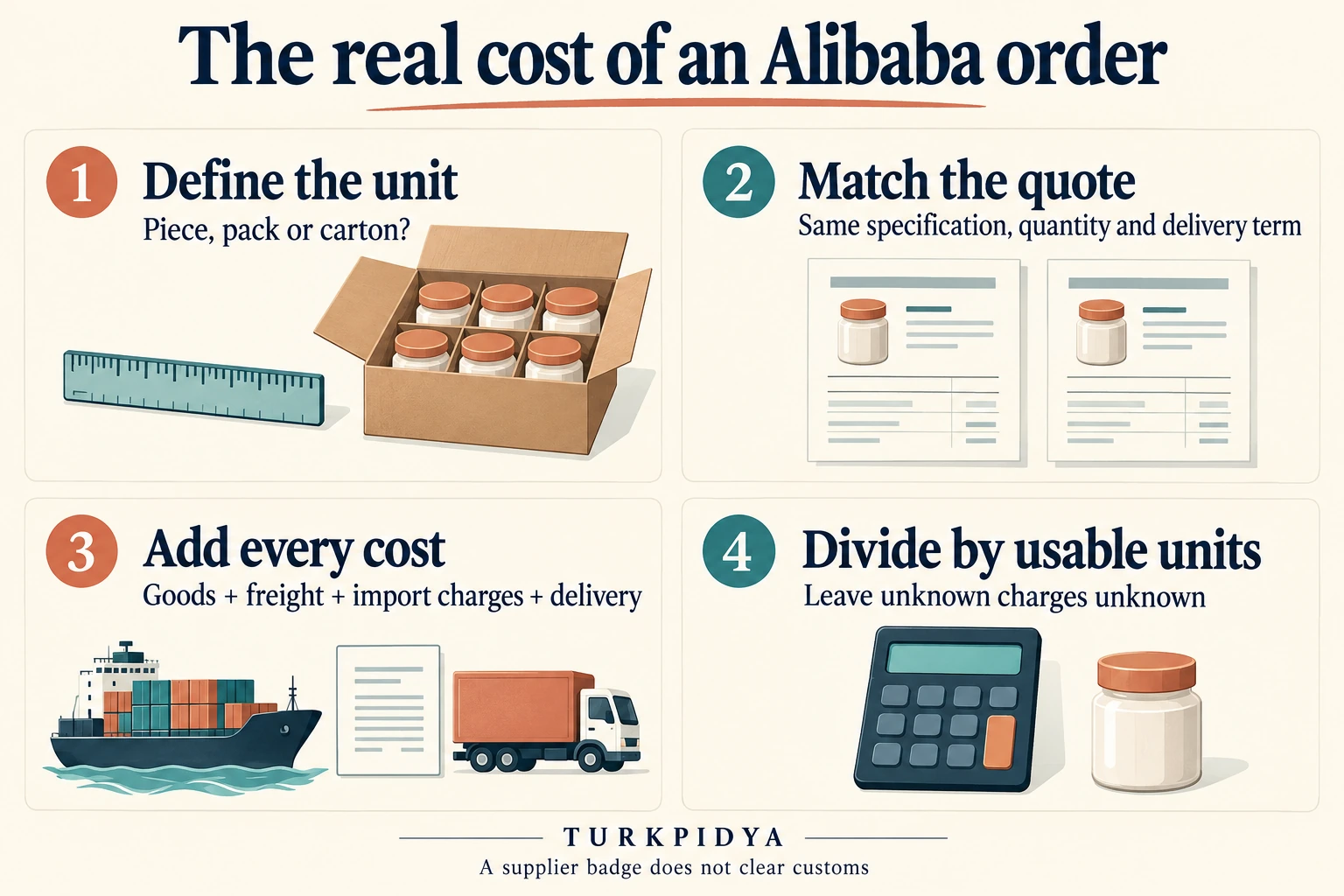
Request a written breakdown for goods, tooling and sample charges, export handling, freight, insurance, destination handling, customs services, duties and taxes, inspection, final delivery and payment fees. Include each cost once. A DDP or delivered quote may already contain charges that an EXW quote leaves out.
Keep three things separate: costs already quoted, costs still unknown, and amounts that may be recoverable in your accounts. Import VAT can be a cash payment even where a business may later recover it. Get accounting advice for that treatment; the tool below compares cash outlay and does not deduct tax automatically.
Private, on-page buying worksheet
Compare two quotes on a usable-piece basis
A cheap pack price is not necessarily a cheaper order. Normalize the quantity, add only confirmed cash costs, and keep unknowns visible.
Planning arithmetic only. This tool does not estimate tax rates, validate a supplier or recommend a purchase. Import VAT may be recoverable later, depending on your situation; it remains in cash outlay here and is never automatically deducted. Your entries stay on this page: no storage and no network requests.
Quote results
Cash totals use integer minor units (cents / kuruş). Per-piece amounts are rounded to two decimal places only for display. Comparisons use the unrounded cash totals when both piece counts match. Costs outside the six cash lines are not included.
Manual method and hypothetical worked example
- Ordered pieces = quoted units ordered × pieces in each quoted unit. For a piece quote, pieces in each unit = 1.
- Goods cash cost = quoted units ordered × goods price per quoted unit.
- Known subtotal = the known goods cash cost plus any known extra cash-cost lines. If any amount is unknown, this is a partial subtotal, not a complete landed cost.
- Complete landed cash outlay = goods cash cost + non-credited sample / tooling cost + freight / insurance + import duty / tax cash outlay + inspection / brokerage / storage / export handling + final delivery / payment fees. Use 0 only where explicitly confirmed.
- Cash outlay per usable piece = complete landed cash outlay ÷ your explicit expected usable piece count. Do not divide by packs or cartons. Usable pieces must not exceed ordered pieces.
- Compare only when both quotes use the same currency, ordered piece count, expected usable piece count, product specification, destination and tax / delivery cost basis. Check written delivery terms and dispatch timing first.
Hypothetical example, not a market quote: Supplier A: 10 packs × 12 pieces = 120 pieces, at 24.00 USD per pack. Supplier B: 120 one-piece units at 1.90 USD each. Both assume 114 usable pieces. For A, the five extras are 0 + 48 + 36 + 12 + 6 = 102.00 USD; for B they are 0 + 66 + 36 + 12 + 6 = 120.00 USD. A totals 342.00 USD, or 3.00 USD per usable piece. B totals 348.00 USD, or about 3.05 USD per usable piece. A has a lower calculated cash outlay by 6.00 USD for this invented, matched scenario; that alone does not establish a better supplier.
Use a single currency for a comparison. Turkpidya’s currency converter can help with an initial budget, but the bank’s executable rate and the customs valuation rules may differ. Record the conversion date and fees when turning a foreign-currency quote into your buying budget.
Plan delivery as several stages
Ask for separate dates for sample dispatch, sample approval, production completion, inspection, freight departure, estimated arrival and final delivery. An express freight estimate does not include a month of production unless the supplier expressly says so. Customs checks, missing documents and storage can change both timing and cost.
Express can suit a small sample; air cargo can suit urgent or high-value loads; road and sea may fit other routes and volumes. For sea freight, compare less-than-container-load consolidation with a full container using the real packed dimensions and weight. A cheap freight headline can exclude destination handling, release charges or final delivery. Ask when storage starts and what happens if clearance is delayed.
Before dispatch, check the commercial invoice, packing list, transport document and any product-specific certificates or origin documents with the person handling clearance. Manufacturing origin and shipping country are different concepts. Do not let an unverified origin claim drive your tax estimate.
If the order arrives late or wrong
Keep the packaging and document the issue immediately. Compare the goods with the agreed specification and approved sample, recording quantities and affected units. Contact the supplier through the order and use Alibaba’s dispute workflow before the applicable deadline if a resolution is not reached. Do not confirm that a problem is resolved just to obtain a promised refund later.
For a customs hold, first find out which document, charge or requirement is missing. A supplier may need to correct legitimate paperwork, but do not agree to falsify it. Ask the carrier about deadlines, storage, return or abandonment consequences in writing. Neither a supplier promise nor opening a platform dispute stops every external charge.
Selling Turkish products on Alibaba.com
For a Turkish manufacturer or exporter, the same details make a stronger listing: exact materials and dimensions, capacity you can support, realistic MOQ by variant, sample policy, packaging options, test documents and shipping terms. State whether you manufacture or trade the product, and identify the origin accurately.
Review the current seller agreement, membership charges, supported categories and payment arrangements directly with Alibaba.com before signing up. Do not treat an old Gold Supplier price or an agency’s sales pitch as the platform’s current offer. Build the sample, inspection and export-document process before promising overseas buyers a delivery date.
A sensible first order
Shortlist suppliers who answer the specification, approve a representative sample, confirm the import route and compare complete written quotes. Put the product and delivery commitments into the protected order. A slightly higher unit price can be a better buying decision when it comes with clear responsibilities and fewer unresolved costs.
Source check: 1 October 2026. Official Turkish customs guidance, Alibaba.com buyer-policy and verification pages, and ICC guidance are linked where used. Supplier listing details can change and are examples, not endorsements. This guide and its calculator are planning aids, not a customs ruling or a guarantee of supplier performance.