Turkey’s Top Trading Ports: The 2026 Logistics & Middle Corridor Guide
Table of Contents
In an era where global supply chains are being rewritten by Red Sea crises and geopolitical shifts, Turkey has moved to the center of the global economic stage. The country is no longer just a geographical bridge; it has become the decisive maritime command center of the “Middle Corridor.”
Forget the outdated statistics: Turkey now boasts over 180 port facilities and coastal structures, handling a total volume of approximately 13.5 million TEU (standard containers) in 2024. But for importers, logistics managers, and investors, only a few key ports truly matter. We analyze the “Big Players” across the Marmara, Black Sea, and Mediterranean, explaining exactly why they are critical for your trade operations.

The Strategic Hubs: A 2026 Analysis
The Turkish merchant fleet and its ports serve as the backbone connecting Asia and Europe. Each port plays a specific rolefrom the consumer goods gateway for Istanbul to the heavy industry hub for the Middle East. If you are starting a company in Turkey or managing a supply chain, understanding these distinctions is vital.
Ambarlı (Altaș Ambarlı): The Gateway to Europe
If you need to move consumer goods into Istanbul or the European side of Turkey, Ambarlı is your non negotiable entry point. Located in the Beylikdüzü district, this port complex is one of the country’s largest container handling centers.
Why this port matters:
- Volume: The complex (including terminals like Marport and Kumport) handles approximately 3 million TEU annually.
- Structure: It is divided into two main zones: the new Ambarlı Port (west of the oil terminals) for containers and general cargo, and a separate area for oil platforms and tankers.
- Logistics: It serves as the primary supply hub for the Greater Istanbul area and the Thrace region. Tip: Ensure your paperwork matches the specific terminal codes to avoid delays. See our guide on Turkish address formats for logistics accuracy.
Port of Mersin (MIP): The Southern Anchor
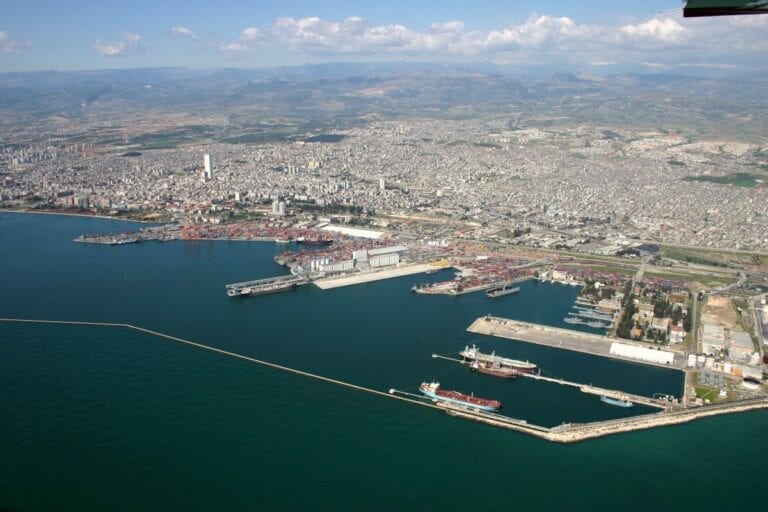
Mersin International Port (MIP) is the strategic heavyweight of the Mediterranean and often the most critical port for transit trade into the Middle East (Iraq, Syria). Following massive recent investmentsincluding the completion of the EMH2 expansion phase in 2025—it is now one of the most technologically advanced ports in the region.
The Facts:
- Capacity: With an annual throughput exceeding 2 million TEU, it is a bustling hub. The expansion project targets a capacity increase to 3.6 million TEU by 2026.
- Connectivity: Five berths are directly connected to the railway network, allowing for seamless freight forwarding from Adana and Anatolia.
- Versatility: Beyond containers, the port features specialized terminals for Ro Ro, oil, and grain (silos with 100,000-ton capacity).

Port of Istanbul (Galataport & Karaköy)
Avoid the confusion: When people speak of the “Port of Istanbul” in the city center (Karaköy/Salıpazarı) today, they are usually referring to Galataport. This is no longer a cargo port; it is a state-of-the-art cruise and tourism terminal.
Historically, this was the trade center, but cargo traffic has long since shifted to Ambarlı and Haydarpaşa. Today’s Galataport welcomes millions of tourists and features an underground passenger terminala masterpiece of modern architecture, but irrelevant for container trade.
Port of İzmir (Alsancak) vs. Aliağa
The Aegean region is the export powerhouse for Turkish agricultural products and textiles, but a major shift is underway:
The traditional Port of İzmir (Alsancak), operated by the state railway TCDD, struggles with capacity limits and declining volumes (dropping below 300,000 TEU recently). The real growth is happening in the neighboring Aliağa Cluster (Nemrut Bay), where private ports now handle over 2.1 million TEU. For exporters in the region, prioritizing Aliağa over the congested Alsancak is often the smarter tactical move.
Haydarpaşa Port
Haydarpaşa, located at the southern entrance of the Bosphorus, was once the industrial heart of Istanbul. Today, the port is in transition. While it has lost significance for container traffic (a role taken over by Ambarlı), it remains relevant for Ro Ro traffic (trucks on ships) and general cargo.
It serves as a vital link for trade with Black Sea neighbors and is directly connected to the Anatolian rail network. However, logistics planners should note that large parts of the area are frequently discussed for future urban development projects.
Port of İskenderun (LimakPort)
İskenderun is the story of an impressive comeback. After sustaining severe damage during the February 2023 earthquake, the port is fully operational again and recorded a volume increase of over 20% in 2024.
It is the strategic gateway for heavy industry (steel) in southeastern Turkey. With an area of 1 million square meters and a capacity of around 1 million TEU, it serves as the primary alternative to Mersin for the Eastern Mediterranean. This is particularly relevant if you are sourcing from the top Turkish iron casting manufacturers located in this industrial belt.
Port of Trabzon
For trade with Russia, Georgia, and Iran, Trabzon is the key. As the most important Turkish port on the Black Sea, it holds historical significance stretching back to the Silk Road.
The port, listed on the stock exchange since 2018, has an annual handling capacity of approximately 10 million tons. It is particularly specialized in bulk cargo and project shipments for the Black Sea region.