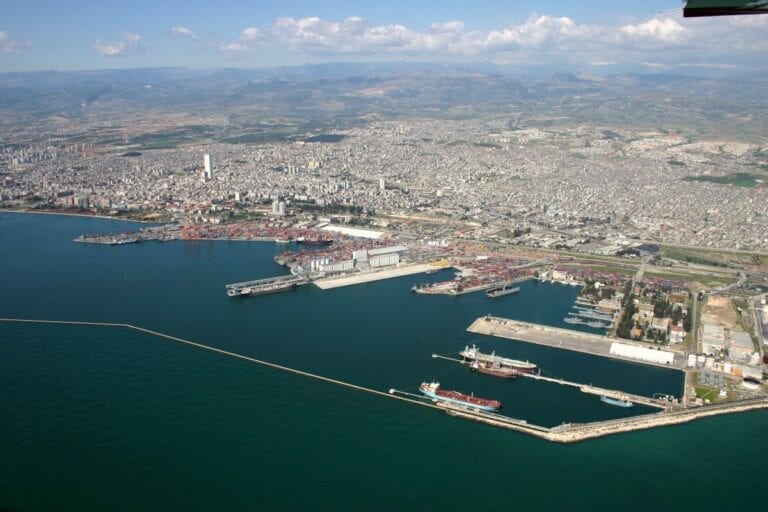
Ports in Turkey 2026: Container Volumes by Port and Area
Table of Contents
Short answer: Turkey’s ports handled 13,996,578 containers (TEU) in 2025, 3.5% more than in 2024, and Ambarlı on the Marmara coast of Istanbul handled the most, 3.43 million. Eight harbour-master areas account for 98% of the total, and about one box in five (19%) is recorded by the ministry as transit cargo.
The figures come from the container statistics of the Ministry of Transport and Infrastructure (UAB), which publishes them by harbour-master area rather than by terminal, so a row such as “Ambarlı” covers every terminal in that area. The first eight months of 2026 are already published: 9,574,529 TEU, 2.1% above the same months of 2025. This guide ranks the areas, says what each port is for and lists what we could not verify. All figures were checked on 1 October 2026.
How Many Containers Do Turkey’s Ports Handle?
Short answer: 13,996,578 TEU in 2025, up from 12,556,401 in 2023, and 9,574,529 TEU in January to August 2026. One TEU is one 20-foot container, so a 40-foot box counts as two, and UAB’s totals include full and empty boxes.
| Period | Containers handled (TEU) |
|---|---|
| 2023 | 12,556,401 |
| 2024 | 13,529,729 +7.8% on 2023 |
| 2025 | 13,996,578 +3.5% on 2024 |
| Jan-Aug 2025 | 9,378,306 |
| Jan-Aug 2026 | 9,574,529 +2.1% on Jan-Aug 2025 |
UAB splits the 2025 total into three kinds: 10,329,519 TEU of international shipping (74%), 949,360 TEU of cabotage, which is domestic coastal shipping (7%), and 2,717,699 TEU of transit (19%). The mix is almost identical in the first eight months of 2026, when transit was again 19% of the total.
How many ports does Turkey have? Trabzon Port’s company page says Türkiye has about 180 ports and coastal facilities operating internationally. We found no UAB list that confirms the count, so treat it as an operator’s statement. What the data do show is concentration: the eight areas in the next section handled 98% of the 2025 total.
Container League: The Eight Areas That Handle 98% of Turkey’s Boxes
Short answer: in 2025 the top three were Ambarlı (3.43 million TEU), Kocaeli (2.51 million) and Tekirdağ (2.14 million), together 58% of the national total. Mersin (1.97 million) was fourth and Aliağa (1.70 million) fifth. Pick a year in the chart to watch the ranking change.
Where Turkey's containers go
Year
| Area and share of the 2025 total | 2025 TEU and change on 2024 |
|---|---|
| 1. Ambarlı 24.5% | 3,428,048 +13.9% |
| 2. Kocaeli 17.9% | 2,505,678 +7.9% |
| 3. Tekirdağ 15.3% | 2,138,327 +5.2% |
| 4. Mersin 14.1% | 1,970,690 +4.3% |
| 5. Aliağa 12.2% | 1,701,274 -19.7% |
| 6. Gemlik 6.5% | 909,524 +2.3% |
| 7. İskenderun 6.2% | 869,527 +10.9% |
| 8. İzmir 1.7% | 234,259 -10.6% |
Two moves stand out. Tekirdağ passed Mersin in 2024 (2.03 million against 1.89 million TEU) and has stayed ahead. Aliağa is the volatile one: it grew 33.6% in 2024 and shrank 19.7% in 2025, and almost all of the swing was transit boxes, which fell from 490,615 to 156,167 TEU while its international traffic fell only 5.9%.
UAB does not publish terminal-level figures in these tables. For terminal sizes we use the operators’ own pages below, and we label them as the operators’ statements, not measured throughput.
Ambarlı, Kocaeli and Tekirdağ: The Marmara Gateways
Short answer: the Marmara coast carries most of Turkey’s containers. Ambarlı, Kocaeli, Tekirdağ and Gemlik together handled 8,981,577 TEU in 2025, 64% of the national total. Ambarlı is the biggest single area, and Tekirdağ records the most transit boxes.
Ambarlı (Istanbul) handled 3,428,048 TEU in 2025, 13.9% more than in 2024 after a 5.1% dip that year. Of that, 2,308,164 TEU were international, 117,814 cabotage and 1,002,070 transit (29%). Marport, one of its terminals, describes its location as serving the industrial western Marmara region, and says it was formed in 2001 when Arkas and Terminal Investment Limited (TIL) bought Armaport at Ambarlı.
| Terminal | What the operator states |
|---|---|
| Marport Ambarlı | 2.3 million TEU handling capacity a year, 1,605 m of quay, about 530,000 m². Reports 1.3 million TEU handled in 2024 |
| Kumport Beylikdüzü, Istanbul | 2.1 million TEU capacity, 16.5 m water depth, 2,234 m of quay, 482,000 m² |
| Asyaport Tekirdağ | 94,264 TEU stacking capacity, 18 m water depth, 2,410 m of quay, 354,000 m² |
Kocaeli handled 2,505,678 TEU in 2025 (+7.9%), 88% of it international, which makes it the most import-export oriented of the three. Yilport lists its Gebze and Körfez terminals among its Marmara-region terminals, handling container, general cargo and bulk. If you are buying cast parts from Turkey, our guide to Turkish iron-casting manufacturers lists seven producers; ask each one which port it ships from.
Tekirdağ handled 2,138,327 TEU in 2025 (+5.2%), and 1,199,000 TEU of it (56%) was transit, the highest transit share of any large area. Ambarlı and Tekirdağ together hold 81% of all transit boxes in Turkey. Asyaport is the container terminal in Tekirdağ, but UAB gives no terminal breakdown, so we cannot say how much of the area’s volume is Asyaport.
If you are sending samples or paperwork to a Turkish company, our guide to the Turkish address format shows how to write the address.
Mersin: The Southern Anchor
Short answer: the Mersin area handled 1,970,690 TEU in 2025 (+4.3%), still under 2 million, and 98% of it was international trade rather than transit. Mersin International Port (MIP), run by a PSA and Akfen joint venture, lists a design capacity of 3.6 million TEU.
TCDD says the right to operate the port was transferred on 11 May 2007 for 36 years to the PSA Akfen joint venture, for USD 755 million, and that the operator is Mersin Uluslararası Liman İşletmeciliği A.Ş. PSA’s July 2026 factsheet lists 8 container berths and 13 multi-purpose berths, 4,013 m of quay, 134.8 hectares, a maximum depth of 17.6 m and 15 quay cranes.
The same factsheet says the port can take ultra-large vessels up to 400 m long and 24,000 TEU, and that its hinterland reaches from Çukurova to Central and Southeast Anatolia, with a role as a transit hub for northern Iraq and Syria. UAB’s “transit” column is small at Mersin (14,358 TEU in 2025), so we cannot tell from UAB data how that trade is recorded.
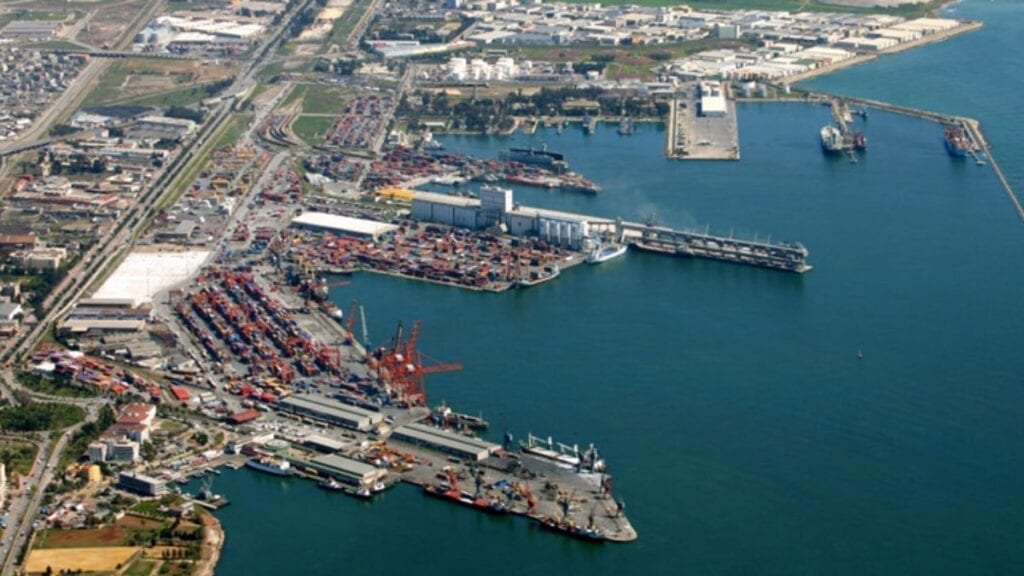
The factsheet also lists the EMH2 extension, a 368 m quay extension and 17.6 hectares of reclaimed land, but gives no completion date. We found no TCDD or PSA source for rail-connected berths or silo capacity, so we make no claim about either.
Galataport and Haydarpaşa: Istanbul’s Old Waterfront
Short answer: neither is a big container port any more. Galataport is a cruise terminal with a shopping and dining district, and Haydarpaşa handled only 6,978 TEU in 2025, down from 18,155 in 2022, with Ro-Ro now its main cargo.
Galataport, at Karaköy, is the cruise port in central Istanbul. It presents itself as a cruise terminal and a shopping, dining and culture district, not as a cargo terminal. Its own page describes the world’s first underground cruise terminal: 29,000 m² below ground, a stated capacity of three ships and 15,000 passengers a day, and an underground car park for 2,400 cars. We found no current cruise passenger count, so we give none.
Haydarpaşa, on the Asian shore at the southern entrance of the Bosphorus, is a TCDD port. TCDD counts 18,155 TEU in 2022, 14,436 in 2023, 7,600 in 2024 and 6,978 in 2025. Of its 791,730 tonnes of cargo in 2025, 425,802 tonnes (54%) were Ro-Ro, meaning vehicles driven on and off ships, followed by 223,188 tonnes of dry bulk, 98,819 of general cargo and 43,921 of containers. TCDD’s capacity sheet of 10 February 2026 still lists 3,413 m of quay and 401,591 TEU of container capacity a year, far more than the port now handles. We found no current statement on redeveloping the site, so this guide makes no prediction.
İzmir (Alsancak) and Aliağa: A New Owner and a Volatile Year
Short answer: the İzmir area handled 234,259 TEU in 2025 (-10.6%), while Aliağa, also in İzmir province, handled 1,701,274 TEU, down 19.7% from 2.12 million in 2024. TCDD’s data sheets say TCDD İzmir Port was transferred to the Türkiye Wealth Fund on 31 July 2026.
TCDD’s sheets carry a note that, under a Presidency decision of 27 February 2026 (no. 10988), the port passed to the Türkiye Wealth Fund (Türkiye Varlık Fonu) on 31 July 2026. We have not checked what the transfer changes for operations or tariffs, so confirm tariffs with the port or your forwarder.
Alsancak is still a large port by tonnage: 7,247,173 tonnes in 2025, of which 3,920,834 tonnes (54%) were dry bulk and 2,346,777 tonnes containers. Its container traffic keeps falling, though. TCDD counts 406,081 TEU in 2022 and 240,192 in 2025 (its own count differs slightly from UAB’s harbour-master figure), about a fifth of the 1,164,917 TEU of container capacity its capacity sheet lists.
Aliağa’s 2025 drop came mostly from transit, which fell from 490,615 to 156,167 TEU; its international traffic fell from 1,553,146 to 1,461,655 TEU. UAB gives no reasons. Which of the two suits an exporter depends on carrier services and rates, so ask your forwarder to quote both.
İskenderun: Growing Two Years in a Row
Short answer: the İskenderun area handled 869,527 TEU in 2025, up 10.9% after +20.7% in 2024, and 94% of it was international trade. The port is run by Limak under a 36-year concession from TCDD.
The area handled 649,472 TEU in 2023, 783,711 in 2024 and 869,527 in 2025. The February 2023 earthquakes hit this region, but we did not find a source on the damage or the repair of the port, so we say nothing about it beyond what the volumes show.
TCDD says the operating right was transferred on 30 December 2011 for 36 years to Limak, for USD 372 million, and that the operator is Limak İskenderun Uluslararası Liman İşletmeciliği A.Ş. We could not load LimakPort’s own website, so we give no port area or capacity figure.
Trabzon: A Small Container Port on the Black Sea
Short answer: Trabzon handled only 24,567 TEU in 2025, and 20,445 TEU of it was cabotage, so it is a regional port, not a container hub. Trabzon Port says it can handle 10 million tonnes of cargo and 350,000 TEU of containers a year.
The company says it has run the port under a 30-year transfer since November 2003 and that it has been listed on the stock exchange since 24 January 2018. Its capacity page lists eight berths with 2,235 m of quay and a stated annual intake of 2,500 ships.
UAB counted 16,001 TEU at Trabzon in 2023, 21,718 in 2024 and 24,567 in 2025, so the actual traffic is about 7% of the stated container capacity. We did not find a source for the port’s trade partners, so we name none.
The Middle Corridor: What the Numbers Do and Do Not Show
Short answer: Turkey’s ports clearly handle a lot of transit containers, but UAB’s data cannot show a “Middle Corridor” effect. The corridor association describes the Trans-Caspian International Transport Route as starting in Southeast Asia and China and running through Kazakhstan, the Caspian Sea, Azerbaijan and Georgia to Europe, and its home page names no Turkish port as a hub.
UAB recorded 2,717,699 TEU of transit in 2025, 19% of all containers, about four-fifths of it in Tekirdağ (about 1.20 million) and Ambarlı (about 1.00 million). At Mersin and İskenderun transit is small, 14,358 and 19,584 TEU. UAB’s tables do not say which routes the transit boxes belong to, so we cannot link them to the corridor, and we did not verify any corridor transit times or volumes through Turkey.
Which Port Should You Use?
Short answer: choose by where the cargo starts or ends, then by carrier schedules and price. The volumes only show where boxes already go.
| Your cargo starts or ends in | Start by looking at |
|---|---|
| Istanbul, Thrace or western Marmara industry | Ambarlı, the largest area. Tekirdağ is the other Marmara option and has a large transit share |
| Kocaeli industry (Gebze, Körfez) | The Kocaeli area, 88% international. Yilport lists terminals at Gebze and Körfez |
| Çukurova, Central or Southeast Anatolia | Mersin, whose operator lists these regions as its hinterland. İskenderun is the other Eastern Mediterranean option |
| Aegean exports | Aliağa for volume (1.70 million TEU in 2025). Alsancak is much smaller (234,259 TEU) |
| Eastern Black Sea | Trabzon, a small container port (24,567 TEU in 2025). Ask the port and your forwarder about services |
Terminal and forwarder quotes may come in dollars or euros. Convert them into lira with our live exchange rates on the day you pay, instead of relying on any rate printed in an article. If you are importing or exporting through a Turkish company, see our guide to starting a company in Turkey.
How We Checked and Sources
Container volumes come from the spreadsheets that UAB publishes on its maritime statistics site: one file per year, by harbour-master area, with the 2026 file covering January to August. We read the area rows directly and checked that they add up to UAB’s national totals. UAB’s cargo-tonnage tables stop at 2018 and its cruise tables at 2019, so we use no tonnage or passenger figures from them.
Port-by-port facts come from TCDD (traffic, tonnage and capacity data sheets and the concession terms for Mersin and İskenderun) and from each operator’s own website. Operator capacity figures are statements, not measured throughput. Mersin International Port’s own website returns a security check to automated requests, so for Mersin we used TCDD and PSA’s July 2026 factsheet. We could not load LimakPort’s website.
What we could not confirm:
- Terminal-level container volumes, and whether Kumport sits inside the Ambarlı area or the Gebze and Körfez terminals inside the Kocaeli area (UAB lists areas only; Kumport’s site gives a Beylikdüzü address).
- What UAB’s “transit” column covers exactly, and which routes (if any) relate to the Middle Corridor.
- The completion date of Mersin’s EMH2 expansion, the number of rail-connected berths and the silo capacity.
- LimakPort’s current capacity and area, and the earthquake damage and repair at İskenderun.
- Who operates Alsancak after the transfer to the Türkiye Wealth Fund, and what changes for users.
- The status of any Haydarpaşa redevelopment, and current Galataport cruise passenger numbers.
- The “about 180 ports” count, which is Trabzon Port’s statement. January to August 2026 figures are partial and may be revised.
- UAB container statistics 2023: 2023 national total and area split, checked 1 October 2026.
- UAB container statistics 2024: 2024 national total and area split, checked 1 October 2026.
- UAB container statistics 2025: 2025 national total, international, cabotage and transit split, and area rows, checked 1 October 2026.
- UAB container statistics 2026: January to August 2026 national total, split and area rows, checked 1 October 2026.
- TCDD port data: Container traffic, tonnage and capacity sheets; İzmir port transfer note, checked 1 October 2026.
- TCDD container traffic (PDF dated 07.09.2026): Haydarpaşa and İzmir container traffic 2022-2026; transfer note, checked 1 October 2026.
- TCDD cargo by group (PDF dated 12.08.2026): Haydarpaşa and İzmir tonnage by cargo group, 2025, checked 1 October 2026.
- TCDD capacity sheet (PDF dated 10.02.2026): Haydarpaşa and İzmir quay length and capacity, checked 1 October 2026.
- TCDD: Mersin port: Mersin operating right: 11.05.2007, 36 years, PSA Akfen joint venture, USD 755 million, checked 1 October 2026.
- TCDD: İskenderun port: İskenderun operating right: 30.12.2011, 36 years, Limak, USD 372 million, checked 1 October 2026.
- PSA: Mersin International Port factsheet (July 2026): MIP berths, quay, depth, cranes, design capacity, vessel size, hinterland, EMH2 extension, checked 1 October 2026.
- Trabzon Port: about us: 30-year transfer from November 2003, stock-exchange listing 24.01.2018, “180 ports” statement, checked 1 October 2026.
- Trabzon Port: capacity and physical status: 10 Mt handling, 350,000 TEU container handling, 8 berths, 2,235 m quay, 2,500 ships a year, checked 1 October 2026.
- Marport: history: Founded 2001 by Arkas and TIL buying Armaport, checked 1 October 2026.
- Marport: terminal details: 2.3 million TEU capacity, 1,605 m quay, 530,000 m², Ambarlı location, checked 1 October 2026.
- Kumport: 2.1 million TEU capacity, 16.5 m depth, 2,234 m quay, 482,000 m², checked 1 October 2026.
- Asyaport: 94,264 TEU stacking capacity, 354,000 m², 18 m depth, 2,410 m quay, checked 1 October 2026.
- Yilport: Türkiye terminals: Gebze and Körfez terminals in the Marmara region; services, checked 1 October 2026.
- Galataport: about the port: Cruise terminal description: underground area, ship and passenger capacity, car park, checked 1 October 2026.
- Trans-Caspian International Transport Route (middlecorridor.com): Route description: Southeast Asia and China, Kazakhstan, Caspian Sea, Azerbaijan, Georgia, Europe, checked 1 October 2026.