

Nasreddin Hodja: Life, Anecdotes and Sayings
Nasreddin Hodja (Nasreddin Hoca), the hero of Turkish anecdotes: his life as sources give it, his Akşehir tomb, UNESCO and the sayings he left.
Table of Contents
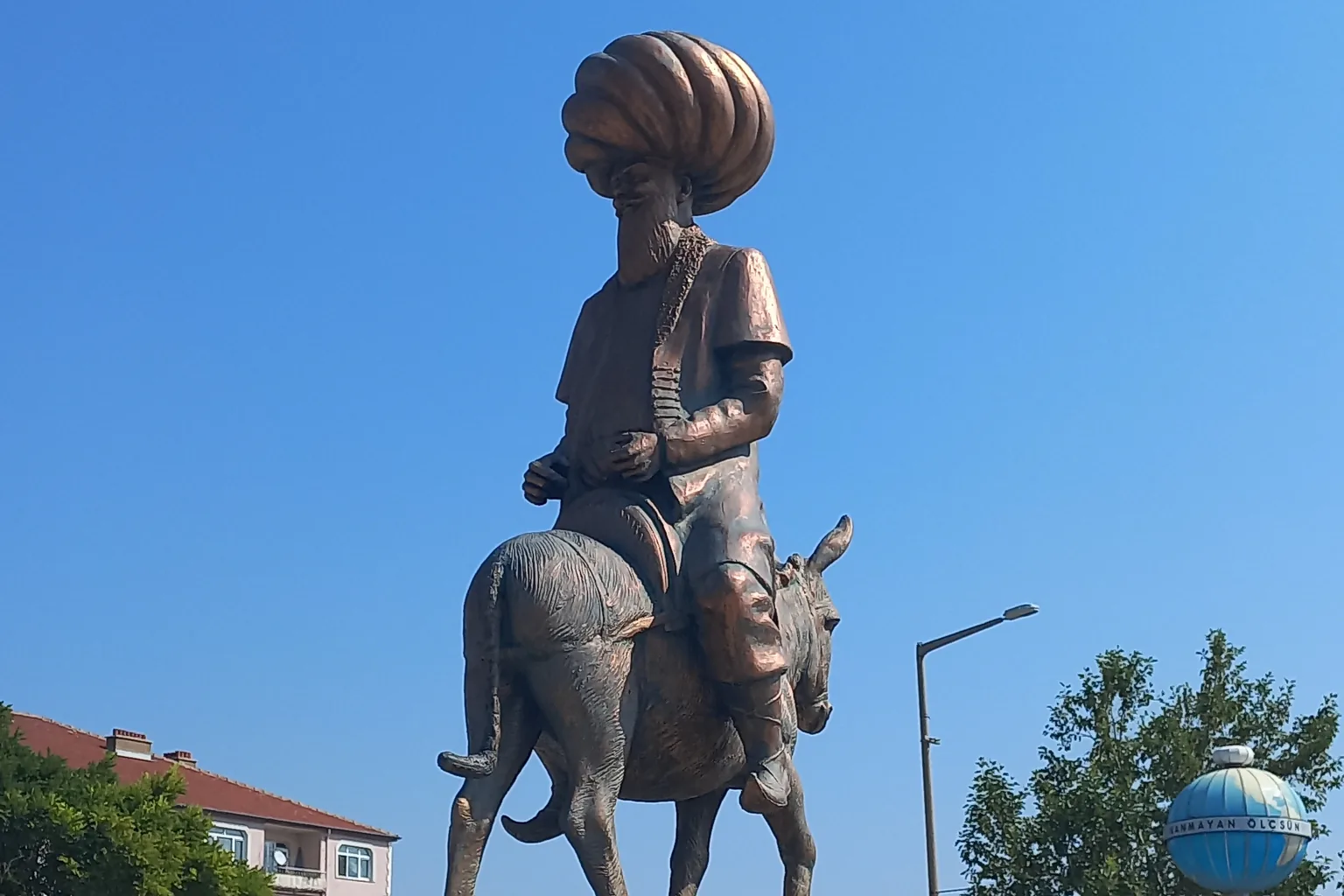
Nasreddin Hodja (Turkish: Nasreddin Hoca; hoca means «teacher») is the hero of Turkish fıkra, short comic anecdotes that end on a quick turn of words. The TDV İslâm Ansiklopedisi, a Turkish encyclopaedia of Islam, says that his era, dates, family and even his historical person are disputed; «according to the sources» he was born in 1208 in the village of Hortu near Sivrihisar, served as a judge in Akşehir and died in 1284. His anecdotes are told from Tunisia to the Ili valley on the Chinese border, UNESCO has listed the tradition of telling them since 2022, and Turkish still uses sayings that came from them.
In short · checked 28.10.2026
A hero of anecdotes, with a life the sources dispute.
- He is the hero of the Turkish fıkra, a short comic anecdote. TDV calls him the humour symbol of the Muslim Turkish people; UNESCO lists the tradition of telling his anecdotes for seven states, Türkiye among them.
- His dates are disputed. TDV gives 1208 (born in Hortu) to 1284 (died in Akşehir) «according to the sources» and says that his era, family and historical person are all debated.
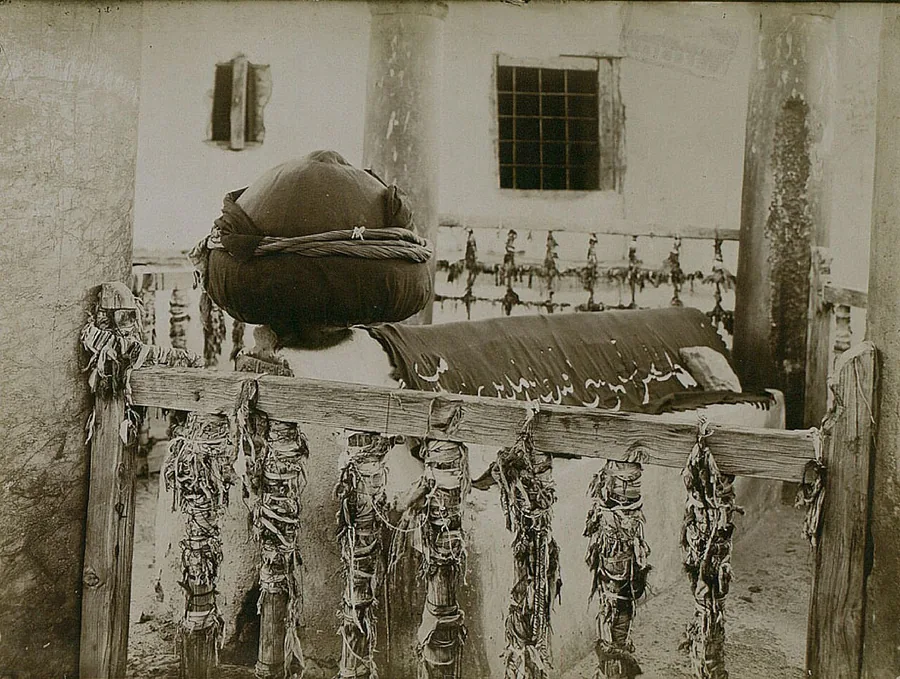
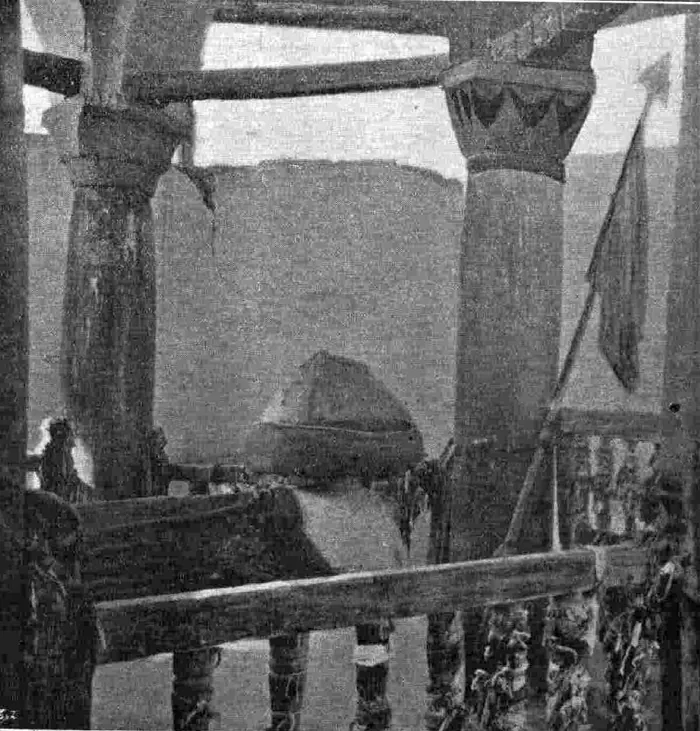
- The tomb in Akşehir, a town in Konya province, is the oldest surviving physical item connected to him, says the Akşehir municipality. A cavalryman named Mehmed cut a six-line text dated 796 (1393/94) on its columns.
- Sivrihisar, a town in Eskişehir province, and Hortu, a village of Sivrihisar, are where TDV places his birth. Sivrihisar’s municipality gives its own account of his father, his daughter and his death.
- Three sayings come with their anecdote: «El elin eşeğini türkü çağıra çağıra arar», «İnce eleyip sık dokumak» and «Bindiği dalı kesmek».
- Not every story is his. TDV says the coarse anecdotes credited to him were added later, and calls the claim that he lived in Timur’s time not correct.
Tool · collection and TDV checked 28.10.2026
The Hoca’s saddlebag
A heybe is a woven saddlebag with a pouch on each side that hangs over a donkey’s back. The Akşehir municipality writes that the Hoca cannot be thought of apart from his donkey. Four things lie in this heybe: a ladle, a pot, a spade and a halter, the rope headgear of a donkey. Take one out: its story plays in three drawn steps and ends on the Hoca’s last line, ready to copy.
The ladle Lake Akşehir
- At the lakeOne day the Hoca takes a ladle and a pot to the shore of Lake Akşehir and starts to work with the ladle. People who see him stop to watch.
- The questionSomeone asks what he is doing. «Can’t you see? I am setting yoghurt in the lake.» Maya is the starter that turns milk into yoghurt. «Good heavens, Hoca, does a lake ever take a starter?»
- His last line«My friends, I know it will not take. But what if it does?»
Ya tutarsa?What if it takes?
He knows the chance is nil and tries anyway. The line stands for a small hope that is still worth one try.
The Hoca’s last line · collection no. 152
Say it when someone is about to try something that will probably fail.
The pot A neighbour’s cauldron
- It gave birthThe Hoca borrows a big cauldron from a neighbour. He returns it with a small pot inside: «Your cauldron was pregnant, and it gave birth.» The neighbour is pleased.
- It diedSome days later he borrows the cauldron again and does not bring it back. The neighbour comes to ask for it: «Your cauldron died.» «Whoever heard of a cauldron dying?»
- His last line«You believe that it gave birth. Why do you not believe that it died?»
Kazanın doğurduğuna inanıyorsun da öldüğüne neden inanmıyorsun?You believe the cauldron gave birth; why do you not believe it died?
A reply to someone who accepts a claim while it pays and refuses the next one when it does not.
The Hoca’s last line · collection no. 143, «Kazan doğurdu»
Say it when a person accepts the first part of an argument and rejects the part that follows from it.
The spade A pit in the garden
- A pitThe Hoca starts to dig a pit in the middle of his garden. A neighbour asks what he is doing.
- The answer«I will bury the soil from the middle of the street here. People who pass by keep complaining about it.»
- His last line«And what will you do with the soil that comes out of this pit?» «Neighbour, I do not like to sift finely and weave tightly.»
İnce eleyip sık dokumayı sevmem.I do not like to sift finely and weave tightly.
He waves away the next, obvious question. The idiom ince eleyip sık dokumak names what he refuses: going over a matter in fine detail, point by point.
TDV lists the idiom «ince eleyip sık dokumak» among those from his anecdotes · collection no. 67
Say it when someone insists on a detail you do not want to argue.
The halter A lost donkey
- A lost donkeyThe donkey of the subaşı, a local administrator, is lost. The Hoca sets out to look for it with a few neighbours.
- A songAs he looks, he sings a folk song, a türkü. A neighbour is puzzled: «Hoca, does a man look for a lost donkey singing?»
- His last line«People look for other people’s donkeys singing songs.»
El elin eşeğini türkü çağıra çağıra arar.People look for other people’s donkeys singing songs.
People search lightly for what belongs to someone else.
TDV lists it among the proverbs from his anecdotes · collection no. 44
Say it when someone shows little worry over another person’s loss.
Nothing you press is stored or sent. The numbers are those of the 156 anecdotes selected by Saim Sakaoğlu and Ali Berat Alptekin from their book «Nasreddin Hoca» (Akşehir Belediyesi Kültür Yayınları), which the Akşehir municipality publishes: collection of 156 anecdotes (PDF).
Who he is: a name, a title and a kind of story
Nasreddin Hodja is a figure of Turkish storytelling. Nasreddin is his name and hoca is a title for a teacher, in particular a religious teacher, so in Turkish he is Nasreddin Hoca. The stories told about him are fıkra (plural fıkralar): short comic anecdotes, a few lines long, that end on a quick answer. UNESCO prints his name in five forms, «Nasreddin Hodja/ Molla Nesreddin/ Molla Ependi/ Apendi/ Afendi Kozhanasyr», and notes that communities differ slightly in imagery, character names and stories.
- Hoca
- «Teacher». A title, in particular for a religious teacher, and part of his name in Turkish. English spells it Hodja, as UNESCO does.
- Fıkra
- A short comic anecdote that ends on a twist. The books on him hold hundreds.
- In the stories
- An ordinary villager who works in his fields, goes to the forest for wood and now and then goes down to town, most often Akşehir, Sivrihisar or Konya. Sometimes he is a scholar, a judge, a doctor or an envoy. Quick with an answer, he tells the truth without hurting people and can laugh at himself. TDV
- Among whom
- Mostly among ordinary people, and almost never at court. Akşehir municipality
- A symbol
- TDV calls him «the humour symbol of the Muslim Turkish people». TDV
checked 28.10.2026 · TDV · Akşehir municipality · UNESCO
The Akşehir municipality writes that his value lies less in the events of his life than in the meaning and the fine point of the anecdotes told in his name.
What the sources say about his life: record and legend
TDV opens with a caution: his era, his birth and death years, his historical person and his family are disputed. The main evidence it names for his time and place is the tomb in Akşehir, inscriptions on the gravestones of people said to descend from him, and an archive document from the reign of Sultan Mehmed II (Fâtih) about a vakıf, a foundation set up to run a public good, in his name.
TDV İslâm Ansiklopedisi is the encyclopaedia of Islam of the Türkiye Diyanet Vakfı (Turkey Religious Affairs Foundation); its entry «Nasreddin Hoca» is by Nurettin Albayrak, printed in 2006.
Dates in the record
- 1208
- Born in Hortu, «according to the sources». TDV
- 1284
- Died in Akşehir, «according to the sources». TDV
- 1393/94
- Mehmed, a cavalryman of Sultan Bayezid I, cuts a six-line text dated 796 on the columns round the tomb. Akşehir municipality
- 1480
- The Saltuknâme, a 15th-century book of tales by Ebülhayr-i Rûmî, holds two anecdotes of the Hoca: the oldest manuscript that mentions him. TDV
- 1571
- The oldest dated manuscript of his anecdotes, by a man named Hüseyin, holds 43. TDV
- 1883
- Letâif-i Nasreddin, the first illustrated print, by Mehmed Tevfik (Çaylak), holds 71. TDV
- 1896
- The magazine Servet-i Fünun prints a picture of the tomb. Wikimedia Commons file page
- 1905
- A restoration gives the tomb its present shape. Akşehir municipality
- 2022
- UNESCO lists the tradition of telling his anecdotes. UNESCO
The first two years are TDV’s «according to the sources» dates; the rest are dates of items that survive. · checked 28.10.2026 · TDV · Akşehir municipality, the tomb · UNESCO
A life in four steps, as TDV gives it
TDV gives this life «according to the sources»; dates, era and family are disputed.
- Born in HortuHortu is a village of Sivrihisar, in what is now Eskişehir province. His father Abdullah was the village imam, the man who leads the prayers in a village mosque. The year is given as 1208.
- His father’s postAfter his father he took over the post of village imam.
- AkşehirHe moved to Akşehir, a town in what is now Konya province, and served as a kadı, a judge who decided local cases.
- His deathHe died in Akşehir in 1284. The tomb there is the evidence TDV puts first.
checked 28.10.2026 · TDV
Born in 1208 in Hortu.
TDV gives Hortu and 1208 «according to the sources» and says that birth and death years are disputed. Sivrihisar’s municipality also gives Hortu and 1208, with a longer account of his schooling (chapter 8).
He served as a judge in Akşehir.
TDV gives the post of kadı «according to the sources». The Akşehir municipality writes that «according to one rumour» he taught at a medrese, a religious school, and served as a kadı.
He lived in the time of Timur.
Evliya Çelebi and some historians show him as a contemporary of Murad I, Bayezid and Timur. TDV says this is not correct: the man who talked with Timur was the poet Ahmedî. The Akşehir municipality writes that the bath-house anecdote with Timur was made up later, since the Hoca lived long before Timur.
He met the Seljuk sultans and grew close to Mevlânâ Rumi.
It lists these among the rumours that mixed into his life story, with talking to Timur and appearing in several places at once. It adds that there is no anecdote about the Seljuk sultans he is said to have met.
His full name was always Nasreddin Hoca.
The Akşehir municipality writes that his duties gave him the name Nasuriddin Hâce, which later became Nasreddin Hoca. Sivrihisar’s municipality reads «Nasrüddin Hoca Nusrat» as his full name on his daughter’s gravestone.
Every anecdote told under his name is his.
Some anecdotes credited to him are coarse and do not fit the moral sense and customs of the people. TDV says it is certain they are not his and were credited to him later. Books list more than 500 anecdotes; by the usual measures the number is about 300.
The anecdotes: built on a turn of words
A fıkra has two or three beats: a setup, a question or a move by someone else, and the Hoca’s answer, which turns the thing round. TDV lists the kinds of humour in them as word play, contrast, surprise, exaggeration and allusion, and says there is more humour in what is said than in the situation. The anecdotes were gathered from tellers and then written down. The retellings here are short versions of anecdotes in a collection of 156 that the Akşehir municipality publishes; the numbers are the collection’s.
How one is built: «Aynı yaştayız», the same age (no. 6)
- SetupHis friends like to tease him, because they find something to laugh at in his answers.
- The moveOne day they ask: «Hoca, are you older, or is your brother?»
- The turn«I asked my mother this a year ago. She said my brother is a year younger than I. A year has passed since then, so now the two of us are the same age.»
Collection no. 6 · checked 28.10.2026 · collection of 156 anecdotes (PDF)
In writing, as TDV counts
2, 43 and 71 anecdotes; 2,064 books.
The oldest manuscript that mentions him, the Saltuknâme of 1480, holds two anecdotes. A manuscript of 1571 holds 43, and the first illustrated print, of 1883, holds 71. Mustafa Duman’s list of books about him (1480–2004) has 2,064 entries.
Books name more than 500 anecdotes; by the usual measures about 300 are counted. TDV
Gold or stone, what does it matter? (no. 3)
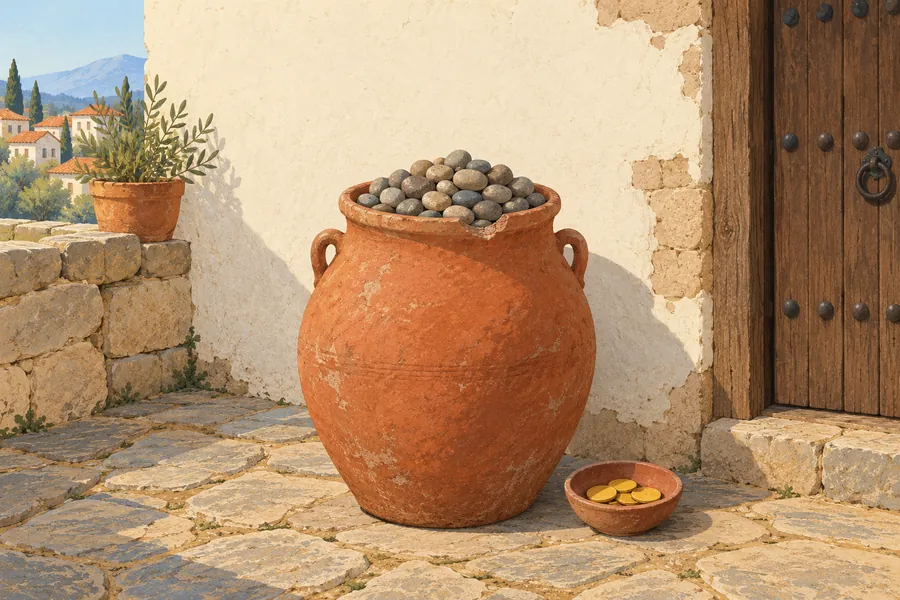
The Hoca reaches a town where some houses fly a flag on the roof. He asks why and is told: «A house with a flag has a jar full of gold in it.» A küp is a large clay storage jar. He buys a big jar and fills it with pebbles. People who have gold gather to talk round their jars.
When it is the Hoca’s turn, the guests look into his jar and find pebbles. «Why are you upset, neighbours?» he says. «Once it lies in a jar, what does it matter whether it is gold or stone?»
Collection no. 3 · checked 28.10.2026 · collection of 156 anecdotes (PDF)
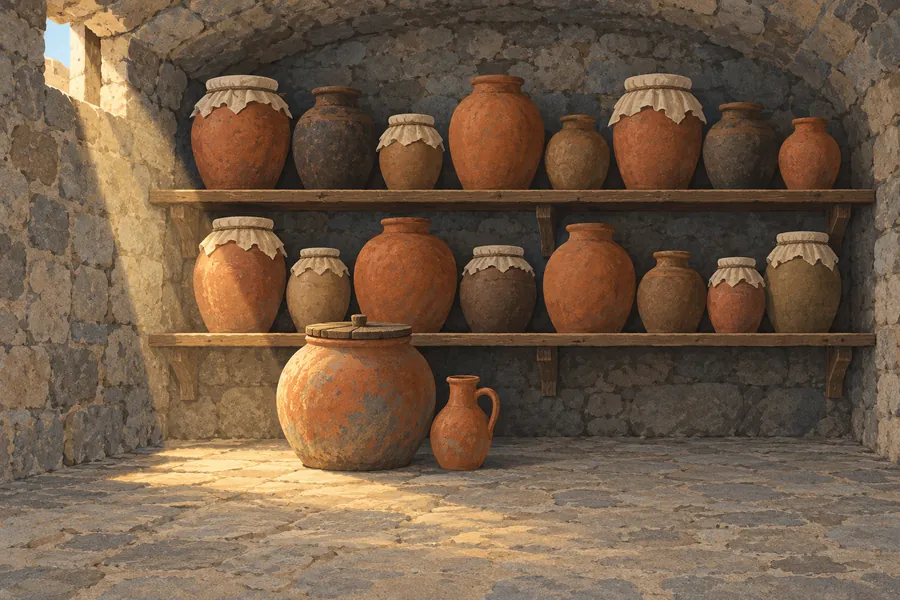
Forty-year vinegar (no. 75)
A neighbour wants to make pickles (turşu) and finds he has no sharp vinegar at home. He sends his son to the Hoca: «Ask for forty-year-old vinegar.» The boy knocks and asks.
The Hoca strokes his beard. «Give your father my greetings. I cannot give forty-year vinegar. If I gave it to everyone who came, would any forty-year vinegar be left in my house?»
Collection no. 75 · checked 28.10.2026 · collection of 156 anecdotes (PDF)
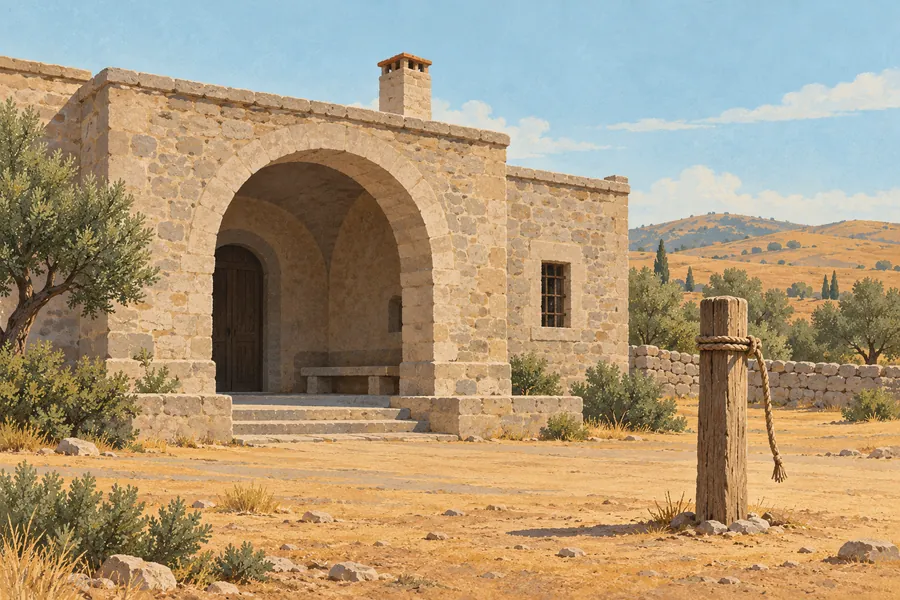
Would I have come to you? (no. 103)
The Hoca’s donkey is stolen. He shouts in the street: «They have stolen my donkey! Thieves have stolen my donkey!» The kadı, the judge, hears him, calls him over and asks: «How did you let it be stolen? Who stole it? When?»
Angry at the questions, the Hoca says: «Judge, if I knew the answers to these questions, would I have come to you?»
Collection no. 103 · checked 28.10.2026 · collection of 156 anecdotes (PDF)
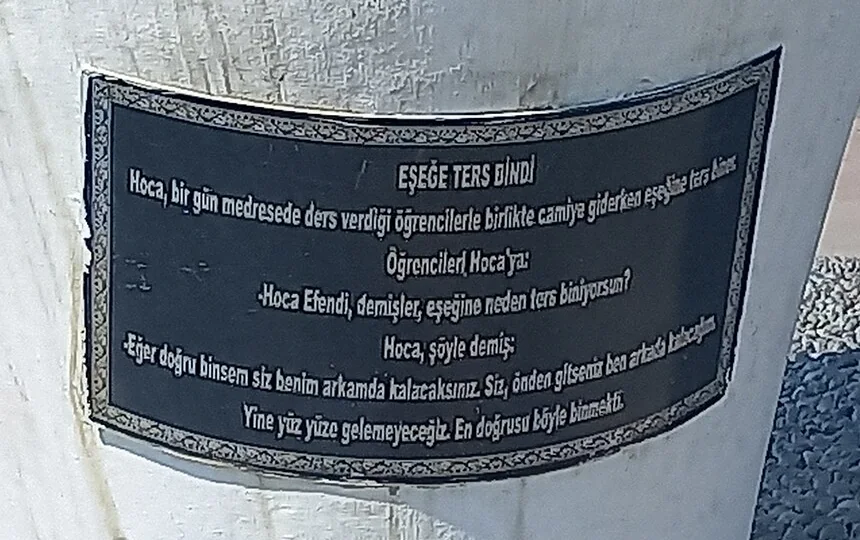
Why he rides backwards
A plaque on the base of the statue in Akşehir tells why the Hoca sits on his donkey facing the tail. He was going to the mosque with the students he taught at the medrese, the religious school, and rode backwards. The students asked: «Hoca Efendi, why do you ride your donkey backwards?»
He answered, as the plaque gives it: if he rode facing forward, they would stay behind him; if they went ahead, he would stay behind them; either way they would not meet face to face. Riding like this was the right way.
Plaque on the statue base · photo of 2024 · Turkish text on the plaque
The sayings: lines the stories gave Turkish
TDV writes that the wide telling of the anecdotes produced many idioms and allusions that are still used today, and that most of them have the force of proverbs. An atasözü is a proverb, a short saying that states a rule of life. A deyim is an idiom, a fixed phrase whose meaning is more than its words. TDV names three proverbs and four idioms as examples. Three of them have their story in the municipality’s collection.
People look for other people’s donkeys singing songs: someone shows little worry over another person’s loss. The Hoca says it while searching for the local administrator’s lost donkey with a song on his lips (the halter in the saddlebag).
TDV lists it among the proverbs from the anecdotes · collection no. 44
To sift finely and weave tightly is to go over a matter point by point. The Hoca says he does not like it when a neighbour asks where the soil from his new pit will go (the spade in the saddlebag).
TDV lists «ince eleyip sık dokumak» among the idioms from the anecdotes · collection no. 67
In no. 130 the Hoca goes up the mountain for wood and starts to saw off, at its base, the branch he is sitting on. A passer-by warns him that it will break and he will fall. The Hoca takes no notice and falls with the branch. The anecdote goes on after the fall.
TDV lists «bindiği dalı kesmek» among the idioms from the anecdotes · collection no. 130
checked 28.10.2026 · TDV · collection of 156 anecdotes (PDF)
Where the anecdotes travelled: one figure in many tongues
TDV writes that anecdotes that spread from Anatolia are taken as a special product of Eastern Islamic wit, and that this made him a shared hero of the whole Eastern Islamic world. It lists where the Hoca is found.
Türkiye, Egypt, Arabia, Tunisia
TDV names Türkiye, Egypt and the Mediterranean coasts as far as Tunisia, and Arabia.
Romania to Albania
Romania, Bulgaria, Serbia, Croatia, Greece and Albania, lands once under Ottoman rule: his anecdotes are common there.
Caucasus, Iranian Azerbaijan, Crimea
The Caucasus, Iranian Azerbaijan and Crimea.
Kazakhstan to the Chinese border
Kazakhstan, and the Ili valley in Turkestan on the Chinese border.
TDV also finds that the themes of his anecdotes match those of anecdotes told from Thailand, Punjab and Turkestan to Germany, France, England, the Iberian peninsula, the Baltic lands, Scandinavia, North Africa, Egypt and Sudan: some by chance or natural likeness, many from the same source. It names figures of other peoples whose anecdotes resemble his.
Figures TDV names beside him
- Arabs
- Cuhâ
- Germans
- Till Eulenspiegel
- Americans
- Paul Bunyan
- Bulgarians
- Hitar Petar
- English
- Joe Miller
- Italians
- Bertoldo
- Russians
- Balakirev
- Yugoslavs
- Kerempuh and Era
- Japanese
- Ikkyū
- In Türkiye itself
- Karagöz, Hacivat and Ebleh Mehmed, comic types of Turkish shadow theatre and folklore.
checked 28.10.2026 · TDV
The UNESCO listing: a tradition of telling
In 2022 UNESCO put the «Telling tradition of Nasreddin Hodja/ Molla Nesreddin/ Molla Ependi/ Apendi/ Afendi Kozhanasyr Anecdotes» on its Representative List of the Intangible Cultural Heritage of Humanity. Intangible cultural heritage means living practices, such as storytelling, passed from person to person. Seven states share the entry. What it covers is the telling: the social practices and festivals round the anecdotes.
- Listed
- 2022, at the 17th session of the Committee (17.COM), on the Representative List.
- States
- Azerbaijan, Kazakhstan, Kyrgyzstan, Tajikistan, Türkiye, Turkmenistan and Uzbekistan.
- What is passed on
- Anecdotes attributed to Nasreddin, passed on by word of mouth and in written sources. They have inspired local idioms and proverbs, and many are classics that also reach people in print, in pictures and in television programmes for children.
- How they are used
- UNESCO’s text says communities use them to enrich conversation, to reinforce an argument, to persuade others or to explain a situation.
- Who keeps it going
- Municipalities, universities and non-governmental organisations, which organise activities and festivals at local, national and international level.
checked 28.10.2026 · UNESCO Intangible Cultural Heritage, nomination file no. 01705
Akşehir today: the tomb, the statue and the festival
Akşehir is a town in Konya province, near Lake Akşehir. The tomb of the Hoca is there, the statue on his donkey stands in the town, and the town has held the International Akşehir Nasreddin Hoca Festival since 1959. For the city of Konya, see Shopping in Konya.
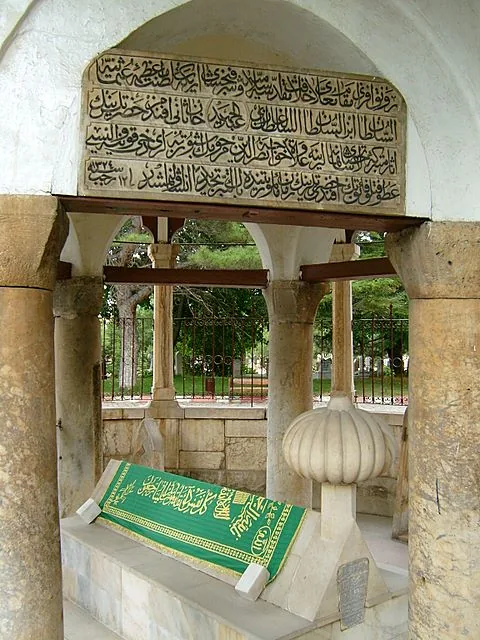
The tomb, as the municipality describes it
A türbe is a tomb building. The Akşehir municipality calls this one the oldest surviving physical item connected to the Hoca.
- 796 on the columnsMehmed, a sipahi (a cavalryman) of Sultan Bayezid I, visited and cut a six-line text dated 796 (1393/94) on the columns round the tomb.
- Two partsThe tomb has two parts, one inside the other. The inner part has six corners with a round column at each, and arches between the columns carry a small dome. The outer part has twelve sides. It took its present shape after the 1905 restoration.
checked 28.10.2026 · Akşehir municipality, «Nasreddin Hoca Türbesi»
A date read backwards
No inscription of the tomb itself survives. The later gravestone gives the death year as «sene 386» of the Hijri calendar (the Islamic calendar), three centuries before the dates TDV gives and before Anatolia was a Turkish homeland, the municipality notes. It offers two explanations: the writer reversed the date as a joke in the Hoca’s style, or forgot that Arabic script runs right to left but its numbers left to right. Read either way, the year is 683 (1284–85).
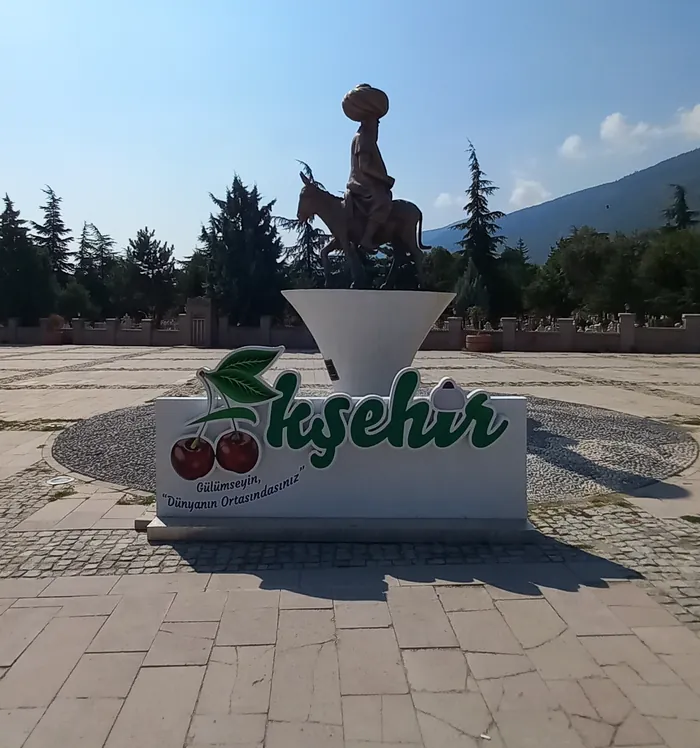
The statue and the lake
A statue of the Hoca on his donkey stands in Akşehir beside the Monument of the Middle of the World, a globe-shaped monument. The plaque on its base tells the backwards-riding anecdote of chapter 3.
Lake Akşehir is the lake of anecdote no. 152, where the Hoca sets yoghurt.
Collection no. 152 · checked 28.10.2026 · collection of 156 anecdotes (PDF)
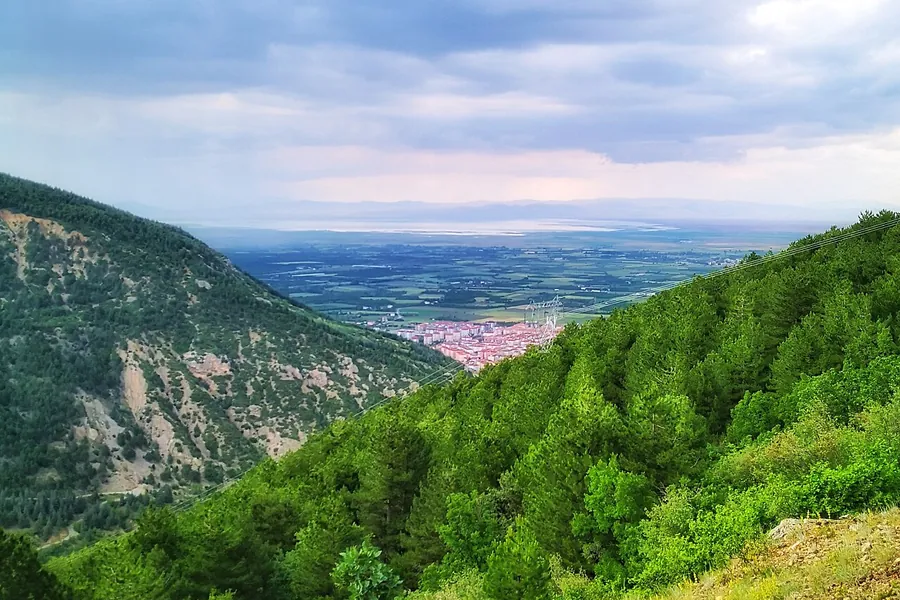
The festival, 5–10 July 2026
- What it was
- The 67th International Akşehir Nasreddin Hoca Festival, Şenlik in Turkish, a town festival. The municipality writes that it was started in 1959.
- 5 July, day one
- A dellal, a town crier, called the people to the festival in the streets; a performer playing the Hoca was called to the festival at the tomb; humour heroes of several peoples met in front of the tomb; a maya (yoghurt starter) ceremony and a parade set out by the Akşehir stream and the Humour Road, Mizah Yolu, a place named for him. Folk dances, exhibitions, children’s activities, the opening ceremony and a concert of songs about the Hoca in languages of the world followed.
- The other days
- Art workshops, children’s theatre, workshops and storytelling, talks and book signings (among them on the Hoca in education and the Hoca in Indonesia), concerts, theatre, quiz contests, a children’s voice contest and Karagöz–Hacivat banter contests.
- Where
- The tomb, the Humour Road, the Humour Park (Gülmece Parkı) and the Nasreddin Hoca Children’s Library, among other places in town.
- Each year
- The municipality publishes each year’s programme.
checked 28.10.2026 · Akşehir municipality, the festival · the 2026 programme (PDF)
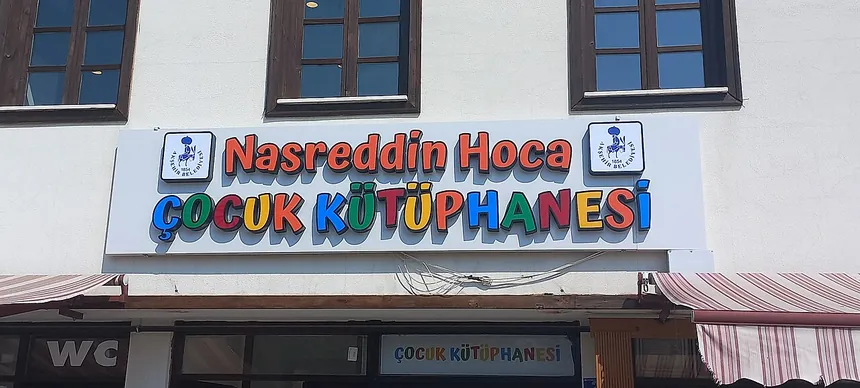
Sivrihisar and Hortu: the village and two accounts
Sivrihisar is a town in Eskişehir province; Hortu is a village of Sivrihisar. TDV, following the sources, places the Hoca’s birth in Hortu. Sivrihisar’s municipality gives the same village and year and tells more: who his father was, where he studied and where he died. For the province, see What to see in Eskişehir.
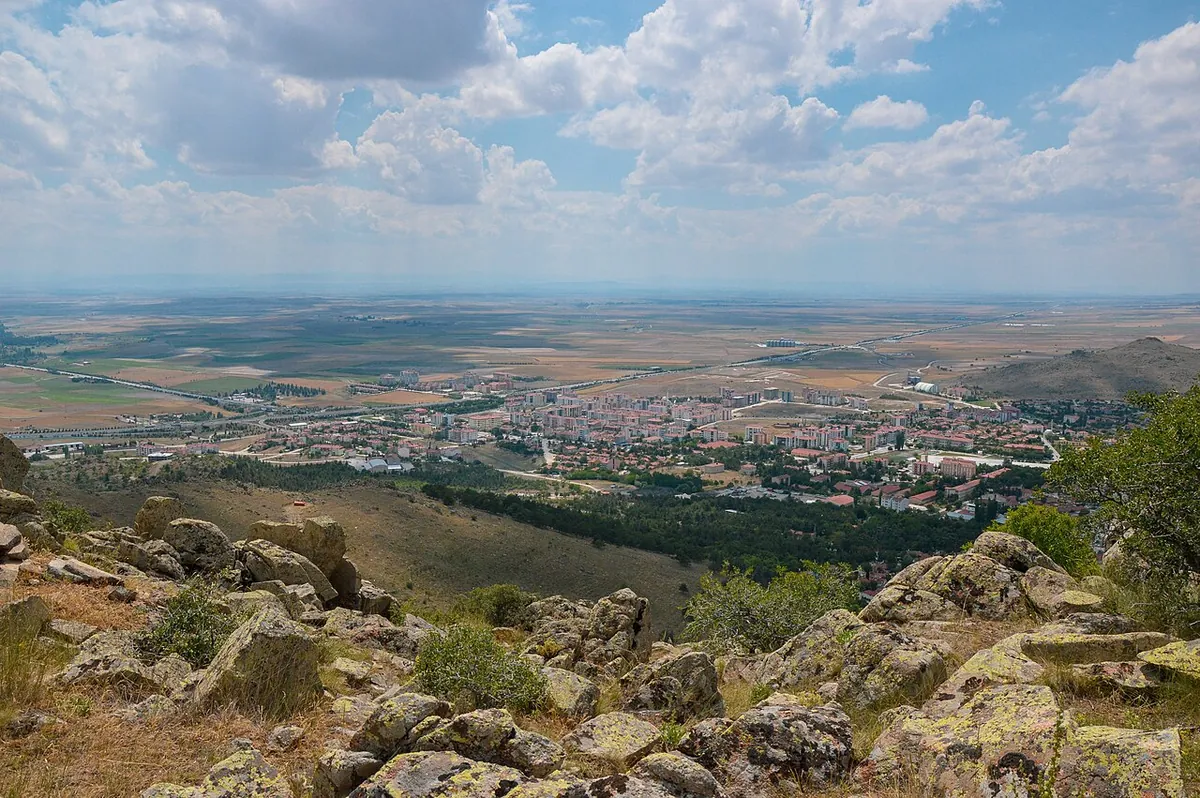
TDV’s trail round Sivrihisar
- Hortu
- Many sources note a house ruin said to be his and people who say they descend from him.
- Sultana village
- Mükrimin Halil Yinanç said that on a journey he saw gravestones of the Hoca’s sons in the village of Sultana, near Sivrihisar.
- Sivrihisar
- A gravestone attributed to one of his daughters was found in the town.
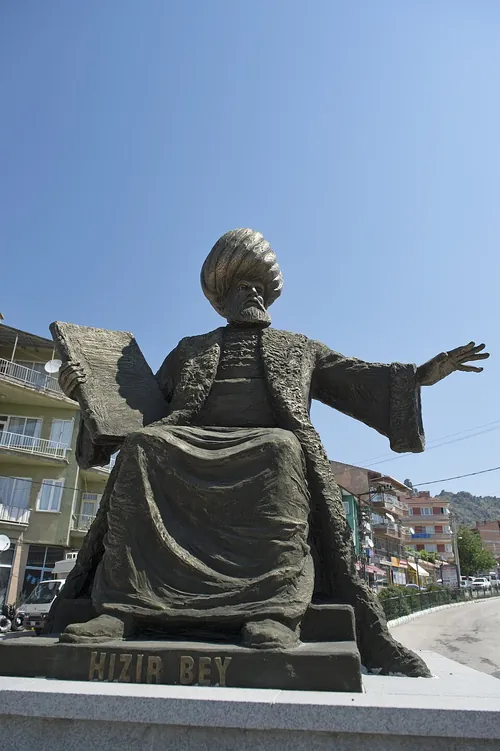
- Hızır Bey
- Sources also say that Hızır Bey, the first kadı of Istanbul and the teacher of Sultan Mehmed II (Fâtih), came from Sivrihisar and that his mother was the Hoca’s granddaughter.
checked 28.10.2026 · TDV
The account in TDV
Born Hortu, 1208, «according to the sources».
Father Abdullah, the village imam, whose post he took.
Later Moved to Akşehir, served as a kadı and died there in 1284.
His family Sons’ gravestones in Sultana village; a gravestone attributed to a daughter in Sivrihisar.
Sivrihisar’s account
Born Hortu, 1208.
Father Read as Şemsüddin Baba from the daughter’s gravestone.
Studies First lessons from his father, then the medreses of Sivrihisar and Konya; imam and preacher in Hortu and Sivrihisar; in Akşehir lessons from Seyyid Mahmud Hayranî and Seyyid Hacı İbrahim Veli.
Name and daughter «Nasrüddin Hoca Nusrat» as his full name; his daughter Hatun, whose grave the municipality says was found in 2003 beside the Seydiler bath after a three-month dig led by Prof. Erol Altınsapan.
Coffin A marble coffin found in the garden of the Ulu Cami (Great Mosque) during its restoration in 2014, which the municipality presents as his.
Hızır Bey A grandchild of the Hoca.
Death In Sivrihisar, the land where he was born.
The Akşehir municipality and TDV place his death and tomb in Akşehir.
The monument park
One statue, a coffin, a grave and stones.
Sivrihisar’s municipality lists in its Nasreddin Hoca monument park (anıt parkı) a bronze statue of the Hoca by the sculptor Metin Yurdanur, the stone coffin at the Hoca’s makam (shrine), his daughter Hatun’s grave and the «information stones» (bilgi taşları), where miniature painting meets ceramics.
checked 28.10.2026 · Sivrihisar municipality
Sources and limits
The page gives no verdict on where the Hoca was born or buried and does not rank places or peoples. Dates, family and the question of a historical person stay as the sources leave them. Legends and beliefs appear only where a named source reports them.
Show the pages checked
- Nasreddin Hoca (Nurettin Albayrak, 2006) — TDV İslâm Ansiklopedisi, checked 28.10.2026
- Telling tradition of Nasreddin Hodja/ Molla Nesreddin/ Molla Ependi/ Apendi/ Afendi Kozhanasyr Anecdotes — UNESCO Intangible Cultural Heritage, nomination file no. 01705, checked 28.10.2026
- Nasreddin Hoca Türbesi — Akşehir Municipality, checked 28.10.2026
- Nasreddin Hoca’nın Hayatı — Akşehir Municipality, checked 28.10.2026
- Nasreddin Hoca ve Akşehir — Akşehir Municipality, checked 28.10.2026
- Nasreddin Hoca Fıkraları — Akşehir Municipality, checked 28.10.2026
- 156 anecdotes selected from «Nasreddin Hoca» by Saim Sakaoğlu and Ali Berat Alptekin (PDF) — Akşehir Municipality, Kültür Yayınları, checked 28.10.2026
- Uluslararası Akşehir Nasreddin Hoca Şenliği — Akşehir Municipality, checked 28.10.2026
- 67. Uluslararası Akşehir Nasreddin Hoca Şenliği, event programme (PDF) — Akşehir Municipality, checked 28.10.2026
- Önemli Şahsiyetlerimiz: Sivrihisar’lı Nasreddin Hoca — Sivrihisar Municipality, checked 28.10.2026
- Gezi Rehberi — Sivrihisar Municipality, checked 28.10.2026
General information on people, places and events that change; check the programme and the opening times before a visit.