
Buying a used car in Turkey: notary, number plates and costs
Can a foreigner buy a car in Turkey? How does the sale work at the notary, what do Turkish number plates tell you, and what should you compare on a dealer’s vehicle information card? A guide based on Turkish regulations.
Table of Contents

Foreigners can buy a used car in Turkey and register it in their own name. Every sale goes through a notary (noter): an agreement made without a notary is invalid. Below you will find an explanation of the letters and digits on a Turkish number plate, a step-by-step guide to buying, advice on what to compare on a dealer’s vehicle information card, and an explanation of why new cars cost so much. All based on Turkish regulations, checked on 15 and 16 October 2026.
Used cars in Turkey at a glance
Notary, your own liability cover, secure payment.
- Foreigners can buy. The notary registers the car using the foreigner’s temporary identification number or, if they do not have one, their tax number. The car receives MA–MZ series plates.
- Sales must go through a notary. The car must have no outstanding tax, fines or restrictions on transfer, and must have a valid roadworthiness inspection. You must have your own compulsory third-party insurance valid on the day of sale.
- Payment through the secure payment system. Cash and bank transfers go through Güvenli Ödeme: the money is held until the agreement is signed.
- Fee at the notary: 2‰ of the price, with a minimum of 1,000 TL. The assessment basis cannot be lower than the car’s value on the kasko value list.
- An inspection report and warranty (3 months or 5,000 km) are required from licensed dealers, and only for cars up to 8 years old and with up to 160,000 km. The regulations do not impose these requirements on private sellers.
Turkish number plates
The number plate is assigned when the car is first registered: the province code from the owner’s address, followed by letters and digits (art. 31 of the regulation on vehicle sale, transfer and registration). Enter a plate or choose an example: the decoder will show the province, the letter and digit layout, and the series and colours that the regulation assigns to particular vehicles.
Plate decoder
What a Turkish plate tells you
Based on art. 31, 34, 35 and 38 of the registration regulation and its Annex 6 (province codes). All example plates are fictional.
Standard plate
The province code, followed by one of the six letter and digit layouts in art. 34(1). Non-government vehicles have a white background with black characters, while government vehicles have a black background with white characters (art. 35(1)(a) and (b)). The letters alone do not tell you which it is.
white background, black charactersblack background, white characters
„Resmi olmayan araçlara takılacak plakalarda zemin beyaz, harf ve rakamlar siyah”
MA–MZ: foreigners
Letters from MA to MZ are assigned to cars belonging to foreigners staying in Turkey (art. 34(3)(c)), including cars bought locally (art. 17). White background, black characters (art. 35(1)(d)).
white background, black characters
„Çeşitli nedenlerle yurdumuzda bulunan yabancı kişilerin araçlarına, “MA”dan “MZ”ye kadar harf”
CD and CM: embassies and international organisations
Letters CD and CM are used by embassies, international organisations and their personnel with diplomatic immunity (art. 34(3)(b)). White background, green characters (art. 35(1)(ç)).
white background, green characters
„Büyükelçilikler ve uluslararası kuruluşlar ile bunların diplomatik muafiyeti bulunan mensuplarının araçlarına “CD, CM””
CC and CG: consulates
Letters CC and CG are used by consulates general and their personnel with consular immunity (art. 34(3)(b)). Green background, white characters (art. 35(1)(ç)).
green background, white characters
„Başkonsolosluklar ile bunların konsüler muafiyeti bulunan mensuplarının araçlarına “CC, CG” harf”
A, AA, AAA: government and police cars
The groups A, AA and AAA are reserved for cars assigned to government offices and for police vehicles (art. 34(3)(a)). Government office cars have a white background with red characters (art. 36(1)(ç)), while police vehicles have a blue background with white characters (art. 35(1)(c)).
white background, red charactersblue background, white characters
„makam hizmetlerine tahsis edilen araçlar ile emniyet araçlarına “A-AA-AAA” harf”
T or G and five digits: temporary plates
Vehicles with a temporary document receive the letter T (prototypes and test drives) or G (other vehicles), followed by five digits (art. 34(3)(ç)). Yellow background, black characters (art. 35(1)(e)).
yellow background, black characters
„prototip veya yol testi için kullanılacaklara “T”, diğerlerine “G” harf ve beşli rakam”
GMR: temporary customs plates
GMR and three digits indicate temporary customs plates (art. 34(3)(d)). Green background, red characters (art. 35(1)(f)).
green background, red characters
„Geçici gümrük plakalarına “GMR” harf ve üçlü rakam”
JAA–JZZ: gendarmerie
Letters from JAA to JZZ and three digits are used by vehicles of the Gendarmerie General Command (art. 34(3)(e)). Blue background, white characters (art. 35(1)(c)).
blue background, white characters
„Jandarma Genel Komutanlığına ait araçlara, “JAA”dan “JZZ” ye kadar harf ve üçlü rakam”
SGH: coast guard
SGH and three digits are used by vehicles of the Coast Guard Command (art. 34(3)(f)). Blue background, white characters (art. 35(1)(c)).
blue background, white characters
„Sahil Güvenlik Komutanlığına ait araçlara, “SGH” harf ve üçlü rakam”
After the sale: the plate passes to the new owner (art. 31(1)). If they live in a different province, they can ask the notary to change it (art. 38(1)(a)); after moving, they have 30 days to do so (art. 38(1)(b)). Foreigners receive the MA–MZ series (art. 17).
81 province codes (Annex 6)
- 01 Adana
- 02 Adıyaman
- 03 Afyonkarahisar
- 04 Ağrı
- 05 Amasya
- 06 Ankara
- 07 Antalya
- 08 Artvin
- 09 Aydın
- 10 Balıkesir
- 11 Bilecik
- 12 Bingöl
- 13 Bitlis
- 14 Bolu
- 15 Burdur
- 16 Bursa
- 17 Çanakkale
- 18 Çankırı
- 19 Çorum
- 20 Denizli
- 21 Diyarbakır
- 22 Edirne
- 23 Elazığ
- 24 Erzincan
- 25 Erzurum
- 26 Eskişehir
- 27 Gaziantep
- 28 Giresun
- 29 Gümüşhane
- 30 Hakkari
- 31 Hatay
- 32 Isparta
- 33 Mersin
- 34 İstanbul
- 35 İzmir
- 36 Kars
- 37 Kastamonu
- 38 Kayseri
- 39 Kırklareli
- 40 Kırşehir
- 41 Kocaeli
- 42 Konya
- 43 Kütahya
- 44 Malatya
- 45 Manisa
- 46 Kahramanmaraş
- 47 Mardin
- 48 Muğla
- 49 Muş
- 50 Nevşehir
- 51 Niğde
- 52 Ordu
- 53 Rize
- 54 Sakarya
- 55 Samsun
- 56 Siirt
- 57 Sinop
- 58 Sivas
- 59 Tekirdağ
- 60 Tokat
- 61 Trabzon
- 62 Tunceli
- 63 Şanlıurfa
- 64 Uşak
- 65 Van
- 66 Yozgat
- 67 Zonguldak
- 68 Aksaray
- 69 Bayburt
- 70 Karaman
- 71 Kırıkkale
- 72 Batman
- 73 Şırnak
- 74 Bartın
- 75 Ardahan
- 76 Iğdır
- 77 Yalova
- 78 Karabük
- 79 Kilis
- 80 Osmaniye
- 81 Düzce
Annex 6: changing a province’s name does not change its number; the number of an abolished province remains unused; new provinces receive numbers after 81.
The regulation also provides for plates bearing a first name, surname or company name, for a fee set by the Ministry of Interior (art. 37), special plates for the highest offices of state (art. 36), and local series for commercial vehicles set by municipal commissions (art. 34(4)). The decoder does not recognise these. Every plate has a blue field marked TR before the province code (art. 35(2)).
From the advert to the notary
Highway Traffic Law No. 2918 (art. 20(d)) is clear: every sale and transfer of a registered car must go through a notary, and a sale made without one is invalid. The notary checks that the car has no outstanding motor vehicles tax (MTV), interest, fines, road penalties or tolls, no restriction on transfer, and a valid roadworthiness inspection, and that the buyer already has their own compulsory third-party insurance valid on the day of sale (the registration regulation, art. 18). Choose who you are buying from and who you are to see what is required at each stage.
The route to the notary
What applies to your purchase
Regulations in force on 16 October 2026. We do not quote the fixed notary fee or the payment system fee because we could not find them in a primary source.
Who is selling?
Who are you?
1 Advert and vehicle card
Buying from a dealer
Required Every car at a dealership has an information card with the details specified in the regulation on the motor vehicle trade (art. 20). The card in the section “What to check before buying” shows what to compare.
Buying from a private seller
Good to know There is no card, but before publishing the advert, the listings site must verify the advertiser’s identity and that the car belongs to them, a close relative or their spouse, or that they have the owner’s authorisation (art. 22).
Regulation on the motor vehicle trade, art. 20 and 22
2 Inspection
Buying from a dealer
Required The dealer commissions a report from a TSE-certified company within the 10 days before the sale and pays for it (art. 16). This applies to cars up to 8 years old by model year and with up to 160,000 km.
Buying from a private seller
Your choice The regulations do not require a report for a private sale. If you want one, agree this with the seller before visiting the notary.
Regulation on the motor vehicle trade, art. 16
3 Your ID and liability cover
You are a foreigner
Required Registration uses the foreigner’s temporary identification number or, without one, their tax number (the registration regulation, art. 17). A third-party insurance policy in your name must be valid on the day of sale (art. 18).
You are a Turkish citizen
Required The agreement includes your T.C. kimlik number (the trade regulation, art. 27). A third-party insurance policy in your name must be valid on the day of sale (the registration regulation, art. 18).
Registration regulation, art. 17 and 18; general conditions of compulsory motor liability insurance, C.4
4 Debts, restrictions, inspection
Every purchase
Required Before the sale, the car must have no outstanding MTV, interest, fines or restrictions on transfer, and must have a valid roadworthiness inspection. In January and July, the MTV instalment must be paid before ownership changes (Motor Vehicles Tax Law No. 197, art. 9).
Highway Traffic Law No. 2918, art. 20(d); registration regulation, art. 18
5 Secure payment
Every purchase
Required The portion paid in cash, by bank transfer or by EFT goes through Güvenli Ödeme: the seller sets up the transaction with an intermediary institution and provides your phone number. You receive an SMS with a reference number and deposit the amount, which is held until the agreement is signed, then released to the seller. The portion financed by a loan is excluded (art. 26).
Fee
Good to know The Ministry of Trade sets the system fee. If the buyer does not pay it on top, it is deducted from the amount due to the seller. At weekends and outside working hours, the FAST transfer limit is 2 million TL (TNB).
Regulation on the motor vehicle trade, art. 26; TNB
6 At the notary
Every purchase
Required The agreement includes the first registration date, chassis number, number plate, date and time, the parties’ identification numbers, and details from the inspection report or the parties’ declaration of mileage (art. 27). The fee (harç) is 2‰ of the price, with a minimum of 1,000 TL. The assessment basis cannot be lower than the value on the kasko value list (Fees Law (Harçlar Kanunu) No. 492, art. 43). There is also a fixed notary fee under Highway Traffic Law No. 2918, adjusted annually, plus the cost of the registration certificate forms.
Notary fee calculator
Example: a contract price of 900,000 TL and a kasko list value of 1,000,000 TL. The higher amount, 1,000,000 TL, is the assessment basis, so the fee is 2‰, or 2,000 TL. With a price of 300,000 TL and a kasko value of 350,000 TL, 2‰ is 700 TL, so the minimum of 1,000 TL is payable. There is no fee for a sale to a licensed dealer.
Fees Law (Harçlar Kanunu) No. 492, tariff 2; Highway Traffic Law No. 2918, art. 20(d)
7 After signing
Every purchase
Good to know You receive a temporary document valid for one month, and the registration certificate within one month. The new owner pays MTV from the day of sale (art. 20(d)). The seller’s third-party insurance ends automatically (the general conditions of compulsory motor liability insurance, C.4).
Buying from a dealer
Required For a car up to 8 years old and with up to 160,000 km, the engine, gearbox, and electrical and electronic systems are covered by the dealer’s warranty for 3 months or 5,000 km. Repairs must be completed within 45 working days (art. 17).
You are a foreigner
Good to know The car receives MA–MZ plates and a note stating who may drive it (art. 17).
Highway Traffic Law No. 2918, art. 20(d); trade regulation, art. 17

On the day of sale
Within three working days, the notary notifies the vehicle register and the tax office. At that point, the car is deemed registered in the buyer’s name (Highway Traffic Law No. 2918, art. 20(d)). MTV is paid in two equal instalments, in January and July (Motor Vehicles Tax Law No. 197, art. 9).
The seller’s third-party insurance ends on the day the insured person changes, and the seller receives a refund of the premium for the remaining days (the general conditions of compulsory motor liability insurance, C.4). That is why you buy your policy before visiting the notary.
Can a foreigner buy a car?
Yes. The regulation on vehicle sale, transfer and registration (art. 17) states that cars bought in Turkey by foreigners are registered by notaries and receive plates with letters from MA to MZ. Registration uses the foreigner’s temporary identification number (geçici kimlik numarası) or, if they do not have one, their tax number (vergi numarası). A tax number is also required for registration by Highway Traffic Law No. 2918 (art. 20). The regulation does not list a residence permit card among the conditions. Ask the notary which documents you need in your circumstances before arranging to meet the seller.
The notary adds a note to the car’s registration record: only the owner, their spouse and children, or a driver employed under an employment contract drawn up at a notary may drive it (art. 17(4)). If you buy a car jointly with a Turkish citizen, MA–MZ plates are not issued and the rules for Turkish citizens apply (art. 17(5)).
Foreigners can drive in Turkey on a foreign driving licence for six months from entry. For details, see the guide to driving licences in Turkey. If you only need a car for a holiday, see the car rental guide.
A car on foreign plates
Turkey’s customs decree 2009/15481 allows someone living abroad to bring in their own car under temporary admission:
- Place of residence means the place where a person spent at least 185 days in the year before their most recent entry into Turkey (art. 3).
- 24 months is the period allowed for a passenger car for personal use (art. 20).
- One month once a year is allowed for residents of the EU, EFTA and the UK who have used up these periods or do not meet the residence condition (art. 20).
- A resident of Turkey may drive such a car only occasionally, with the owner’s consent and while the owner is in Turkey (art. 18).
- People arriving for work or study may obtain temporary registration in Turkey (art. 19).
This guide covers buying a car registered in Turkey, rather than temporary admission.
What to check before buying
A licensed dealer (yetki belgesi) must display an information card beside every car for sale, with the details listed in the regulation on the motor vehicle trade (art. 20). Click a row on the example card to see what to compare it with. The card provides details but does not replace the documents you can inspect before signing the agreement.
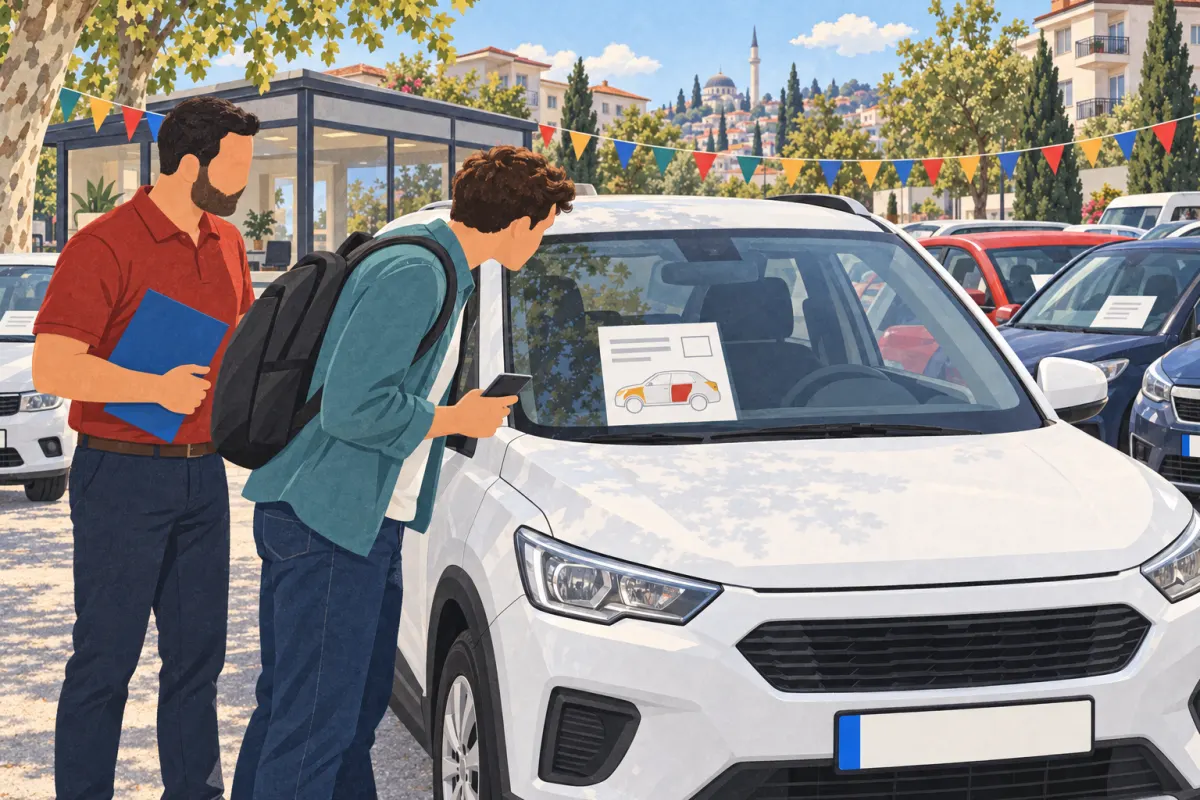
The windscreen card and online advert
The card must be clearly visible and legible, and its details up to date (art. 20). If a dealer advertises the car, the advert includes details from the same list (art. 21).
Before publishing an advert, listings sites verify the advertiser’s identity and whether the car belongs to them, a close relative or their spouse, or whether they have the owner’s authorisation (art. 22).
The dealer’s vehicle card
Row by row: what to compare
Rows as listed in art. 20 of the regulation on the motor vehicle trade. The car, plate and number are fictional.
Information cardDealer licence no.: ••••••
Make, model, type, model year, equipmentcompact hatchback, 2021, base trim
Compare with:
- The car’s registration certificate.
- The inspection report, if available: it lists the make, model, year and mileage (art. 16).
- The agreement at the notary: it records the model year and first registration date (art. 27).
Last 6 characters of the chassis number…K4R219
Compare with:
- The chassis number on the car itself.
- The registration certificate.
- The agreement at the notary: it records the chassis number (art. 27).
Registration number34 ABC 12
Compare with:
- The registration certificate.
- The e-Devlet service “Araç Plakasına Yazılan Ceza Sorgulama” (fines linked to the plate); unpaid fines block the sale at the notary.
Fuel typepetrol
Compare with:
- The registration certificate.
Mileage68,400 km
Compare with:
- The inspection report, if available (art. 16).
- The agreement at the notary: it records details from the report or both parties’ declaration of mileage (art. 27).
Sale price— (example without a price)
Compare with:
- The amount in the agreement at the notary and in the secure payment system.
- The kasko list value: the assessment basis for the fee at the notary cannot be lower (Fees Law (Harçlar Kanunu) No. 492, art. 43).
Repainted and replaced partsrepainted front bumper
Compare with:
- The inspection report, if the car is up to 8 years old and has up to 160,000 km (art. 16).
- The appearance of the parts on the car itself.
Damage history with descriptions1 damage record: rear bumper
Compare with:
- The e-Devlet services “Trafik Poliçe ve Hasar Bilgileri Sorgulama” and “Kasko Poliçe ve Hasar Bilgileri Sorgulama”, which the owner opens after logging in.
- The inspection report, if available.
Pledge or seizure (rehin, haciz)none
Compare with:
- The notary’s check: a car with a restriction on transfer cannot be sold (Highway Traffic Law No. 2918, art. 20(d)).
- The e-Devlet service “Adıma Tescilli Araç Sorgulama”, opened by the owner.
Remaining manufacturer’s warrantynot applicable
Compare with:
- The manufacturer’s or importer’s warranty document.
- This is separate from the dealer’s warranty: 3 months or 5,000 km for cars up to 8 years old and with up to 160,000 km (art. 17).
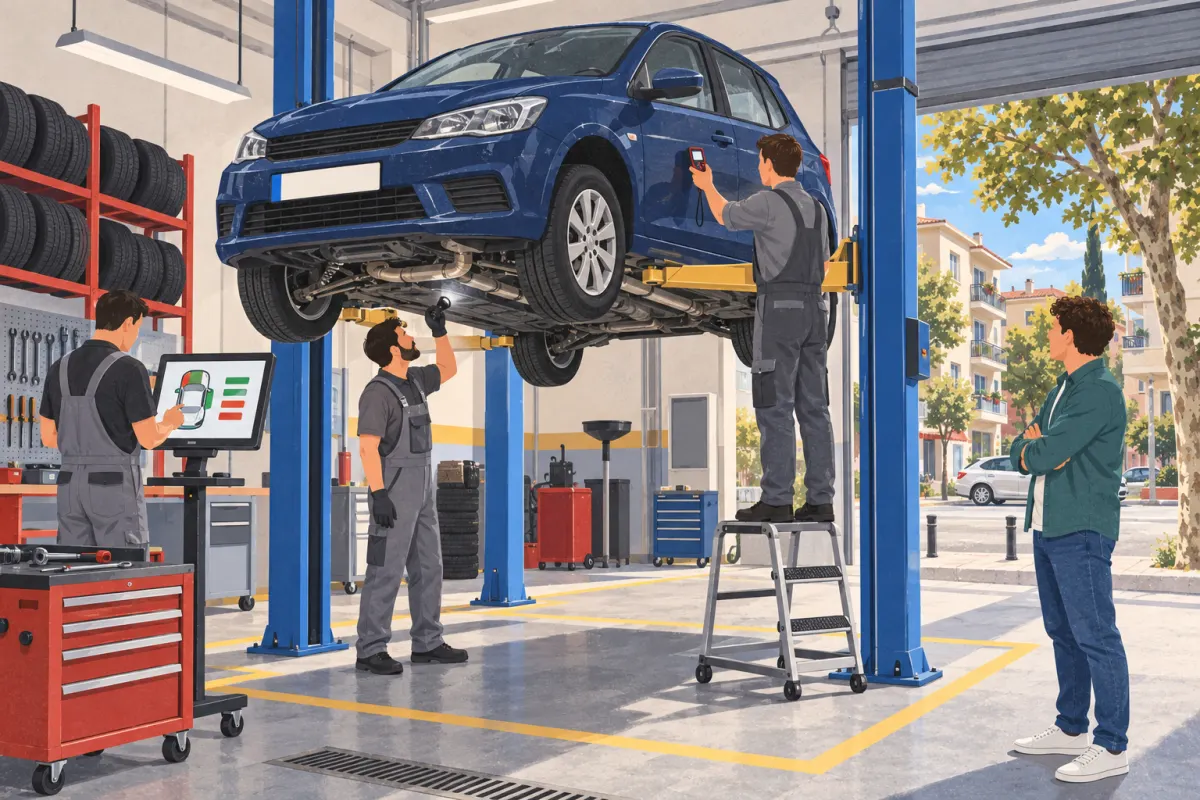
Inspection and warranty
The dealer commissions an inspection report from a TSE-certified company within the 10 days before selling a passenger car or light commercial vehicle. The dealer pays; the buyer pays only if the sale falls through because of their own fault. A report is not compulsory for cars more than 8 years old by model year or with more than 160,000 km (art. 16).
Within the same limits, the dealer is responsible for the engine, gearbox, and electrical and electronic systems for 3 months or 5,000 km, and must repair a fault within 45 working days (art. 17). For a purchase from a private seller, the regulations require neither a report nor a warranty.
e-Devlet (login required) has services that help you compare the details on the card: Adıma Tescilli Araç Sorgulama (cars registered to the logged-in person), Trafik Poliçe ve Hasar Bilgileri Sorgulama and Kasko Poliçe ve Hasar Bilgileri Sorgulama (policies and damage), Barkodlu Araç Muayene Raporu Sorgulama (roadworthiness inspection report), Vergi Borcu Sorgulama ve Ödeme (outstanding taxes), and Güvenli Ödeme Bilgileri Sorgulama: since 12 May 2026, this has shown the parties to transactions from the last 15 days, visible only to the buyer and seller (TNB).
Why new cars are expensive in Turkey
We do not quote market prices: they depend on the model, year and condition of the car. The law does, however, specify how much tax is included in a new car’s price. On the first acquisition of a new car, ÖTV excise tax is paid once (Special Consumption Tax Law No. 4760, art. 1). Its rate depends on engine capacity and the assessment basis, meaning the price before ÖTV and VAT (art. 11). VAT, known as KDV, is charged at 20% on the sum of the price and ÖTV (Decision No. 7346). Subsequent sales of a registered car are no longer subject to ÖTV.
| ÖTV basis | ÖTV rate |
|---|---|
| up to 1,400 cm³ | |
| up to 650,000 TL | 70% |
| 650,000 TL–900,000 TL | 75% |
| 900,000 TL–1,100,000 TL | 80% |
| over 1,100,000 TL | 90% |
| 1,400–1,600 cm³ | |
| up to 850,000 TL | 75% |
| 850,000 TL–1,100,000 TL | 80% |
| 1,100,000 TL–1,650,000 TL | 90% |
| over 1,650,000 TL | 100% |
| 1,600–2,000 cm³, hybrid (electric motor over 50 kW, combustion engine up to 1,800 cm³) | |
| up to 1,250,000 TL | 70% |
| over 1,250,000 TL | 80% |
| 1,600–2,000 cm³, other | |
| up to 1,650,000 TL | 150% |
| over 1,650,000 TL | 170% |
| over 2,000 cm³, hybrid (electric motor over 100 kW, combustion engine up to 2,500 cm³) | |
| up to 1,650,000 TL | 150% |
| over 1,650,000 TL | 170% |
| over 2,000 cm³, other | |
| any | 220% |
| plug-in hybrid up to 1,600 cm³ (below 25 g CO₂/km, electric range at least 70 km) | |
| up to 1,350,000 TL | 45% |
| over 1,350,000 TL | 75% |
| plug-in hybrid 1,600–1,800 cm³ (same conditions) | |
| up to 1,350,000 TL | 85% |
| electric, up to 160 kW | |
| up to 1,650,000 TL | 25% |
| over 1,650,000 TL | 55% |
| electric, over 160 kW | |
| up to 1,650,000 TL | 65% |
| over 1,650,000 TL | 75% |
Worked example: an assessment basis of 600,000 TL and an engine up to 1,400 cm³. ÖTV at 70% is 420,000 TL; VAT at 20% on 1,020,000 TL is 204,000 TL; the total is 1,224,000 TL, more than twice the assessment basis. Since 31 July 2026, ÖTV on a passenger car cannot be less than 100,000 TL (Law No. 7590), and this amount is adjusted annually.
Two restrictions under the regulation on the motor vehicle trade also apply until 1 January 2027 (provisional articles 2 and 3). A used car cannot be advertised above the current price recommended by the manufacturer or distributor. Dealers cannot sell cars until 6 months have passed since first registration and they have covered 6,000 km. The Ministry of Trade extended both restrictions on 22 June 2026.
Quick answers
Can a foreigner buy a used car in Turkey?
Yes. The notary registers it using the foreigner’s temporary identification number or, without one, their tax number. The car receives MA–MZ series plates (the registration regulation, art. 17).
Do I need a residence permit card?
The registration regulation does not list one among the conditions: it specifies a temporary identification number or tax number. Ask the notary which documents you need in your circumstances before arranging the sale.
How much does a sale at the notary cost?
The fiscal fee (harç) is 2‰ of the price, with a minimum of 1,000 TL. The assessment basis cannot be lower than the car’s value on the kasko value list. It is not charged on a sale to a licensed dealer. There is also a fixed notary fee under Highway Traffic Law No. 2918, adjusted annually, plus the cost of the forms.
Can I pay the seller cash in hand?
No. Payment in cash, by bank transfer or by EFT must go through the secure payment system (Güvenli Ödeme). The only exception is the portion financed by a loan (the trade regulation, art. 26).
Will the seller’s third-party cover transfer to me?
No. The policy ends on the day the insured person changes, and the notary can only complete the sale if the buyer has their own compulsory third-party insurance valid on the day of sale.
What do the letters MA on a plate mean?
The series from MA to MZ is assigned to cars belonging to foreigners staying in Turkey, with a white background and black characters (the registration regulation, art. 34 and 35).
Does a private purchase require an inspection report?
No. The report requirement and the warranty of 3 months or 5,000 km apply to licensed dealers and cars up to 8 years old and with up to 160,000 km.
How long can I drive a foreign-plated car in Turkey?
Under customs decree 2009/15481, a passenger car belonging to a person living abroad can stay for 24 months. Residents of the EU, EFTA and the UK who have used up the periods or do not meet the residence condition are allowed one month once a year.
Sources
- Highway Traffic Law No. 2918, art. 20 (sale at the notary) — mevzuat.gov.tr, checked 15 October 2026
- Regulation on vehicle sale, transfer and registration (art. 17, 18, 31, 34–38) — mevzuat.gov.tr, checked 15 October 2026
- Annexes to that regulation (Annex 6: province codes) — mevzuat.gov.tr, checked 15 October 2026
- Regulation on the motor vehicle trade of 2024 (art. 5, 16, 17, 20, 22, 26, 27) — mevzuat.gov.tr, checked 15 October 2026
- Extension of restrictions until 1 January 2027; 22 June 2026 — Ministry of Trade, checked 15 October 2026
- Secure payment system for car sales — Türkiye Noterler Birliği, checked 15 October 2026
- Checking secure payment details in e-Devlet, 15 May 2026 — Türkiye Noterler Birliği, checked 15 October 2026
- Fees Law (Harçlar Kanunu) No. 492: tariff 2 and art. 43 — mevzuat.gov.tr, checked 15 October 2026
- Motor Vehicles Tax Law No. 197, art. 3 and 9 — mevzuat.gov.tr, checked 15 October 2026
- General conditions of compulsory motor liability insurance, C.4 — mevzuat.gov.tr, checked 15 October 2026
- Customs decree 2009/15481, art. 3 and 16–20 — mevzuat.gov.tr, checked 15 October 2026
- Special Consumption Tax Law No. 4760, art. 1, 11 and 12 — mevzuat.gov.tr, checked 16 October 2026
- Presidential Decision No. 10115 (ÖTV rates for passenger cars) — Resmî Gazete, checked 16 October 2026
- Presidential Decision No. 7346 (VAT 20%) — Resmî Gazete, checked 16 October 2026