Plugs and voltage in Turkey: check your charger
From the UK or Ireland, take a G to C/F adapter. From the US or Canada, take an A/B to C/F adapter and check for 230 V and 50 Hz.
Table of Contents

From the UK or Ireland, take a G to C/F adapter for Turkey. The supply is the same: 230 V at 50 Hz. From the US or Canada, take an A/B to C/F adapter and check the label for 230 V and 50 Hz. Most phone and laptop chargers accept 100–240 V; devices made only for 120 V, such as many hair dryers, need a voltage converter.
Before you pack
The same supply, a different socket.
- British G: take a G to C/F adapter.
- 230 V · 50 Hz: the same supply as the UK.
- American A/B: adapter; voltage converter if the label lacks 230 V.
- Hair dryer and straighteners: read the input first.
Your plug, your label
A C or F plug fits a Turkish socket. For other shapes, choose an adapter that accepts your plug. Tap the shape, then the rating on the label: the summary combines both choices, and you can copy it to take with you.
Connect in two steps
What are you bringing?
Your plug
Your label
Also check for 50 Hz or 50/60 Hz. For a device that needs an earth connection, take an earthed F adapter and stay within its power rating.
All plugs and ratings
| Plug | Connection |
|---|---|
| Europlug C | Fits |
| Schuko F | Fits |
| British G | Adapter to C/F |
| American A/B | Adapter to C/F |
| Swiss J | Adapter to C/F |
| Italian L | Adapter to C/F |
| Label | What to do |
|---|---|
| 100–240 V | The range includes 230 V. Use your charger. |
| 220–240 V | The range includes 230 V. The voltage matches. |
| 110–120 V | Leave the device at home or choose a converter suitable for its model and power rating. |
| 115/230 V | Set the switch to 230 V with the device unplugged, following its manual. |
Read the INPUT
INPUT shows what the charger accepts from the wall socket. Look for a range that includes 230 V and a frequency of 50 Hz or 50/60 Hz. Phone and laptop chargers usually have a wide input range; for heating appliances, check your own model carefully. Tap each line of the example.
AC / USB
1INPUT
2100–240 V ~
350/60 Hz · 0.5 A
4OUTPUT 5 V ⎓ 3 A
5
Sample label showing how to read the symbols.
- 1Input from the socket. The wall supply goes to the input.
- 2Voltage range. Includes Turkey’s 230 V.
- 3Frequency and input current. Includes 50 Hz. A indicates the input current.
- 4Output to the phone. The low USB voltage refers to the charger’s output.
- 5Double insulation. A square inside a square indicates a Class II device. The Europlug C has no earth connection.
Hair dryer, straighteners, kettle
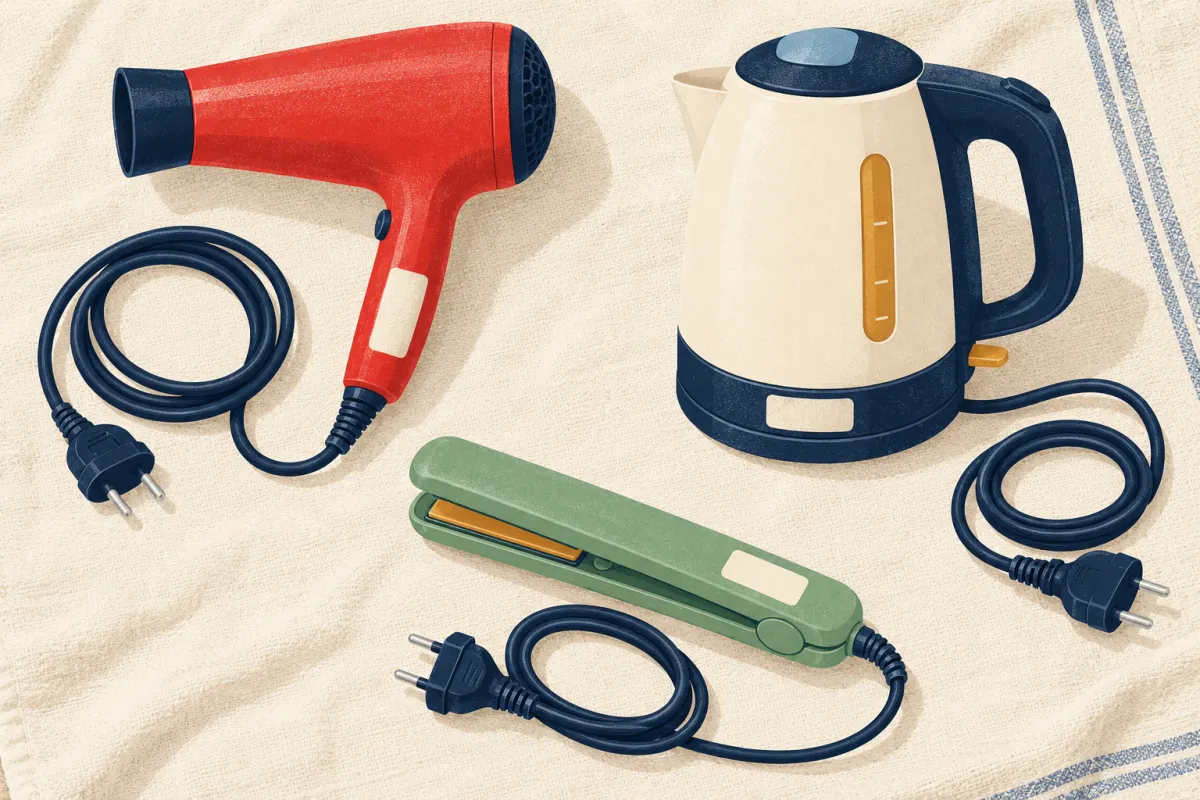
For a heating appliance, the label determines what you pack. If it says 110–120 V only, leave it at home and ask your accommodation for an equivalent appliance. A simple adapter changes the plug, not the voltage. See the answer for each appliance.
Does it have a voltage switch?
Set it to 230 V before plugging it in and follow the model’s instructions. Some travel hair dryers have a specific speed setting for the higher voltage.
What does the input say?
With a range of 100–240 V and 50/60 Hz, the supply matches. For a different plug shape, add the appropriate adapter and check its power rating.
Does it say 120 V only?
Leave it at home. To use it at 230 V, you need a converter suitable for the appliance and its load; using the kettle at your accommodation is the easy option.
At the hotel, charge with ease
Use the socket beside the bed or on the desk for your chargers. A short power strip bought in Turkey (a Schuko “çoklu priz”) helps when you need more sockets. Keep it dry, check the total load and plug it directly into the wall.

The bathroom socket
For small loads only
A socket with a shaver symbol is intended for a shaver. For a toothbrush, check the power ratings on both the socket and the charger. Plug a hair dryer into a regular socket, away from water.
- Loose, blackened or hot connection: stop using it and tell reception.
- One adapter plugged into another: avoid it. Do not plug one power strip into another either.
If you’re missing something
Ask for an adapter at an electronics shop such as Teknosa, or a power strip at a hardware and homeware shop such as Koçtaş. Show your plug or a photo of it and check that the adapter works in the right direction before buying. In Turkish, priz means socket, adaptör means adapter and voltaj means voltage.
Priz adaptörü var mı?
Do you have a plug adapter?
Bunu Türk prizine takabilir miyim?
Can I plug this into a Turkish socket?
Akım korumalı çoklu priz arıyorum.
I’m looking for a power strip with surge protection.
Şarj aleti nerede satılıyor?
Where can I buy chargers?
Frequently asked questions
For devices you use at home, preparation is quick: pack the right cable with your charger. The answers below cover exceptions and last-minute purchases.
Do I need an adapter coming from the UK?
Yes: take a G to C/F adapter. The supply is the same, 230 V at 50 Hz, so you do not need a voltage converter.
Can I charge a phone bought in the US?
Yes, with a charger whose INPUT includes 230 V and 50 Hz. For an American A/B plug, you need an adapter to C/F, with an earth connection if the charger needs one.
Can I find an adapter on Sunday?
Usually, yes: electronics shops in shopping centres (AVM) also open on Sundays. If you arrive late at night, buy the adapter at home before you leave (an airport shop also sells them).
Is “100–240 V” enough to plug in my device?
For voltage, yes: it includes 230 V. Also check for 50 Hz, the plug, any earth connection the model requires and the adapter’s power rating.
Sources
Sources checked on 5 October 2026. The images are illustrations created for this article.
- Supply and plugs in Turkey — Electrical Safety First, checked 5 October 2026
- Supply and plugs in the UK — Electrical Safety First, checked 5 October 2026
- Europlug: fit and double insulation — Interpower, checked 5 October 2026
- Adapters, earthing and the double insulation symbol — Electrical Safety First, checked 5 October 2026
- Mains input and charger output — Apple, checked 5 October 2026
- Dual-voltage selector on a hair dryer — Conair, checked 5 October 2026
- Power strip load and damaged connections — Electrical Safety First, checked 5 October 2026
- Toothbrush in a shaver socket — Schneider Electric, checked 5 October 2026
- Plug shapes: Europe, Switzerland, Italy — Interpower, checked 5 October 2026
- Turkish terms: power strip with surge protection — Koçtaş, checked 5 October 2026
- Turkish terms: adapter — Teknosa, checked 5 October 2026