
AliExpress Turkey: 2026 Customs Rules and Total-Cost Checks
Table of Contents
Shopping in Turkey · Reviewed 1 October 2026
Before ordering from AliExpress to Turkey, answer two questions: where is this item actually coming from, and what will it cost to get it into your hands? A low listing price is only the start of the calculation.

The short answer
AliExpress can be worth investigating for a specific part you cannot find locally. For everyday purchases, compare a clearly identified Turkish-stock offer first. Do not order an imported item until you understand its clearance route, possible extra charges and return arrangements.
The Ministry’s explanation of the February 2026 import changes says ordinary overseas e-commerce purchases no longer use the former low-value simplified declaration route. Normal import procedures remain possible. Keeping a basket below €30 does not bring the old process back.
First, check where the item ships from
“AliExpress Turkey” can mean browsing AliExpress with Turkey selected as the delivery destination. It does not, by itself, identify a Turkish seller, a Turkish warehouse or a domestic delivery contract. Equally, it is unwise to assume that every listing must come from China. Investigate the exact variant you intend to buy.
Stock already in Turkey
Ask whether the item is physically in Turkey and already cleared for domestic sale. Check the invoice issuer, delivery address for returns and who handles warranty questions. A “ships from Turkey” label is a useful starting point, not your complete evidence.
Dispatch from abroad
Ask which country it leaves, which carrier brings it in and who arranges customs clearance. An EU warehouse is still outside Turkey. A fast international flight does not tell you how long release or onward delivery will take.
Set the destination before comparing prices. Then revisit it after changing the size, model, bundle or dispatch option. A listing can look attractive until the selected item cannot be delivered to your address or the shipping charge changes. This guide does not confirm live availability for any particular Turkey-addressed order.
Keep a record of the seller’s answer inside the platform. Useful questions are: “Where will this exact item be dispatched from?”, “Who is the importer or clearance contact?”, and “Which charges are excluded from the displayed total?” If the answers are vague, the price comparison is unfinished.
What Turkish customs rules mean for a buyer in 2026
A customs declaration is the information submitted to customs about the goods, their value and how they are being imported. A detailed declaration involves a different process from the simplified parcel procedure many older buying guides describe.
The Ministry’s current postal and express-cargo guidance describes detailed declarations for eligible personal, non-commercial goods valued at €0–€1,500 and weighing no more than 30 kg gross. An express operator may handle that process; import obligations still apply, and carrier service charges may apply. These figures are not a promise that your item qualifies or that clearance is cheap.
The implementing customs circular effective 6 February 2026 removed the €30 lower boundary from the detailed-declaration provision. Its date differs from the earlier announcement’s 1 February date; for a new order, use the current procedure rather than an old launch-date headline.
Why there is no automatic “add 60%” button here
The FAQ’s 30%/60% flat rates concern its qualifying medicine and supplement exception. They are not a universal rate for ordinary AliExpress orders. Ask the carrier or a qualified customs adviser for an item-specific assessment before buying.
You do not need to guess a tariff code to use this article. The official FAQ includes freight in customs valuation, so ask what value the assessment uses. Give the clearance contact a plain description, a product link, material, intended use, model, quantity, invoice price, freight cost and dispatch country. Ask them to identify the relevant classification and documents. If a seller supplies a code, have the clearance contact check it rather than treating it as a guarantee.
Items needing special caution
The same official FAQ rules out ordinary postal/express purchases of mobile phones, tobacco and alcohol. Cosmetics cannot use the exempt parcel route; supplements require particular documents. Shoes, toys and leather or artificial-leather bags/suitcases are excluded from the cited simplified provision. That last restriction is not a ban on every possible import route.
For a regulated product, get an answer about the actual product and procedure. Do not turn a special exemption into a shopping tip. The circular’s narrowly defined model/R&D route is not a general exemption for hobby electronics. Never ask a seller to mark a purchase as a gift, lower its value or split it to conceal what is being imported.
If you are buying stock to resell, pause here: a household shopping checklist is not an import plan for a business. Describe the commercial purpose honestly and obtain advice for that activity.
Work out the total cost before you pay
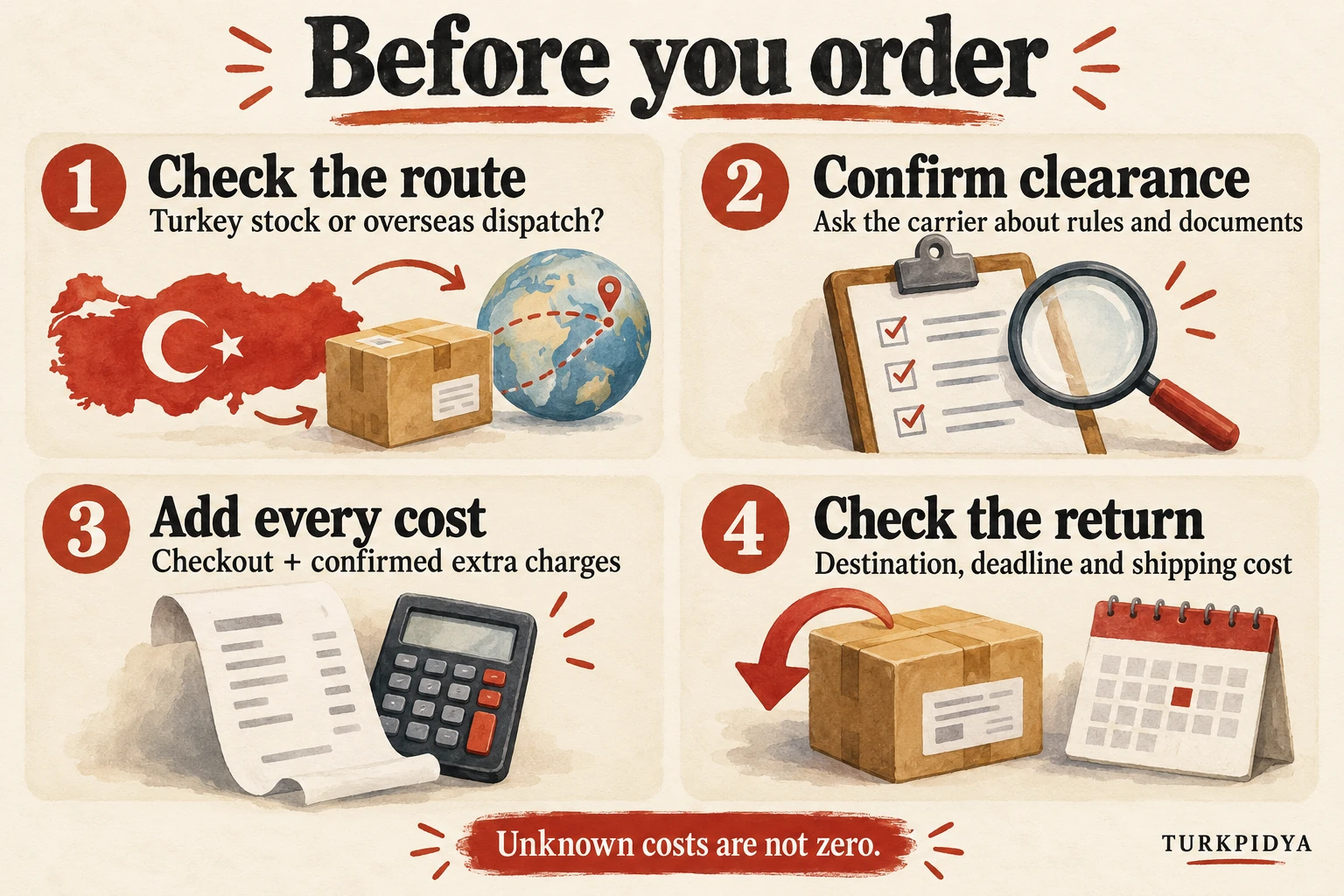
Start with the full checkout amount for the exact order, including the shipping and taxes shown there. Then add only costs that are definitely outside that amount. This avoids counting the same shipping or tax line twice.
Ask for separate figures for import charges, clearance or brokerage, handling, possible storage, onward delivery and payment conversion. If a charge is unknown, leave it unknown. A €20 product with €10 delivery and a separately quoted €25 service fee already involves €55 before any other excluded cost. Those numbers are an arithmetic example, not Turkish tariffs or a carrier quotation.
Use one currency throughout. If your card and checkout use different currencies, ask the card issuer which rate and fees apply. Turkpidya’s currency comparison tool can help you compare amounts, but it cannot set your bank’s rate or the customs valuation rate.
Your route and cost worksheet
Check a quoted budget
Enter one order’s figures in one currency. Leave unknown costs blank. Enter 0 only when that charge is confirmed absent or already included in another field. This tool does not calculate tax rates or approve imports.
JavaScript is needed for live results. Without it, add the five cost fields manually and keep every unknown separate. All route cautions remain explained in the article.
Confirm dispatch, import arrangements and documents before ordering.
Changing the route, product check or currency clears all amounts so different quotes are not mixed.
Include the item, shipping and taxes already displayed at checkout.
Only charges excluded from checkout, based on your item-specific assessment.
Only separately payable carrier, representative or handling charges.
Only amounts excluded from the other fields. Ask about possible later storage.
Only excluded bank/card/currency charges; use the same currency.
Final delivered price for the same item and quantity; blank means no comparison.
Blank fields remain unknown.
Manual formula: checkout + excluded import charges + clearance/handling + extra delivery/storage + payment fees. The five amounts are added; no customs percentage is assumed. This tool sends and stores nothing and needs no identity, card or order number.
What if AliExpress shows tax at checkout?
Read the label and the order terms, then ask what the amount actually covers. Save that breakdown. Your practical question is whether anything remains payable to a carrier, customs representative or delivery company, and whether you still need to provide documents.
Do not interpret “IOSS” as a Turkish all-in import guarantee. The EU’s Import One-Stop Shop explanation concerns VAT on qualifying imports for EU customers. A Turkish destination requires its own applicable treatment.
For an allegedly all-inclusive offer, request a written answer: “Does this total include the import charges, clearance service and delivery to my address? If another amount is collected, who pays it?” Keep that answer alongside the order. If the responsibility is unclear, compare a domestic-stock alternative instead of guessing.
How to place a more informed order
Choose the exact specification
Check measurements, material, connector type, voltage, plug, compatibility, quantity and what is actually in the package. A cheap “from” price may describe the smallest accessory rather than the pictured set. For a replacement part, compare the manufacturer’s part number and photographs of the connections.
Check the seller and recent product evidence
Read critical reviews for the same variant, not only the overall star score. Look for consistent complaints about fit, missing pieces or a different model arriving. Ask a clear question when the description contradicts the photos. Save the listing as it appeared when you decided to buy.
Confirm delivery and the import route
Use your real destination and the exact dispatch option. Check whether the selected service has tracking. Before payment, establish who will handle the package at arrival and how to contact them. Do not make a time-sensitive purchase on the strength of an optimistic banner alone.
Write the address carefully
Check the recipient’s full name, province, district, neighbourhood, street, building and apartment details, postcode and reachable phone number. Keep the address consistent with the documents used for the order. If a carrier asks for identity information, verify the request through its genuine site or support channel and provide only what that process requires.
Check the payment, currency and final amount
Review the live checkout’s available payment methods and the currency actually charged. Do not assume instalments, a particular card or a promotional discount will be available. Keep payment on the platform. A seller asking you to pay separately creates a different transaction with different evidence.
Save the order and the return terms
Keep the order number, paid invoice, shipping service, checkout breakdown, dispatch claim and seller messages together. Record the return destination, relevant deadline and who pays return shipping. You want these details while deciding, not after discovering the item is wrong.
Tracking, delays and unexpected payment requests
Use the estimate shown for your actual order. There is no useful universal “15–40 days” promise: a dispatch estimate, customs processing and final delivery are separate stages. For a wedding, trip, repair appointment or other fixed deadline, compare with stock you can collect or receive locally.
Keep both the platform tracking reference and any local carrier reference. If tracking stops, ask the carrier what is missing: transport movement, customs documents, a payment, an address correction or an attempted delivery. Send the order details needed to identify the parcel rather than repeatedly asking whether it has arrived.
For a payment request, ask for an itemised invoice and identify the collector. The Ministry warns about fake customs-payment messages; its customs units do not solicit payment through account numbers or links sent by email, call or message. Independently contact the named carrier before using an unexpected link.
If the package is being held, ask how long you have to respond and whether storage is accruing. Also ask what happens if you do not proceed: return to sender, another procedure, or disposal, and at whose cost. Do not assume that refusing collection cancels the order or creates an automatic refund.
Returns, refunds and buyer protection
Check the actual order’s return benefit before paying. AliExpress’s Free Returns and delivery terms make participation dependent on the product, seller and country. There is no verified Turkey-wide promise that every order has free international return shipping.
The published program distinguishes 90 days from a successful order/payment for participating mainland-China sellers from 15 days after receipt confirmation for participating EU sellers. These are program conditions, not a universal deadline for your order. Use the deadline and instructions shown in your own order.
Open the order’s Return/refunds process, keep the requested evidence and use the assigned return instructions. Item condition, accessories and packaging matter. Self-arranged shipping can be at your expense. A fast-delivery coupon is not the same as a refund; customs disruption does not automatically entitle you to every advertised benefit.
As a practical precaution, photograph the unopened package, its label, the contents and any defect. Keep the packaging until you have checked the item. Be specific in a claim: wrong connector, damaged screen, missing quantity or non-delivery is more useful than “bad quality.” Do not confirm satisfactory receipt simply to make a notification disappear.
Before posting anything back, confirm the authorised address, label, tracking requirement, parcel deadline and any instructions about batteries or restricted contents. Keep your postage receipt and delivery proof. Track a refund separately from the return: the parcel moving does not tell you when funds will appear on your card.
If you need support, start inside the order or use the official AliExpress Help Center. Do not rely on an unverified “Turkey support” telephone number found in an advertisement.
When AliExpress may be worth the work
Consider it for a specific, non-urgent item
You have identified the exact part, cannot find an equivalent locally, have checked the import route, have a defensible budget and can live with the return arrangements. Even then, compare the saving with the time and inconvenience you are accepting.
Compare local stock first for everyday needs
Urgent deliveries, sizing-sensitive clothing, fragile products and purchases where warranty support matters deserve a local comparison. Use the same model and quantity, and compare the final delivered price rather than a headline discount.
Turkpidya’s guides to shopping on Hepsiburada in English and using Amazon Turkey can help with that comparison. Check the actual seller and dispatch location on any marketplace; the platform name alone does not settle the question.
For clothing, compare a local store’s measurements and return options with the exact AliExpress garment. For standard cables or accessories, compare the correct specification and safety information. For tools or repair components, include the cost of a mismatch: another order, another wait and possibly another clearance process.
What about selling from Turkey?
Selling is a separate business decision, not the reverse of this shopping checklist. Check AliExpress’s current merchant onboarding for your business location, then investigate invoicing, export paperwork, fulfilment, returns and product compliance. Do not assume that an old seller-program article proves your current eligibility or that a personal buyer account covers commercial importing.
The useful rule
Buy only when you can explain the route, the likely total cost and the return plan in plain language. If one of those is still unknown, investigate it before treating the low price as a bargain.
Source check: 1 October 2026. This is a practical buying guide, not an individual customs assessment. Order availability, payment options, benefits and charges must be checked for the selected item. Official source links appear beside the relevant rules.