
Gold in Turkey: Karats, Coins and Buying Safely (2026 Guide)
Ziynet or sikke, 22K or 14K? Ten Mint coins to scale, a bill checker for the jeweller and the questions to ask before you buy or sell gold.
Table of Contents
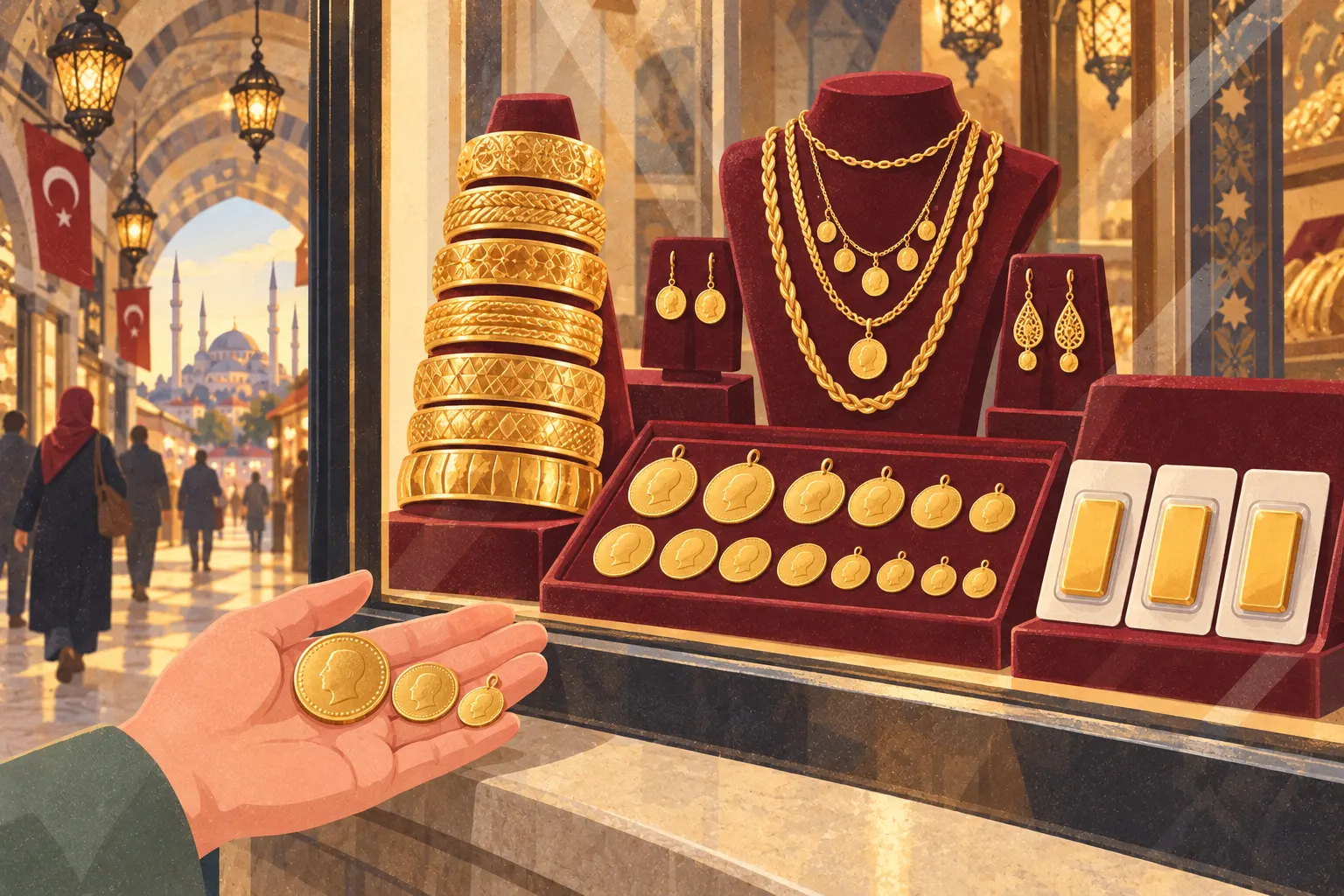
Gold in Turkey is jewellery, a wedding gift and a way to save, all at the same counter. It is not money: you cannot pay a bill with it, and its lira price moves every day. Before you buy, know three things: what the stamp says, which coin you are holding and what the shop will pay you back for it.
Before you pay
Read the stamp. Weigh it. Ask both prices.
- Stamp: 916 is 22 karat, the standard of the Mint’s Cumhuriyet coins; 585 is 14 karat.
- Coin: ziynet is wide and thin, sikke small and thick. The one-lira sikke is the Ata Lira.
- Prices: ask the buying and the selling price for the same piece, and the total in writing.
- Not money: gold has a price risk and a gap between the two prices.
Today’s board: gold prices in Turkey. The tools below take your own quotes, so they never go out of date.
Karat and the stamp
Karat tells you how much of the weight is gold. 24 karat is pure gold; 22 karat is 22 parts in 24, about 91.67%; 18 karat is 75%; 14 karat about 58.3%. The rest is other metals, and that mix changes the colour and how hard the piece is. In Turkey you will hear ayar for karat and has altın for pure gold.
A stamp in thousandths is easier to read than a karat word. Look inside a ring or bangle, or on the clasp, with the jeweller’s loupe. Bullion bars are marked by fineness, such as 995, 999 or 999.9. Tap a stamp to see what it means.
What does the stamp say?
Stamp 585 · 14K
14 parts in 24
About 58.3% gold by weight (the stamp rounds it to 585 in a thousand).
Plenty of alloy: compare it with 22 karat by weight of gold, not by weight of the piece.
Stamp 750 · 18K
18 parts in 24
75% gold: three quarters of the weight.
Colour depends on the alloy: yellow, white and rose gold can all be 18 karat.
Stamp 875 · 21K
21 parts in 24
87.5% gold, a little less than 22 karat’s 91.67%.
Compare by the gold inside: the gap with 22 karat is about four points of the weight.
Stamp 916 · 22K
22 parts in 24
91.67% gold. The Mint’s Cumhuriyet coins are 22 karat, 916.6 in a thousand.
For the coins that is fixed; for jewellery, read the stamp of the piece in your hand.
Stamp 995+ · 24K
Bullion fineness
Bars and bank gold are labelled 995, 999 or 999.9: almost pure gold.
A bank gold account has its own fineness; Ziraat’s demand account uses 1000/1000.
A stamp is the maker’s claim, not a lab test. For an expensive piece, or one you plan to sell later, ask the shop how it tests gold and what it writes on the invoice.
Cumhuriyet gold: ziynet and sikke
The coins you see in every jeweller’s window are Cumhuriyet gold, made by the Mint in two groups of five. Ziynet coins are wide and thin, with a decorative border; sikke coins of the same name are heavier, thicker and smaller across. The Mint calls the 7.216 g one-lira sikke the Ata Lira. Both groups are 22 karat, 916.6 in a thousand.
Tap a coin. The tray is drawn to scale, so you can see why a sikke quarter looks smaller than a ziynet quarter. Type today’s price of 1 g of pure gold to see what the metal inside is worth; add a shop’s quote to see how far above the metal it is.
| Coin | Ziynet | Sikke | Gold content |
|---|---|---|---|
| Quarter (çeyrek) | 1.754 g · 18 mm | 1.804 g · 15 mm | 1 × quarter |
| Half (yarım) | 3.508 g · 22 mm | 3.608 g · 18 mm | 2 × quarter |
| One lira (tam) | 7.016 g · 30 mm | 7.216 g · 22 mm | 4 × quarter |
| Two and a half (iki buçuk) | 17.540 g · 40 mm | 18.040 g · 27 mm | 10 × quarter |
| Five (beşli) | 35.080 g · 45 mm | 36.080 g · 35 mm | 20 × quarter |
The content ratios hold within a group: a half has twice the gold of a quarter, a one-lira four quarters, a two and a half ten, and a five twenty. Prices do not follow those ratios exactly, because each coin carries its own margin. A loop or a frame added for wearing is a separate fitting and is not part of the Mint’s weight.
Tell the two apart by the faces too. A sikke shows Atatürk with “Hakimiyet Milletindir” and “Ankara”, and on the back “Türkiye Cumhuriyeti”, 1923 and the anniversary number of the Republic. A ziynet shows Atatürk with decorative motifs, and on the back the Republic’s name and the calendar year it was minted.
Reşad coins
Reşad coins carry the design of Sultan Mehmed V Reşad and the Rumi date 1327, which is symbolic, not the year they were made. The Mint says it has had sole responsibility for making them since 2022, as five 22 karat sikke weights from 1.804 g to 36.080 g. Ask whether the coin on offer is a historic one or a modern issue, and compare it as that.
Gold at a wedding

The takı
At many Turkish weddings there is a moment called the takı: family and guests come up and pin gold on the couple, often quarter coins on a ribbon or sash, sometimes a bangle or a necklace. Close family may give larger pieces.
Nothing is fixed. What people give depends on the family, the region and their budget, and no coin is expected of a particular relative. If you are unsure, ask a family member what is usual on that side.
Buying for a wedding? A quarter ziynet (çeyrek) is the classic gift. It may come loose or with a pin or ribbon attached. Ask for the price of the coin and of the fitting separately, so you know what you can sell back later. The legal steps of marrying are in our guide to getting married in Turkey.
Check the jeweller’s bill
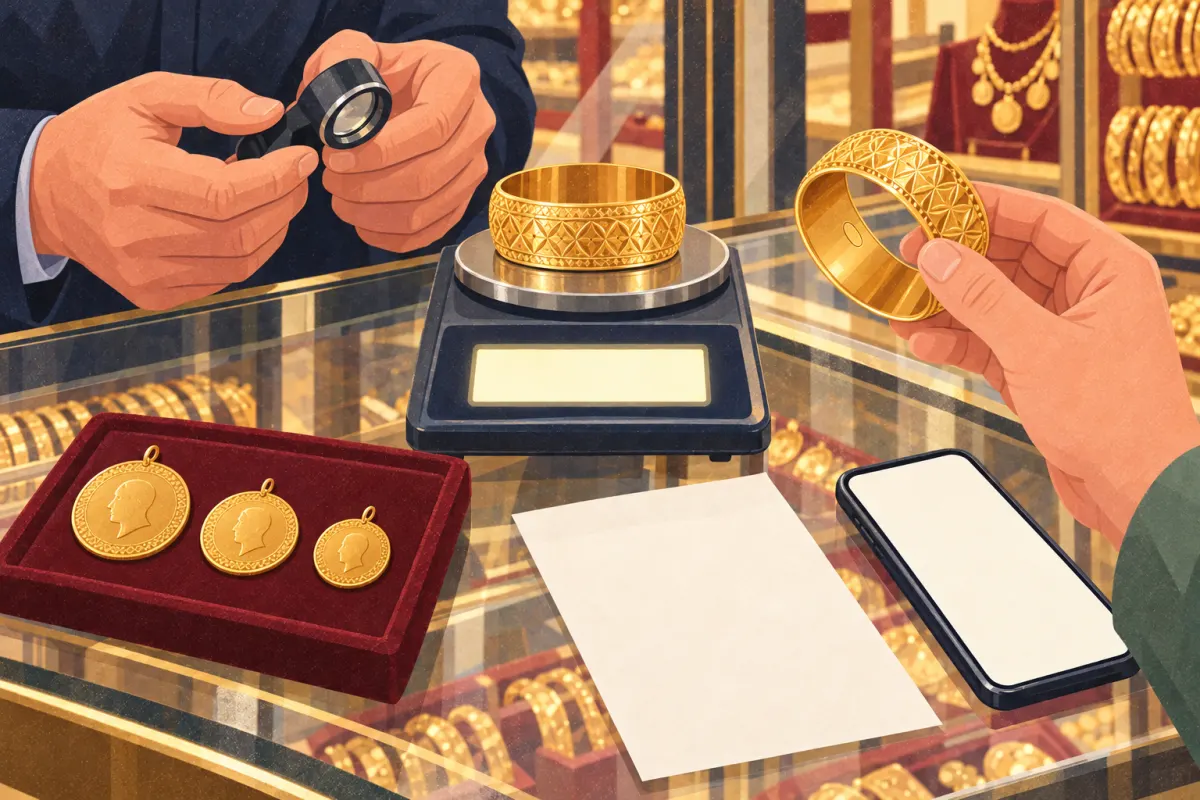
A Turkish jeweller usually works from the day’s price for a gram of pure gold. For jewellery, the price often comes as weight × that gram price × a factor in thousandths called milyem: a 22 karat bangle has 916 thousandths of gold, and anything charged above that is workmanship and margin. For coins and bars the shop quotes a buying and a selling price per piece.
Type what the jeweller tells you. The checker shows the gold inside, how much of the total is above the metal, and what you would lose if you sold it back today. The pure-gold price you typed for the coins is already here.
Ask for it in writing
Ask for the exact product, its weight, the buying and the selling price, every workmanship or fitting charge and the total, on paper. Paying by card does not automatically cost more; ask the shop what it charges for each way of paying.
Take an invoice with the shop’s name. It tells the next jeweller what you bought, and it is the first thing you will want if anything goes wrong.
Selling it back
Every shop has two prices: what it sells at and what it buys at. The gap between them is your cost of the round trip, so ask both for the same piece on the same day. A worn coin, a damaged piece or one with a fitting may be priced lower, and the shop may test the metal or decline to buy it.
Ask two or three shops before you sell. Work out the gap from the offers you get, not from an average you read somewhere: it changes with the product, the day and the shop.
Gram bars and refineries
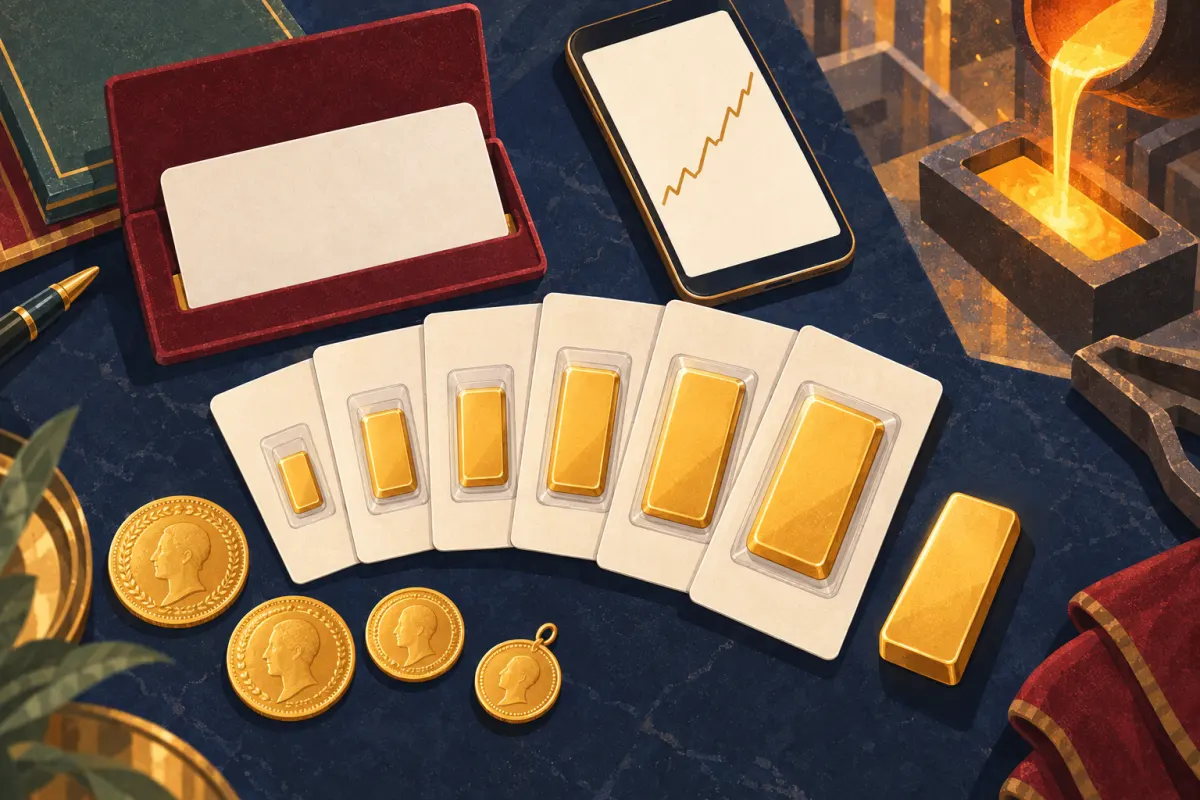
Small bars from 1 g up are sold sealed in a card that names the maker, the weight and the fineness. Some refinery names you will see on the cards are on the London Bullion Market Association’s Good Delivery list for wholesale gold. That list is about large wholesale bars; it does not vouch for every small bar, package or seller.
Istanbul Gold Refinery
On the current Good Delivery list for gold (checked 5 October 2026). Check the exact retail product, its weight, fineness and packaging.
Nadir Metal
On the current list too. It also recovers gold, silver, platinum and palladium from scrap and waste.
Ahlatcı
A refinery whose history page describes its acceptance at Borsa İstanbul. Not on the inspected LBMA gold list.
Harem
A gold and currency quote app. Its prices are the provider’s quotes, not offers every shop will match.
Whatever the name on the card, check the maker, the weight and fineness, that the seal is intact, and the seller’s invoice. Before relying on a bar to sell later, ask what a shop would pay for it.
Banks, ATMs and online shops
Banks sell gold without a counter. In a gold account you hold gold by weight, but the details differ by bank and by account. Ziraat’s demand gold account counts in 1000/1000 gold and does not pay out physical gold. Garanti BBVA also offers gold accounts; read the fineness, fees and delivery terms of the one you open.
Ziraat demand gold account
Gold by weight at 1000/1000. No physical delivery or payment from this account.
Garanti BBVA gold account
Gold accounts with their own terms: check fineness, fees and whether you can take gold out.
Kuveyt Türk gold ATMs
Eligible customers can buy gram or quarter gold from selected ATMs, up to four pieces a day, at the quoted rate and charges.
Buying gold online
Marketplaces list gold from many sellers. Before you order, check who the actual seller is, the product’s assay and invoice, how it is shipped and what the insurance covers. Good seller ratings do not prove that a bar is genuine or that the parcel is insured.
What sets the price
The lira price of gold follows two numbers: the world price in dollars per troy ounce and the lira’s dollar rate. A troy ounce is 31.1034768 g. When the lira weakens and the world price stays the same, gold in lira goes up.
Dollars × lira ÷ 31.1
Pure gold in TL per gram = the world price in USD per troy ounce × TL per USD ÷ 31.1034768.
With round example numbers, USD 4,000 an ounce at 50 lira to the dollar gives 4,000 × 50 ÷ 31.1035 ≈ 6,430 TL a gram. For a dated rate: the central bank’s indicative dollar rate on 2 October 2026 was 48.9699 TL buying and 49.0582 TL selling. Shop prices add the product’s margin and the buying or selling side.
₺Today’s gold pricesIs gold cheaper in Turkey than in Europe? The metal follows one world price, but shop totals differ with workmanship, tax and margins. Compare the same weight, fineness and product on the same day, both buying and selling, and convert with today’s exchange rates.
Gold in numbers
Turkey mines gold and buys far more. The figures below come with their dates; an estimate is marked as one.
28.21 tonnes
Energy Ministry. Modern production began in 2001 at Ovacık, Bergama, at 1.4 tonnes a year.
USD 13 billion
Energy Ministry: domestic output does not cover consumption.
About 5,000 tonnes
An industry estimate by Mustafa Atayık, president of the Istanbul Chamber of Jewellers. Other estimates differ.
25.443 million troy oz
Valued at USD 117.089 billion in the reserve table; the weekly release of 25 September 2026 gives USD 109.640 billion.
A 2021 ministry statement gave 42 tonnes for 2020 and named 100 tonnes a year as a target; the 2025 figure is the latest. The central bank’s gold figure includes deposits and swaps as it defines them, so it is not the same as what the bank owns outright or bought in a year.
Ask in Turkish
Whatever the jeweller’s English, these lines get you the two prices and the paperwork. Show one large on your screen or hear it in Turkish.
Has altının gramı ne kadar?
hahs al-tuh-nuhn grah-muh neh kah-dar
How much is a gram of pure gold?
Alış ve satış fiyatı ne?
ah-luhsh veh sah-tuhsh fee-yah-tuh neh
What are the buying and selling prices?
Kaç ayar?
kahch ah-yar
What karat is it?
İşçilik ne kadar?
eesh-chee-leek neh kah-dar
How much is the workmanship?
Fatura alabilir miyim?
fah-too-rah ah-lah-bee-leer mee-yeem
Can I have an invoice?
Bunu geri alır mısınız?
boo-noo geh-ree ah-luhr muh-suh-nuhz
Would you buy this back?
Five lines on the receipt
Tick them off at the counter. Your ticks stay on this phone.
The stamp and the weight come first: everything else is worked out from them.
Before you pay
All five. Keep the invoice with the gold.
Quick answers
Is gold money in Turkey?
No. Gold is not legal tender: you buy and sell it at a price that changes every day. People hold it as jewellery, gifts and savings, with the price risk and the gap between buying and selling prices.
What karat are Turkish gold coins?
The Mint’s Cumhuriyet coins, both ziynet and sikke, are 22 karat, 916.6 in a thousand. The Reşad coins it makes are 22 karat too.
What is the difference between ziynet and sikke?
Both are Cumhuriyet gold in five sizes. A sikke is heavier, thicker and smaller across than the ziynet of the same name; a ziynet has a decorative border. The 7.216 g one-lira sikke is the Ata Lira.
Can I take physical gold out of a bank account?
It depends on the account. Ziraat’s demand gold account does not pay out physical gold. Kuveyt Türk’s gold ATMs sell gram or quarter gold to eligible customers, up to four pieces a day.
How much will I lose if I sell gold back?
The gap between the shop’s selling and buying price for the same piece. Ask both on the same day, and expect a shop to test the piece; the bill checker above shows the loss in lira.
Sources
Coin weights and sizes are the Mint’s nominal figures; the other facts were checked on 5 October 2026. No prices are written into this page: the tools work with the quotes you type. The illustrations show the subject, not real products.
- Cumhuriyet gold production: specifications — Darphane (State Mint), checked 5 October 2026
- Cumhuriyet gold in questions (FAQ, incl. Reşad) — Ministry of Treasury and Finance, checked 5 October 2026
- Gold: production and trade — Ministry of Energy and Natural Resources, checked 5 October 2026
- 2020 output and the 100-tonne target — Ministry of Energy and Natural Resources, checked 5 October 2026
- Household gold estimate — Istanbul Chamber of Jewellers (İKO), checked 5 October 2026
- Gold colours and karats — GIA, checked 5 October 2026
- International reserves, August 2026 — Central Bank of the Republic of Türkiye, checked 5 October 2026
- Weekly reserve developments, 25 September 2026 — Central Bank of the Republic of Türkiye, checked 5 October 2026
- Indicative exchange rates, 2 October 2026 — Central Bank of the Republic of Türkiye, checked 5 October 2026
- Troy ounce in grams — Royal Canadian Mint, checked 5 October 2026
- Gold Good Delivery current list — LBMA, checked 5 October 2026
- The OTC guide: introduction — LBMA, checked 5 October 2026
- Istanbul Gold Refinery review — LBMA, checked 5 October 2026
- Precious metal recovery — Nadir Metal, checked 5 October 2026
- Company history — Ahlatcı Metal, checked 5 October 2026
- Harem Altın app listing — Google Play, checked 5 October 2026
- Precious metals market — Borsa İstanbul, checked 5 October 2026
- Demand gold deposit account — Ziraat Bankası, checked 5 October 2026
- Gold accounts — Garanti BBVA, checked 5 October 2026
- Gold ATMs — Kuveyt Türk, checked 5 October 2026