PayPal in Turkey: Current Restrictions and Four Transfer Alternatives
Table of Contents
PRACTICAL MONEY GUIDE · CHECKED 1 OCTOBER 2026
PayPal is still suspended for customers in Turkey. If you have moved here, have money in an old account or need to get paid by an overseas client, start with the specific job you need to do.
A bank transfer, a cash pickup and an online shop checkout solve different problems. This guide explains the restrictions, what to ask about an old balance or refund, and how to compare four transfer routes without relying on invented addresses or headline fees.
What happened to PayPal in Turkey?
PayPal dates its suspension to June 2016. Its current notice for customers in Turkey still says it is not permitted to provide the service there. A Turkish account cannot receive a payment simply because the buyer lives abroad.
This matters when reading older guides: instructions to log in and withdraw normally no longer match the current Turkish notice. We also avoid reducing the licensing history to an unsupported claim that one technical change would bring the service back.
Is PayPal coming back?
The Turkish notice checked for this guide does not announce a restart. PayPal’s July 2025 PayPal World announcement describes a global interoperability project. It is not evidence that Turkish PayPal accounts have reopened. Do not make a payment plan around a rumoured return date.
An old balance: what to do next
PayPal directs questions about Turkish accounts and remaining money to [email protected]. Use that address from the official notice, rather than a social-media “recovery agent”. It is a support channel, not a guarantee that a particular withdrawal method is available.
- Find your records. Collect the account email, any balance statement, transaction dates and previous support references. Keep these privately; the tool below does not need them.
- Ask for the account-specific process. Explain that the account was registered in Turkey and ask how ownership and the remaining balance can be reviewed.
- Use a verified document channel. If documents are requested, confirm the upload route through PayPal. Never send a password, card security code or one-time login code to an intermediary.
- Keep the case number. Ask what the next step is and whether further information is missing. Do not treat an automated reply as confirmation that a payout has been approved.
Opening another transfer-service account does not by itself release money held by PayPal. Avoid anyone asking for an “unlock fee”, a rented account or remote access to your device.
A refund is different from withdrawing a balance
Start with the original purchase: ask the seller whether a refund has actually been issued and request its date and reference. A seller saying “we sent it” is different from the money reaching your payment method.
PayPal’s US explanation of refund destinations generally routes refunds to the original payment method, with exceptions for balances and mixed funding. It also describes different processing times by method. Those US timings do not establish a procedure or deadline for an inaccessible Turkish account.
If the original payment was card-funded, ask the card issuer how to trace the refund, especially if the card has expired or been replaced. If it is stuck in an inaccessible account, ask PayPal to review that transaction. A converted refund can differ from the original local-currency amount because exchange rates may change. Keep the purchase receipt and refund confirmation together.
Can you use a PayPal account opened abroad?
PayPal says accounts should be opened in the country where the customer resides. Having a foreign passport, foreign bank account or holiday address does not by itself establish residence there. A VPN, false address or borrowed identity does not fix the account requirements.
Distinguish a short trip from a genuine move. For an existing foreign account, check the terms for its registered country and tell PayPal about a real change of residence. Its guidance on moving countries says you cannot simply change an account address to another country; a move can require closing the old account and opening another where supported. Ask how to handle pending payments, refunds and the remaining balance before closing anything.
That is not an instruction for a Turkey resident to create a foreign account. Nor can this guide guarantee that a legitimate account will work during every trip: account checks, location and the applicable terms can still matter.

Four alternatives, matched to the task
Here, “alternative” means another way to move a new payment. These services are not verified routes for cashing out a suspended PayPal balance. Compare only options that actually support your sending country, funding method, recipient and payment purpose.
1. Western Union: cash pickup or a supported bank route
Cash pickup can be useful if the recipient does not have a Turkish bank account. Western Union’s receiving instructions for Turkey ask for accepted valid ID, the money transfer control number (MTCN), sender details, sending country and expected amount. Its list for non-Turkish citizens includes a national passport; check acceptance for your document with the collection point.
PTT offers Western Union services, but do not assume every nearby branch handles your payout in the currency and amount you need. Confirm opening hours, identification, name matching and cash availability before travelling there. Keep the transfer number between the sender and intended recipient.
Receiving through a participating bank’s mobile app or ATM is a different route and requires the relevant active bank account. Other payout methods vary by sending country. Ask for the actual quote; an old fee table for a small dollar transfer cannot price a different route today.

2. International bank transfer: ask what will reach the account
A bank transfer may fit an invoice, family support or a move between your own accounts when both banks accept the purpose and route. For SWIFT, the international bank messaging network, ask the receiving bank for the account holder’s exact name, IBAN or account number, SWIFT/BIC, receiving currency and any intermediary-bank instructions.
Check whether the account holds the currency you want or automatically converts incoming money. A correct IBAN is not proof that a particular cross-border payment will be accepted.
İş Bankası’s SWIFT guidance highlights costs that depend on the amount, destination, bank and charge arrangement. You may encounter these labels:
- OUR: the sender is instructed to bear transfer charges
- SHA: the sender pays its bank’s charges and the recipient bears other applicable charges
- BEN: transfer charges are borne by the recipient
These are the usual meanings of bank charge options, not a promise that every bank offers each one or guarantees a deduction-free payout. Ask about sender, intermediary and receiving-bank fees separately.
Garanti BBVA explains that bank checks can affect SWIFT timing. Cutoff times and holidays matter too. If a transfer is delayed, ask the sender to obtain the bank’s trace or payment reference. A returned transfer can be reduced by charges already incurred along the route.
3. Wise: a transfer to a bank is not a receiving wallet
Wise’s restrictions for customers based in Türkiye distinguish transfers from account features. Eligible senders can transfer to a Turkish bank account; the page also says international transfers funded from a Turkish bank account can continue. This does not provide unrestricted Wise balances, receiving account details or currency conversion to a Turkey-address customer.
For a lira payout, Wise’s TRY transfer guide requests the recipient’s name, occupation and 26-character IBAN beginning TR. The account must accept EFT, the local bank-transfer system; a term-deposit account is unsuitable. Outgoing TRY transfers have separate identity requirements, so a foreign resident should not assume that a Turkish account alone makes them eligible.
If you need dollars to stay dollars, compare the USD-to-Turkey SWIFT route rather than using a lira quote. The fees, timing and deductions can differ. Check what is offered for your personal or business profile before promising it to a client.

The useful comparison is the complete quote: debit, stated fee, rate and expected credit. The earlier “from 0.47%” figure is not a verified universal current fee. If you choose to explore Wise through our affiliate link, we may receive a commission. That does not change eligibility or guarantee savings; compare the final terms with another available route.
4. MoneyGram: check the payout your sender can select
MoneyGram’s Turkey page lists cash pickup, bank accounts and mobile wallets. It is therefore too narrow to describe the service as cash-only, but the methods shown to a sender depend on the country and channel. Its technical coverage page describes Turkish bank and wallet payout options; that coverage is not a promise that every retail app exposes them.
For cash, confirm the selected agent’s documents, exact recipient name, payout currency and hours. MoneyGram’s general cash-collection instructions use photo ID and an eight-digit reference number. This is not Western Union’s MTCN. Follow the requirements on your specific transfer.
PTT’s MoneyGram information and Kuveyt Türk’s MoneyGram service page are useful local starting points. Check the actual service and final price before sending; neither a branch listing nor a headline delivery estimate guarantees your transaction.
Freelancers and online shops: agree how you will be paid
For a freelancer: settle the payment method before starting work. Ask whether the client can pay an invoice to your actual bank account, in a currency the account accepts, using a route approved for commercial payments. Agree who covers charges and what counts as full payment. Keep the invoice, payment reference and bank credit together for your records.
For an online shop: separate collecting card payments from sending money. Check the payment provider’s supported business country, legal entity, product category, settlement currency, refund process and verification requirements. A personal cash-transfer service does not automatically provide shopping-cart integration, recurring billing or buyer protection.
For a real overseas business: foreign incorporation alone does not guarantee a PayPal Business account. The UK PayPal agreement, for example, sets country-specific eligibility and account-information rules. Use the terms for the actual company and account country, and obtain appropriate accounting advice for your circumstances. Do not buy a “ready-made” account or misstate where the business operates.
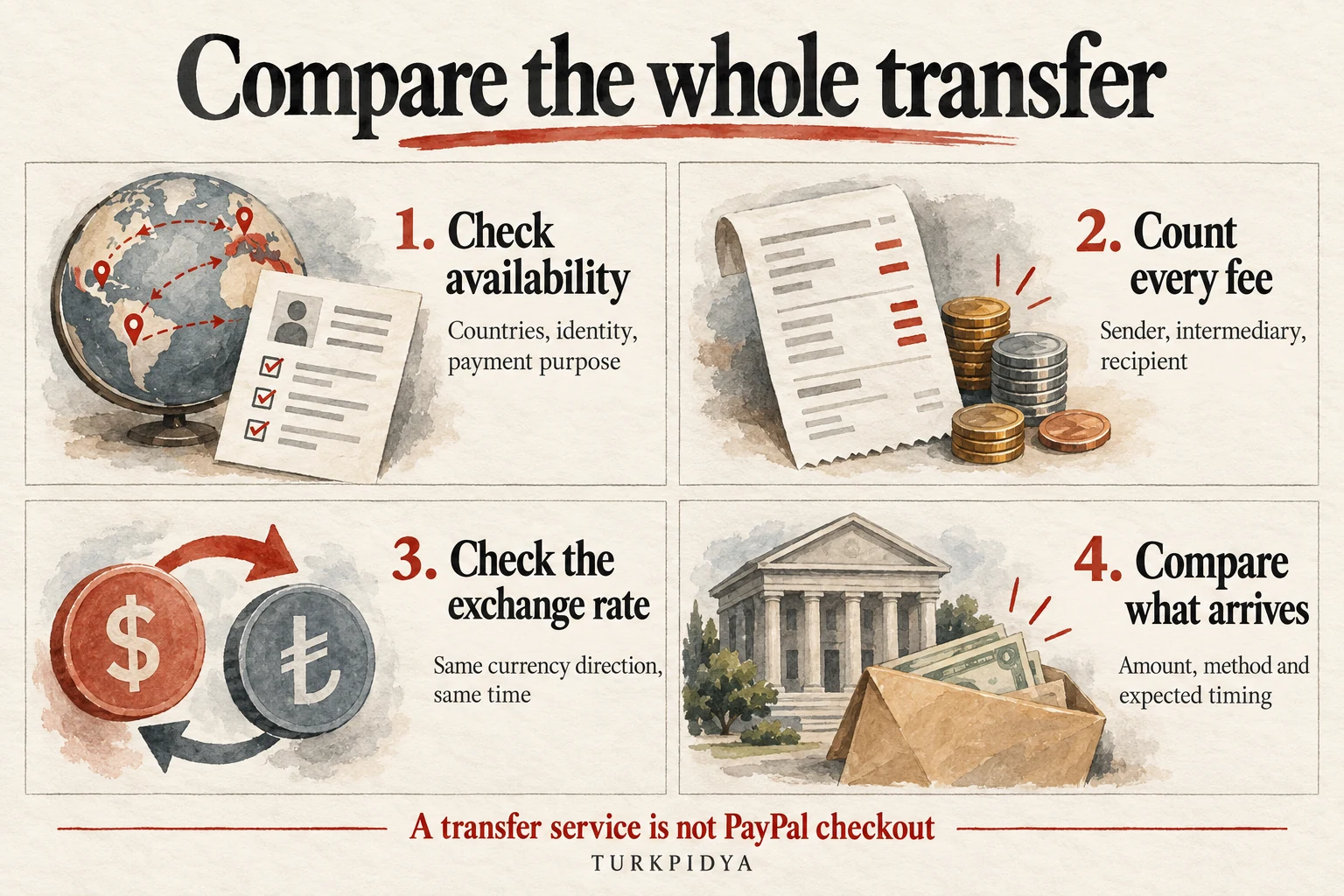
Compare the whole transfer, not just the fee
Ask each provider for a quote at roughly the same time, using the same total spending budget, sending and receiving currencies, destination and delivery method. Write down all charges and the expected amount the recipient gets. If a deduction is unknown, keep it marked unknown rather than entering zero.
Turkpidya’s Turkish lira currency converter provides indicative Central Bank rates for budgeting. It is not an executable bank or transfer-service quote. Make sure a reference rate points in the same direction as your offer: for EUR to TRY, use lira per euro.
The tool uses this formula: (total sender budget − fees charged before conversion) × quoted rate − deductions in the receiving currency. The effective rate divides the final receipt by the entire budget. This makes a “zero fee” offer with a poorer rate easier to compare.
Fictional example, not current rates or prices: with a total budget of 500 EUR, offer A charges 5 EUR, converts at 40 TRY per EUR and deducts 10 TRY, leaving 19,790 TRY. Offer B charges zero, converts at 39 and deducts zero, leaving 19,500 TRY. A delivers 290 TRY more. Speed, cancellation terms and cash-collection practicality still need a separate check.
NO SIGN-UP OR ACCOUNT ACCESS
Choose your situation and compare two offers
Get a practical next step, then compare two quotes you have already obtained. This tool does not connect to banks, check identity or send money.
Two offers for the same total budget
Use the same countries, currencies, purpose and receiving method. Enter only known charges: an unknown deduction is not zero. Assess timing and convenience separately.
Use numbers without thousands separators: 500, 12.50 or 12,50. For the same currency, enter a rate of 1. Enter 0 only when no fee or deduction is confirmed. Complete every required field. Maximum entry: 1 billion per field.
This tick is your acknowledgement, not eligibility approval from Turkpidya. Do not enter names, IBANs, card numbers, identity documents or codes. The tool processes these entries on this page and does not store them.
Changing any entry clears earlier results and guidance. An invalid calculation clears them too. Reset removes every entry, result and note; select a situation again whenever you need its guidance.
If the tool does not start, use: (total budget − fees before conversion) × rate − deductions after conversion. Compare both totals in the same currency. The article also contains all practical steps.
Before you send
- Confirm both parties, countries, documents, banks and the personal or commercial purpose are supported. A service operating in Turkey does not mean it accepts every overseas route.
- Match the recipient’s name to the required ID or bank record. Check the currency and receiving instructions independently with the recipient.
- Check total debit, all known deductions, quoted rate, expected credit and estimated arrival. Ask which amount is guaranteed and which is only an estimate.
- Read cancellation and refund conditions before paying. Keep the quote, receipt and reference. Do not send a transfer to “test” an unverified PayPal workaround.
Common questions
Which alternative is cheapest?
There is no reliable universal winner. Compare the final amount for your exact route, amount, currency and payout method. A low advertised fee can be outweighed by the exchange rate or bank deductions.
Do I need a Turkish bank account?
For payment into your own Turkish account, yes. Cash pickup is a different route and can work without that account, subject to accepted ID and the selected transfer’s rules. Bank-app or ATM collection is not the same as over-the-counter cash pickup.
Can someone send money to my old Turkish PayPal?
Do not give it as a working payment destination. Ask the sender to use an eligible alternative for a new payment; unresolved past transactions should go through PayPal’s support process.
Can this tool check my eligibility or make a transfer?
No. It shows practical next steps and compares numbers you enter. It has no bank connection, does not verify documents, does not store your entries and cannot send, receive or recover money.
Source check: 1 October 2026. Official provider pages are linked beside the relevant advice. Availability, identity checks, fees and delivery estimates depend on the account and route and can change. This guide provides practical information rather than account-specific financial or legal advice.