Turkish Banks: The 2026 Insider Guide to Accounts, Credit & Interest
Table of Contents
If you plan to live, work, or invest in Turkey, you cannot bypass the local banking system. But let’s be clear: Turkish banking is about more than just parking your Liras. It is a high-speed, volatile sector that is undergoing a massive transformation as we close out 2025. There are worlds of difference between the agile digital neo banks and the traditional state giants, and for foreigners, the path to that first IBAN is often far rockier than the glossy brochures suggest.
We have pushed the generic Wikipedia facts aside to take a look behind the curtain. Here is what the current numbers mean for your money and how to navigate the bureaucratic red tape like a pro.

The Status Quo: More Than Just Branches
The Turkish banking system has grown massively and is more digital than ever. Forget the outdated data: As of September 2025, there are 68 banks operating in Turkey. The system is supported by over 10,778 physical branches and employs roughly 210,497 people. But the real revolution isn’t happening at the teller windowit’s happening on your smartphone.
The landscape is now clearly divided:
- 38 Deposit Banks: This now includes purely digital players like Colendi and Enpara, who are shaking up the market.
- 21 Development and Investment Banks: Including specialized institutes like Aytemiz Yatırım Bankası.
- 9 Participation (Katılım) Banks: The segment for interest-free, Islamic banking is growing rapidly.
Monetary Policy & Credit: What Investors Must Know
For entrepreneurs and investors, liquidity is king. The Central Bank (TCMB) has loosened the reins slightly in late 2025, but with precision:
- Credit Volume: The total credit volume has swelled to a gigantic 21.58 Trillion TL by October 2025.
- Rediscount Credits: To boost exports, the daily limit for rediscount credits was raised to 4.5 Billion TL starting in November 2025. Interest costs here have dropped to around 24.89%—a vital signal for trade.
- State Banks Dominate: If you are looking for loans, state banks like Ziraat (52% growth) or VakıfBank (45% growth) are currently far more aggressive in lending than their private competitors. This trend mirrors the broader economic pressure seen in domestic producer prices, pushing businesses to seek state backed liquidity.
The Most Important Banks: A Curated List
Not every bank is suitable for every purpose. Here is our assessment of where you should focus your attention:
The “Big Three” for Expats (State & Private)
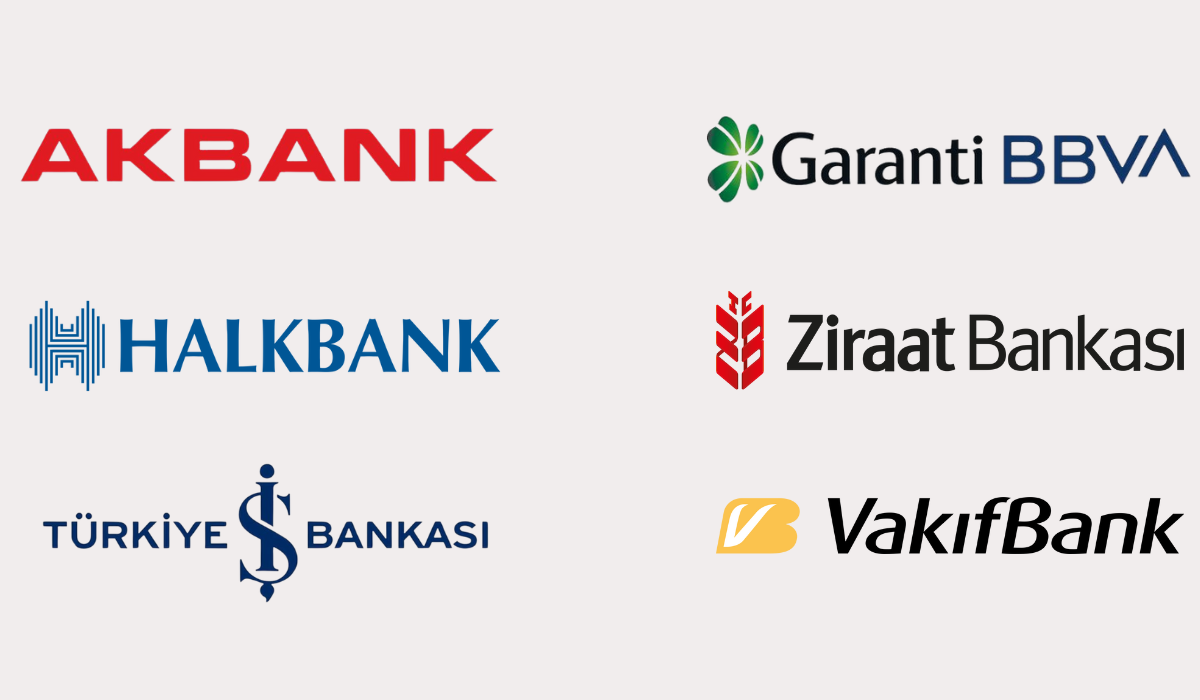
- Ziraat Bank: The state giant. It has the densest branch network and is often the primary stop for government fees or tax payments.
- Garanti BBVA: The technology leader. Their app is excellent and often available completely in English, making it a favorite for foreigners.
- İş Bankası: The “Bank of Turkey.” Extremely solid, great for business transactions, and maintains a strong presence in Europe.
Other Key Players: Halkbank, VakıfBank, Yapı Kredi, Akbank, QNB Finansbank, DenizBank, TEB (BNP Paribas Partner).
Pro Tip: If you conduct international business, consider international banks in Northern Cyprus as a comparative option for offshore services.
Practitioner’s Guide: Opening an Account (2026 Edition)
Here is where theory meets hard reality. Officially, it’s simple; in practice, every branch demands something different. These are the facts you need before you step through the security doors:
Required Documents
- Valid Passport: You must present the original.
- Potential Tax Number (Vergi Numarası): You can get this easily at the tax office or online.
- Proof of Address: A utility bill (electricity, water, gas) in your name, or an official residence certificate. Securing this can be tricky if you are new; check our guide on renting in Istanbul to understand how to get your name on a bill. Note: If you use foreign documents, legalization is often required.
- Turkish Phone Number: Online banking will not work without this. If your phone has been blocked, you need to solve that firstread our guide on phone registration and IMEI fees.
The “Hidden Gem” Tip: Many banks officially require a residence permit (Ikamet). If you don’t have one yet, some banks (often Ziraat or Kuveyt Türk) offer account opening in exchange for a Deposit. You will likely need to block a certain amount of funds for 1-3 months.
Credit Cards for Foreigners: The “Blokeli” Hack
Getting a real credit card without a Turkish credit history is nearly impossible. However, there is a workaround that bank consultants don’t always offer immediately: the “Blokeli Kredi Kartı” (Secured Credit Card).
With this method, you deposit a cash amount (e. g., 10,000 TL) at the bank, which is then frozen. The bank issues you a credit card with a limit of about 80-100% of this amount. This is the fastest way to enable online payments or rent a cara necessity given the risks highlighted in our guide to car insurance and traffic traps—especially since PayPal remains unavailable in Turkey.
Islamic Banking: Ethical & Interest-Free
For those who avoid interest for religious or ethical reasons, Turkey offers a rapidly growing sector. These banks operate on the principle of profit sharing (Murabaha/Mudaraba). Especially during Ramadan, these banks often offer special conditions.
Currently (as of December 2025), there are 9 active participation banks in Turkey:
- Albaraka Türk
- Kuveyt Türk (Market leader in this segment)
- Türkiye Finans
- Ziraat Katılım (State owned)
- Vakıf Katılım (State owned)
- Türkiye Emlak Katılım (State owned)
- Dünya Katılım
- Hayat Finans (Digital)
- T. O. M. Katılım (Digital)
Verdict: Embrace Digital, Plan for Bureaucracy
Turkish banking is modern, fast, and secure. The apps are often more advanced than those in many European countries. The challenge lies in the analog part: the initial opening. Go prepared, bring all your documents, and ideally a Turkish speaking companion to avoid misunderstandings at the branch.