Yunus Emre: Works, Life-Date Uncertainty and Later Tradition
Table of Contents
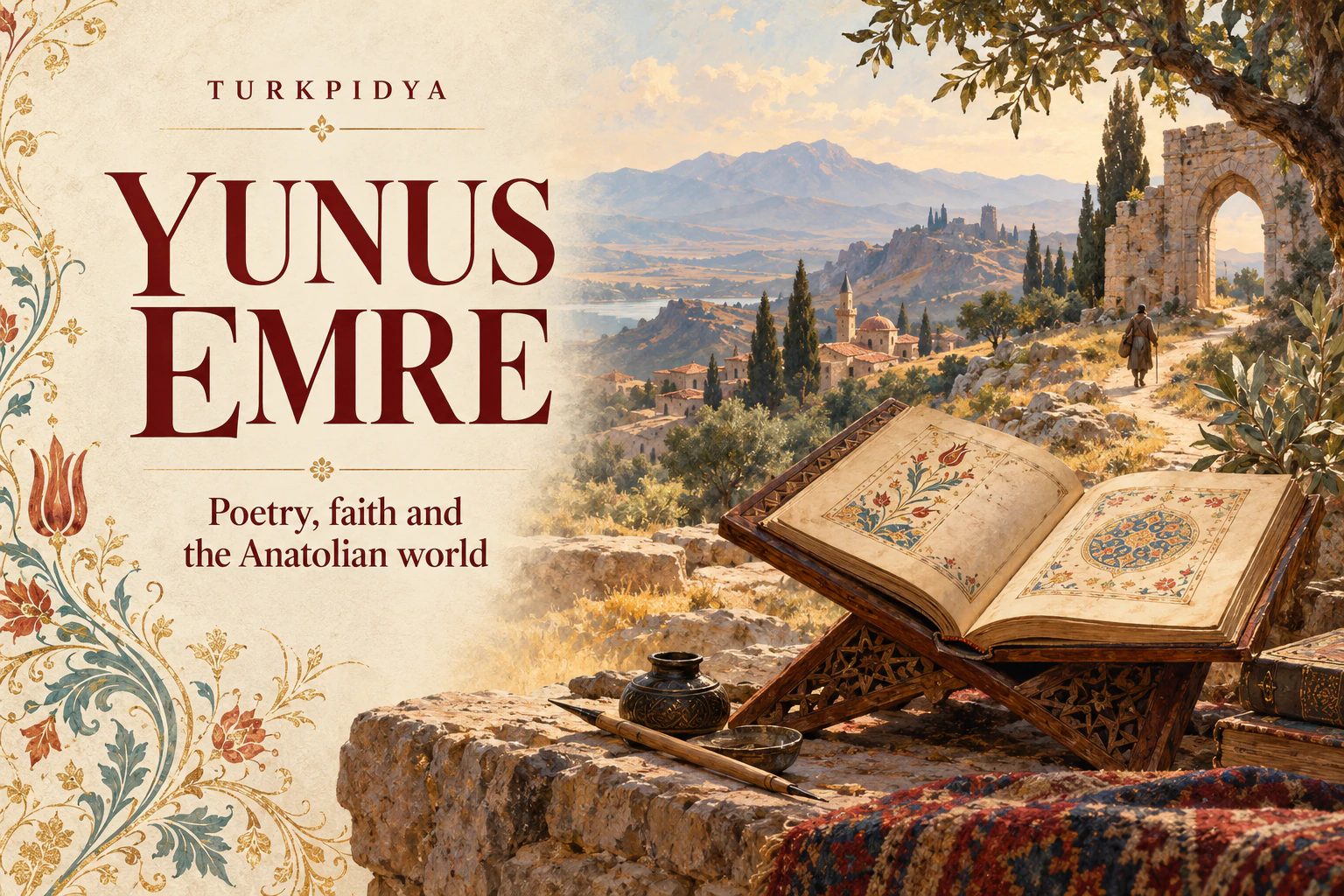
Yunus Emre helped give Turkish poetry a voice that could speak about God, longing and the human heart with extraordinary directness. His poems belong to the spiritual world of medieval Anatolia, yet their questions are familiar: what does learning change in us, what does love ask of us, and how should we treat another person?
There are two ways to meet Yunus: through the works transmitted in his name, and through the stories people told about him. Reading both is rewarding. Keeping them distinct lets us enjoy the stories without turning them into a biography more certain than the evidence allows.
Yunus and the Anatolia of his time
Yunus is usually placed in the late thirteenth and early fourteenth centuries. Anatolia was then a region of changing political power. The Seljuk defeat by the Mongols at Kösedağ in 1243 brought lasting upheaval and subordination. This is the historical setting of his world; it does not tell us that he witnessed a particular battle or wrote a particular poem in response to it. Faruk Sümer’s account of Kösedağ explains the wider background.
Persian had an important place in literary culture, while Yunus wrote in Turkish. His achievement was to make the language carry a rich spiritual vocabulary and a strikingly personal poetic voice. Calling it simply “pure Turkish” misses the texture of his writing: familiar expressions sit beside the religious learning of his age. His language also belongs to an earlier stage of Turkish, so an apparently simple line may need explanation today. The university-based Turkish Literature Names Dictionary places this contribution in literary history.
Why the life dates remain approximate
A widely used reconstruction places his birth around 1240–41 and his death around 1320–21. Ziya Avşar’s introduction explains this using a manuscript lifespan note read as 82 years and a death in 720 AH. Historian Adnan Sadık Erzi brought the note into scholarly discussion in 1950; later readers corrected the lifespan printed in that first discussion. This is evidence to weigh, rather than a surviving birth certificate. Calendar conversion also helps explain why references print 1320 or 1321. See Avşar’s introduction and the study explaining the corrected reading.
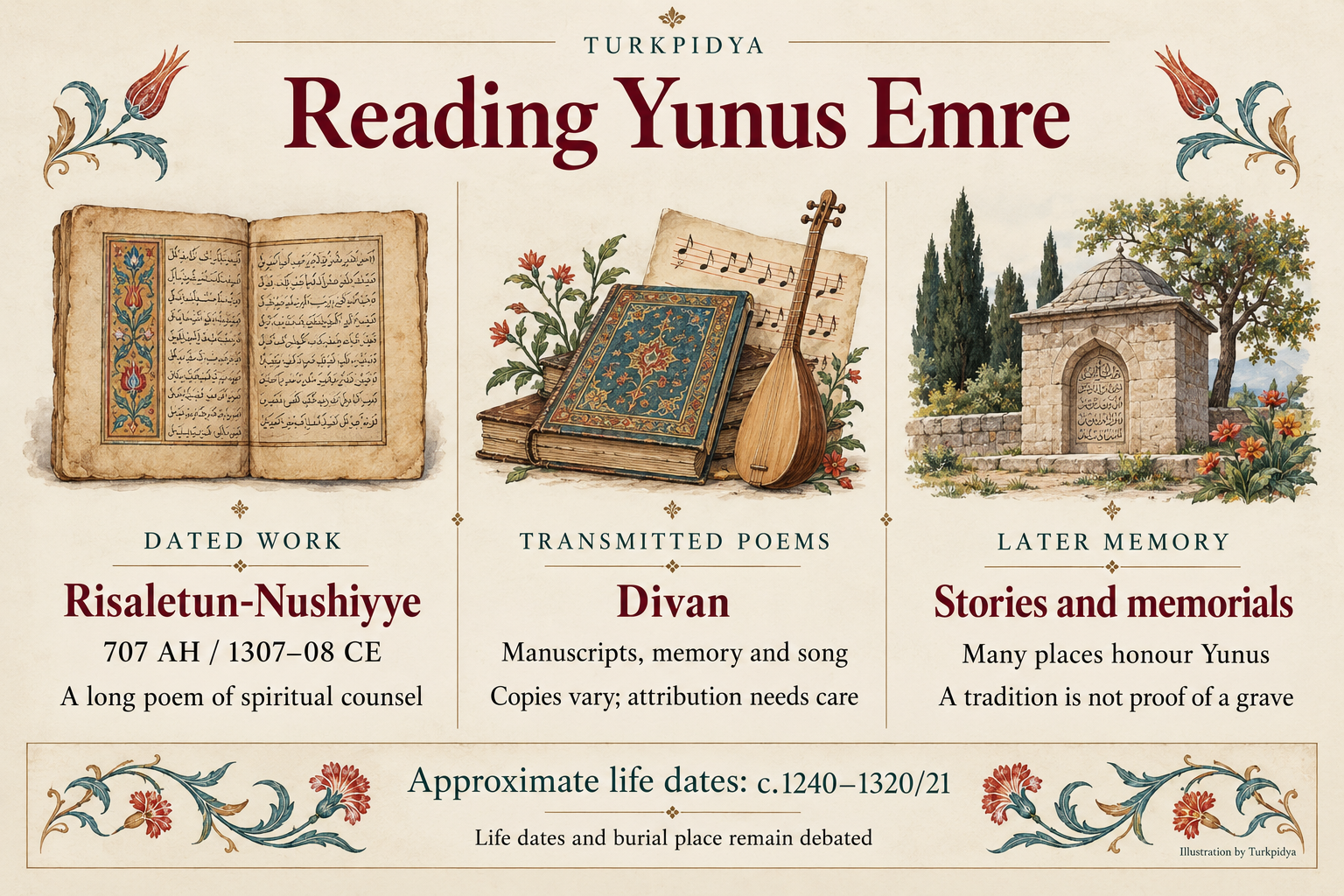
The firmer chronological anchor is a work: Risâletü’n-Nushiyye carries the date 707 AH, commonly given as 1307 or 1307–08 CE. We can place the writer in that period without claiming a precise birthday, a complete travel diary or a securely documented burial place. “Around 1240–1320/21” is therefore a useful shorthand, provided “around” stays attached.
Even the name needs care. Manuscripts preserve poetry by more than one poet called Yunus. Hayati Develi’s study of a poem dated 1465 argues for another, later Yunus, distinct from the medieval poet and from Âşık Yunus. A name at the end of a verse is not sufficient by itself to settle authorship. Develi’s research shows why editors compare manuscripts and dates.
Tapduk Emre and the path of a dervish
Tapduk Emre is remembered as Yunus’s spiritual teacher, and Yunus’s verse names him. A dervish is someone following a Sufi path of spiritual discipline; a tekke is a lodge where such a community gathers. That relationship helps us understand why service, guidance and the transformation of the self matter so much in this poetry. The TDV study of Tapduk Emre examines the relationship and the later traditions around it.
It is tempting to fill every gap with a story: a fixed number of years in a lodge, a confirmed marriage, an exact route across Anatolia. The accounts do not give us that kind of uniform record. Nor should simple language be treated as proof that Yunus could not read. The older image of the unlettered saint and the learning visible in his works need to be considered together; his formal education remains difficult to reconstruct. Tatcı’s discussion of his education explains the differing views.
The Divan and the Book of Counsel
The Divan
A divan is a collection of poems. Yunus’s Divan is not one book he published on a single known day: it comes to us through copied manuscripts and the wider life of the poems in performance and memory. Editions differ in wording and in what they include.
That difference can be surprisingly concrete. İdris Nebi Uysal compares manuscript versions of a much-loved couplet about making life easier together. The familiar wording differs from the verbs and expressions in several copies. This does not make the poem less moving; it makes the choice of edition part of reading it. It also explains why a fixed total of “all Yunus’s poems” can be misleading. Uysal’s manuscript study is a useful guide to these problems.
For an English reader, a translation is another layer. Word choice, rhythm and the treatment of religious terms all shape the result. A good edition identifies its editor and translator and explains how the text was established. An attractive quotation circulating online may omit all of that information.
Risâletü’n-Nushiyye
The title is often rendered as the Book of Counsel or Book of Advice. This extended mesnevi—a poem in paired rhyming lines—offers spiritual and ethical instruction. It gives a sustained argument where a short lyric may give one concentrated moment.
Alper Günaydın’s close reading shows how the poem imagines the human inner world through places: houses, territory and especially a city with walls and a ruler. The image makes moral struggle something we can picture. Greed, pride and the competing forces within a person become more than a list of faults; they belong to a dramatic inner landscape. Günaydın’s study of space in the work explains this allegory.
Read the two works side by side and their different strengths become clear. The Divan offers short, memorable encounters with longing and faith. The Book of Counsel develops the work of becoming a better person over a longer form. Neither is a substitute for the other.
Love, the heart and knowing yourself
Yunus’s vocabulary of love comes from Sufi Islam. The “beloved” or “friend” in a poem may point beyond an ordinary human relationship; the heart is a place of spiritual understanding, and knowledge asks for an inward change. Those meanings are lost if every line is read as a modern romantic saying.
Francesco Conte’s close reading of the Divan follows this relationship between the self, the spiritual guide and divine truth. His interpretation treats learning as a practice of examining oneself, rather than merely accumulating information. It also shows why Yunus’s religious language cannot be separated neatly from his concern for how a person lives. Conte’s study offers one scholarly reading, not the only possible interpretation.
The poetry rewards attention to a small word as much as a grand idea. An English “heart,” for example, can suggest emotion alone, while gönül may carry a wider inward and spiritual meaning. Read a poem slowly, notice who is speaking and who is addressed, and let the translator’s notes keep that older world in view.
The wheat and the straight wood
In a famous devotional story, a poor Yunus goes to Hacı Bektaş Veli for wheat during a shortage. Offered a spiritual blessing instead, he chooses food, then returns after reconsidering. He is directed to Tapduk Emre. The story sets immediate bodily need beside a different kind of nourishment.
Another tradition tells of Yunus carrying only straight wood into his teacher’s lodge: even the wood should be worthy of the place. It is a memorable image of service and integrity. Accounts give different lengths for his service, including thirty and forty years. These are later stories about spiritual formation, not a dated employment record. Mustafa Tatcı’s TDV article identifies the narrative sources and their differences.
Reading a legend responsibly does not drain its meaning. The wheat story can speak about need and spiritual awakening; the wood story can make honesty visible. What changes is the claim we make: “a tradition tells” preserves the story’s character.
Where is Yunus Emre buried?
Several places have burial or memorial traditions associated with Yunus. A makam can be a place that honours a holy person’s presence or memory; it should not automatically be treated as a proven grave. The existence of several sites shows the reach of his memory and leaves the historical question open.
Sarıköy, now associated with the name Yunus Emre in Eskişehir’s Mihalıççık district, has an important monument and museum complex. The provincial Culture and Tourism Directorate describes its modern development and lists the museum, books and displayed architectural fragments. Its separate biography page dates the completion of the present monument tomb to 1970. These are details about the memorial’s history; they do not independently prove a unique medieval burial. The official complex listing and the provincial biography explain the local tradition.
Karaman also preserves a Yunus Emre tomb tradition at the Yunus Emre Mosque. Afyonkarahisar’s official culture listing describes sites at Döğer and Sandıklı. These places deserve attention as local heritage, without forcing every claim into one supposedly certain itinerary. Karaman’s culture directorate and the Culture Portal’s Afyonkarahisar listing document the sites.
Explore the dates, works and places
Compare the evidence behind a date, a book or a memorial. All entries are shown below; the filters let you focus on one strand.
CHRONOLOGY · APPROXIMATE
Around 1240–41
A commonly used birth estimate comes from interpreting a manuscript lifespan note. It is a reconstruction, not a precise recorded birthday.
CHRONOLOGY · HISTORICAL CONTEXT
1243
The Seljuks suffer defeat at Kösedağ. This locates Yunus’s wider world; it is not an event securely documented in his personal life.
CHRONOLOGY · DATED WORK
707 AH / 1307–08 CE
The Book of Counsel carries a date in its text. This is a stronger anchor for the poet’s period than a later legend.
CHRONOLOGY · APPROXIMATE
Around 1320–21
The commonly cited death range corresponds to 720 AH. References use different conversions and qualifications; an exact date is not established here.
CHRONOLOGY · MODERN MEMORY
1970
Eskişehir’s provincial biography dates the present monument tomb’s completion to this year. A modern construction date does not settle a medieval burial.
CHRONOLOGY · COMMEMORATION
1991 and 2021
UNESCO commemorations used the 750th anniversary of his birth and the 700th of his death. Anniversary conventions do not remove the earlier uncertainty.
WORKS · POEM COLLECTION
Divan
Follow the short poems through manuscripts and editions. Wording and attribution vary, so the editor’s explanation matters.
WORKS · EXTENDED COUNSEL
Risâletü’n-Nushiyye
Follow a longer spiritual argument in rhyming couplets. Its inner city gives shape to moral struggle.
PLACES · MEMORIAL COMPLEX
Sarıköy / Yunus Emre
In Mihalıççık, Eskişehir, the complex preserves a major local tradition. Its museum and monument belong to the history of commemoration.
PLACES · LOCAL TOMB TRADITION
Karaman
The local culture directorate identifies a Yunus Emre tomb at the mosque bearing his name. The listing documents local heritage, not a settled comparison of all burial claims.
PLACES · MULTIPLE LOCAL SITES
Afyonkarahisar
The Culture Portal describes Yunus traditions at Döğer and Sandıklı. Multiple monuments should not be joined into an invented travel route.
The Yunus we remember
His afterlife belongs to readers, singers, editors and the communities that honour him. The official UNESCO anniversary record includes commemorations in 1991 and 2021. Those events show his continuing cultural importance, while their anniversary dates remain conventions for remembrance. UNESCO Türkiye’s record gives the details.
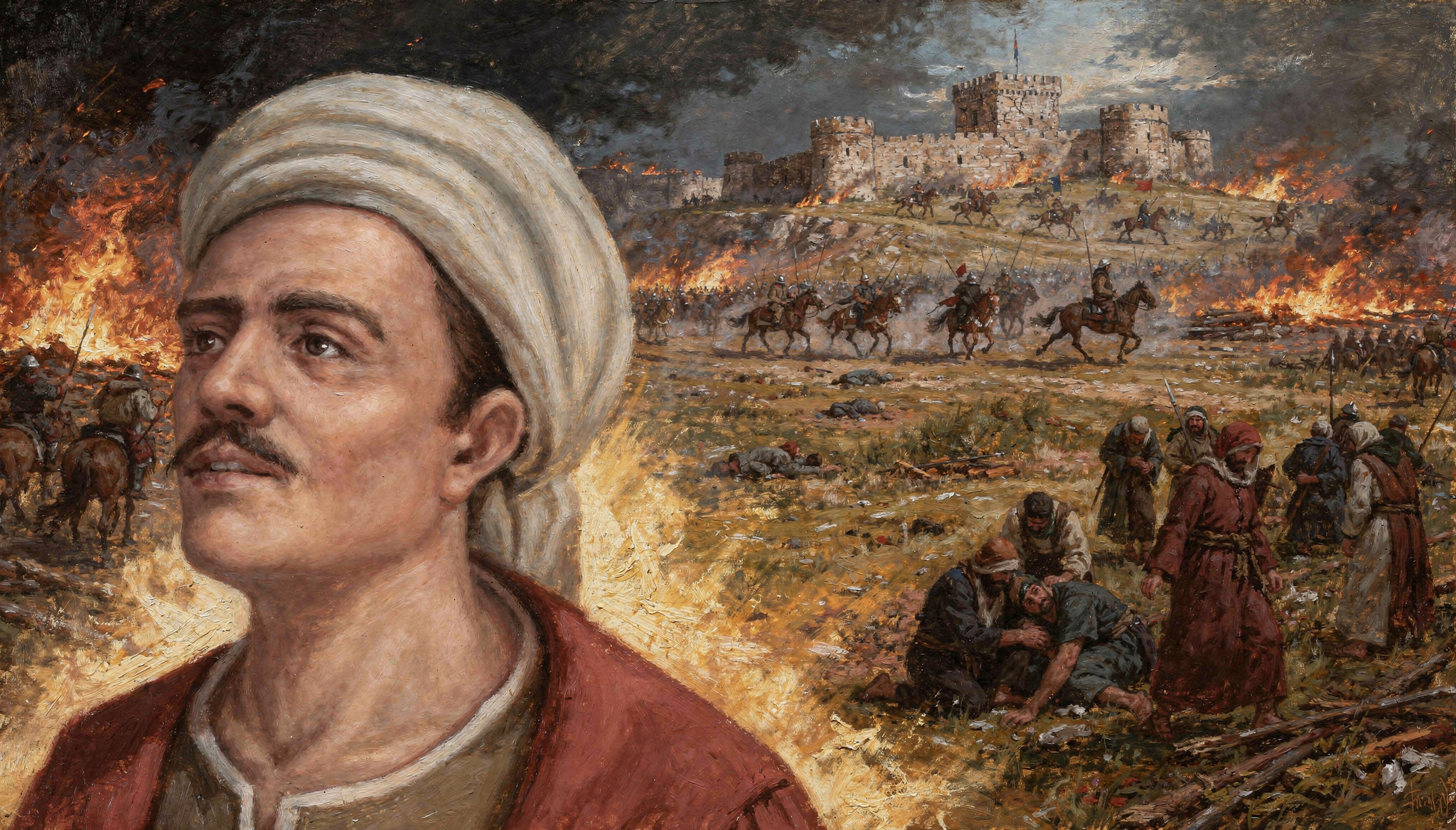
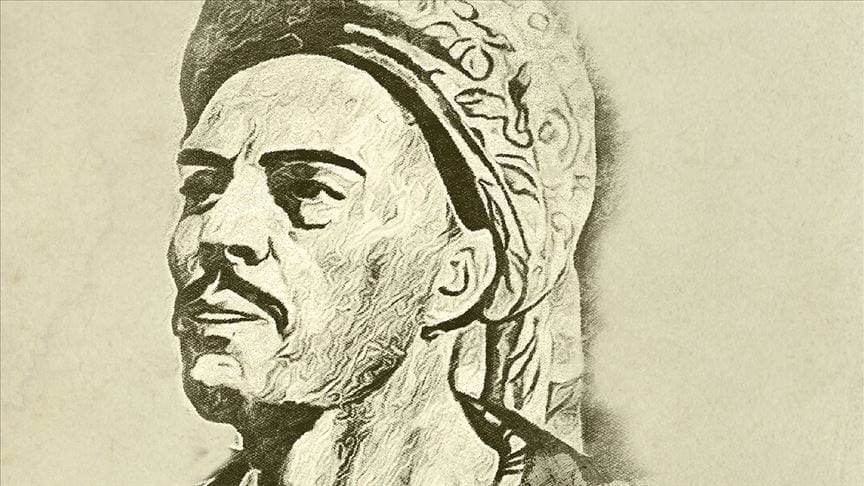
The two archive images below are retained as illustrations of Yunus. Neither is presented as an authenticated likeness or historical photograph. Their artists are not identified in the existing archive records.
Start with a poem, then read the longer counsel and the traditions around it. Yunus’s voice becomes richer when the language, faith and history behind it remain in view.