Fish in Turkey: names, seasons by month, prices and how to choose fresh fish (2026)
Which fish you can buy in Turkey each month, their Turkish names, prices in October 2026 and how to choose fresh fish.
Table of Contents
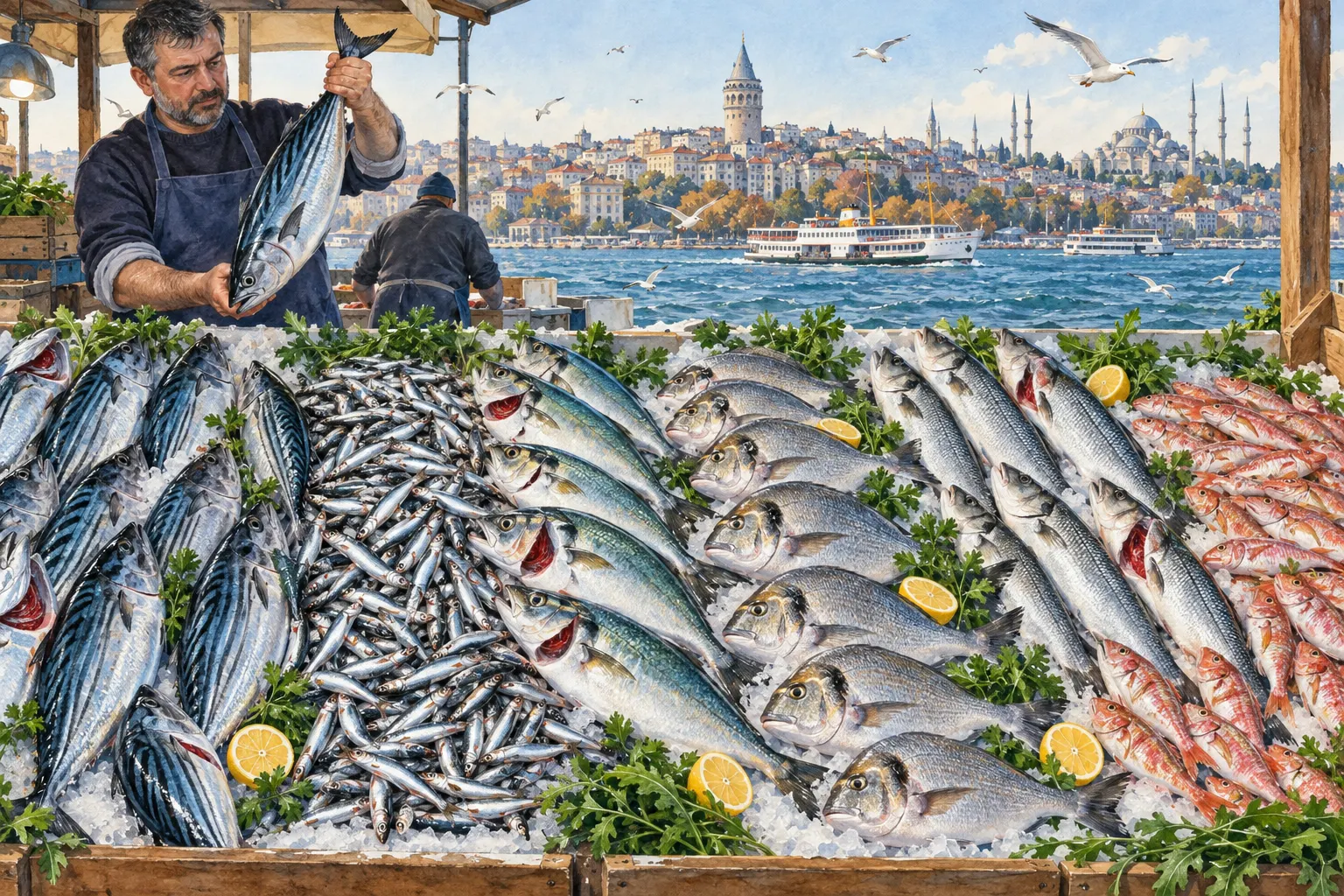
In Turkey, fish is a seasonal affair. From 15 April to 31 August, purse seiners and trawlers stay moored at the quays. From 1 September, bonito, bluefish and horse mackerel return to the stalls, followed by anchovies. Here you’ll find the Turkish names of twelve fish sold at markets, a month-by-month calendar, prices from the Izmir and Istanbul wholesale markets for October 2026, legal minimum sizes and five signs of fresh fish.
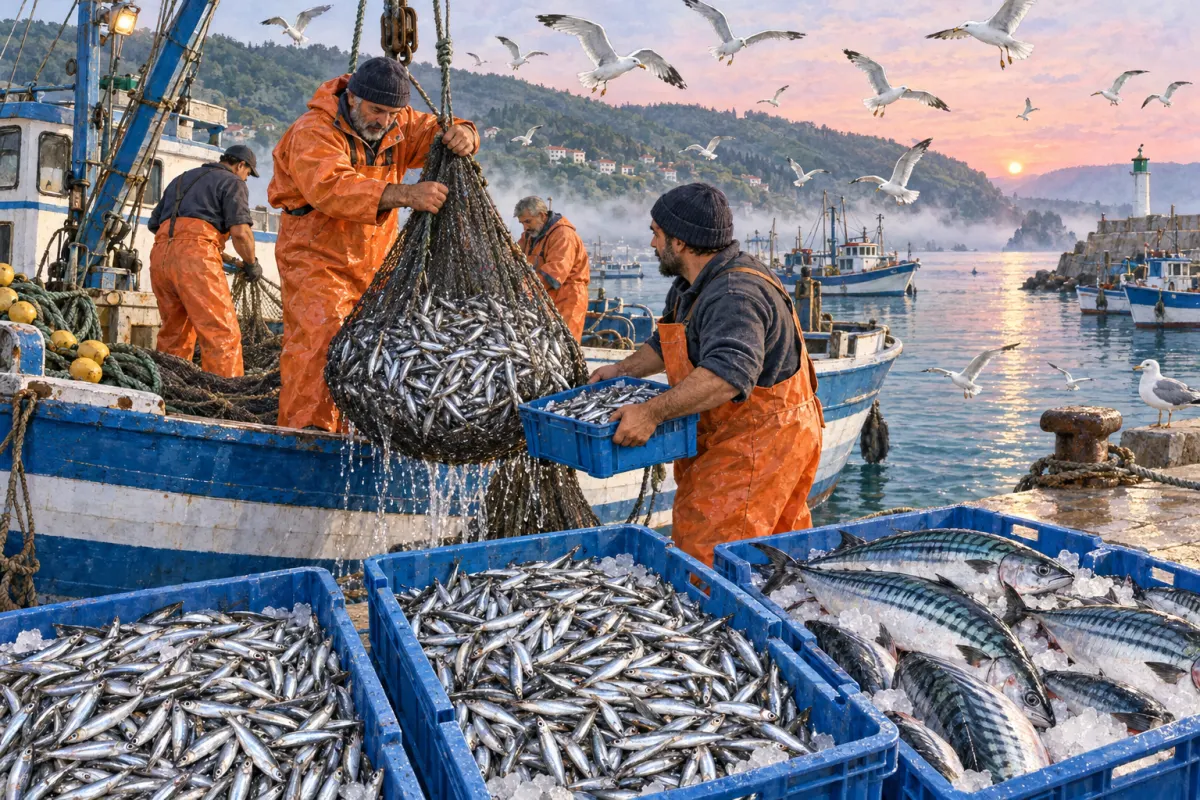
At a glance · checked on 13 October 2026
In October, choose bonito: it’s in season now.
- In season in October: bonito, bluefish, mackerel, horse mackerel, red mullet, whiting and sardine; anchovy from November.
- Bonito: at Istanbul’s wholesale market on 7 October — 48–67 TL/kg (four fish weighing 1.05 kg); at the stall — 130–150 TL per fish.
- Markup: anchovy at the same wholesale market cost 150–183 TL/kg; at the stall — around 300 TL.
- Fishing ban: purse-seine and bottom-trawl fishing is closed from 15 April to 31 August; turbot cannot be caught until 15 June.
- Sea bass and gilthead sea bream: mostly farmed and sold all year round.
What’s on the stall: Turkish names
Fish on price labels have Turkish names, often different from the word on a menu in English. Levrek is sea bass, çipura is gilthead sea bream, barbunya is red mullet, and palamut is bonito, sold in Turkey by the piece and by size. Tap a fish to see its Turkish and Latin names, how it’s cooked, the wholesale price per kilogram and the minimum length below which it cannot be caught or sold.
On the stall today
12 fish · wholesale prices per kg
Palamut
Bonito (Atlantic bonito)
Sarda sarda
48–67 TL/kgIstanbul, wholesale market, 7 October 2026, “four fish weighing 1.05 kg”; in Izmir on 10 October, bonito and large bonito share one entry — 40–300 TL
- Origin
- Wild; shoals pass through the Bosphorus in autumn.
- How it’s cooked
- As steaks on the grill or in the oven, or whole over charcoal.
Hamsi
Anchovy (European anchovy)
Engraulis encrasicolus
150–183 TL/kgIstanbul, wholesale market, 7 October 2026; in Izmir — 33–87 TL
- Origin
- Wild; the Black Sea’s main catch.
- How it’s cooked
- Hamsi tava — coated in flour and pan-fried; hamsili pilav — anchovy pilaf.
İstavrit
Horse mackerel
Trachurus
154–192 TL/kgIstanbul, wholesale market, 7 October 2026
- Origin
- Wild.
- How it’s cooked
- Pan-fried whole; small fish are cooked like anchovies.
Lüfer
Bluefish
Pomatomus saltatrix
200–1,600 TL/kgIzmir, wholesale market, 10 October 2026
- Origin
- Wild.
- How it’s cooked
- Grilled whole. Small fish are called çinekop, medium-sized ones sarıkanat.
Levrek
Sea bass (European sea bass)
Dicentrarchus labrax
300–450 TL/kgIzmir, wholesale market, 10 October 2026, farmed; wild — 800 TL
- Origin
- Usually farmed; wild fish cost more.
- How it’s cooked
- Grilled, baked in salt, or buğulama — braised with vegetables.
Çipura
Gilthead sea bream
Sparus aurata
180–300 TL/kgIzmir, wholesale market, 10 October 2026, farmed; wild — 650–1,000 TL
- Origin
- Usually farmed; wild fish cost more.
- How it’s cooked
- Grilled whole, with lemon and rocket.
Barbunya
Red mullet
Mullus barbatus
100–2,000 TL/kgIzmir, wholesale market, 10 October 2026: entries “barbun tekir” at 100–400 TL and “barbun kaya” at 800–2,000 TL
- Origin
- Wild.
- How it’s cooked
- Coated in flour and fried whole. Striped red mullet is tekir (Mullus surmuletus).
Mezgit
Whiting
Merlangius merlangus
120–150 TL/kgIzmir, wholesale market, 10 October 2026
- Origin
- Wild, from the Black Sea.
- How it’s cooked
- Fillets coated in cornmeal and fried.
Uskumru
Mackerel
Scomber scombrus
100–600 TL/kgIzmir, wholesale market, 10 October 2026
- Origin
- Wild.
- How it’s cooked
- Grilled; also used in balık ekmek — fish in bread.
Sardalya
Sardine
Sardina pilchardus
33–120 TL/kgIzmir, wholesale market, 10 October 2026
- Origin
- Wild, from the Aegean.
- How it’s cooked
- Grilled or cooked in vine leaves.
Kalkan
Turbot (Black Sea turbot)
Scophthalmus maximus
1,000–1,200 TL/kgIzmir, wholesale market, 10 October 2026
- Origin
- Wild; fishing is banned from 15 April to 15 June.
- How it’s cooked
- Cut into pieces, coated in flour and fried.
İskorpit
Black scorpionfish
Scorpaena porcus
80–800 TL/kgIzmir, wholesale market, 10 October 2026
- Origin
- Wild.
- How it’s cooked
- Used in fish soup, balık çorbası, and buğulama. Its spines are venomous: the seller cleans it.
The table gives no minimum size for this fish.
The same fish can have different names at the market depending on its size. Small bluefish are sold as çinekop, medium-sized ones as sarıkanat, and only large ones as lüfer; large bonito are called torik. There are two red mullet species: barbunya (Mullus barbatus) and striped red mullet, tekir (Mullus surmuletus), listed under those names in Turkish law too. And kolyoz is Atlantic chub mackerel, Scomber colias, smaller and cheaper than uskumru.
Seasons by month: what’s caught and what’s banned
Turkey’s Ministry of Agriculture publishes a calendar showing which fish taste best in each month. We’ve added the fishing rules to it. From 15 April to 31 August, purse-seine (gırgır) and bottom-trawl fishing are banned in Turkish seas; in the Mediterranean, the ban lasts until 15 September. Fish don’t disappear during these months: the ban doesn’t cover other fishing gear, and sea bass and gilthead sea bream come from farms. The calendar opens on the current month; months with a fishing ban are hatched.
Which fish, which month
Turkey’s Ministry of Agriculture calendar
Januaryin the calendar: 4
- palamutbonito
- lüferbluefish
- uskumrumackerel
- hamsianchovy
Nets are at work at sea: the season for purse seiners and trawlers runs from 1 September to 15 April.
Februaryin the calendar: 5
- kalkanturbot
- hamsianchovy
- uskumrumackerel
- lüferbluefish
- palamutbonito
Nets are at work at sea: the season for purse seiners and trawlers runs from 1 September to 15 April.
Marchin the calendar: 6
- kalkanturbot
- levreksea bass
- kefalgrey mullet
- lüferbluefish
- palamutbonito
- uskumrumackerel
Nets are at work at sea. Turbot can be caught until 15 April.
Aprilin the calendar: 5
- kalkanturbot
- mercancommon pandora
- kılıçswordfish
- levreksea bass
- kırlangıçtub gurnard
The season is open until 14 April. From 15 April, purse-seine and bottom-trawl fishing are banned, as is fishing for turbot with any gear until 15 June.
Turbot appears in the calendar for April, but can only be caught until 15 April. Farmed sea bass and gilthead sea bream are sold all year round.
Mayin the calendar: 4
- barbunyared mullet
- tekirstriped red mullet
- levreksea bass
- iskorpitblack scorpionfish
Purse-seine and bottom-trawl fishing are banned. Turbot fishing is banned until 15 June.
Farmed sea bass and gilthead sea bream are sold all year round.
Junein the calendar: 3
- levreksea bass
- barbunyared mullet
- tekirstriped red mullet
Purse-seine and bottom-trawl fishing are banned; turbot fishing is banned until 15 June.
Farmed sea bass and gilthead sea bream are sold all year round.
Julyin the calendar: 3
- sardalyasardine
- istavrithorse mackerel
- uskumrumackerel
Purse-seine and bottom-trawl fishing are banned until 31 August; in the Mediterranean, until 15 September.
Farmed sea bass and gilthead sea bream are sold all year round.
Augustin the calendar: 2
- sardalyasardine
- çingene palamuduyoung bonito
Purse-seine and bottom-trawl fishing are banned until 31 August; in the Mediterranean, until 15 September.
Farmed sea bass and gilthead sea bream are sold all year round.
Septemberin the calendar: 3
- sardalyasardine
- kılıçswordfish
- palamutbonito
Purse seiners and trawlers return to sea from 1 September; in the Mediterranean, from 16 September.
Hürriyet, 28 August 2026: the 2026 season opened on 1 September.
Octoberin the calendar: 6
- palamutbonito
- mezgitwhiting
- çipuragilthead sea bream
- sardalyasardine
- zarganagarfish
- levreksea bass
Nets are at work at sea: the season for purse seiners and trawlers runs from 1 September to 15 April.
Milli Gazete, 28 September 2026, adds bluefish, mackerel, horse mackerel and both red mullet species to October.
Novemberin the calendar: 3
- hamsianchovy
- uskumrumackerel
- toriklarge bonito
Nets are at work at sea: the season for purse seiners and trawlers runs from 1 September to 15 April.
Milli Gazete: mackerel is at its peak in November.
Decemberin the calendar: 4
- tekirstriped red mullet
- uskumrumackerel
- palamutbonito
- lüferbluefish
Nets are at work at sea: the season for purse seiners and trawlers runs from 1 September to 15 April.
Turkey’s Ministry of Agriculture calendar was published in October 2024; the fishing rules come from Order 6/1, which applies until 31 August 2028.
Prices: wholesale and at the stall
Wholesale fish markets publish prices every day. Izmir’s bulletin for 10 October 2026 lists bonito and large bonito at 40–300 TL/kg, bluefish at 200–1,600 TL, farmed sea bass at 300–450 TL and wild at 800 TL, farmed gilthead sea bream at 180–300 TL, and turbot at 1,000–1,200 TL. The range is wide because small and large fish share one entry. Prices at the stall are higher: according to Timeturk, on 7 October anchovy cost 150–183 TL/kg at Istanbul’s wholesale market and around 300 TL at the stalls; horse mackerel cost 154–192 TL wholesale and around 350 TL at the stall.
The scales below work out how much fish to buy for your group and what it will cost. A price per kg is already entered, but replace it with the one on the price label.
How much to buy
Scales · price is editable
- Buy
- 1.4 kg
- Approximately
- ≈ 6 pcs
- Total
- 740 TL
Bonito sized at “four fish weighing 1.05 kg” cost 130–150 TL per fish at the stall (Istanbul, 7 October) — around 530 TL per kg. Our guide is 350 g per person.
4 people × 350 g: bonito, whole, with head and bones.
Our guide per person, for whole fish: Hamsi — 250 g; İstavrit — 300 g; Palamut — 350 g; Levrek — 400 g; Çipura — 400 g; Uskumru — 300 g.
The portion size is our guide, rather than a standard. If the fish is cleaned and filleted, less than half its weight reaches your plate.
How to choose fresh fish: five signs
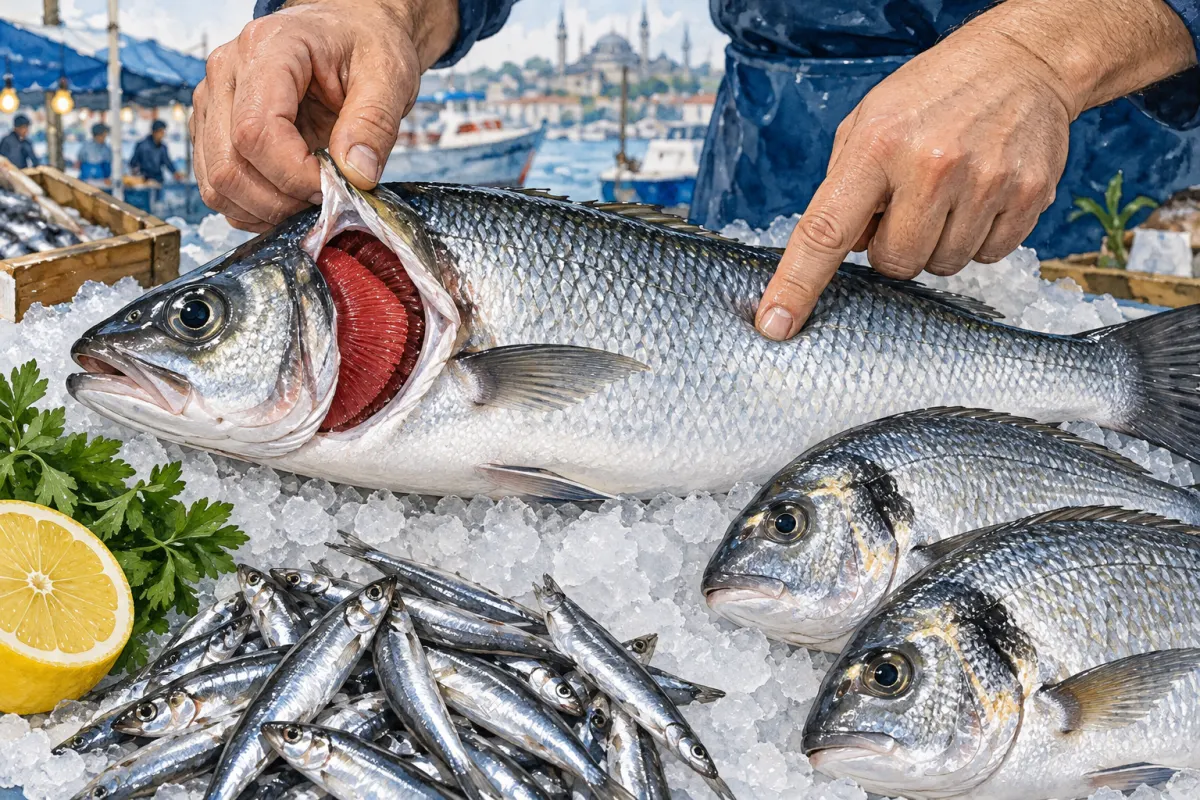
You can touch fish at the market
Ask the seller to show you the gills and press the fish’s side with a finger. Turkey’s Ministry of Agriculture names the eyes, gills, smell, scales and firmness of the flesh in its advice; FAO gives the same advice in its buyers’ guide, cited by Yeni Ankara in September 2026.
If the signs are unclear, ask: Bugün mü geldi?Did it arrive today?
Five signs of fresh fish
Mark what you see at the stall
- Eyes
Fresh: Bulging, clear and shiny.
Not fresh: Cloudy, then sunken.
- Gills
Fresh: Bright red or pink.
Not fresh: Brown or grey, with slime.
- Skin and scales
Fresh: Skin is firm and shiny; scales stay in place when you run your hand from head to tail.
Not fresh: Skin is dull and scales fall off.
- Flesh
Fresh: A dent made by your finger springs back immediately.
Not fresh: The finger mark remains.
- Smell
Fresh: Almost no smell, with a faint scent of the sea.
Not fresh: Sour or pungent.
One sign doesn’t match: ask for another fish or ask when it arrived.
Another sign from Turkey’s Ministry of Agriculture advice: if you lift a fresh fish by the head, the tail holds its shape; on a fish that isn’t fresh, it droops. Fillets have no eyes or gills, so check the flesh and smell.
The law: fishing bans and minimum lengths
Turkey’s commercial fishing rules are set by the Ministry of Agriculture’s Order 6/1 (published on 11 August 2024). It applies from 1 September 2024 to 31 August 2028.
- Nets: purse-seine and bottom-trawl fishing are banned from 15 April to 31 August; in the Mediterranean, until 15 September.
- Turbot: fishing with any gear is banned from 15 April to 15 June.
- Length: fish below the minimum length cannot be caught or sold. Undersized anchovies, sardines and horse mackerel may make up 15% of the catch by weight; for other fish, the allowance is 5%.
| Fish | At least |
|---|---|
| Hamsi — anchovy | 9 cm |
| Sardalya — sardine | 11 cm |
| Barbunya — red mullet | 12 cm |
| Tekir — striped red mullet | 12 cm |
| İstavrit — horse mackerel | 13 cm |
| Mezgit — whiting | 13 cm |
| Mercan — common pandora | 15 cm |
| Lüfer — bluefish | 18 cm |
| Kolyoz — Atlantic chub mackerel | 18 cm |
| Çipura — gilthead sea bream | 20 cm |
| Uskumru — mackerel | 20 cm |
| Dil — sole | 20 cm |
| Levrek — sea bass | 25 cm |
| Palamut — bonito | 25 cm |
| Kalkan — turbot | 45 cm |
| Kılıç — swordfish | 110 cm to the tail fork |
Length is measured from the tip of the snout to the end of the tail. The gilthead sea bream and red mullet entries follow Akuaturk’s list: the first page of the table is missing from the gazette’s archive. The table gives no minimum size for black scorpionfish.
Where and how to eat fish: from sandwiches to meyhane
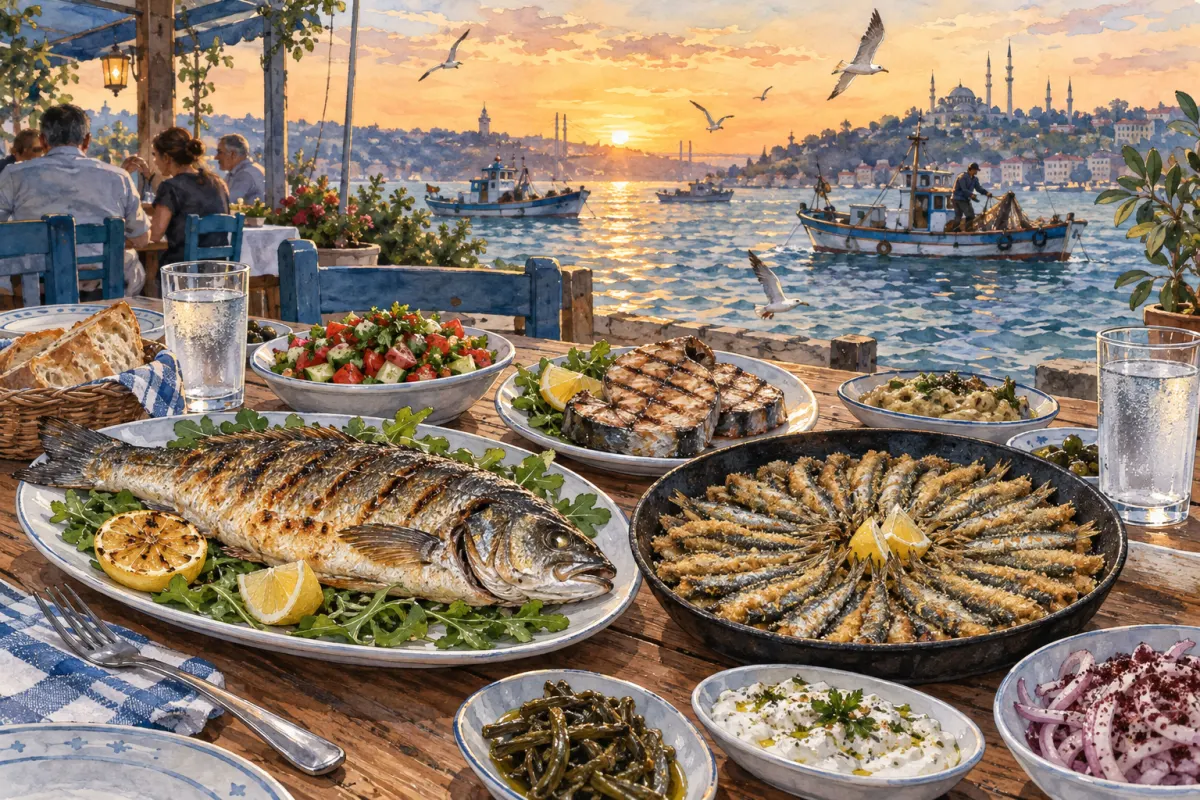
Five dishes to try
- Balık ekmek. Fish in bread, usually mackerel, with onion and salad. A classic by the Eminönü quays in Istanbul.
- Hamsi tava. Anchovies coated in flour and pan-fried in a fan shape. In season from November.
- Hamsili pilav. Rice with anchovies, baked under a layer of fish — a dish from the Black Sea coast.
- Balık çorbası. Fish soup; the best, they say, is made with black scorpionfish.
- Grilled. Sea bass, gilthead sea bream and bluefish — whole. Order with: Izgara olsun, lütfen.Grilled, please.
In fish restaurants, you often choose your fish from the display and pay by weight: ask the price per kilogram before it’s taken to the kitchen — Kilosu kaç lira?How much per kilogram? At home, fish is fried in olive oil; find out which to choose in our guide to Turkish olive oil, and frying pans and cauldrons in our ranking of Turkish cookware.
How much fish Turkey produces: catches and farms
According to TÜİK data published in June 2026, Turkey produced 1,037,019 t of fish and seafood in 2025. More than half — 626,591 t — was farmed, and another 410,428 t was caught. The marine fish catch was 346,366 t, of which 245,261 t was anchovy. The main farmed fish were sea bass (174,859 t) and gilthead sea bream (164,643 t), and in fresh water, trout (185,310 t).
Answers at a glance
When is fish in season in Turkey?
Purse seiners and trawlers operate from 1 September to 15 April. In autumn, there’s bonito, bluefish and horse mackerel; from November to February, anchovy and mackerel; in spring, turbot until 15 April; and in summer, sardine. Farmed sea bass and gilthead sea bream are available all year.
Can you buy fish in summer?
Yes. The ban from 15 April to 31 August covers only purse-seine and bottom-trawl fishing. It doesn’t cover other fishing gear, and sea bass and gilthead sea bream come from farms.
How much does fish cost in Turkey?
At Izmir’s wholesale market on 10 October 2026, farmed sea bass cost 300–450 TL/kg, gilthead sea bream 180–300 TL and turbot 1,000–1,200 TL. Prices at the stall are higher: anchovy in Istanbul cost around 300 TL/kg, compared with a wholesale price of 150–183 TL.
What are “fish” and “fresh” in Turkish?
Fish is balık, fresh is taze. To ask whether it’s fresh: Taze mi? A fish market is balık pazarı, a fish restaurant is balık restoranı.
What’s the difference between barbunya and tekir?
They’re two red mullet species: barbunya (Mullus barbatus) and striped red mullet, tekir (Mullus surmuletus). Both are sold whole and fried in flour, and both have a minimum length of 12 cm.
Why is turbot fishing banned in spring?
Order 6/1 bans turbot fishing with any gear from 15 April to 15 June. The minimum length is 45 cm.
Sources
We checked the fishing rules, prices and calendar on 13 October 2026. Wholesale market prices change every day; prices at the stall are higher. The illustrations depict the subject rather than a specific market.
- Order 6/1 on commercial fishing (2024/20), 11 August 2024 — Turkey’s law gazette, No. 32629, checked on 13 October 2026
- Minimum sizes and fishing bans 2024–2028 — Akuaturk, checked on 13 October 2026
- When the 2026 fishing season opens, 28 August 2026 — Hürriyet, checked on 13 October 2026
- Which fish to eat in October, 28 September 2026 — Milli Gazete, checked on 13 October 2026
- The Ministry of Agriculture’s monthly fish calendar, 9 October 2024 — Sözcü, checked on 13 October 2026
- Fish market prices, bulletin for 10 October 2026 — Izmir Municipality, checked on 13 October 2026
- The same prices as open data (JSON) — Izmir Municipality, checked on 13 October 2026
- Anchovy and bonito prices: wholesale and at the stall, 7 October 2026 — Timeturk, checked on 13 October 2026
- Wholesale fish market prices — Istanbul Municipality, checked on 13 October 2026
- Catches and farms in 2025 according to TÜİK, 4 June 2026 — Dünya (via AA), checked on 13 October 2026
- How to recognise fresh fish, 28 September 2026 — Yeni Ankara, checked on 13 October 2026
- Ministry of Agriculture tips: how to choose fresh fish, 22 January 2025 — CGTN Türk, checked on 13 October 2026